
- Release Year: 2001
- Platforms: Macintosh, Windows
- Genre: Action, Puzzle
- Game Mode: Single-player
- Gameplay: Boss fight, Concentration, Flying, Mini-games, Pillow fight, Shooting, Side-scrolling
- Setting: Fantasy
Description
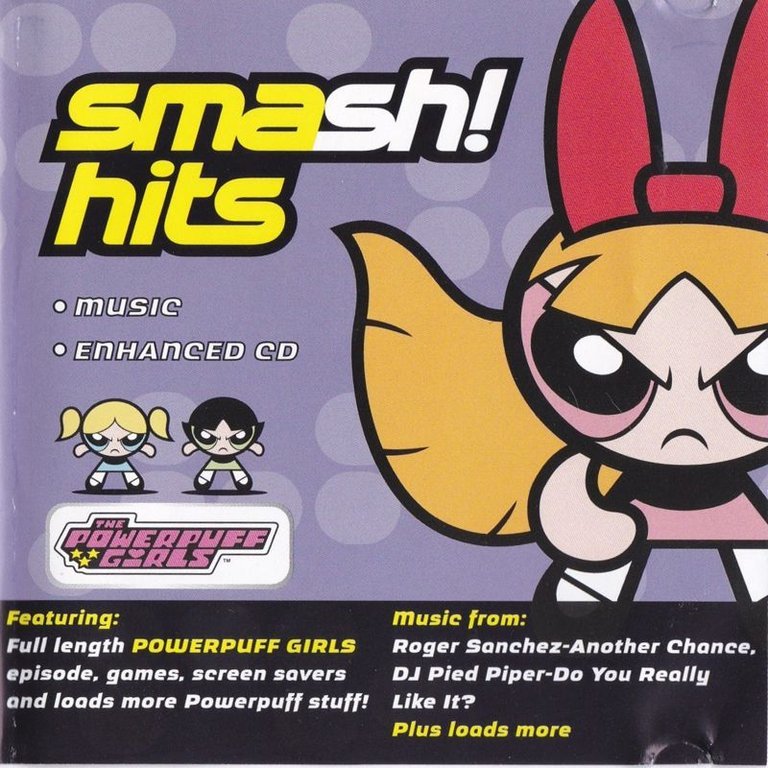
Smash! Hits: The Powerpuff Girls (included games) is a 2001 freeware CD-ROM bundled with the UK’s Smash! Hits magazine, offering a menu-driven interface with Powerpuff Girls-themed mini-games (such as Pillowfight, DangerGrid, and PowerPerfect), screensavers, wallpapers, a Concentration-based prize game, fun facts, email options, and a full cartoon episode, all set in the fantastical world of the animated series.
Smash! Hits: The Powerpuff Girls (included games): A Time Capsule of Cross-Media Promotional Gaming
Introduction: More Than a Game, a Relic
In the sprawling, often-overlooked archives of licensed video game history, there exist titles that defy conventional critical analysis. They are not blockbuster sequels, nor genre-defining indie darlings, but rather curious artifacts—snapshots of a specific moment where media conglomerates, technology, and fandom intersected in peculiar ways. Smash! Hits: The Powerpuff Girls (included games) is precisely such an artifact. Released in November 2001 as a cover-mounted CD for the UK’s Smash! Hits magazine, this “game” is less a standalone product and more a quintessential piece of early-2000s promotional ephemera. My thesis is this: its historical value does not lie in its miniscule gameplay innovations or its artistic merit, but in its function as a pristine, preserved example of the “enhanced CD” phenomenon—a hybrid media object that served simultaneously as a music compilation, a software installer, a web portal, and a very, very simple game suite. To review it is to dissect the mechanics of cross-promotional marketing at the dawn of the new millennium and to understand how minor interactive experiences were used to deepen brand engagement for a then-peaking cultural property like The Powerpuff Girls.
Development History & Context: The Magazine Cover-Mount Golden Age
The development context is inseparable from its distribution model. Smash! Hits was a long-running, highly popular UK music magazine targeting teens, known for its cover-mount CDs featuring hit singles and, increasingly in the late 1990s and early 2000s, “enhanced CDs” with multimedia content. The year 2001 was a peak period for this format. PC CD-ROM drives were ubiquitous, internet access was spreading but not universal, and magazines used these discs as a value-add to drive newsstand sales.
The studio credited is simply “Push” (as seen in the MobyGames release data), a UK-based software developer known for producing these low-budget, high-volume cover-mount titles for magazines and publishers. Their vision, dictated by the magazine’s editorial and commercial teams, was not to create a definitive Powerpuff Girls game—that turf was occupied by larger studio efforts like Chemical X-Traction (VIS Entertainment, 2001) and Relish Rampage (VIS Entertainment, 2002). Instead, the vision was twofold: 1) create a fun, instantly accessible tie-in that a child could load and play within minutes of opening the magazine, and 2) use the disc’s audio tracks and web links to drive continued engagement with the Smash! Hits brand and Cartoon Network’s properties.
Technologically, the constraints were severe but telling of the era. The games are Windows/Macintosh applications built with early-2000s multimedia tools (likely Macromedia Director or similar), resulting in the fixed/flip-screen visuals and Direct Control interface noted in the specs. The “Business Model: Freeware / Free-to-play / Public Domain” classification is accurate; it had no standalone commercial existence. Its “release” was an event of inclusion, not of market competition. This places it in a sprawling ecosystem of Powerpuff Girls games, as documented on Wikipedia, ranging from full-priced console titles to free online Flash games like Townsville Terror (2000). Within this ecosystem, the Smash! Hits disc occupied the lowest rung: a promotional give-away with no pretensions of longevity or depth.
Narrative & Thematic Deep Dive: A Fragmented Brand Experience
Narratively, the disc presents a fractured, non-canonical slice of the Powerpuff Girls universe. There is no overarching plot. Instead, each mini-game offers a tiny, self-contained scenario drawn from the show’s lore, emphasizing the core themes of sisterhood, scientific mishap, and battling bizarre villains.
- Pillowfight transposes the iconic bedroom setting into a straightforward last-person-standing brawl. The narrative justification is pure, timeless childhood: the girls fighting with pillows. It reflects the show’s balance of superheroics with mundane kid-life. The AI-controlled sisters create a dynamic where the player must constantly assess threats from two directions, mirroring the chaotic teamwork (and friendly rivalry) seen in episodes like “Crime 101.”
- DangerGrid provides the most direct narrative link: Professor Utonium’s training simulation is hijacked by a villain (unnamed in the description, but likely Mojo Jojo or a generic menace) who sets the “danger level to eleven!” This is a direct parody of the show’s frequent plot device of the Professor creating a lesson that goes horribly wrong, forcing the girls to apply their powers in a controlled environment turned lethal. The theme here is improvisation and responsibility under pressure.
- PowerPerfect is the most elaborated narrative sequence. It structures the hero’s journey into three distinct acts: reconnaissance (“locate the baddie’s hideout”), a hazardous journey (the side-scrolling obstacle course representing infiltration), and confrontation (the boss fight). This mirrors the classic three-act structure of many episodes, condensing a full adventure into three minutes.
- Win (Concentration) and Know (Facts) are pure brand reinforcement. The memory game uses character art and iconography to reinforce recognition, while the “fun facts” section serves as a basic lore primer, potentially educating new fans. Send (E-mails) and the broken Win competition link are the most telling: they are explicit calls to action, attempting to extend the digital experience onto the burgeoning internet and into Cartoon Network’s own ecosystem, a strategy to build a mailing list and drive web traffic.
The thematic through-line is not deep storytelling but brand immersion. Every section—from playing as a girl to learning “facts” to sending themed emails—is designed to make the user feel a temporary, gamified membership in the world of Townsville.
Gameplay Mechanics & Systems: The Architecture of Simplicity
The core gameplay loops are deliberately minimalist, prioritizing immediate playability over complexity. This is a masterclass in constrained design.
1. Control Schemes & Interface:
* Pillowfight: Uses a classic “action keys” (likely arrow keys + one button) for movement and automatic pickup/throw. This eliminates inventory management. The genius is the automaticity: running over a pillow equips it, facing a direction primes the throw. This creates a frantic, arena-based chaos where positioning and prediction are key. The fixed screen (the bedroom) is a perfect, understandable arena.
* DangerGrid & PowerPerfect: Both use the mouse for steering and shooting, with Space for flight in DangerGrid. This is the classic “twin-stick” control scheme (mouse + keyboard) simplified for an audience likely unfamiliar with such setups. The mouse directly maps to the character’s facing and projectile direction, making aiming intuitive but movement potentially clumsy—a design choice that increases challenge without needing complex physics.
* UI: The central menu screen is the sole interface, a clean, static hub. No options, no difficulty settings. This absolute simplicity is a feature, not a bug, for its intended audience.
2. Gameplay Deconstruction:
* Pillowfight (Bomberman-lite): The Bomberman comparison is apt but reductive. It shares the grid-based movement and projectile attacks in an enclosed space, but lacks terrain destruction, power-ups beyond the basic weapon, and the strategic tension of trapped opponents. It is pure, twitch-based combat. The AI for the other two girls is likely simple: random movement + attack when in line of sight.
* DangerGrid (Time-Pressure Exploration): The loop is “fly, scan, collect key, repeat.” The four keys corresponding to four robots creates a clear, quantifiable goal. The limited time is the primary antagonist. The appearance of bonus time-granting sprites introduces a minor risk/reward: deviate from the search pattern for a chance at extension. It’s a “scavenger hunt” simulator with a flight combat overlay.
* PowerPerfect (Stage-Based Trial): The three-level structure is a condensed version of a platformer or shmup campaign. Level 1 (map selection) is a simple choice mechanic. Level 2 (side-scroller) tests dodging reflexes against a “walls coming from the right” pattern—a classic, punishing mechanic. Level 3 (boss) implies a pattern to learn, though the source doesn’t detail its complexity. Playing as any girl suggests no mechanical differentiation, a cost-saving measure reflecting their “same powers, different personalities” canon status.
3. Innovative or Flawed Systems?
There are no true innovations here. The “flawed” systems are precisely what define the experience: the lack of save states (likely relying on session-based play), the potential for frustrating control in DangerGrid, and the extreme brevity. However, within its context, the design is effectively functional. It understands its audience (children, fans) and its medium (a free, disposable disc). The “flaws” are symptoms of its low budget and short development cycle. The most interesting systemic element is the hub-and-spoke design: the menu isn’t just a launcher; it’s an integral part of the product, offering non-game content (facts, screensavers) that were considered equal value to the games themselves.
World-Building, Art & Sound: A Cast-Off Aesthetic
The visual and audio presentation is a direct reflection of its production constraints and its source material.
- Art Direction: The screenshots reveal flat, brightly colored 2D sprites ripped directly from the TV series’ palette. The “Anime / Manga” genre tag on MobyGames is a slight misnomer; the show’s aesthetic is American animation influenced by anime, and the game assets are traced or simplified copies. The “Fixed / flip-screen” visual style in Pillowfight means a single, static room. There is no parallax scrolling, no detailed backgrounds—just the essential elements of a Powerpuff bedroom (walls, bed, pillows). This is not a bug but a necessity; detailed animation was beyond scope. The art succeeds in being immediately recognizable to fans.
- Setting & Atmosphere: Each mini-game drops the player into a iconic, distilled location: the bedroom, the Danger Grid (a abstract, geometric training space), and the villain’s lair/route. The atmosphere is one of familiarity and safety. Even the “danger” is cartoonish. The world of Townsville is not simulated; it is iconographically referenced.
- Sound Design: The most fascinating audio element is the dual nature of the disc itself. As a standard audio CD, it contains eight tracks of late-90s/early-2000s UK pop and dance (DJ Pied Piper, Roger Sanchez, etc.). This is the primary audio experience if played in a stereo, tying the Powerpuff Girls content to the mainstream musical youth culture of Smash! Hits magazine. When booted on a PC, the game likely uses simple, generated MIDI sounds or low-bitrate sampled effects for actions (throws, keys collected, explosions). There is no licensed music from the show’s acclaimed score by James L. Venable or Thomas Chase. The sound is functional, placeholder, and entirely subordinate to the magazine’s musical identity. This creates a bizarre dissonance: the visual identity of a Cartoon Network show fused with the aural identity of a pop music magazine.
Reception & Legacy: The Silence of a Give-Away
Critical reception, as per the source material, is essentially non-existent. The MobyGames pages for both the main entry and reviews state “Be the first to add a critic review.” This is the ultimate testament to its perceived insignificance. It was not reviewed by mainstream outlets. It was not a product to be critiqued, but a freebie to be installed, played for ten minutes, and discarded. Its commercial success is immeasurable but inherently massive—it was distributed with a major magazine, so its “player base” was enormous but utterly passive and transient.
Its legacy is one of perfect obscurity. It did not influence game design. It is not remembered by fans of the show as a meaningful entry. It represents the dead-end of a promotional strategy. Where other Powerpuff Girls games (even the poorly reviewed Chemical X-Traction) are studied as examples of licensed game struggles, this one is a ghost. Its only “influence” is as a data point in the history of multimedia convergence and the lifecycle of the enhanced CD format, which itself died with the rise of direct digital distribution and Flash-based web games.
In the broader context of the Powerpuff Girls franchise (as listed in Wikipedia), it sits apart. It is not part of BAM! Entertainment’s core series. It is not an arcade cabinet like Konami’s 2001 Powerpuff Girls, The—a dedicated, six-button fighting game for arcades. Instead, it is the software equivalent of a Happy Meal toy: legally licensed, instantly recognizable, designed for brief engagement, and ultimately disposable.
Conclusion: A Historical curiosity, not a lost classic
Smash! Hits: The Powerpuff Girls (included games) is not a “good” game by any conventional metric. Its mini-games are rudimentary, brief, and technically unrefined. Its non-game components are now defunct links and dead software. Yet, as a historical document, it is remarkably evocative.
It captures a precise moment: 2001, when the internet was a link to be clicked in a PC game, when CD-ROMs held both music and software, when children’s entertainment was aggressively cross-promoted across print, music, and nascent digital media. It is a fossil of the “magazine cover CD” era, a practice that built millions of casual tech users but left little behind except questions of preservation like this one.
Its final, ironic legacy is that its entire value today is as a preserved artifact on sites like MobyGames and the Internet Archive. The effort by contributors like “piltdown_man” to document its screenshots and specifications is more significant than any gameplay within it. It is a game remembered not for being played, but for having existed—a tiny, blinking node in the network of early-21st-century media. In the canon of The Powerpuff Girls games, it is the ultimate footnote: a promotional trifle that achieved its ephemeral purpose and was rightfully forgotten, leaving behind only the digital equivalent of a dusty CD in a long-thrown-out magazine. Its place in video game history is not on a pedestal, but in a museum case labeled “Marketing Materials, Early 2000s.” And within that case, it is a perfectly representative specimen.
Final Verdict: ★★☆☆☆ (2/5) — As a game: profoundly shallow and fleeting. As a cultural artifact: an invaluable, specific snapshot of its time.