
- Release Year: 2001
- Platforms: Windows
- Publisher: SimRon Interactive Programming
- Developer: H.N.C. Software Solutions
- Genre: Educational
- Perspective: 1st-person
- Game Mode: Single-player
- Gameplay: Audio learning, Item collection, Matching, Multiple Choice, Point-and-click
- Setting: Camp
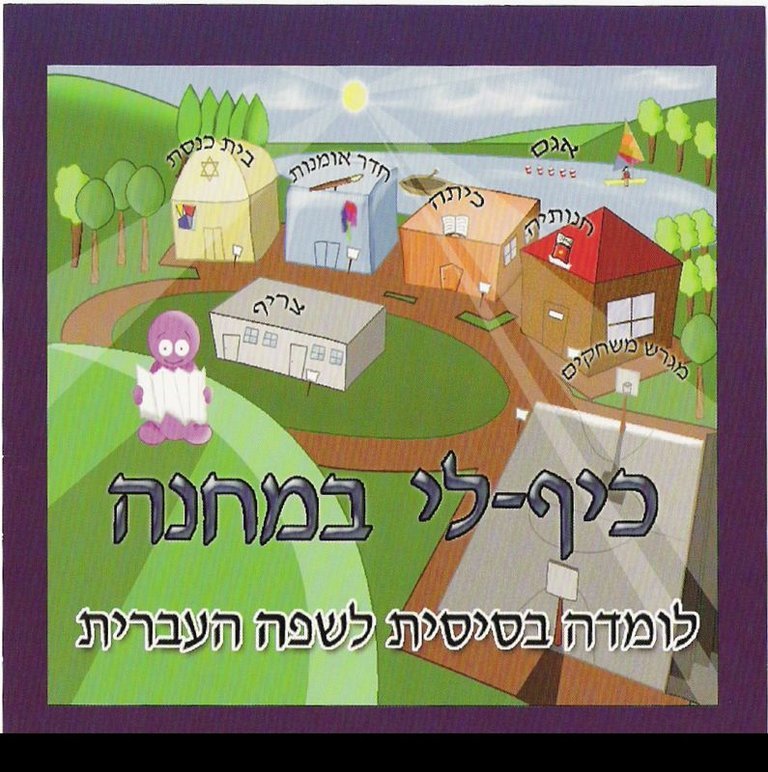
Description
Kef-Li Goes to the Camp is an educational Windows game focused on Hebrew language learning, set in Camp Ramah where players are guided by the purple-pink blob Kef-Li. Through exploring camp areas and clicking objects to hear their Hebrew names, players complete multiple-choice or matching tests in each of six areas, earning special items to win the game, with minimal English text making it ideal for those with some prior Hebrew knowledge.
Kef-Li Goes to the Camp Reviews & Reception
retro-replay.com : Kef-Li Goes to the Camp delivers a solid, user-friendly experience.
Kef-Li Goes to the Camp: Review
Introduction: A Niche Artifact of Linguistic Edutainment
In the vast, crowded archives of video game history, certain titles exist not as groundbreaking auteurs’ visions or commercial blockbusters, but as fascinating, hyper-specific artifacts of a particular cultural and pedagogical moment. Kef-Li Goes to the Camp (2001), known in its native Hebrew as Kef-Li Ba-Makhane, is one such game. Developed by Israel’s H.N.C. Software Solutions and published by SimRon Interactive Programming, this Windows title represents a dedicated, if modest, effort to fuse interactive software with Hebrew language acquisition. It is the improved sequel to the 1997’s Kef-Li Learns Hebrew, suggesting a small but persistent niche market. My thesis is this: Kef-Li Goes to the Camp is not a “good game” by conventional entertainment metrics, nor is it a forgotten masterpiece. Instead, it is a revealing case study in the constraints and intentions of late-era point-and-click edutainment, a purposeful tool built for a specific, non-English-speaking audience. Its value lies not in innovation or artistry, but in its unwavering focus on a singular educational goal and what its design—and its apparent obscurity—reveals about the marginalized position of non-English language learning software in the global games industry of the early 2000s.
Development History & Context: The Why and How of a Israeli Edutainment Title
The Studio and the Vision
The game emerges from H.N.C. Software Solutions, an Israeli developer about whom almost no public information exists. The publisher, SimRon Interactive Programming, is equally enigmatic. This lack of a corporate footprint is itself telling. Unlike the majestically documented studios of the era, H.N.C. operated in a space where digital preservation and industry historiography are thin, likely a small team or even a single developer catering to local Israeli educational and religious markets. The “vision” appears purely functional: to create an engaging, camp-themed vehicle for Hebrew vocabulary reinforcement. The choice of a “purple pinkish blob” protagonist, Kef-Li, suggests an attempt to create a memorable, non-threatening mascot for younger learners, a common trope in late-90s/early-2000s educational software (e.g., Reader Rabbit, Carmen Sandiego).
Technological Constraints and Aesthetics
The game runs on Windows (2001), placing it squarely in the twilight of the 2D point-and-click adventure’s dominance and the rise of 3D. The described visual style—”vibrant, cartoonish,” “static 2D drawings with modest details”—indicates a development budget and technical scope firmly rooted in the mid-to-late 1990s asset pipeline. This is not a game pushing the boundaries of DirectX or 3D acceleration. Instead, it utilizes accessible, low-cost 2D graphics to ensure broad compatibility in Israeli schools, homes, and potentially summer camps (like the fictional “Camp Ramah”). The decision for a first-person perspective is pragmatic: it eliminates the need for complex character sprite animations for the player avatar, focusing resources on the static background objects that are the core learning material.
The Gaming Landscape of 2001
The year 2001 was a monumental one for “core” gaming (Grand Theft Auto III, Halo: Combat Evolved, Metal Gear Solid 2). The edutainment genre, however, was in a transitional phase. The CD-ROM boom of the mid-90s had plateaued, and the market was saturated with low-quality “shovelware.” Serious attempts at educational game design were often siloed, sold through educational catalogues, or bundled with hardware. Kef-Li Goes to the Camp existed entirely outside this mainstream discourse. It was a product of a specific national curriculum need (maintaining Hebrew language skills, potentially for diaspora youth attending camps like Ramah) and was almost certainly distributed through Israeli educational or religious channels, not retail game stores. Its “improved version” status points to iterative development based on teacher or parent feedback from the original 1997 game, a classic edutainment lifecycle unrecognized by most gaming press.
Narrative & Thematic Deep Dive: The Story That Teaches
Plot Structure: The Edutainment Blueprint
The narrative is a skeletal scaffold designed solely to contextualize the learning activities. You, the player, are a child arriving at “Camp Ramah.” There is no backstory, no conflict, and no character arc. The entire plot is a series of spatial and cognitive challenges: visit six distinct areas of the camp, master the Hebrew names of objects within them, pass a quiz for each area, and collect six special items to win. This is the classic “quest” structure of edutainment—a chain of discrete, validated tasks culminating in a reward. The “victory” of being declared the “camp’s honorary Hebrew champion” is a purely extrinsic motivator, a digital badge for completing associative learning drills.
Characters: The Guide and the Learner
There is only one character: Kef-Li, the “purple pinkish blob.” Kef-Li functions as an omniscient, cheerful narrator and coach. Its personality is defined entirely by function: it offers hints, celebrates successes, and provides a consistent, friendly presence. This is not a character with a history or emotions, but a pedagogical tool—a “learning companion” archetype meant to reduce anxiety and provide positive reinforcement. The player-character is a silent, blank-slate avatar. This intentional anonymity is critical: the game requires the player to project themselves into the camp, making the learning experience personally applicable. The narrative’s complete absence of an “other” or an antagonist underscores its purely instructional purpose; there is no villainous force threatening the camp, only the personal challenge of language acquisition.
Themes: Immersion, Repetition, and Cultural Specificity
The dominant theme is immersive vocabulary acquisition through environmental association. The camp setting is not an arbitrary whimsy; it’s a culturally resonant location for its target audience (North American Jewish youth attending religious summer camps). Objects are not random; they are items one would find in a dining hall, arts & crafts tent, or archery range. This contextual learning—tying words to real-world scenarios—is a core, evidence-based language pedagogy.
A secondary, more subtle theme is success through incremental mastery. The six-zone structure creates a clear, measurable progression. Each quiz acts as a gate, ensuring comprehension before moving on. This rewards patience and thoroughness, mirroring the disciplined practice required for language learning.
The most profound thematic element, however, is cultural and linguistic insularity. The source explicitly notes: “As there is little English the game seems to actually be trying to improve the knowledge of individuals who already speak the language a little.” This is not a game for beginners. It assumes a pre-existing passive knowledge of Hebrew or a very strong foundational curriculum from another source. It is a refinement tool, not an introductory one. This靶向 (targeted) approach is its defining academic characteristic. It eschews bilingual support, forcing full immersion in the target language, a method suitable for speakers with some comprehension but not fluency. This makes it a deeply niche cultural product—a piece of software for a specific community’s internal linguistic maintenance, opaque and impenetrable to outsiders.
Gameplay Mechanics & Systems: The Click-and-Learn Loop
Core Gameplay Loop: Exploration, Association, Validation
The game’s loop is rigidly defined and brutally efficient:
1. Enter Zone: The player is presented with a first-person static view of a camp location (e.g., dining hall).
2. Click-to-Learn: The player scans the environment and clicks on objects (e.g., a table, a cup, a sandwich). Upon clicking, the Hebrew word (font) appears on screen, and the pronunciation is played through audio. This is a standard direct mapping learning mechanic: visual object → written word → spoken word.
3. Completion & Trigger: Once all interactive objects in the zone are activated, the game triggers the quiz phase.
4. Quiz Phase: Tests are “generally Multiple choice or matching questions.” These are recall-based assessments. A multiple-choice question might show an object and several Hebrew words; the player must select the correct one. A matching exercise likely pairs images with text or audio.
5. Reward & Progression: Passing the quiz awards a “special item,” a digital trophy for that zone. The player then proceeds to the next zone.
6. Final Victory: Collecting all six zone items completes the game.
This loop is behaviorist in design: stimulus (object click), response (seeing/hearing word), reinforcement (correct quiz), reward (item). There is no free play, no branching paths, no failure states beyond retaking a quiz (implied).
Combat & Character Progression: An Absence That Speaks Volumes
There is no combat, no character stats, no skill trees, no experience points. This is not a RPG or action game. “Progression” is purely curricular and spatial. You progress by moving through the camp’s geography and by increasing the size of your recognized vocabulary set. Your “character” is your growing knowledge. This pure separation from traditional game progression systems is the hallmark of serious/educational titles of this era. The game mechanics are the learning mechanics.
UI and Innovative (or Flawed) Systems
The UI is minimalist: a first-person viewport, likely with a cursor and perhaps a list of remaining objects. The innovation, if it can be called that, is in its absolute commitment to immersive language immersion. No English subtitles during vocabulary phases, no dual-language hints. It creates a “sink or swim” micro-environment within each quiz, confident that the immediate feedback during the exploration phase has built enough association.
However, this is also its primary flaw for broader applicability. The system offers no scaffolding for beginners. A player with zero Hebrew would see only strange glyphs and sounds, with no anchor point. The “improved version” aspect mentioned in the source material might have added more objects, clearer audio, or better quiz logic, but the core pedagogical model remains unchanged and narrow. It lacks adaptive difficulty, personalized review, or sentence construction—all features that would later become common in language learning software like Rosetta Stone or Duolingo. It is a drill-and-practice simulator, beautiful in its single-mindedness but limited in its pedagogical depth.
World-Building, Art & Sound: Constructing a Camp of Words
The Setting: Camp Ramah as Pedagogical Space
“Camp Ramah” is not just a backdrop; it is the curriculum’s syllabus. The six zones are the lesson plan. The Retro Replay description lists “bustling cabins, shimmering lakefronts, and lively dining halls” plus “arts and crafts tent” and “archery range.” These are specific, functional spaces rich with discrete, nameable objects. The world-building is diegetic and utilitarian. Every visual element exists to be named and learned. There is no atmospheric fat. The “sun-dappled pines” mentioned in one review create a warm, nostalgic atmosphere that aligns with positive childhood memories of summer camp, subtly encouraging a pleasant emotional association with the learning process.
Visual Direction: Cartoonish Simplicity as a Feature
The art style is described as “vibrant, cartoonish” with a “warm, welcoming hues—sunny yellows, soft greens, and the game’s signature purple-pink blob, Kef-Li.” This is a deliberate aesthetic choice. It targets a younger audience (the “8-11” and “12-16” brackets noted in the Serious Game Classification) and uses a friendly, non-threatening palette to reduce intimidation. The static 2D backgrounds, while “modest,” are functionally clear. Objects are rendered distinctively enough to be easily identifiable and clickable. The character design of Kef-Li as a “squishy, expressive blob” adds a touch of whimsy and provides a consistent, guiding presence. The lack of complex animation is a constraint that becomes a strength: it prevents visual noise from competing with the textual and auditory language content.
Sound Design: The Primacy of the Spoken Word
If the visuals provide the context, the audio provides the core data. The description of “crystal-clear audio” for Hebrew pronunciations is the game’s most critical technical feature. For a language learner, accurate, clear audio样本 (samples) are non-negotiable. The sound design is entirely subservient to pedagogy. Background music, if present, is likely light, cheerful, and non-intrusive, existing only to set a pleasant mood. The human (or synthesized) voice uttering the Hebrew words is the star. This audio-visual pairing—seeing a “cup” and hearing “kosi”—is the engine of the entire experience. It’s a testament to the developers’ focus that they prioritized clear audio for their target language over expansive soundscapes or voice acting for a non-existent narrative.
Reception & Legacy: Silence in the Global Discourse
Critical and Commercial Reception at Launch
There is no evidence of mainstream critical reception. MobyGames records an average score of 2.4 out of 5 based on a single user rating and zero written reviews. This is the digital equivalent of a shrugged shoulder. Its commercial performance is entirely undocumented, but its presence only in niche databases and its lack of widespread physical or digital re-release suggest minimal sales outside its initial Israeli educational/church camp market. It was a functional tool that served its immediate purpose and was then discarded by the mainstream historical record.
Evolution of Reputation: From Tool to Artifact
Its reputation has not evolved so much as it has been rehabilitated by retrospection and classification. On platforms like Retro Replay and Serious Game Classification, it is now analyzed not as a “game” to be judged for fun, but as a serious game or edutainment title. Its score is often withheld or marked as “N/A” because standard rating criteria (gameplay, graphics, story) are almost irrelevant to its design intent. Its legacy is being rewritten as a cultural and pedagogical artifact—a window into how a specific community approached language preservation through technology in a specific technological moment.
Influence and Industry Footprint
Kef-Li Goes to the Camp had no discernible influence on the broader video game industry. It did not pioneer a mechanic adopted by major studios. It did not inspire a genre. Its lineage is narrow and direct: an improved sequel to an earlier, equally obscure title. Its influence, if any, is micro-local. It may have been used in a handful of Ramah camps or Hebrew schools, subtly aiding a few dozen children’s vocabulary retention. In the grand history of gaming, it is a dead end, not a branch.
However, its value in a comprehensive historiography is significant. It represents the vast, uncounted “long tail” of game development—the thousands of titles made for specific languages, religions, educational curricula, and local markets that never penetrate the English-language dominated critical discourse. It is proof that the “video game” as a medium was, from its earliest days, being used for hyper-localized, non-entertainment purposes. It is a cousin not to Final Fantasy, but to the countless Mavis Beacon Teaches Typing, Carmen Sandiego, and Oregon Trail variants produced for every conceivable school subject and regional language.
Conclusion: A Verdict on a Quiet, Purposeful Title
To judge Kef-Li Goes to the Camp by the standards of interactive entertainment is to fundamentally misunderstand its existence. It is not a captivating adventure; it is a digital flashcard deck with a map. Its graphics are dated, its mechanics are simplistic, its narrative is nonexistent. By the conventional metrics that earn games scores of 9/10 or 1/10, it is a non-entity.
But to judge it as a historical artifact of game-based learning is to see its quiet success. It accomplished its stated goal with a singular, uncluttered focus. It took the established, accessible technology of the 2001 point-and-click adventure and stripped it down to its barest instructional essentials. It assumed a specific user base and a specific pedagogical need, and it served them without pretension. Its “improved” status over its 1997 predecessor suggests it was a living project, iterated upon based on real-world use.
Its ultimate place in video game history is not on a pedestal, but in a carefully labeled archive box. It is a textbook example of context-specific, utilitarian game design. It reminds us that the medium’s potential extends far beyond fantasy and violence into the mundane, vital work of cultural continuity and language education. Kef-Li Goes to the Camp will never be rediscovered as a lost classic. But for the historian willing to look, it is a perfect, unassuming specimen of a game that knew exactly what it was, whom it was for, and what it needed to do. In its utter lack of ambition beyond its niche, it achieves a kind of austere integrity. It is, therefore, not a good game, but a perfectly functional one—and that, in its own quiet way, is a legacy worth documenting.