
- Release Year: 1996
- Platforms: Macintosh, Windows 16-bit, Windows
- Publisher: Panasonic Interactive Media
- Developer: Conexus, Inc.
- Genre: Educational
- Game Mode: Single-player
- Gameplay: Mini-games, Multiplication, Puzzle
- Setting: Africa, Europe, Japan, North America, Oceania, South America
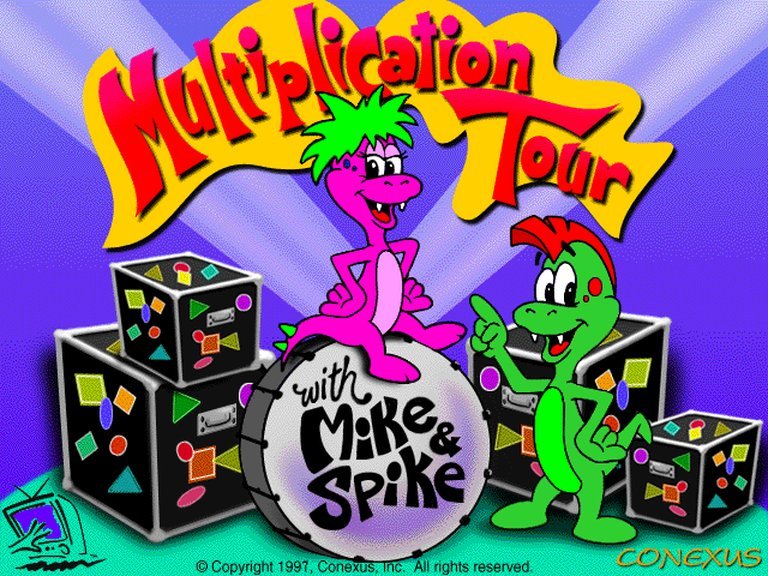
Description
Multiplication Tour with Mike & Spike is an educational game from the Learning Ladder series where players join the musical dragons Mike and Spike on a global concert tour across 12 countries, including settings in Africa, Europe, Japan, North America, Oceania, and South America. The gameplay involves various multiplication-based mini-games such as clicking correct products, solving story problems, and ordering statements in a movie studio challenge, with a printable certificate earned upon completion.
Gameplay Videos
Multiplication Tour with Mike & Spike Free Download
Multiplication Tour with Mike & Spike: A Rhythmic Romp Through Multiplication Obscurity
Introduction: The Unlikeliest of Rock Stars
In the grand tapestry of 1990s edutainment, few titles occupy as peculiar and charming a niche as Multiplication Tour with Mike & Spike. Released in 1996 by Panasonic Interactive Media and developed by Conexus, Inc., this title represents a fascinating, albeit largely forgotten, attempt to fuse the global spectacle of a rock tour with the rigors of elementary arithmetic. While the era was dominated by more bombastic franchises like Math Blasters or The Oregon Trail, Multiplication Tour carved its own idiosyncratic path, trading jetpacks and wagon trains for a pair of dragons with a passion for times tables and world music. This review argues that the game is a significant, if modest, artifact of the “Learning Ladder” series—a testament to the ambitious, studio-driven push into educational software during the CD-ROM boom. Its legacy is not one of critical acclaim or commercial blockbuster status, but of earnest creativity, a unique pedagogical approach wrapped in a vibrant, if dated, aesthetic.
Development History & Context: The Learning Ladder Initiative
Multiplication Tour with Mike & Spike was not an island. It was a product of Panasonic Interactive Media’s broader “Learning Ladder” series, a suite of educational titles designed to leverage the burgeoning CD-ROM medium’s capacity for rich audio, animation, and interactive content. The development studio, Conexus, Inc., emerges from the credits as a team of at least 50 individuals, led by producers Brian Devine and Vinod Lobo. The inclusion of Dr. Randolph Philipp as Instructional Design consultant signals a serious, if not revolutionary, commitment to pedagogical validity, grounding the whimsical premise in actual curriculum design.
Technologically, 1996 was a moment of transition. Windows 95 had normalized the graphical user interface, and CD-ROMs offered ~650MB of storage—a vast expanse compared to floppy disks. This allowed for the game’s extensive use of digitized voice work (featuring veterans like Lani Minella, who would later voice countless characters in the Sonic series and beyond) and a soundtrack rich with region-specific musical cues, as evidenced by the hundreds of .AIF audio files archived on the Internet Archive. The “Fixed / flip-screen” visual style and “Point and select” interface reflect the era’s constraints and conventions—simple, clear, and easily navigable for young learners. The game’s simultaneous Windows and Macintosh release (targeting System 7.1+) was standard for premium educational software aiming for the school and home markets.
Conexus’s portfolio, as hinted by the “Collaborations” on MobyGames, suggests a specialist in this niche. The same core team worked on Little Caesars Fractions Pizza, Radio Addition with Mike and Spike, and even titles like Babes in Toyland, painting a picture of a small, versatile studio pivoting between branded partnerships and original IP within the edutainment space.
Narrative & Thematic Deep Dive: A World Tour with a Purpose
The narrative is elegantly simple and powerfully direct. Mike (the purple dragon with green hair, drummer) and Spike (the green dragon with red spikes, guitarist/keyboardist) are a musical duo on a global concert tour. Their mouse companion serves as the tour manager and tutor, providing instructions and encouragement. The“world” is not a single cohesive map but a selection of 12 countries, each representing a continent or culturally distinct region: Africa (e.g., Egypt, Kenya, Zimbabwe), Europe (France, Ireland), North America (New York, Mexico, Hawaii), South America (Brazil), Oceania (Australia), and Japan.
The theme is cultural exposure through mathematics. Each mini-game session is framed as an activity “in” a specific country, accompanied by a distinct musical style—from the sampled African rhythms of the Congo to the synthesized pop of Japan. The story problems are littered with local color: a “walk in Central Park,” a “Yankee fan” in New York, or a “hot dog stand.” This does the double duty of teaching multiplication and offering a sanitized, engaging glimpse into global diversity, a common trope in 90s children’s media that now feels both charmingly idealistic and culturally stereotypical.
The underlying theme is achievement and reward. The tour structure—select a country, play games, earn “points” (audio files like POINTS1.AIF), and eventually unlock visits to a movie studio—creates a clear progression loop. The ultimate reward is a printable certificate, a physical testament to the player’s “Multiplication Tour” completion. This mirrors the era’s belief in tangible, school-friendly achievements.
Gameplay Mechanics & Systems: Repetition with Regional Flair
The core gameplay loop is deceptively simple but thoughtfully varied across four primary mini-game formats, all tied to a specific multiplication factor (e.g., the 6s, the 7s):
- Object Clicking (Real-Time Reflex): Objects move across the screen (likely on a conveyor belt or parade). The player must click only on objects displaying a product of the current multiplier (e.g., all objects showing “24” when learning 6s). This tests rapid recall and visual discrimination under time pressure.
- Crocodile Crossing (Problem-Solving): Spike must cross a body of water populated by crocodiles. Each crocodile displays a multiplication problem. The player must click the correct answer to make a safe stepping stone. This is a classic, tense “bridge-building” mechanic.
- Multiple Choice Selection: A straightforward problem (
7 x 8 = ?) is presented with several objects as answer choices. This is the most direct assessment. - Story Problem Chain: This is the most narratively integrated and cognitively demanding. A short story describing a situation (e.g., “There are 5 cages with 9 parrots each…”). The player inputs the answer, which then becomes a clue for the next, more complex problem in the sequence. This encourages multi-step reasoning.
Progression & Structure: The player begins by choosing one of two “recommended” countries, suggesting a guided learning path. Completing a certain number of countries triggers the “movie studio” sequence. Here, the gameplay shifts to a sequencing puzzle. The player must arrange statements in the correct order to solve a mystery, with a harder variant also matching number sentences to those statements. This represents a clever step up Bloom’s Taxonomy from simple recall (multiplication facts) to procedural knowledge (order of operations) and even rudimentary logical deduction.
Systems: There is no traditional character progression (stats, levels). Progression is purely based on completion of countries and puzzle sets. The UI is minimalist: a point-and-click interface with clear icons and the ever-present mouse friend for help. The “real-time” pacing in the object-clicking games adds urgency not found in static flashcards.
Innovations & Flaws: The innovative synthesis of cultural context, musical motifs, and arithmetic practice is the game’s strongest suit. Using music as a mnemonic and engagement device (as per the Reddit post’s recollection of song lyrics) is a brilliant, underutilized idea. The sequencing puzzles at the movie studio provide meaningful variation. However, the core mini-games are fundamentally repetitive. The real-time clicking can devolve into stressful, non-mathematical reflexes for some players. There’s no adaptive difficulty; the player is locked into a multiplier for an entire country session, which could lead to boredom or frustration depending on the child’s mastery level.
World-Building, Art & Sound: A Vibrant, Authentically 90s Aesthetic
The game’s world is its most memorable feature. The visual direction is pure 1990s CD-ROM cartoon: bright, saturated colors, simplified character designs (Mike and Spike are immediately recognizable), and backgrounds that suggest rather than detail their locations. A pyramid silhouette for Egypt, the Eiffel Tower for France, a kangaroo for Australia—these are iconic, instantly readable visual shorthand perfect for young children. The “fixed / flip-screen” perspective means each country is a single, static illustrated tableau, minimizing scrolling and maximizing focus on the mini-game elements overlaid on top.
The sound design is where the game truly shines, as confirmed by the massive AUDMULT directory in the archived ISO. The archive lists hundreds of AIF audio files: region-specific background music (FRANCE1.AIF, JAPAN3.AIF), character voice lines (MIKE/10VBAND1.AIF), and a library of sound effects (POP1.AIF, BOOM1.AIF). Music and lyrics are credited to Darren Ray Thorn and a team of producers, suggesting original compositions for each region. The Reddit user’s recollection of “Go for a walk in central park…” is proof that these musical mnemonics achieved their goal of sticking in the memory. The audio isn’t just background; it’s a core part of the pedagogical and atmospheric experience.
Together, art and sound create a cohesive, if geographically superficial, world tour. It’s less about authentic representation and more about creating a playful, recognizable “ version” of each continent that serves the primary goal: making multiplication practice feel like a game show or concert adventure. The atmosphere is consistently upbeat, encouraging, and safe—the digital equivalent of a brightly lit, friendly classroom.
Reception & Legacy: The Quiet Giant
Contemporary reception is almost non-existent. The sole cited critic review is from Mac Addict (1997), which famously offered no scored verdict but the cryptic, positive observation: “It has a good beat that’s easy to do math to.” This pithy comment actually captures the game’s essence perfectly: its success hinges on its rhythmic, musical engagement. Commercial data is unavailable, but its presence on multiple platforms (Windows, Windows 16-bit, Macintosh) and its preservation on sites like My Abandonware and the Internet Archive suggest it had a moderate print run and a dedicated, if small, user base.
Its legacy is twofold:
- As a Historical Artifact: It stands as a prime example of mid-90s “edu-tainment” ambition—a full CD-ROM experience aiming to compete with entertainment software on production values. Its focus on a specific mathematical operation (multiplication) rather than a broad curriculum was a common strategy for depth over breadth.
- As a Nostalgic Relic: For those who played it, the game is a potent memory trigger. The Reddit post seeking identification is telling; the specific details—purple and green dragons, the song structure with embedded questions—are vivid. This places it in a similar nostalgic category as The Oregon Trail or Number Munchers, but far more obscure. Its influence on the industry is indirect; it represents a strand of educational design (thematic, game-show-like mini-games) that would later be absorbed into more sophisticated platforms like online learning portals and mobile apps.
The fact that it requires a virtual machine or DOSBox to run on modern systems is a common fate for CD-ROM games, but its preservation is a quiet victory for software historians.
Conclusion: A Curious and Charming Footnote
Multiplication Tour with Mike & Spike is not a lost masterpiece. Its gameplay is repetitive, its cultural portrayals are by-now-problematic stereotypes, and its pedagogical approach is straightforward drill-and-practice in a catchy wrapper. Yet, to dismiss it is to overlook its unique charm and historical position. It is a game with heart and rhythm. Its unwavering commitment to its conceit—a global concert tour—infuses the dry process of memorizing multiplication tables with narrative purpose and musical joy. The sheer volume of region-specific music and voice work, evident in the game files, speaks to a development team genuinely trying to create an immersive world, however simplistic.
In the canon of educational gaming, it lacks the groundbreaking interactivity of The Oregon Trail or the sheer cultural penetration of Where in the World is Carmen Sandiego?. Instead, its place is that of the cult classic: a game remembered with startling clarity by a generation of students for its quirky characters, its catchy (if cheesy) songs, and its gentle, globe-trotting pressure to remember that seven times eight is fifty-six. For the game journalist and historian, it is a perfect case study in the era’s “edutainment” ethos—well-meaning, technically competent for its time, and ultimately more memorable for its atmosphere and ambition than its innovation. It may not have rewritten the rules, but for a brief, shining tour, Mike and Spike’s band made math feel like a worldwide party.
Final Verdict: 3.5 out of 5 Stars. A historically significant, endearingly quirky piece of 90s edutainment that succeeds as a nostalgic time capsule and a testament to the power of music in learning, but whose core gameplay shows its age. Recommended for historians, preservationists, and anyone curious about the more obscure corners of the educational software landscape.