
- Release Year: 2015
- Platforms: Linux, Macintosh, Windows
- Publisher: Cliffhanger Productions Games GmbH, Nordic Games GmbH
- Developer: Cliffhanger Productions Games GmbH
- Genre: Role-playing (RPG), Strategy, Tactics
- Perspective: Diagonal-down
- Game Mode: Online Co-op, Single-player
- Gameplay: Character progression, Co-op, Isometric, Missions, Tactical, Turn-based combat
- Setting: Cyberpunk, dark sci-fi, Fantasy, Futuristic, Sci-fi
Description
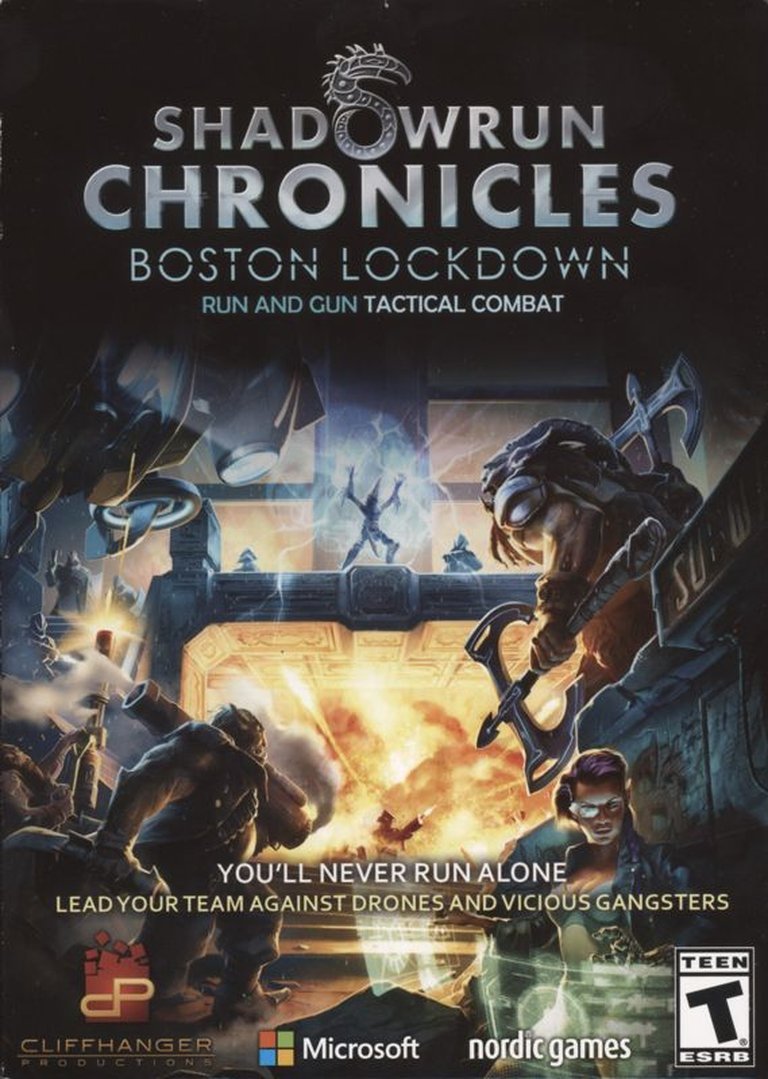
Shadowrun Chronicles: Boston Lockdown is a turn-based tactical role-playing game set in the cyberpunk-fantasy Shadowrun universe. In 2076, Boston is under quarantine due to ominous events like a dragon’s awakening and a rainbow-colored rain that causes insanity, plunging the city into chaos with gang warfare and corporate conspiracies. Players assume the role of shadowrunners, mercenaries who undertake dangerous missions for megacorporations and shady clients, earning nuyens and karma to upgrade equipment and skills in a cooperative or solo experience across the quarantined city.
Gameplay Videos
Shadowrun Chronicles: Boston Lockdown Reviews & Reception
ign.com : It’s far from the definitive Shadowrun experience, but it’s a fairly competent and streamlined strategy title that borrows quite a bit from the newly established trend.
Shadowrun Chronicles: Boston Lockdown: A Cautionary Tale of Ambitious Visions and Digital Decay
Introduction: The Promise of a Connected Shadowrun
In the annals of licensed video game adaptations, few franchises carry the weight of expectation quite like Shadowrun. A unique and enduring synthesis of cyberpunk grit and high fantasy wonder, its transition from tabletop to digital has been a tumultuous journey marked by brilliance, missteps, and, in the case of Shadowrun Chronicles: Boston Lockdown, a profound and irreversible tragedy. Released in 2015 by the Austrian studio Cliffhanger Productions, this game arrived at the crest of a Shadowrun renaissance sparked by Harebrained Schemes’ celebrated Returns and Dragonfall. Yet, where those titles deepened the lore and refined the turn-based tactical formula, Boston Lockdown charted a divergent, ultimately doomed course. It was a game explicitly designed for an always-connected, cooperative future that never materialized, a titular “chronicle” that now exists only in fragmented memories and the fading echoes of its own servers. This review will argue that Shadowrun Chronicles: Boston Lockdown is not merely a failed game, but a critical artifact representing a specific, now largely discredited, design philosophy of the mid-2010s—one that prioritized live-service co-op hooks over foundational single-player substance, and was ultimately destroyed by the very business and technological models it championed.
Development History & Context: Kickstarter, Ambition, and the Online Gamble
The game’s origins are intrinsically tied to the crowdfunding boom following the success of Shadowrun Returns. While Harebrained Schemes validated the market for a faithful, narrative-driven Shadowrun RPG, Cliffhanger Productions, a smaller studio founded in 2010 with only one prior release (Crazy Machines 2), saw a different opportunity. In July 2012, they launched their own Kickstarter for Shadowrun Online, seeking $500,000 to build a persistent-world, multiplayer-focused experience set in the Fifth Edition timeline. The campaign succeeded, raising over its goal, but from the outset, the project was shrouded in ambiguity. Promises of a “large online world” and “persistent character progression” gradually crystallized into the more modest, level-based co-op tactical RPG that became Boston Lockdown.
This shift from MMO-lite to instanced missions speaks to the immense technological and scope constraints faced by the studio. The game was built in Unity, a capable but often unoptimized engine for complex multiplayer systems, and the team was required to build robust netcode, matchmaking, and server infrastructure from scratch—a monumental task for a small team. The “always-online” requirement, even for solo play (a notorious point of controversy, especially with German retail copies falsely advertised as “DRM free”), was not a design choice made in a vacuum but a fundamental architectural pillar for a game conceived as a “chronicle” of shared runner experiences. This decision would prove to be its fatal flaw. The gaming landscape of 2015 was still grappling with the implications of always-online DRM (remember SimCity?), and for a niche tactical RPG, it was a hard sell. Compounding this was the shadow of Harebrained Schemes’ work; Boston Lockdown was inevitably compared to Returns and Dragonfall, titles that offered deeper narratives, richer world-building, and no such connectivity demands, all at a lower price point.
Narrative & Thematic Deep Dive: A Plot Buried Under Repetition
Set in 2076 Boston, Boston Lockdown’s premise is a classic Shadowrun cocktail of apocalyptic mystery and corporate malfeasance. The city is under quarantine following a series of bizarre events: the emergence of a mysterious dragon, a surreal “rainbow rain,” and a pandemic inducing violent insanity. The player, an amnesiac shadowrunner, awakens in a medical facility and is thrust into the underworld to uncover their past and survive the chaos.
Where the Narrative Succeeds: Atmosphere and Premise.
The core scenario is potent. A quarantined Boston is a fantastic sandbox for Shadowrun‘s signature blend of street-level grit and world-spanning conspiracy. The metaplot effectively ties into the Fifth Edition’s “Dragon of the West” storyline, giving fans a tangible connection to the wider lore. The initial amnesia hook provides a serviceable personal motivation. Some reviewers, like Shacknews, praised the “story, setting, strategy,” acknowledging that the core narrative beats are coherent and the world, through text logs and NPC chatter, feels authentically Shadowrun—complete with references to the Matrix (though its implementation is absent), megacorporations like Aztechnology, and the constant tension between mundane and magical.
Where the Narrative Fails: Execution, Agency, and Depth.
The execution, however, is where the game collapses under its own ambitions. The most cited and damning criticism is the complete lack of branching dialogue or role-playing choices. As IGN’s review starkly notes, the game presents text boxes seemingly designed for choice but offers none, stripping away the very essence of a role-playing game. This transforms what could be an immersive narrative into a linear corridor of mission-givers spouting plot points. The writing itself is described as “serviceable” at best and “weak” at worst. The Dread Central review savaged the dialogue, calling the default female protagonist’s voice “obnoxious” and “akin to a poorly mimicked Harley Quinn,” while finding the male option a “comforting… imitation of Mark Wahlberg.” This inconsistency in tone and quality undermines the dark, tense atmosphere the setting demands.
Furthermore, the thematic depth of Shadowrun—the dehumanization of technology, the ethics of augmentation, the plight of the disenfranchised—is largely surface-level. The story is told almost exclusively through the mission hub and mission text. There is no organic exploration of the city’s districts, no chance encounters that flesh out the world’s social strata. The mission structure itself is relentlessly repetitive and combat-centric. As Hardcore Gamer observed, “it’s a shame this hasn’t been implemented yet” regarding non-combat solutions. Nearly every mission devolves into “wiping out the bad guys,” a fundamental betrayal of Shadowrun‘s philosophical roots where stealth, diplomacy, and hacking are often more profitable and prudent than firefights. The narrative becomes not a chronicle of runners navigating a complex world, but a repetitive checklist of tactical engagements with minimal plot advancement between them.
Gameplay Mechanics & Systems: Tactical Combat Shines in a Underwhelming Framework
The core turn-based tactical combat is, by most accounts, the game’s strongest pillar and its only genuine redeeming feature.
Combat & Tactical Loop:
The system is clearly inspired by XCOM, with an isometric perspective, action points for moving and shooting/using skills, and heavy emphasis on flanking and cover. The risk-reward mechanic for melee is a standout design choice: melee attacks have a 100% hit chance but require closing distance, making brutes like trolls viable and satisfying. The AI is noted as “smart” and aggressive, making fights challenging and requiring careful positioning. Cooperative play, as Destructoid highlights, is where the system truly sings. Teaming with friends to combine a hacker’s decking with a mage’s summoning and a street samurai’s firepower creates the synergies the solo game lacks. The tactical depth of combining spell slots, summoning duration, and weapon skills in co-op is a genuine highlight.
Character Progression & Customization: A Major Step Backward.
This is where the game’s “streamlining” becomes its critical failure. The 11 skill trees (Blades, Blunt, Pistols, Automatics, Shotguns, Summoning, Spellcasting, Hacking, Rigging, and two passive stat trees) are not deep, but broadly shallow. As IGN and Hardcore Gamer both note, many skills are simply “advanced iterations” of others, offering incremental upgrades rather than transformative new abilities. This creates a sense of progression that is numerative (adding +1 to damage) rather than qualitative (unlocking a whole new way to play). The racial metatypes (Troll, Orc, Dwarf, Elf, Human) provide stat tweaks so minor they are “near inconsequential,” as IGN states, utterly failing to deliver on the fantasy of playing a truly distinct archetype.
Compounding this is the hired henchman problem. AI companions come with preset, often useless, skill loads and cannot be customized or outfitted with gear. This forces players to rely on co-op for a balanced team, a design decision that feels punitive to solo players and antithetical to the “lone wolf” Shadowrun fantasy. The loot system (nuyens for gear) and karma (for skills) is functional but unrewarding, with rewards often not proportional to mission difficulty (Shacknews‘s criticism). The core gameplay loop—hub, mission, return, upgrade—is cyclical and “samey,” lacking the narrative milestones or overworld exploration that break up the grind in Returns or Dragonfall.
User Interface & QoL:
The UI is repeatedly described as “barebones,” “uninspired,” and still feeling like a beta product post-launch. It lacks the polish and readability of Harebrained Schemes’ interfaces. Options are minimal, and important information can be buried. The always-online requirement introduces server lag, a pervasive issue at launch that made the game “unplayable for over a week” (GameSpot) and continued to plague it with “half a minute” response delays (IGN). This not only breaks immersion but can be fatal in a turn-based tactical game where timing is everything.
World-Building, Art & Sound: Capturing the Cyberpunk aesthetic, Missing its Soul
Visuals & Setting:
The game uses a clean, functional Unity art style. Character models, especially player avatars, have a surprising amount of cosmetic variety (tattoos, visors, clothing), allowing for personalization. However, environments are often described as “simple” and lacking texture. The Boston hub is a generic “cyberpunk grungehole” (IGN) that fails to capture the specific, recognizable identity of the city, feeling more like a generic Neo-Tokyo. The isometric tactical maps are serviceable but lack environmental storytelling and verticality. The world feels sparse, a series of disconnected combat arenas rather than a living, breathing city under quarantine.
Sound Design & Voice Acting:
The soundtrack is acknowledged as “far from bad” but “lacks diversity and depth,” failing to leave a memorable impression. Voice acting is a point of contention. While some, like Hardcore Gamer, praise it as “quality” with “cultural inflection,” others, like Dread Central, find it “emotionless and inconsistent,” with particular performances (like the female protagonist) actively grating. The inconsistent quality and limited scope of voice work (not all dialogue is voiced) further diminish the narrative impact.
Atmosphere:
The game mechanically understands Shadowrun—orcs with shotguns, trolls with clubs, mages with spirits—but struggles to feel like Shadowrun. The absence of the Matrix as a playable space, the lack of non-combat run types, and the repetitive mission structure strip away the genre’s signature blend of high-tech and high-magic intrigue. It presents the what but none of the why or how that gives the setting its legendary depth.
Reception & Legacy: A Metacritic Mess and a Server’s Silent Death
Critical Reception:
Shadowrun Chronicles: Boston Lockdown was met with largely negative to mixed reviews. Its Metacritic score hovers at 61/100, but the distribution is telling: a handful of 7/10s from Shacknews, Destructoid, and Gaming Nexus praising its co-op combat and competent story, versus scathing 3/10s from GameSpot (“a bad game… that comes from a series with such an exceptional pedigree”) and 30% scores from German outlet GameStar (in a notably negative Early Access review). The consensus was that it was a mediocre tactical game that was a poor Shadowrun experience.
Reviewers consistently pointed to:
1. Server and connectivity issues as a major launch problem.
2. Lack of depth compared to Returns and Dragonfall, particularly in role-playing, character building, and narrative choice.
3. Repetitive, combat-only mission design.
4. Pointless death timer and poorly balanced rewards.
5. A high price tag ($39.99) for the limited content, especially when weighed against the more complete and cheaper Harebrained Schemes titles.
Commercial Performance & Shutdown:
The game was not a commercial success. The combination of a niche audience, divisive always-online requirement, fierce competition from its own license-mates, and technical issues at launch doomed it. The final, ignominious chapter was written on November 30, 2018, when Cliffhanger Productions, citing the expiration of its Microsoft Shadowrun license and unsustainable server costs exacerbated by “persistent ransomware attacks,” shut down the authentication servers. Because the game’s architecture physically required a connection to these servers even for solo play, Shadowrun Chronicles: Boston Lockdown ceased to function entirely. It did not become a “classic”; it was “killed.” The German packaging controversy, falsely advertising it as “DRM free,” adds a layer of consumer distrust to its legacy.
Legacy:
Its legacy is twofold. First, as a cautionary tale about the perils of building a single-player-adjacent game on a fragile always-online foundation, especially for a small studio. Second, as the most prominent “failed” entry in the modern Shadowrun pantheon, constantly used as a benchmark for what not to do when adapting the setting. It demonstrated that the Shadowrun audience, while hungry for content, values depth, player agency, and respect for the tabletop roots above streamlined co-op mechanics. The success of the later Shadowrun: Hong Kong Director’s Cut, which bundled Harebrained Schemes’ complete, offline-friendly games, stood in stark, damning contrast.
Conclusion: The Unplayable Chronicle
Shadowrun Chronicles: Boston Lockdown is a game defined by what it is not. It is not a worthy successor to Shadowrun Returns. It is not a robust or deep tactical RPG. It is not a game you can play today. Its combat system, while competent and occasionally brilliant in co-op, is bolted to a framework that is too shallow, too repetitive, and too technologically fragile to sustain interest. Its narrative is a linear parade of missed opportunities, stripped of the interactive storytelling that defines the RPG genre. Its world is a cosmetic skin stretched over a skeleton of monotonous instance-based missions.
The tragedy of Boston Lockdown is not that it was a bad game, but that it was a game of wasted potential. It understood the aesthetic of Shadowrun—the guns, the blades, the orcs, the rain-slicked streets—but fundamentally misunderstood its soul. That soul resides in the freedom of the run, the creativity of character building, and the weight of narrative consequence. By trading these for the fleeting promise of a connected, persistent runner community, Cliffhanger Productions built a beautiful, shallow cyberpunk façade on a foundation of sand. When the servers fell silent in 2018, the entire structure collapsed, leaving behind only the hollow memory of what could have been and a stark lesson for the industry: a live-service model is not a substitute for a great game, and in the world of Shadowrun, as in all things, you need more than a cool hat and a big gun to survive the lockdown.
Final Verdict: 4/10 — A conceptually interesting but deeply flawed tactical RPG whose mandatory online requirement and fatal design missteps have rendered it a historically significant, currently unplayable relic. It serves as a somber monument to the risks of chasing trends over crafting timeless gameplay.