
- Release Year: 2009
- Platforms: Windows
- Publisher: 1C Company, Snowball.ru, TGC – The Games Company GmbH
- Developer: Silver Style Entertainment e.K.
- Genre: Adventure
- Perspective: 3rd-person
- Game Mode: Single-player
- Gameplay: Graphic adventure, Puzzle elements
- Setting: Fantasy
- Average Score: 73/100
Description
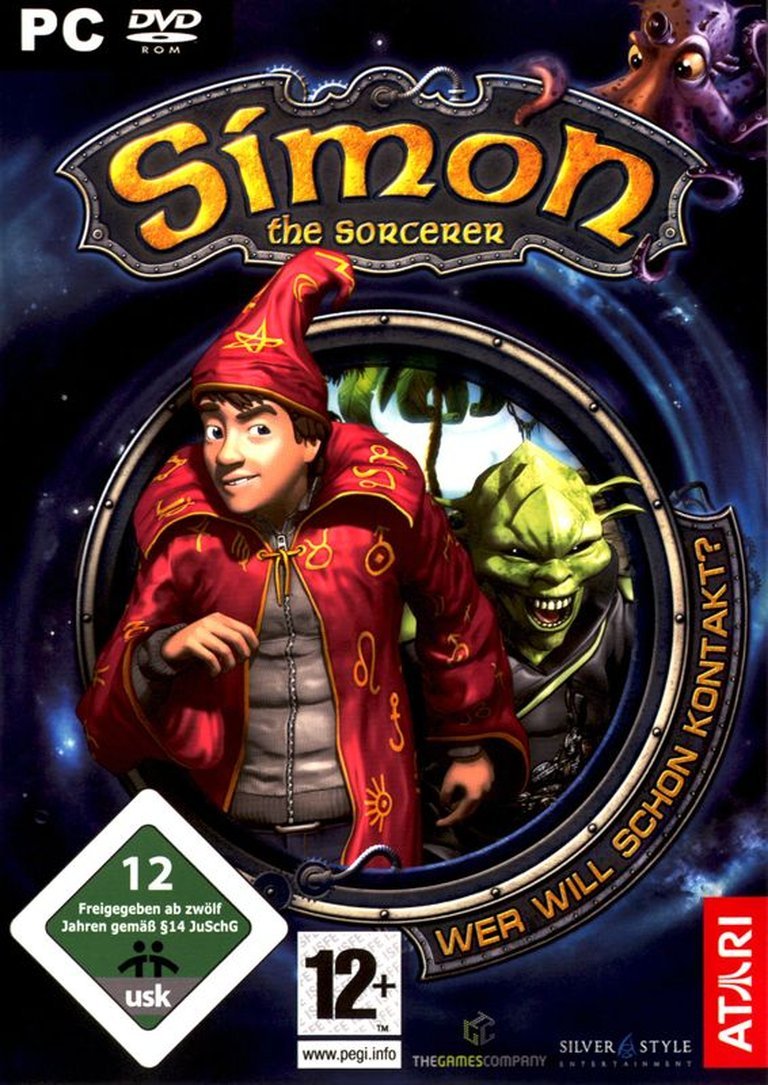
In ‘Simon the Sorcerer: Who’d Even Want Contact?!’, the titular sorcerer embarks on a rescue mission after aliens kidnap his girlfriend Alix, attacking his fairyland home and forcing him to travel through eclectic locations like a Caribbean beach and outer space. This humorous point-and-click adventure features traditional gameplay with exploration, item-based puzzles offering multiple solutions, and witty dialogues, all presented in a refreshed cel-shaded visual style that enhances the fantasy-meets-sci-fi setting.
Gameplay Videos
Simon the Sorcerer: Who’d Even Want Contact?! Cracks & Fixes
Simon the Sorcerer: Who’d Even Want Contact?! Guides & Walkthroughs
Simon the Sorcerer: Who’d Even Want Contact?! Reviews & Reception
mobygames.com (73/100): Slightly better than the last one but not up to standard of the Simon series
ign.com (73/100): The voices and character designs aren’t exactly top-notch, but there’s still a lot of fun to be had.
Simon the Sorcerer: Who’d Even Want Contact?!: Review
Introduction: A Franchise Adrift in a Cosmic Sea
The Simon the Sorcerer series occupies a curious space in adventure gaming history. Born in the early 1990s from the clever, Terry Pratchett-esque pen of British developer Adventure Soft, the first two games stood as towering, witty parodies of fantasy tropes, beloved for their sharp British humor and iconic hero—a wonderfully sarcastic, slacker teenager magically transported to a world of fairy tales. By 2009, nearly a decade after the last classic, the franchise had changed hands, continents, and, most crucially, its soul. Simon the Sorcerer: Who’d Even Want Contact?! (marketed as Simon 5) represents the nadir of this transition: a technically smoother but creatively hollow experience that asks the titular, desperate question of its own premise. Developed not by its British creators but by Germany’s Silver Style Entertainment, this installment abandons the grounded, bookish fantasy parody for a chaotic, sci-fi-infused mishmash, asking players to endure an alien invasion in Fairyland. The thesis is stark: while competent in its mechanics and visually upgraded, Who’d Even Want Contact?! is a franchise low point, a game that misunderstands the core charm of its own hero and legend, leaving only a polished shell of what once was.
Development History & Context: The German Reboot and the Death of a Personality
To understand Simon 5, one must grapple with the schism in the series’ development. The first two games (1993, 1995) are classics, created by Adventure Soft with Chris Barrie’s iconic voice performance defining Simon as a quintessential, insolent British teen. After the poorly received 3D experiment Simon 3D (2002), the series was revived by a new team. Simon the Sorcerer 4: Chaos Happens (2007) was developed by Silver Style Entertainment, a German studio, and published by TGC – The Games Company GmbH. This marked a definitive break: the series was now in German hands, localized for international audiences.
Who’d Even Want Contact?! (2009) is the direct sequel, built on the same engine and assets as Chaos Happens. The technological constraint was clear: Silver Style used a hybrid of pre-rendered 2D backgrounds with 3D cel-shaded character models, a style they introduced in Chaos Happens but refined here. The cel-shading was a notable visual upgrade, giving characters a cartoonish, less plasticky look than the previous game’s awkward 3D. However, this was a era of transition—full 3D adventures were becoming standard, and this hybrid approach felt like a cost-saving compromise, not an artistic choice. The gaming landscape of 2009 was seeing a indie-driven resurgence of point-and-click adventures (Telltale’s Sam & Max, later The Walking Dead), but major publishers were still wary. Simon 5 was a commercial afterthought, a budget-priced sequel from a niche German publisher (TGC would later go insolvent, making the game abandonware), aiming squarely at existing fans and genre newcomers with its simple interface and hint system. It was a product of a franchise on life support, lacking the resources or, seemingly, the creative vision of its 90s heyday.
Narrative & Thematic Deep Dive: From Fairy Tale Spoof to Sci-Fi Slog
The plot of Who’d Even Want Contact?! is its most derided and perplexing element. Following the events of Chaos Happens, Simon has supposedly “settled down” with his girlfriend Alix, running a magic shop. The inciting incident is not a classic fantasy summons but a full-scale alien invasion of the magical realm. The extraterrestrials—generic, grey-area bug-like creatures— abduct Alix, forcing Simon onto a rescue mission that spirals through wildly disparate locations: a Caribbean beach, a mole-people city, and finally a deep-space battle station called “the Eye of Death.”
This thematic leap from fantasy parody to sci-fi pastiche is catastrophic for the series’ identity. The original games’ genius lay in juxtaposing Simon’s modern, cynical snark against the earnest absurdity of folklore (a depressed Three Billy Goats Gruff, a vainglorious Robin Hood). Here, the satire is blunt and lazy. The aliens are not clever parodies of Star Wars or Star Trek tropes but generic invaders. The ” Caribbean beach” sequence feels like a perfunctory pirate-themed detour. The mole-people city is a nonsensical addition, reviewed by critics as a “What?!” moment. The narrative thread is a convoluted scavenger hunt lacking the cohesive, escalating tension of the first two games.
The characterization is equally problematic. Most damningly, Simon is no longer the British sarcastic hero voiced by Chris Barrie. In this German-developed iteration, he is an Americanized, “total wanker” (as a user review aptly states)—loud, obnoxious, and lacking the clever, world-weary wit that made him endearing. His dialogue is described as “woodenhammer humor” and “flat and pubertal.” Supporting characters like Red Riding Hood are “annoying in their failed attempt to be obnoxiously funny.” The only consistently praised element is a depressed war robot, a clear Marvin the Paranoid Android parody from Hitchhiker’s Guide, which stands out as a lone beacon of intelligent, character-driven humor in a desert of forced jokes. Alix, the motivating damsel, is notably underused beyond the opening abduction and a final confrontation, a wasted opportunity. The multiple-choice dialogues, shorter than in Chaos Happens, and the puzzle solutions that alter the ending and a final “psycho-analysis” are mechanical nods to player agency that feel unearned and unimpactful, never integrating into a meaningful thematic core.
Gameplay Mechanics & Systems: Solid Foundation, Empty Heart
Mechanically, Simon 5 is a textbook, conservative point-and-click adventure. It uses the “two-click” system (left-click to interact/use, right-click to examine) flawlessly, with a responsive cursor and no major interface frustrations—a definite improvement over some clunkier titles. The “Questbook” journal returns, listing active and completed tasks, and this time it’s complemented by a three-tier hint system for every puzzle (from a nudge to a near-solution), a clear accommodation for a more casual, modern audience. This is a genuinely good design choice, reducing frustration without breaking immersion.
The core loop is pure inventory-based puzzling: explore hand-painted backgrounds, collect every non-fixed item, combine items in the inventory, and use them on the environment or characters. Puzzles are generally logical and solvable, ranging from simple to moderately challenging. A few require combining multiple components from different locations, and some offer multiple solutions (e.g., being nice vs. being a jerk), which influences the ending. However, the overarching criticism from reviewers is that the puzzles are often too easy and lack the inspired, lateral-thinking brilliance of the genre’s gold standard (Monkey Island, early Simon). They are “colourful” and “bunt gestaltet” (colorfully designed) but rarely “aha!”-inducing. The game’s length is consistently cited as very short (around 10 hours), and the streamlined, less dialogue-heavy design compared to Chaos Happens strips away the narrative padding but also the engaging conversational world-building. The gameplay is professionally executed but devoid of the innovative spark needed to elevate it above competent mediocrity.
World-Building, Art & Sound: A Gilded Cage
This is the game’s strongest, most consistently praised aspect. The shift to cel-shaded 3D characters on detailed, painterly 2D backgrounds is a significant visual upgrade from Chaos Happens. The hand-drawn backgrounds are frequently described as “beautiful,” “hübsch” (pretty), and “convincingly cartoon-like.” Locations like the alien spacecraft, the Caribbean shore, and the mole burrows have a distinct, vivid atmosphere. The cel-shading, while sometimes giving characters a slightly stiff, action-figure quality, largely succeeded in creating a cohesive, readable cartoon aesthetic that avoids the “uncanny valley” of the previous game’s attempts at realistic 3D.
However, this visual polish is undermined by two critical flaws. First, character animation is often stiff and limited, lacking the expressive fluidity of top-tier adventures. Second, and more damningly, the art direction fails to capture a unified tone. The clash between classic fairy tale iconography (Red Riding Hood, a Swampling) and sci-fi elements (aliens, spaceships) feels visually jarring, not cohesively parodic. The world doesn’t feel like a parody of anything; it feels like a random assortment of assets.
The sound design and voice acting are major weak points. Critics universally pans the voice acting as “terrible,” “wooden,” and “not top-notch.” Simon’s new voice (replacing Chris Barrie) lacks the iconic sarcasm, coming across as grating. Other characters are described as having “lächerlichen Stimmen” (ridiculous voices). The soundtrack is functional but unmemorable, failing to enhance the slapstick or parody moments. The one audio highlight mentioned by players is a specific, naughty scene involving Alix’s video recording—a rare moment where writing, voice, and context align for a genuine laugh. Overall, the soundscape is a net negative, with the option to turn off voices and use subtitles being a recommended fix by reviewers like IGN’s Kristine Steimer.
Reception & Legacy: A Middle Finger to Nostalgia
Who’d Even Want Contact?! received a mixed-to-positive reception from German press (scores ranging from 82% down to 70%), who generally praised its polish, humor (though noting it was less subtle), and accessibility for newcomers. International and fan reception was far more negative. The MobyGames user review summary perfectly captures the divide: “Slightly better than the last one but not up to standard of the Simon series.” The average critic score of 73% masks a bitter divide: while outlets like Game Captain (84%) and GameStar (82%) saw a solid, if flawed, adventure, Absolute Games (AG.ru) savaged it with a 35%, calling its humor “öd” (tedious). The common refrain from series veterans was disappointment: the soul, the British wit, the clever parody—all were gone, replaced by a generic, “kindischen” (childish) farce.
Its legacy is one of franchise stagnation. It did not revive the series’ fortunes. Instead, it solidified the perception that the series had lost its way under non-original developers. This directly contributed to the failed crowdfunding attempt for Simon the Sorcerer 6: Between Worlds (2014-2016), which aimed to return to the series’ roots with original voice actor Chris Barrie and 2D art but collapsed due to funding issues. Simon 5 is the bridge between the last official retail release and the series’ effective hiatus. It serves as a cautionary tale: a franchise can survive a change in development studio, but it cannot survive a change in core identity and voice. Its availability today is solely through abandonware sites, a direct result of publisher TGC’s insolvency, making it a digital ghost of a once-vibrant series.
Conclusion: A Polished, Soulless Relic
Simon the Sorcerer: Who’d Even Want Contact?! is not an irredeemable game. As a technical piece of adventure game construction, it is competent and user-friendly. The cel-shaded graphics are a notable improvement, the puzzles are logical, and the hint system is thoughtful. For a genre newcomer in 2009 with no frame of reference for the series’ heyday, it was likely an enjoyable, breezy 10-hour romp.
But as an installment in a legendary franchise, it is a profound failure. It surgically removes the core DNA that made Simon the Sorcerer iconic: the specific, British, fourth-wall-breaking cynicism of its protagonist; the sharp, literary parody of fairy tales and fantasy; the cohesive, witty world. In its place, it offers a haphazard sci-fi plot, an Americanized and insufferable hero, forgettable characters, and humor that relies on broad gags over clever wordplay. It is a game that asks “Who’d even want contact?” with its own premise, and the answer, for anyone remembering the first two games, is a resounding “not me.”
Verdict: 5.5/10 – A technically sound but creatively bankrupt sequel that misunderstands its own legacy, leaving only a visually polished shell of a once-great adventure series. It is a competent time-waster for the completist, but a disappointing ghost for the fan.