
- Release Year: 2009
- Platforms: Blacknut, OnLive, Windows
- Publisher: 1C Company, 1C Publishing EU s.r.o.
- Developer: Farm 51 Group S.A., The
- Genre: Action
- Perspective: First-person
- Game Mode: LAN, Online PVP, Single-player
- Gameplay: Combo, Magic, Shooter, Vehicles
- Setting: Fantasy, Horror
- Average Score: 78/100
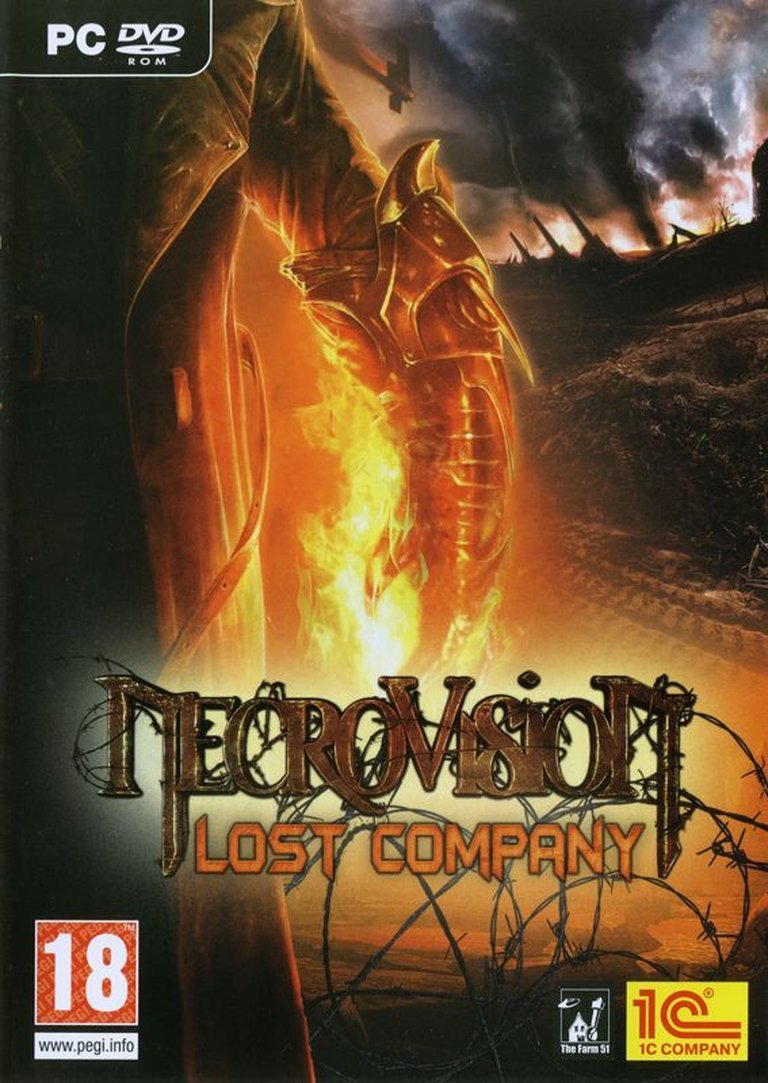
Description
NecroVisioN: Lost Company is a first-person shooter prequel set during World War I, where players assume the role of Jonas Zimmermann, the main antagonist from the original game, as he’s sent to the Western Front to find a vaccine for a mysterious disease affecting troops. Featuring WWI-era weaponry including six new weapons and special vampiric abilities like the ShadowHand, players must mow down hordes of zombies while utilizing combo systems, adrenaline mechanics, and demonic powers. The game includes a ten-mission single-player campaign where players take control of vehicles like tanks and airplanes, along with multiplayer modes for up to 8 players, all set in a unique fantasy-horror alternate history of the Great War.
Gameplay Videos
Where to Buy NecroVisioN: Lost Company
NecroVisioN: Lost Company Patches & Updates
NecroVisioN: Lost Company Guides & Walkthroughs
NecroVisioN: Lost Company Reviews & Reception
metacritic.com (80/100): NecroVision: Lost Company as a standalone add-on to NecroVisioN is an average-good game, shorter than its original, has the same level of bug, and still can give a fun factor.
metacritic.com : Underrated game….probably the most intense WW1 fantasy game with old school gunplay.
metacritic.com (77/100): This game is not going to waste your time i: just action and explosions.
NecroVisioN: Lost Company Cheats & Codes
PC
Press ~ during gameplay to open the console, then type the code and press Enter.
| Code | Effect |
|---|---|
| NVNALLLEVELS | Unlock All Levels |
| NVNGOD | God Mode |
| NVNAMMO | Full Ammo |
| NVNGRINDER | Grinding Machine |
| NVNFUNNY | Toon Mode |
| NVNHEALME | Refill Health |
| NVNUNLOCK | All Special ShadowHand Attacks Unlocked |
| NVNMAKEMYDAY | Refill Health |
| NVNGYJMODE | Fairy Mode |
| NVNCHAIN | Maximum Fury Level Granted |
| NVNWEAPONS | All Weapons |
| NVNMANA | Extra Adrenaline |
| NVNSSAO | Toggle Textures |
NecroVisioN: Lost Company: Review
Introduction
In the annals of first-person shooters, few settings are as daringly unique as the blood-soaked trenches of World War I, infested with zombies, vampires, and demons. NecroVisioN: Lost Company, a prequel to the 2009 cult hit NecroVisioN, thrusts players into this unhistorical nightmare as Jonas Zimmermann—the antagonist from the original game—during his descent into necromantic villainy. Released in December 2009 by Polish studio The Farm 51 and publisher 1C Company, Lost Company arrived amid a gaming landscape dominated by modern military shooters like Call of Duty: Modern Warfare 2. Yet it carved its own niche by doubling down on its predecessor’s gonzo premise: historical reimagined as cosmic horror. This review argues that Lost Company is a flawed yet fascinating artifact—a jank-ridden, ambitious experiment that succeeds through sheer audacity and atmosphere, even as its technical shortcomings and repetitive design hold it back from greatness. It is a testament to a studio unafraid to defy genre conventions, even when the results are uneven.
Development History & Context
Developed by The Farm 51—a Polish studio later known for titles like Painkiller: Hell & Damnation and Deadfall Adventures—Lost Company emerged as a direct response to the critical and commercial reception of NecroVisioN (2009). Using a modified version of the Painkiller engine (the “Pain Engine”), the team sought to refine the formula while expanding the lore. Lead designer Kamil Bilczyński and art director Wojciech Pazdur envisioned a prequel that would humanize Jonas Zimmermann, revealing his transformation from WWI soldier to necromancer through hands-on gameplay. Technologically, the game was constrained by its era; while it boasted Havok physics and Bink Video support, its visuals and AI lagged behind contemporaries. The 2009–2010 release window placed it in a competitive FPS market saturated with gritty realism, yet its alt-horror WWI setting was virtually unparalleled. The Farm 51’s ambition to blend historical authenticity with supernatural chaos was bold, but limited resources and engine constraints resulted in a product that felt both innovative and rushed.
Narrative & Thematic Deep Dive
NecroVisioN: Lost Company recontextualizes the series’ events through the eyes of its primary antagonist, Jonas Zimmermann. Set in 1916, the plot follows Zimmermann, a German officer dispatched to the Western Front to investigate a plague turning soldiers into ravenous zombies. What begins as a search for a vaccine spirals into a Lovecraftian odyssey, as Zimmermann uncovers demonic forces manipulating the war. He discovers vampiric technology—including the ShadowHand, a necromantic gauntlet—and eventually confronts a golem guardian, becoming the first necromancer. The narrative, penned by Jarosław Scislak and Patrycja Skorek, is a schlocky B-movie pastiche, rife with tropes of war, corruption, and cosmic horror. Dialogue is functional but uninspired, hampered by a weak English dubbing where German soldiers inexplicably adopt British accents and vice versa. Thematically, the game explores war as a crucible for moral decay, with Zimmermann’s descent mirroring the real-world horrors of WWI industrialized slaughter. Yet the story’s potential is undercut by clichés and abrupt pacing, reducing its tragic protagonist to a cartoonish villain by the game’s climax. As one critic quipped, the plot is “a cliché as cliché can be for an ‘old-school shooter’” (GameOn).
Gameplay Mechanics & Systems
Lost Company retains its predecessor’s straightforward shooter DNA while introducing refinements and new systems. Core combat blends WWI-era weaponry—Lee-Enfield rifles, trench shotguns—with vampiric ShadowHand abilities. The ShadowHand, fueled by adrenaline earned via combo kills, allows players to resurrect fallen enemies, unleash spells, and perform brutal finishers. A “Fury meter” amplifies these abilities after successive combos, rewarding aggressive play. However, the ShadowHand is gated by challenge rooms, where players must complete tasks like “shoot 50 airborne zombies” to unlock new spells, adding frustrating artificial depth.
The game excels in chaotic, horde-based combat but falters in execution. Dual-wielding and time-slow effects after headshot combos create moments of kinetic glee, yet enemies are repetitive—zombies, hellhounds, and demons with predictable AI. Vehicle sections (an FT17 tank and Halberstadt CL.II biplane) break up the action but are marred by clumsy controls and poor pacing, with tank levels feeling “long and boring” (AlienwareGamer). Multiplayer supports up to 8 players across modes like Deathmatch and the new “Gas Attack,” but relies heavily on maps from the first game, offering little innovation. AI companions, present in half the levels, are a liability—terminally stupid, prone to friendly fire, and more hindrance than help. Ultimately, Lost Company delivers “a fun factor” (PC Action) but suffers from monotonous enemy patterns and technical bugs that undermine its ambition.
World-Building, Art & Sound
The game’s greatest triumph is its atmospheric world-building. The Farm 51 masterfully merges the grimy realism of WWI trenches with grotesque supernatural elements: mud-caked battlefields give way to steampunk vampire laboratories and hellish caverns. Art director Kamil Bilczyński’s direction ensures visual cohesion, with gas-masked soldiers silhouetted against mustard gas clouds and demonic runes etched into crumbling fortresses. The ShadowHand’s ethereal glow and the “strange oil” plague’s necrotic effects add visceral texture. However, graphics are dated for 2009, with flat textures and stiff animations that clash with the game’s ambition. German censors neutered the experience, replacing blood with grey smoke and removing gore, stripping the horror of its impact.
Sound design compensates effectively. Battlefield cacophony—distant artillery, rifle cracks—merges with unsettling ambient whispers and guttural enemy roars. The score features Immediate Music’s bombastic “Preliator” during boss fights and Globus’s “Orchard of Mines” in credits, elevating the melodrama. Voice acting, however, is inconsistent. While Zimmermann’s descent is compelling, the mismatched accents and stilted line delivery (“our allies which are German have British accents,” notes KOles) undermine immersion. Yet the fusion of historical grit and supernatural dread creates an unforgettable atmosphere, proving that Lost Company’s artistry lies in its world-building, not its polish.
Reception & Legacy
Upon release, Lost Company received a tepid critical reception. MobyGames aggregates a 63% score, with outlets like Absolute Games (40%) lambasting its “cosmetic changes” and lack of innovation, while GamingXP (80%) praised its “trashy” charm. Player reviews on Steam are mixed (“Mostly Positive,” 71/100), with fans lauding its “nostalgic charm” and “unique WWI fantasy” but criticizing “jankiness” and “bullet sponge bosses” (Harbinger134). The game’s legacy is one of cult appreciation: it’s a “hidden gem” (howlongtobeat.com) for FPS purists, revered for its bold concept but overlooked due to technical flaws. Its influence is modest but notable, predating later WWI-horror titles like Trench Tales and inspiring modders (e.g., Sui’s Extended Menu). Over time, it’s been reevaluated as a flawed precursor to games that blend history with fantasy, securing a niche in the pantheon of experimental FPS. As one retrospective notes, it’s “a flawed masterpiece” (GameArchives), remembered more for its audacity than its execution.
Conclusion
NecroVisioN: Lost Company is a paradox—a game that feels both ahead of its time and stuck in the past. It succeeds wildly in its vision, marrying the visceral horror of WWI with supernatural spectacle in a way few games have dared. The ShadowHand, the atmospheric trenches, and the tragic arc of Jonas Zimmermann create an experience that is uniquely compelling. Yet, it is equally undone by its own ambition: repetitive combat, janky mechanics, and a narrative that squanders its potential. For fans of old-school shooters or alt-history horror, it’s a must-play, available for pennies on GOG.com. Its legacy is that of a valiant failure—a game that dared to be different, even when it couldn’t quite deliver. In an era of derivative blockbusters, Lost Company stands as a reminder that true innovation often comes wrapped in flaws, and that the most memorable games aren’t always the most polished. They’re the ones that dare to show you hell in a gas mask.