
- Release Year: 1997
- Platforms: Windows 16-bit, Windows
- Publisher: Animagination
- Developer: Animagination
- Genre: Adventure
- Perspective: Third-person
- Game Mode: Single-player
- Gameplay: Puzzle elements
- Setting: Detective, Mystery
- Average Score: 74/100
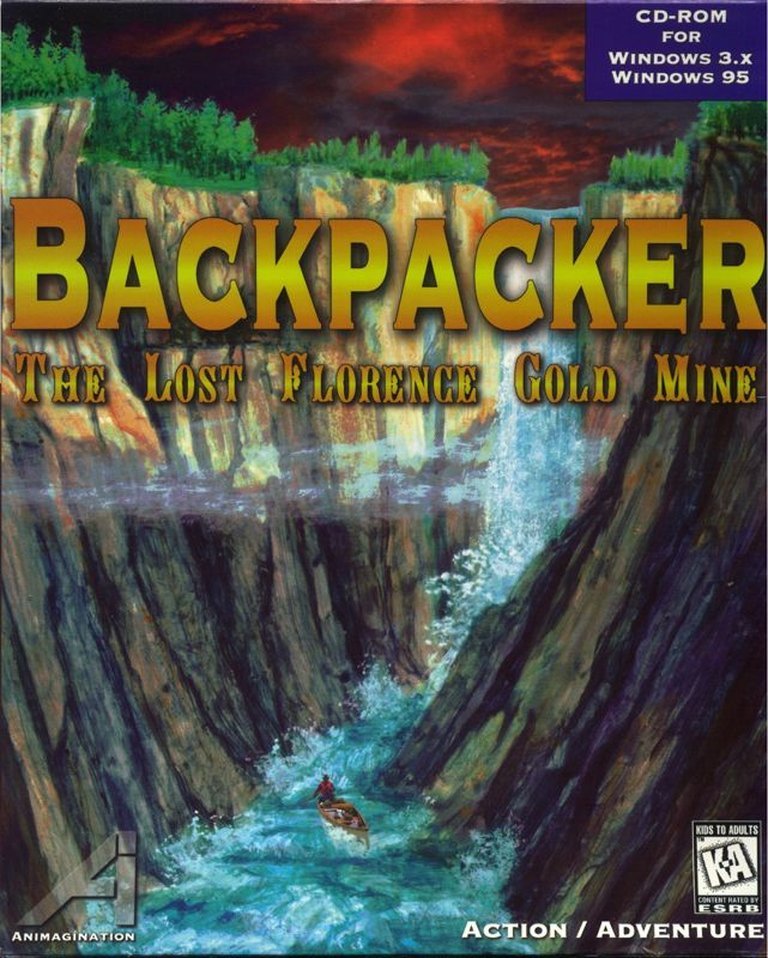
Description
Backpacker: The Lost Florence Gold Mine is a traditional third-person point-and-click adventure game where players assume the role of detective McBlade, who receives a mysterious letter prompting an investigation into a decades-old unsolved murder. The case intertwines with the ancient Indian myth of the Death Cave, leading players through dialogue-driven puzzles and perilous discoveries to uncover hidden truths.
Gameplay Videos
Backpacker: The Lost Florence Gold Mine Free Download
Backpacker: The Lost Florence Gold Mine Reviews & Reception
metzomagic.com : This isn’t a game for adventure purists, or for experienced adventurers, it’s much better suited for novice to intermediate adventurers and younger game players.
Backpacker: The Lost Florence Gold Mine: A Curious Obscurity
Introduction
In the twilight years of the point-and-click adventure genre’s golden age, a modest yet enigmatic gem emerged from the shadows of mainstream gaming: Backpacker: The Lost Florence Gold Mine. Developed by the fledgling California-based studio Animagination over four years of spare-time dedication, this 1997 release remains a haunting footnote in interactive storytelling history. Despite its obscurity—buried by genre decline, limited distribution, and technical quirks—Backpacker offers a compelling fusion of detective noir, Native American mythology, and wilderness survival. This review deconstructs its ambitious vision, dissecting its narrative ambition, mechanical design, and cultural footprint to argue that, for all its flaws, Backpacker stands as a poignant testament to the experimental spirit of 90s indie game development.
Development History & Context
Animagination, founded by Richard Williams and Phil Grabmiller, operated as a passion project with shoestring resources. The game’s four-year gestation (1993–1997) was marked by a critical pivot: originally conceived as a DOS title, it was hastily adapted for Windows 3.1/95 following Microsoft’s dominance, explaining its archaic interface and 256-color graphics. This shift, coupled with the team’s part-time efforts, resulted in a product that visually resembled Sierra’s early 90s adventures while technologically lagging behind contemporaries like The Curse of Monkey Island (1997). The release coincided with the adventure genre’s perceived decline, overshadowed by the rise of 3D action games. Animagination’s subsequent pivot to Christian-themed content further marginalized Backpacker, cementing its status as a niche curiosity. Yet its reverence for Idaho’s Payette Lake and Nez Perce lore reveals a sincere commitment to authentic world-building, even when constrained by technological limitations.
Narrative & Thematic Deep Dive
The plot follows Detective Chuck McBlade, a suburban sleuth drawn into a 60-year-old murder mystery after receiving a cryptic letter and John Florence’s gold-rush diary. The narrative intertwines two threads: the 1886 death of Florence at Payette Lake, linked to a mythical “Cave of Death,” and the present-day struggle between innkeeper Joseph Florence and his unscrupulous partner, Bart. McBlade’s investigation—motivated by curiosity rather than personal stakes—unearths themes of greed, cultural erasure, and the weight of history. Characters like Megan Florence (Joseph’s daughter) and the elderly Susquehene embody the tension between preservation and exploitation, while the Cave of Death myth grounds the story in real indigenous lore. Dialogue is functional but underdeveloped, with voice acting ranging from serviceable (narrator Paul Smet) to stilted (NPCs). The script prioritizes puzzle logic over emotional depth, yet its integration of wilderness survival tips—culled from in-game flora/fauna guides—adds a layer of edutainment rarely seen in adventures. The climax, though abrupt, successfully ties Florence’s murder to the cave’s curse, rewarding patience with a bittersweet resolution.
Gameplay Mechanics & Systems
Backpacker operates as a traditional third-person point-and-click adventure, prioritizing environmental interaction over action. Core gameplay involves traversing 100+ wilderness scenes, gathering clues, and solving puzzles tied to nature and local history. A unique feature is the identification mechanic: players use an in-game flora/fauna compendium to distinguish edible plants from poisonous ones, integrating real-world botany into puzzle design. However, the interface is plagued by inconsistencies:
– Pixel Hunting: Critical items (e.g., a porcupine’s quill) are represented by single pixels, demanding meticulous clicking.
– Static Icons: The cursor never highlights interactive objects, forcing trial-and-error.
– Mini-Games: Unskippable segments like a dart-throwing challenge (requiring mouse-precision sliders) and a treacherous hang-gliding sequence over Payette Lake frustrate players lacking reflexes.
Death is frequent but mitigated by a robust quicksave system (F6/F5). Puzzles are logically derived from context—e.g., using cattails to lure porcupines—but environmental hazards (rushing rivers, toxic gas) often feel arbitrary. The lack of combat distinguishes it from action-adventures, yet the arcade sequences clash with the game’s cerebral tone.
World-Building, Art & Sound
Set in Idaho’s Payette Lake region, Backpacker leverages its location for atmospheric immersion. Backdrop paintings evoke the Pacific Northwest’s pine forests, rocky cliffs, and placid waters, though rendered in low-resolution VGA that obscures detail. Character sprites float unnaturally over scenes—a relic of its DOS origins—and facial animations during dialogues are stiff. Sound design fares better: natural effects (lapping water, rustling leaves) and a minimalist score (easily toggled off) enhance immersion. Voice acting, while uneven, adds authenticity to characters like Bart’s gruff innkeeper and Megan’s concerned pleas. The game’s strongest artistic achievement is its synthesis of wilderness and mysticism: glowing petroglyphs in the Cave of Death and ceremonial chants during flashbacks hint at a deeper cultural narrative, even if underexplored. Yet the visual limitations—cramped UI, poor lighting—undermine this potential, reducing the world to a static diorama.
Reception & Legacy
Upon release, Backpacker received mixed-to-poor reviews. Quandary praised its accessibility for families but noted “fiddly bits,” while Electric Games lambasted its “dated graphics, inane arcade sequences, and bugs.” Computer Games Magazine dismissed the plot as “hackneyed,” highlighting an “arbitrary” climax. Commercial performance was minimal, hindered by Animagination’s limited distribution and the genre’s waning popularity. Retrospectively, however, Backpacker has found a niche audience. Abandonware sites like MyAbandonware and The Collection Chamber celebrate its preservation of 90s indie ambition, while forums lament its technical flaws. Its legacy lies in its fusion of education and adventure—a precursor to modern edutainment titles—and its capture of a specific American frontier mythos. Though it never influenced mainstream design, its rediscovery highlights the era’s experimental spirit.
Conclusion
Backpacker: The Lost Florence Gold Mine is a flawed but fascinating artifact. Its narrative ambition, authentic setting, and unique survival puzzles offer rewards for patient players, while its technical shortcomings—archaic graphics, punishing mini-games, and a non-intuitive interface—stand as cautionary tales of overambition under resourced constraints. As a product of its time, it embodies the 90s adventure genre’s twilight struggles: clinging to point-and-click roots while battling obsolescence. For historians, it’s a window into indie development’s grassroots ethos; for gamers, a quirky curiosity best approached with savestates and a forgiving spirit. Though it lacks the polish of contemporaries, Backpacker endures as a testament to the power of niche storytelling—a lost gold mine of ideas, worth excavating for those willing to endure its rough terrain.