
- Release Year: 1989
- Platforms: Amiga, Amstrad CPC, Atari ST, Commodore 64, DOS, Windows, ZX Spectrum
- Publisher: Mindscape, Inc., Throwback Entertainment Inc.
- Developer: Gray Matter Inc.
- Genre: Action
- Perspective: Side view
- Game Mode: Hotseat, Single-player
- Gameplay: Arcade, Mini-games, stunts, Tricks
- Setting: Circus
- Average Score: 80/100
Description
In Fiendish Freddy’s Big Top O’ Fun, players must save a struggling circus from seizure by earning $10,000 through six thrilling acts—high diving, juggling, trapeze, knife throwing, tightrope walking, and cannonball shooting—while thwarting the evil clown Fiendish Freddy, who sabotages the performance with traps and distractions. Up to five players compete independently, with money awarded by a jury after each act, combining skill-based challenges with comedic circus chaos.
Gameplay Videos
Where to Buy Fiendish Freddy’s Big Top O’ Fun
Fiendish Freddy’s Big Top O’ Fun Free Download
Fiendish Freddy’s Big Top O’ Fun Guides & Walkthroughs
Fiendish Freddy’s Big Top O’ Fun Reviews & Reception
lemon64.com (80/100): An original idea, and very entertaining indeed.
Fiendish Freddy’s Big Top O’ Fun: Review
Introduction
Step right up, ladies and gents, to the digital big top where chaos reigns and laughter is currency! Fiendish Freddy’s Big Top O’ Fun (1989) isn’t just a circus-themed game—it’s a raucous, darkly comedic spectacle that defied the 8-bit/16-bit era’s conventions. Developed by Gray Matter under Chris Gray and published by Mindscape, this anthology of grotesque mini-games masterfully blends slapstick absurdity with genuine challenge. Its legacy? A cult classic revered for its audacious humor and technical bravado, yet remembered for its punishing hardware limitations. This review dissects how Fiendish Freddy transformed the multi-event genre into a symphony of sabotage, where every missed dive or dropped bomb could spell doom for a beleaguered circus.
Development History & Context
Gray Matter’s Vision: Founded by Chris Gray (creator of Infiltrator), Gray Matter aimed to innovate beyond sports simulations. They envisioned Fiendish Freddy not as a clone of Epyx’s California Games, but as a narrative-driven anthology with a “save the circus” premise. Gray’s team prioritized cinematic animation and black humor, aiming for a “computer cartoon” experience where every frame pulsed with manic energy.
Technological Constraints: Released across 1989–1990 for Atari ST, Amiga, DOS, Amstrad CPC, C64, and ZX Spectrum, the game’s ambition collided with hardware limits. The Amiga/ST versions required three disks for loading, with animated sequences that crippled gameplay flow (“a constant five-disk shuffle,” lamented ST Action). Spectrum players suffered “unwieldy multi-load” systems (Your Sinclair), while DOS versions on slower PCs moved “very slowly and jerkily” (The Games Machine). Yet developers like Axel Brown and Kristi-Louise Herd squeezed fluid animations into 16-bit sprites, creating a paradox of technical prowess and logistical agony.
Gaming Landscape: The late ’80s saw a glut of sports compilations, but Fiendish Freddy stood out by injecting dark comedy and a cohesive narrative. Its release predated mainstream controversies over game violence, allowing graphic gags (e.g., jugglers blown to bits) to slide without scrutiny. Awards like Crash!’s “Best Graphics” and the UK Industry Dinner’s “Best Advertisement” underscored its niche triumph amid a crowded market.
Narrative & Thematic Deep Dive
Plot & Characters: The story is pure Dickensian farce: The Big Top O’ Fun circus faces foreclosure from the Big Greedy Bank unless it raises $10,000 in one night. Enter Fiendish Freddy, a corporate clown saboteur sent by banker I.M. Tightwad to demolish the show. The ringmaster’s desperation fuels a six-act gauntlet, where players control performers like Horace the High Diver, Finola the Trapeze Artist, and Knancy the Knife Thrower. Each character is rendered with tragicomic flair—Finola’s fiery demise or Knancy’s blood-curdling screams (“she screams out and several knives are removed from the stock”) blend pathos with slapstick.
Dialogue & Tone: The narrative drips with gallows humor. Judges—five deranged clowns—award funds with deranged enthusiasm, while Freddy’s sabotage is gleefully sadistic. The dialogue is sparse but potent: Freddy’s fan blasts Horace off-course; bombs explode with cartoonish brutality. Thematic depth lies in its critique of corporatization, where Freddy’s greed (building “Freddy’s Towers” over the circus) mirrors late-’80s anxieties about gentrification. Yet the game never loses its anarchic heart, framing failure as dark comedy: “If the player fails, the circus is demolished,” Wikipedia notes, “and a building labeled Freddy’s Towers is erected.”
Underlying Themes: Capitalism vs. Art: The circus’s fight for survival symbolizes art under siege. Chaos vs. Control: Freddy’s interference turns skill-based acts into battles against entropy. Violence as Satire: Graphic deaths (tightrope walkers “sliced in two”) subvert children’s media tropes, proving that in a circus, laughter is often laced with blood.
Gameplay Mechanics & Systems
Core Loops & Events:
1. High Diving: Horace must spin and pose mid-air while Freddy fans him off-course. Precision meets timing as platforms rise and targets shrink.
2. Juggling: Jeffy Joe juggles increasingly chaotic items—babies, bombs, missiles. Dropping five items ends the act, but bombs can be thrown back at Freddy for cathartic explosions.
3. Trapeze: Finola swings through flaming hoops; Freddy’s jetpack and scissors demand split-second jumps.
4. Knife Throwing: Knancy’s blindfolded wheel-spinning requires careful aim—hit her, and blood floods the screen. Smoke bombs add chaos.
5. Tightrope: Tony’s balance beam deflection against Freddy’s saw blades is a tense ballet of death.
6. Cannonball: Fernando’s trajectory math and Freddy’s cannon-corking sabotage blend calculation with absurdity.
Combat & Progression: “Combat” is purely reactive—Freddy’s antics are environmental hazards, not direct fights. Progression is monetary: Players accumulate funds per act, with judges scoring on “quality of the show.” The $10,000 goal creates narrative urgency, but multiplayer (up to five players) pits friends against each other for circus-saving cash.
UI & Innovations: The menu system is whimsically circus-themed, but disk-swapping on Amiga/ST/DOS breaks immersion. Keyboard/joystick controls vary per event—some (diving) favor joysticks, others (juggling) need keyboard finesse. The “practice mode” is a saving grace, letting players hone skills before Freddy’s sabotage escalates.
Flaws: Repetitive loading (“the ratio of Loading/Playing is 1:1,” complained ASM), and later acts feel unfairly hard. The juggling act’s “five mistakes” mechanic can feel punitive, especially when Freddy’s seal is distracted mid-toss.
World-Building, Art & Sound
Setting & Atmosphere: The circus is a character itself—a vibrant, grotesque wonderland. Each act’s arena is packed with details: marching bands in the trapeze act, eccentric crowds, and Freddy’s helicopter blades slicing tension. The “Big Top O’ Fun” world feels alive, with subplots like the seal’s indifference or Knancy’s plight adding narrative texture.
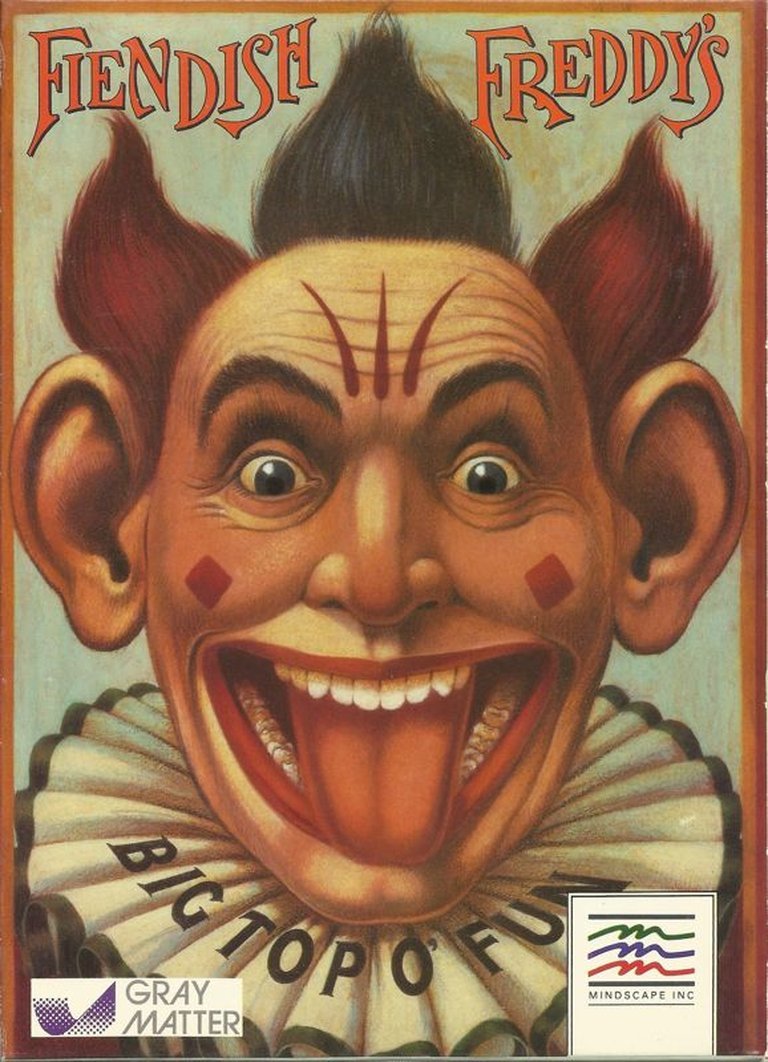
Visual Direction: Gray Matter’s graphics were revolutionary. Zzap! praised Amiga sprites as “first-class demo quality,” with fluid animations (e.g., Horace’s spinning dives, Finola’s trapeze arcs). The art style is a caricature-rich nightmare: Freddy’s manic grin, the judges’ bulbous noses, and the blood splatter in knife-throwing scenes. Even on Spectrum, the game’s “amazing” graphics (Crash!) packed personality.
Sound Design: Music is a “jolly” (The Games Machine) circus medley, with tinny piano and calliope melodies fading into background noise. Sound effects steal the show: knives thwacking balloons, Freddy’s maniacal cackles, and the sickening splat of a failed dive. The Spectrum’s “weak point” (Crash!) was overcome with “hundreds of little jingles,” making each act’s chaos feel sonically distinct.
Atmospheric Synergy: Art and sound blend to create unease beneath the circus veneer. The juxtaposition of bright colors with graphic violence (e.g., Knancy’s blood-soaked wheel) makes the world both inviting and unnerving—a perfect stage for Freddy’s reign of terror.
Reception & Legacy
Critical Reception:
– Amiga/ST: Lauded as a “graphical delight” (ST Action) with “hilarious characterization” (Zzap!). Scores peaked at 91% (Zzap!) but dipped to 59% (Amiga Format) due to loading times.
– Spectrum: Crash! awarded 94%, calling it “the best game I’ve seen in yonks,” while Your Sinclair noted tape-load drawbacks.
– C64: Mixed—Zzap! praised its “brilliant cartoon look” (89%), but Power Play scored it 66%.
– PC: EGA graphics impressed, but “jerkiness” on slow PCs hurt scores (The Games Machine).
Commercial Success: A hit in Europe (bundled with C64 Games System cartridges), though exact sales figures are elusive. Its cult status grew via shareware and later re-releases (2023 Windows port).
Legacy & Influence:
– Genre Evolution: Proved narrative and humor could elevate multi-event games beyond California Games clones.
– Technical Benchmark: Pushed 16-bit animation limits, inspiring titles like The Great Giana Sisters.
– Dark Comedy Pioneer: Preceded games like Conker’s Bad Fur Day by using violence for laughs, proving mature themes could thrive in family-friendly genres.
– Enduring Appeal: Modern players praise its “fun but short” (Squakenet) design, with cartridge versions on C64 avoiding loading hell.
Conclusion
Fiendish Freddy’s Big Top O’ Fun is a flawed masterpiece—a chaotic, hilarious, and occasionally maddening circus of digital delights. Its narrative ambition, technical artistry, and dark humor make it a standout of the late ’80s, while its loading quirks and uneven difficulty temper its brilliance. Yet its legacy endures: a testament to Gray Matter’s vision that a game about clowns, knives, and financial ruin could be both artistically bold and endlessly fun.
Final Verdict:
– For Historians: An essential artifact of 8/16-bit innovation and subversive storytelling.
– For Players: A nostalgic romp best experienced on cartridge or modern ports to bypass loading hell.
– For Industry: A blueprint for blending narrative, humor, and challenge—a reminder that the greatest shows embrace both spectacle and chaos.
Step right up, but watch your back—Freddy’s always ready with a fan or a bomb.