
- Release Year: 2011
- Platforms: Windows
- Publisher: Excalibur Publishing Limited
- Developer: Techland Sp. z o.o.
- Genre: Driving, Racing
- Perspective: 1st-person / Behind view
- Game Mode: LAN, Single-player
- Gameplay: Arcade, Simulation, Vehicular
- Setting: Real-world
- Average Score: 57/100
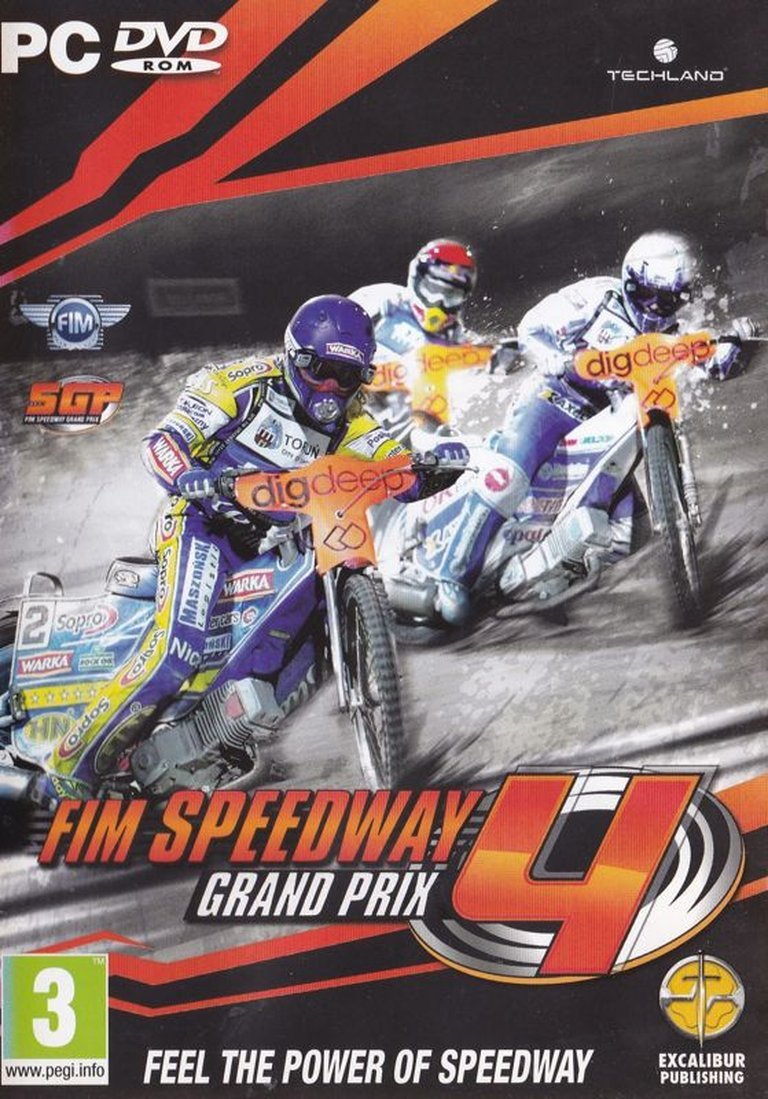
Description
FIM Speedway Grand Prix 4 is a realistic simulation of the speedway motorcycle racing sport, featuring authentic riders and oval tracks across global locations like Leszno, Gothenburg, and Cardiff. Players can choose between Arcade or Simulation modes, engage in single-player experiences including GP Season and Career modes with adjustable difficulties, or compete in multiplayer races via LAN or Internet. The game offers multiple camera perspectives, keyboard/joystick controls, and profiles for customization, immersing users in the high-speed, tactical challenges of professional speedway racing.
Gameplay Videos
FIM Speedway Grand Prix 4 Free Download
FIM Speedway Grand Prix 4 Patches & Updates
FIM Speedway Grand Prix 4 Mods
FIM Speedway Grand Prix 4 Reviews & Reception
newandoldpcgames.blogspot.com (30/100): The biggest problem in this game, that destroys the good feeling for once and for all, is the gameplay and the controllers.
gamercast.net : FIM Speedway is very similar to the old Hang On and Monaco GP Megadrive games; if you are not the first past the starting line you will not be able to catch up with the extremely difficult AI racers, no matter what difficulty you are playing at.
FIM Speedway Grand Prix 4 Cheats & Codes
PC
Press the specified function keys during gameplay to activate the cheats.
| Code | Effect |
|---|---|
| F1 Easy Building Construction | Easy Building Construction |
| F2 Super Challenge Timer | Super Challenge Timer |
| F3 Edit Combat Leadership | Edit Combat Leadership |
| F4 Unlimited Reinforcement Ships | Unlimited Reinforcement Ships |
| F5 Add Speed | Add Speed |
| F6 Instant Buildings | Instant Buildings |
| F7 Mega Radioactives | Mega Radioactives |
| F8 Set Resources | Set Resources |
| F9 Change Stats of Selected Character | Change Stats of Selected Character |
| F10 Unlimited Cooling Potions | Unlimited Cooling Potions |
| F11 Edit: Max Mana | Edit: Max Mana |
| F12 Set Lotus Potions | Set Lotus Potions |
| HOME Disable All | Disable All |
FIM Speedway Grand Prix 4: Review
Introduction
Few sports capture the raw, unadulterated intensity of speedway: four riders, four laps, and one minute of thunderous, sideways chaos on oval tracks worldwide. FIM Speedway Grand Prix 4, developed by Techland and released in 2011, is not merely a game—it is a digital tribute to this brutal, beautiful niche of motorsport. As the fourth entry in a series spanning nearly a decade, it arrived at a crossroads: deepen its simulation roots or chase broader appeal. Techland chose the former, crafting a relentlessly authentic experience that demands dedication but rewards obsession. This review argues that FIM Speedway Grand Prix 4 stands as a benchmark for niche sports simulations, a flawed yet faithful encapsulation of speedway’s soul that captures its tension, technical depth, and cultural resonance with rare precision.
Development History & Context
Techland, a Polish studio renowned for later hits like Dead Island, brought its technical rigor to FIM Speedway Grand Prix 4 using the Chrome Engine 3. The game emerged in 2011, an era when simulation racing games were increasingly overshadowed by arcade-friendly titles. Techland’s vision was uncompromising: to replicate speedway’s unique mechanics—no brakes, power-sliding corners, and unforgiving rules—with licensed authenticity. The partnership with Benfield Sports International (BSI) ensured inclusion of real-world riders like Tomasz Gollob (2010 World Champion) and Jason Crump, alongside 11 meticulously recreated stadia (e.g., Cardiff Millennium Stadium, Vojens Speedway Center).
Technologically, the game reflected its era. DirectX 9 graphics, while functional, struggled with modern standards—widescreen resolutions were stretched, and 4K support was nonexistent. Infamously, it shipped with StarForce DRM, a notoriously intrusive copy-protection system that required legitimate DVD checks and complicated modding. This choice, coupled with a lack of post-launch patches (especially for English-speaking audiences), hindered accessibility. Yet, these constraints underscored Techland’s commitment: FIM Speedway Grand Prix 4 was not built for mass appeal but for the speedway faithful.
Narrative & Thematic Deep Dive
FIM Speedway Grand Prix 4 eschews traditional narrative, instead weaving a personal story through its career mode. Here, players embody a rising speedway star, navigating the grueling world of Grand Prix racing. The “narrative” is one of incremental progress: starting in obscurity, selecting a team, and battling through 11 European tournaments to claim the World Championship. This structure mirrors the sport’s real-world hierarchy, where riders like Greg Hancock (oldest champion at 41 in 2011) exemplify perseverance.
Themes of mastery and cultural identity permeate the experience. Career mode’s depth—allowing bike tuning, team contracts, and performance-based objectives—reflects speedway’s blend of individual skill and team strategy. The licensed roster adds authenticity; riders like Emil Sayfutdinov and Artem Laguta aren’t just names but archetypes: the prodigy, the veteran, the comeback story. Even stadia carry thematic weight. Racing in Gorzow (a Polish stronghold) evokes national pride, while Cardiff’s tight corners demand tactical nuance. The game’s lack of overt story is its strength, letting the sport’s inherent drama—where a single heat can define a career—take center stage.
Gameplay Mechanics & Systems
FIM Speedway Grand Prix 4’s core loop is deceptively simple yet devilishly complex. Each heat lasts 60 seconds, with four riders competing across four laps. Victory hinges on mastering slide-based cornering, as speedway bikes lack brakes. The game nails this physics: throttle control dictates entry angle, while weight distribution affects exit speed. Mastery requires muscle memory—oversteer into a turn, feather the gas, and hold the slide until the straightaway.
Modes cater to diverse skill levels. Training is non-negotiable; newcomers must learn basic slide techniques before facing AI. Single Match offers four heats to test tuning adjustments, while GP Season spans a full championship. Career mode extends this with team management, budget constraints, and rider-specific goals. Difficulty settings (Easy, Medium, Hard) barely soften the AI’s brutality; opponents exploit gate starts and track limits, often leaving lapped riders in the dust.
Controls are unforgiving. Keyboard/joystick sensitivity demands pixel-perfect inputs, and a false start (touching the tapes) results in instant disqualification—faithful to real-world rules. Multiplayer (LAN/Internet, supporting 4 players) is theoretically robust but functionally dead at launch due to server incompatibilities. Techland’s attention to detail shines here: heat formats, scoring (3-2-1-0 per heat), and even qualifying sessions mirror FIM regulations. Yet, this fidelity creates a steep barrier to entry, as noted by reviewers: “If you aren’t quick off the mark, you’ll never make it.”
World-Building, Art & Sound
The game’s world is a love letter to speedway’s geography. Stadia like Malilla (Sweden) and Terenzano (Italy) are visually distinct—Malilla’s long straights favor top speed, while Gorzow’s compact layout demands agility. Track surfaces degrade subtly, affecting grip, while crowds animate dynamically, swelling during final heats. Graphics, while dated, capture speedway’s aesthetic: gritty dirt surfaces, rider-specific helmet colors (red, blue, white, yellow), and pit areas buzzing with mechanics.
Sound design is a mixed bag. Engine notes are visceral, revving with terrifying intensity, but they drown out ambient details like crowd noise. Collisions lack impact, and the absence of commentary leaves races feeling sterile. Menu music (hard rock) fits the extreme-sports vibe, but in-race audio is sparse. This contrasts with the sport’s real-world auditory richness, where the roar of methanol-fueled engines and crowd roar define the atmosphere. Still, the Chrome Engine’s stability ensures consistent performance, even on modest hardware.
Reception & Legacy
At launch, FIM Speedway Grand Prix 4 polarized audiences. Critics praised its simulation depth but lamented its accessibility. GamerCast noted its “complex simulation control system” and “substantial learning curve,” while GamePressure admired the career mode’s depth but criticized the AI’s difficulty. Commercial performance was muted, hampered by niche appeal and StarForce’s reputation. Abandonware communities later preserved the title, with PCGamingWiki documenting technical fixes (e.g., NoDVD cracks for DRM issues).
Legacy-wise, the game remains a cult classic. It captured speedway’s spirit during a pivotal era—Greg Hancock’s 2011 title, the rise of riders like Tai Woffinden—yet never reached the mainstream. Its influence is subtle: Techland’s focus on licensed authenticity set a template for niche sports sims, though no direct successors emerged. For speedway fans, it remains a time capsule—a rare digital reflection of a sport where “age is just a number” (Hancock) and “the ultimate prize is sealed in one heat.”
Conclusion
FIM Speedway Grand Prix 4 is a flawed masterpiece—a simulation so committed to its subject that it sacrifices accessibility for authenticity. Techland’s refusal to dilute speedway’s unforgiving nature results in a game that feels less like entertainment and more like a digital apprenticeship. The steep learning curve, dated visuals, and DRM issues are significant flaws, but they underscore the studio’s reverence for the sport. For the dedicated speedway enthusiast, this is a treasure: a meticulously crafted digital arena where the roar of methanol engines and the tension of a last-chance heat feel real.
In the pantheon of sports games, FIM Speedway Grand Prix 4 occupies a unique space: it is a monument to a niche, a technical benchmark for simulation, and a testament to the passion of its creators. While it may never reach the masses, its legacy endures in the hearts of those who crave a game that dares to ask: “Can you handle the slide?” For them, this isn’t just a game—it’s the track.