
- Release Year: 2008
- Platforms: Windows
- Publisher: Halycon Media GmbH & Co. KG
- Genre: Compilation
- Perspective: Third-person
- Game Mode: Single-player
- Setting: Germany
- Average Score: 80/100
Description
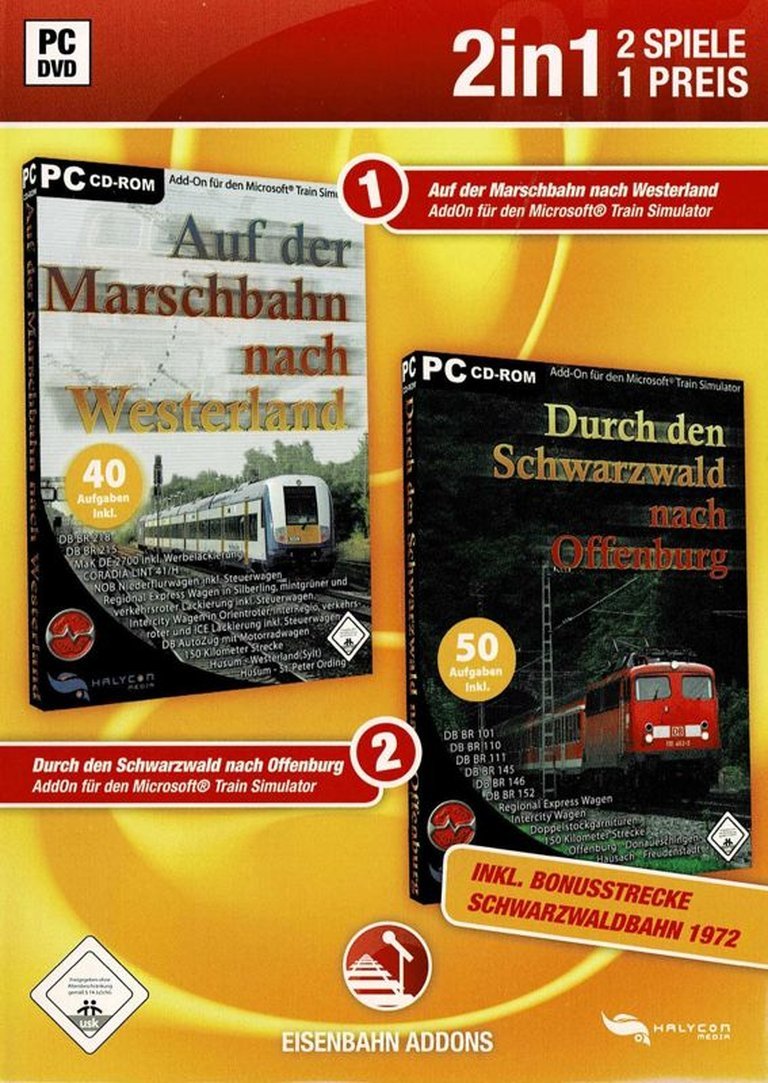
This 2008 compilation for Microsoft Train Simulator combines two meticulously detailed German rail routes: the flat Marschbahn in Schleswig-Holstein running from Husum to Niebüll and St. Peter-Ording, and the challenging Schwarzwaldbahn through the Black Forest connecting Offenburg to Donaueschingen and Hausach to Freudenstadt. Players navigate over 250 kilometers of tracks with historically accurate locomotives, rolling stock, and over 90 tasks, including a bonus 1970s version of the Black Forest route featuring vintage Deutsche Bundesbahn aesthetics, steam/diesel engines, and period infrastructure like form signals and manual crossings.
2in1: Auf der Marschbahn nach Westerland / Durch den Schwarzwald nach Offenburg Reviews & Reception
amazon.de (80/100): Spitzenrezensionen aus Deutschland Es gab ein Problem beim Filtern der Rezensionen. Bitte lade die Seite neu.
3dzug.de : Ich habe das Produkt installiert mir wird es aber nicht im Spiel angezeigt kann mir jemand helfen?
2in1: Auf der Marschbahn nach Westerland / Durch den Schwarzwald nach Offenburg: Review
Introduction
In an era dominated by high-budget, graphically intensive simulations, 2in1: Auf der Marschbahn nach Westerland / Durch den Schwarzwald nach Offenburg (2008) stands as a testament to the enduring appeal of niche, meticulously crafted content. This compilation from Halycon Media bundles two major add-ons for Microsoft Train Simulator (MSTS), offering a dual journey across Germany’s most iconic landscapes: the flat, windswept Marschbahn in Schleswig-Holstein and the rugged, engineering-defiant Schwarzwaldbahn. While lacking traditional narrative, the game’s profound strength lies in its hyper-realistic recreation of two contrasting German rail experiences, elevated by a unique historical bonus mode. This review posits that the package represents a pinnacle of route simulation for MSTS—a labor of love that transcends technical limitations to deliver unparalleled immersion for enthusiasts, despite its aging underpinnings.
Development History & Context
Developed by Halycon Media GmbH & Co. KG, this compilation emerged from Germany’s robust tradition of train simulation modding. By 2008, Microsoft Train Simulator (released in 2001) was technologically dated, yet its open architecture allowed dedicated developers to expand its horizons. Halycon’s vision was ambitious: to create an “ultimate double pack” that showcased Germany’s rail diversity. The Marschbahn (2006) and Schwarzwald (2007) routes were initially separate releases, each receiving version 1.1 updates before being bundled. Technically, the team navigated MSTS’ constraints—such as texture limitations and rigid track-editing tools—by leveraging community-driven solutions like the DBTracks upgrade. The gaming landscape of 2008 saw MSTS coexisting with newer simulators like Rail Simulator, but this package’s niche focus on German authenticity carved a loyal following. Halycon’s commitment is evident in the inclusion of the 1972 Schwarzwaldbahn bonus mode, a deep facelift requiring extensive research into period-specific infrastructure (form signals, pre-electrification track layouts, and DB-era liveries). This dedication preserved the game’s legacy as a historical artifact, predating modern simulators’ hyper-realism.
Narrative & Thematic Deep Dive
Though not story-driven, the game’s routes weave implicit narratives of geography, history, and human ingenuity. The Marschbahn (Husum–Niebüll/St. Peter Ording) embodies northern German maritime life. Players traverse the Marsch’s reclaimed land, dykes, and the iconic Hindenburg Damm, ferrying tourists to Sylt or hauling freight through Friesian farmlands. The absence of roads to Sylt adds thematic weight, emphasizing rail as the island’s lifeline. Activities include managing tourist-packed RE trains or the SyltShuttle auto train, mirroring real-world logistical challenges.
The Schwarzwaldbahn (Offenburg–Donaueschingen/Hausach–Freudenstadt) tells a different tale of conquest—over terrain. Kehrtunnels, steep gradients, and dense forests frame this route as a testament to 19th-century engineering. Activities here involve navigating tight schedules through mountain passes, with freight trains hauling timber or regional services stopping at picturesque stations like Triberg. The 1972 bonus mode deepens this narrative, transporting players to an era of V200 diesel locomotives, steam-era signals, and pre-Bundesreform infrastructure. Bahnhofs like Niederwasser evoke nostalgia for a time when Bonn was the capital, and Elvis Presley’s music blared from radios. This mode isn’t mere gimmickry; it’s a temporal capsule celebrating Germany’s rail evolution, where form signals and manual crossings evoke a slower, more tactile past.
Gameplay Mechanics & Systems
Core gameplay revolves around operating trains across two distinct systems, with MSTS’ familiar interface serving as the foundation.
-
Route Selection & Activities:
The Marschbahn (100km) and Schwarzwaldbahn (150km) each offer ~40–50 activities, ranging from simple point-to-point runs to complex timetables. Schwarzwald’s inclines demand precise throttle control, while Marschbahn’s coastal routes test adherence to tight passenger schedules. The 1972 Schwarzwaldbahn mode adds period-specific challenges, like managing non-electrified track and vintage rolling stock. -
Rolling Stock & Realism:
An exhaustive roster authenticates German rail history. Marschbahn features DB Class 218 diesels, the NOB’s Lint 41/H railbuses, and the SyltShuttle auto train. Schwarzwald includes BR 101 electrics, Class 294 freight locomotives, and the V200 diesel. The 1972 bonus adds the iconic V220 (later BR 220). Wagons include IC/IR coaches, n-Wagen, and even period-specific “Silberlinge.” Each vehicle’s physics and sounds (whistles, engine hums) reflect real-world behavior, though MSTS’ aging audio limits dynamism. -
Innovations & Limitations:
The DBTracks upgrade for Marschbahn replaces generic track with hyper-detailed DB-standard rails, enhancing realism. However, MSTS’ core flaws persist: clunky controls, polygon-limited scenery, and reliance on third-party tools like Trainstore to manage memory. Night driving for Schwarzwald is atmospheric but suffers from overly bright headlight textures. Activities lack dynamic events, focusing instead on adherence to timetables—a trade-off for authenticity over arcade thrills.
World-Building, Art & Sound
The game excels in recreating Germany’s microclimates and micro-cultures.
-
Marschbahn:
The route is a masterclass in environmental storytelling. Friesian-style station buildings, wind turbines dotting the Geest, and drainage ditches evoke the region’s struggle against the sea. Photorealistic textures depict reed-thatched cottages, thatched platforms, and the Wadden Sea’s mudflats. The Hindenburg Damm’s journey is framed by endless sky and sea, emphasizing isolation. -
Schwarzwaldbahn:
Dense pine forests, exposed rock faces, and tunnel portals create claustrophobic tension. The 1972 mode’s gravel roads, manual crossings, and pre-war signals transport players to a pre-modern Black Forest. Stations like Hausach feature period-specific signage, while the absence of catenaries pre-electrification adds authenticity. -
Visuals & Sound:
For 2008, the graphics were groundbreaking—detailed textures, dynamic lighting (especially in Schwarzwald’s night mode), and objects like switch signals and road signs. However, polygon counts and draw distances feel dated today. Sound design is functional but limited; diesel clanks and brake squeaks loop predictably, lacking the layered audio of modern sims. Yet, the ambience—the crunch of gravel under wheels in 1972 mode or the wind on the Marschbahn—compensates through atmospheric immersion.
Reception & Legacy
At launch, the compilation garnered acclaim for its value and depth. Amazon.de reviews averaged 4.0/5 stars, with praise for the “cinematic” graphics and “fat slice” of realism compared to other add-ons. Stefan Adamczewski noted: “Kleinheiten wie Straßenschilder, Felder, Weichensignale lassen die Fahrten realistischer rüber kommen” (Small details like road signs, fields, switch signals make the driving feel more realistic). The 1972 bonus was lauded as a unique time capsule. However, criticism centered on technical hurdles: installation issues (e.g., slow DVD scans) and dependency on MSTS’ aging engine. User “Klopfer” lamented: “nicht ausgereift, support mangelhaft” (not mature, support lacking).
Long-term, the game’s reputation solidified among MSTS purists. It remains a benchmark for German route simulation, influencing later titles like ProTrain series by emphasizing historical accuracy over graphical flair. The Black Forest route’s Kehrtunnels and Marschbahn’s coastal vistas are still celebrated for their authenticity. Its legacy lies in preserving Germany’s rail heritage digitally—a niche but vital role in simulation history. Today, it endures as a beloved artifact, with eBay listings fetching premium prices for “gut” (good) condition copies, underscoring its cult status.
Conclusion
2in1: Auf der Marschbahn nach Westerland / Durch den Schwarzwald nach Offenburg is a paradox: technically dated yet transcendentally immersive. As a compilation, it delivers unmatched value, bundling two meticulously researched routes and a revolutionary historical bonus mode. While MSTS’ limitations constrain its modern appeal, Halycon’s devotion to detail—from the DBTracks upgrade to the V220’s 1972 liveries—elevates it above mere simulation. The game’s strength lies not in narrative or graphics, but in its ability to transport players through time and terrain. For enthusiasts, it remains an essential slice of German rail history—a testament to simulation’s power to preserve and celebrate real-world infrastructure. In an age of glossy, homogenized games, this compilation stands as a poignant reminder of authenticity’s enduring charm. Verdict: A masterclass in niche simulation, flawed yet unforgettable.