
- Release Year: 1998
- Platforms: Windows
- Publisher: Interactive Magic, Inc.
- Developer: Erudite Software
- Genre: Strategy, Tactics
- Perspective: Top-down
- Game Mode: Online PVP, Single-player
- Gameplay: Turn-based tactics, Wargame
- Setting: Classical antiquity, Historical events
- Average Score: 72/100
Description
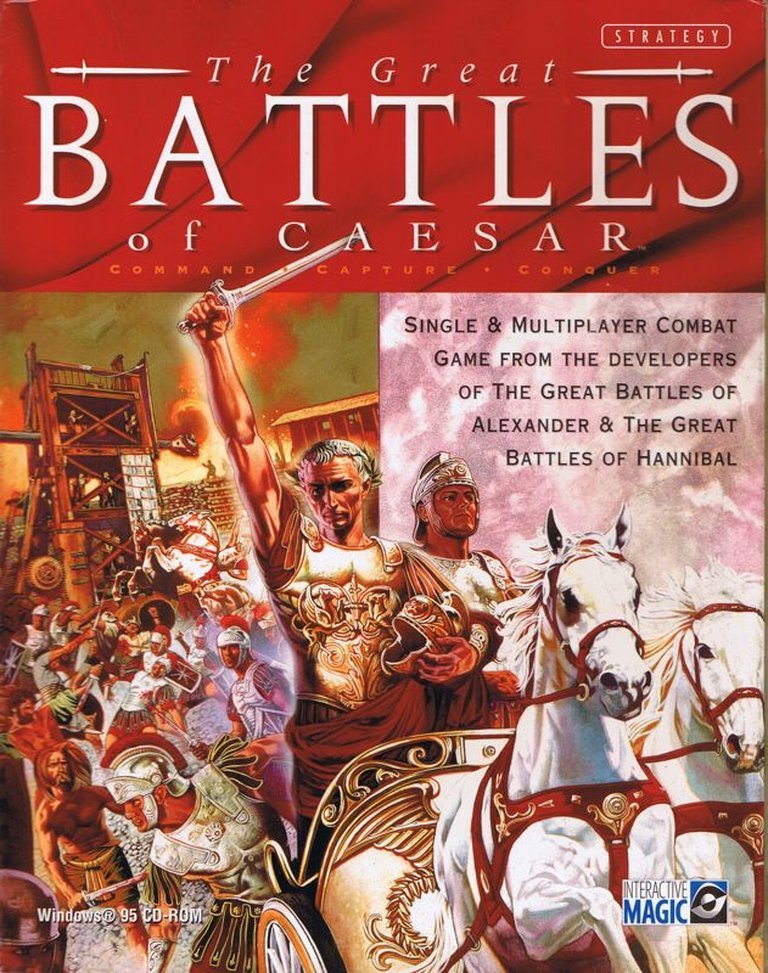
The Great Battles of Caesar is a turn-based strategy wargame that immerses players in the military conflicts of classical antiquity. As an installment in The Great Battles series, the game allows players to command armies across nine of Julius Caesar’s most famous historical engagements, including Bibracte, Pharsalus, and Thapsus. Utilizing mechanics reminiscent of tabletop wargaming, players must carefully issue tactical orders to their generals to maneuver troops, manage morale, and break the enemy’s rout level in either standalone battles or a grand campaign focused on winning the Roman Civil War.
The Great Battles of Caesar Free Download
The Great Battles of Caesar Patches & Updates
The Great Battles of Caesar Mods
The Great Battles of Caesar: Review
Introduction
In the golden age of 1990s PC wargaming, few series commanded as much reverence among history buffs and tactical purists as The Great Battles. As the third and final installment in Erudite Software’s magnum opus for Interactive Magic, The Great Battles of Caesar (1998) stands as a monument to meticulous historical simulation, chronicling nine pivotal conflicts in Julius Caesar’s meteoric rise and Rome’s civil war. From the frozen fields of Vercellae to the sun-scorched sands of Thapsus, this game transforms ancient warfare into a chess match of unprecedented depth. Yet, while it earned critical acclaim as Computer Gaming World’s runner-up for 1998’s Best Wargame—and remains the definitive digital recreation of Marian legion tactics—it is also a product of its time, burdened by technological limitations that challenge modern players. This review dissects Caesar’s legacy as both a triumph of historical authenticity and a relic of an era where complexity often superseded accessibility, arguing that its flaws ultimately underscore its unique place in wargaming history.
Development History & Context
The Great Battles of Caesar emerged from a collaboration steeped in both ambition and industry pragmatism. Developer Erudite Software, fresh from adapting GMT Games’ acclaimed board series to PC (having released Alexander in 1997 and Hannibal later that year), refined its proprietary “mechanical” engine for this 1998 finale. The project was announced alongside its predecessors in early 1997, with Interactive Magic strategically positioning the trilogy as a cohesive historical arc. S. Craig Taylor, a veteran wargame designer, served as producer, ensuring adherence to GMT Games’ rigorous standards for historical accuracy. Technologically, the game operated within the constraints of late-1990s Windows CD-ROMs, leveraging an updated engine that introduced 3D rotation and hex-based topography—advancements that reviewers noted yet criticized for sluggish performance on systems slower than a Pentium 166. The gaming landscape of 1998 was a paradoxical one: while titles like Age of Empires dominated mainstream strategy, niche wargaming sought deeper fidelity. Caesar, therefore, occupied a precarious niche—praised by historians and hardcore tacticians but overshadowed by faster-paced rivals. Interactive Magic’s abrupt decision to cease the series post-Caesar (announced in January 1998) cemented its status as a swan song, though the engine’s reuse for North vs. South (1999) hinted at its technical viability beyond antiquity.
Narrative & Thematic Deep Dive
As a historical simulation, Caesar eschews traditional narrative for a tapestry of authentic military campaigns. Its “story” is woven through nine meticulously recreated battles—Vercellae, Chaeronea, Bibracte, Sabis, Dyrrachium, Pharsalus, Ruspina, Thapsus, and Munda—each serving as a vignette in Caesar’s conquests and civil war against Pompey. The campaign mode frames these engagements as chapters in a larger saga, requiring players to secure strategic victories to overcome Pompey’s legions. Characters here are archetypes rather than fleshed personas: Caesar himself symbolizes tactical brilliance and relentless ambition, while Pompey embodies the fading Republican ideal. Dialogue is absent, replaced by historical context in the manual and pre-battle briefings, where the weight of Rome’s transformation from Republic to Empire looms large. Thematically, the game excavates the “Marian reforms,” reflecting how Rome’s military evolved from flexible manipular legions (hastati, principes, triarii) into the standardized Marian cohorts—a shift mirrored in gameplay through simplified unit hierarchies but emphasized via chain-of-command mechanics. Underlying tensions permeate every hex: the clash between disciplined Roman engineering and “barbarian” chaos, the calculus of generalship versus the fog of war, and the tragic inevitability of civil conflict. These themes resonate beyond antiquity, framing Caesar as a meditation on power, legacy, and the brutal mathematics of empire.
Gameplay Mechanics & Systems
Caesar’s gameplay is a masterclass in turn-based tactical depth, albeit one demanding significant investment. Battles unfold on hexagonal maps with 3D-rotatable perspectives, each turn comprising multiple “rounds” where generals issue orders based on their leadership rating—a system that forces players to weigh aggression against restraint. The core loop revolves around manipulating three key elements:
– Unit Management: Units are grouped into legions, replacing the manipular system of earlier titles. Cohorts, Numidian archers, and Germanic barbarian cavalry introduce asymmetrical challenges, each with unique stats and roles. Fortification and siege mechanics add strategic layers, allowing players to entrench positions or storm ramparts.
– Command & Control: The game’s signature innovation is its “leader proximity” system. Units can only activate within a general’s command radius, and each general’s order limit per turn dictates battlefield tempo. This brilliantly simulates the chaos of pre-modern warfare, where a single routed officer could unravel a flank.
– Victory Conditions: Rout levels replace attritional combat, with battles ending when one side’s morale collapses to zero—a nod to historical battles where disintegration often proved deadlier than slaughter.
Modes include standalone skirmishes, a Civil War campaign, and (in the Collector’s Edition) a scenario editor for hypothetical battles. Multiplayer supports two players via modem or null-modem cable, enabling cooperative or adversarial command of historical armies. The UI, praised as “elegant” by critics like Electric Games, centralizes orders, terrain, and morale tracking but suffers from dated icons and a steep learning curve. Performance woes, particularly on slower systems, marred the experience, with PC Joker noting that scrolling and unit selection felt “unacceptably sluggish.” These eccentricities—slow pacing, complex systems, and unforguing difficulty—define Caesar as a wargame for connoisseurs, not casuals.
World-Building, Art & Sound
Erudite Software crafted Caesar’s world through obsessive historical fidelity rather than spectacle. The battlefields—Gaulish forests, Greek plains, African deserts—are reconstructed from primary sources, with terrain elevation, weather, and vegetation influencing tactics. Units, while not photorealistic, are rendered in distinct, historically inspired silhouettes: Roman legionaries in segmented armor, Gallic warriors in horned helmets, and Numidian horsemen with feathered javelins. The art direction, subtly improved over Hannibal, evokes Roman mosaics and frescoes, with a muted color palette of ochre, slate, and rust that critics like Power Play lauded as “reminiscent of original Roman depictions.” Yet for all its authenticity, the visuals feel dated; as GameStar lamented, “grafik und sound hätten schon zu Caesarszeiten nicht viel hergemacht.” Sound design is minimalistic—clanging steel, distant war cries, and sparse environmental audio—intended to underscore tension rather than impress. The absence of a dynamic soundtrack amplifies the game’s somber tone, turning each clash into a stark auditory tableau. Together, art and sound forge an atmosphere of scholarly immersion, where the weight of history overshows technical limitations.
Reception & Legacy
Upon release, Caesar polarized audiences, embodying the wargaming niche’s triumphs and tribulations. Critics lauded its depth: Computer Gaming World awarded it 80%, hailing it as “the best ancients-era game yet on the PC” and “the most realistic” recreation of Roman warfare. Electric Games (90%) and Gambler (81%) similarly praised its refined mechanics and AI, while Game Express (79%) highlighted the “authentic” battlefields. Yet German outlets like GameStar (52%) and PC Player (58%) lambasted it as a “müder aufguß” (stale rehash) of Hannibal, criticizing its pacing and antiquated graphics. Commercially, figures were scarce, but the series’ “relative success” (per GameSpot) and the 1998 release of The Great Battles: Collector’s Edition—which bundled Caesar with updated versions of its predecessors—sustained its footprint. Awards underscoreed its niche prestige: CGW’s runner-up for Best Wargame and the Charles Roberts Award for “Best Pre-Twentieth Century Computer Wargame.” In retrospect, Caesar’s legacy is twofold. It remains a benchmark for ancient tactical simulation, cited for its influence on later games like Imperivm III: The Great Battles of Rome. Yet it also epitomizes the era’s wargaming challenges—slow, complex, and visually compromised—leading to its cult status among historians and its obscurity among mainstream players. Its engine’s reuse for North vs. South (1999) proved its adaptability, but Caesar itself endures as a historical artifact: a flawed masterpiece that wargamers revisit not for spectacle, but for its unyielding commitment to the past.
Conclusion
The Great Battles of Caesar is a paradox: a game that both transcends and is defined by its time. As the culmination of a trilogy, it refines the series’ core tenets—historical accuracy, tactical depth, and command-driven simulation—into a potent albeit demanding experience. Its greatest strengths lie in its unflinching recreation of Roman warfare, from the Marian reforms’ impact on legion structure to the psychological fragility of ancient armies. Yet these strengths are counterbalanced by technological constraints: sluggish performance, dated visuals, and a learning curve that borders on punitive. For contemporary players, Caesar may feel like a relic—a museum piece of wargaming’s analog roots. For historians and tacticians, however, it remains an invaluable tool, a digital time capsule where every hex and rout roll whispers of Caesar’s Gauls and Pompey’s legions. Its legacy is thus etched not in commercial triumph but in reverence: a footnote in mainstream history, but a cornerstone in the annals of hardcore wargaming. In an age of instant gratification, Caesar demands patience—and rewards it with a depth few games have dared to replicate. For all its flaws, it stands as a testament to a bygone era when passion for the past outweighed the pursuit of profit. Verdict: An essential, if flawed, monument to historical gaming—best appreciated by those willing to fight its battles, not just win them.