
- Release Year: 1997
- Platforms: Windows
- Publisher: Microsoft Corporation
- Developer: Terminal Reality, Inc.
- Genre: Driving, Racing
- Perspective: 1st-person
- Game Mode: Online PVP
- Gameplay: Automobile, Track racing, Vehicle simulator
- Setting: Sports
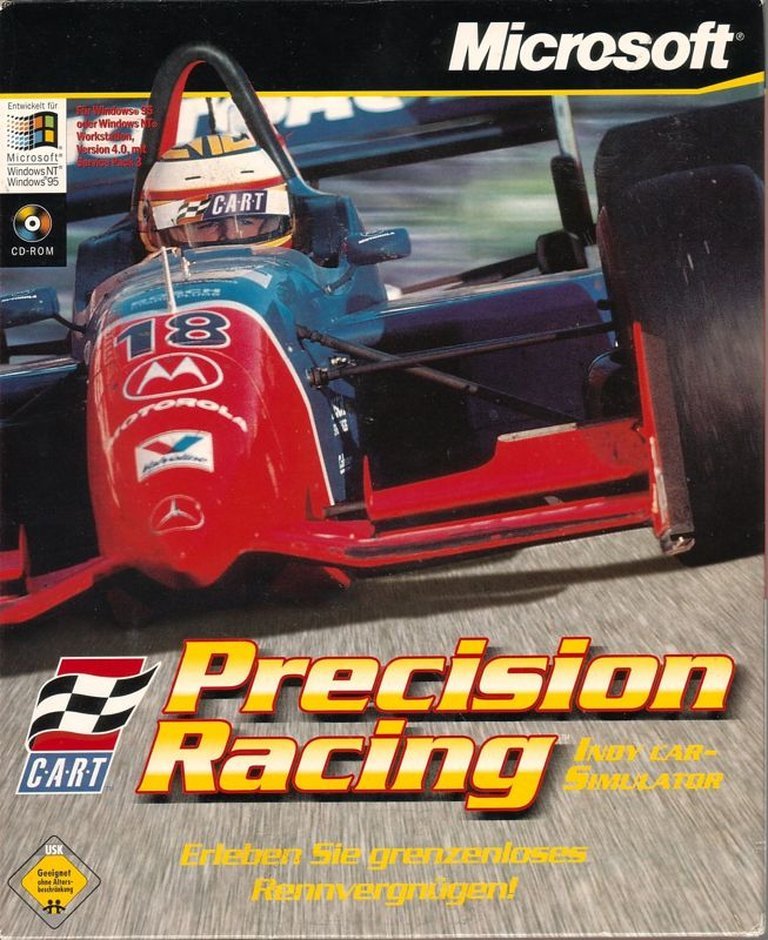
Description
CART Precision Racing is a licensed racing simulator based on the American Championship Auto Racing Teams (CART) series, featuring diverse track types including road, street, and oval circuits. Developed by Terminal Reality and published by Microsoft in 1997, the game offers highly realistic driving experiences with photo-realistic cockpits, panning views, and a virtual mechanic to optimize car setups. Players can race offline or compete with up to eight players online, praised for its detailed physics and immersive sense of speed.
Gameplay Videos
CART Precision Racing Free Download
CART Precision Racing Patches & Updates
CART Precision Racing Reviews & Reception
oldpcgaming.net : Terminal Reality has found a good balance between hardcore realism and fun.
CART Precision Racing Cheats & Codes
PC
Press or type codes during gameplay.
| Code | Effect |
|---|---|
| ec | Toggle speedometer units |
| v | Change camera position |
| x | No damage |
| car | Drive yellow pit car |
| noflag | No flags |
| frame | View frame rate |
| bravo | Super wheels |
| head | Remove driver’s helmet |
| r | Rotating map |
| M | Bring up map view |
CART Precision Racing: A Landmark in Simulation Racing
Introduction
In the annals of racing simulation history, few titles captured both the technical complexity and visceral thrill of open-wheel racing quite like CART Precision Racing. Released in December 1997 by Microsoft and developed by Terminal Reality, this game arrived at a pivotal moment for PC gaming. With the genre dominated by Papyrus’ IndyCar series, Microsoft’s ambitious debut challenged conventions by merging licensed authenticity with unprecedented depth. While not without its flaws, CART remains a towering achievement that pushed hardware limits and redefined player expectations. This review deconstructs its legacy, dissecting how a game developed by creators of Monster Truck Madness crafted a meticulous, pulse-pounding ode to Champ Car racing that still resonates among purists.
Development History & Context
A New Challenger for the Papyrus Throne
Terminal Reality, fresh off the success of the arcade-inspired Monster Truck Madness, pivoted toward meticulous simulation with CART. Under producers Mark Randel and Greg Seehusen, the team collaborated with real CART drivers and engineers to ensure authenticity—a radical departure from their prior work. The game was showcased at E3 1997, signaling Microsoft’s bold entry into the hardcore racing space. Technologically, it operated within the constraints of late-1990s PCs: Pentium 60 MHz CPUs, 16MB RAM, and SVGA graphics. Notably, it eschewed 3Dfx Voodoo support, a decision that would draw criticism as competitors embraced hardware acceleration. The gaming landscape was fiercely contested; Papyrus’ IndyCar Racing series set the gold standard, while European players gravitated toward Formula 1 titles. CART Precision Racing carved its niche by focusing on the underrepresented American open-wheel circuit, offering 17 tracks—including iconic ovals like Indianapolis and road courses like Laguna Seca—that were alien to many global gamers.
Narrative & Thematic Deep Dive
The Drama of the Track as Narrative
Devoid of traditional plot or characters, CART’s “narrative” is forged in the crucible of competition. The game’s core theme is the relentless pursuit of perfection through precision. Every lap is a story of calculated risk and mechanical mastery, where the player’s skill against AI rivals or human opponents creates emergent drama. Dialogue is sparse but purposeful: the “virtual mechanic” offers spoken telemetry advice during setup sessions, translating complex engineering into accessible guidance. This voice acts as a mentor, reinforcing the game’s reverence for technical knowledge. The underlying themes celebrate the marriage of human intuition and machine—a reverence for the driver’s craft that elevated CART beyond mere entertainment into a digital homage to motorsport’s intellectual rigor.
Gameplay Mechanics & Systems
Engineering a Racing Revolution
Precision Racing’s gameplay revolves around two interconnected loops: on-track racing and pre-race engineering. The physics engine simulated nuanced behaviors like turbo lag, tire grip degradation, and downforce effects, demanding realistic driving styles. Its standout innovation was the telemetry module, which synchronized replays with graphs for post-race analysis. Though lauded for setup guidance, it lacked critical data like ride height or tire temperatures—a flaw acknowledged by reviewers. The virtual mechanic provided spoken advice, helping novices tune gear ratios and wing angles without drowning them in jargon.
Depth vs. Accessibility
– Setup Customization: Over 200 adjustable parameters (e.g., camber, toe-in) allowed granular control but intimidated newcomers.
– Damage Model: Simplified for online multiplayer (cars “bounced” off walls), prioritizing race continuity over realism.
– Multiplayer: Supported 2-8 players via internet play, a rarity in 1997. Low-latency races offered unmatched competitive thrills, though AI opponents were criticized for erratic pathfinding.
– Flaws: Bugs included phantom downshifts, wheels spinning in neutral, and unbalanced car speeds. The manual’s thinness compounded issues, leaving players to navigate cryptic menus.
World-Building, Art & Sound
The Theater of Speed
Precision Racing recreated the vibrant ecosystem of the CART series with meticulous attention to detail. World-building manifested in licensed drivers, teams (Penske, Newman-Haas), and sponsors like Marlboro, immersing players in a sanctioned championship atmosphere. Tracks featured accurate elevation changes and surface textures, from the brick dust of Indianapolis to the corkscrew at Laguna Seca.
Visual Design
– Cockpit View: A signature innovation, it featured photo-realistic LCD displays showing RPM, speed, and gear. The panning camera allowed drivers to preview corners, a feature praised for enhancing immersion.
– Graphics: While lauded for its sense of speed and dynamic lighting (Adrenaline Vault noted “breathtaking” visuals), it couldn’t match the polish of Ubisoft’s F1 Racing Simulation. Critics cited angular car models and inconsistent textures.
Sound Design
Kyle Richards’ soundtrack blended orchestral tension with electronic beats, but it was the engine and tire sounds that defined the experience. The turbocharged V8s roared with authentic ferocity, while tire squeals and skids conveyed weight and traction. This auditory realism made players “feel” the 200+ mph speeds, creating what Computer Gaming World called “edge-of-your-seat excitement.”
Reception & Legacy
Critical Acclaim and Lingering Flaws
At launch, CART Precision Racing was met with near-universal praise, earning an 83% average on MobyGames. Computer Gaming World awarded it a perfect 100%, declaring it “the best game of its type ever produced.” The Adrenaline Vault (90%) emphasized its “breathtaking sense of speed,” while German magazine PC Games (87%) hailed its “competent physics.” However, criticisms were pointed: GamePro cited “quirky controls” and sound card compatibility issues, while GameStar (67%) lamented the AI’s intelligence. Commercially, it secured Computer Gaming World’s 1997 “Sports Game of the Year,” tying with Baseball Mogul.
Enduring Influence
Precision Racing’s legacy lies in its technological ambition. It proved simulations could thrive without 3Dfx acceleration, prioritizing depth over flash. Its telemetry and virtual mechanic set precedents for future titles like iRacing. While Papyrus retained its crown, CART expanded the genre’s scope, proving there was demand for American open-wheel sims. Terminal Reality’s patches mitigated many launch flaws, and its online multiplayer became a template for competitive racing. Today, it’s revered as a cult classic—a testament to how its blend of realism and accessibility bridged arcade and simulation divides.
Conclusion
A Flawed but Foundational Masterpiece
CART Precision Racing stands as a paradox: a game both ahead of its time and constrained by its era. Its physics and telemetry redefined simulation depth, while its licensed authenticity offered a unique glimpse into the CART world. Yet, nagging bugs and AI issues prevented it from displacing Papyrus, leaving it as a brilliant runner-up in the simulation race. What endures, however, is its unwavering commitment to the craft of racing—the way it made every setup tweak and braking point feel like a conversation with the machine. For historians, it’s a vital artifact of PC gaming’s golden age; for players, it remains a thrilling challenge. In the end, CART Precision Racing didn’t just simulate racing—it captured its soul.