
- Release Year: 2010
- Platforms: Windows
- Publisher: Nitro Games Ltd., Paradox Interactive AB
- Developer: Nitro Games Ltd.
- Genre: Action
- Perspective: Top-down
- Game Mode: Single-player
- Gameplay: Boss battles, Naval combat, Power-ups, Shooter, Tower defense
- Setting: Sea pirates, Zombies
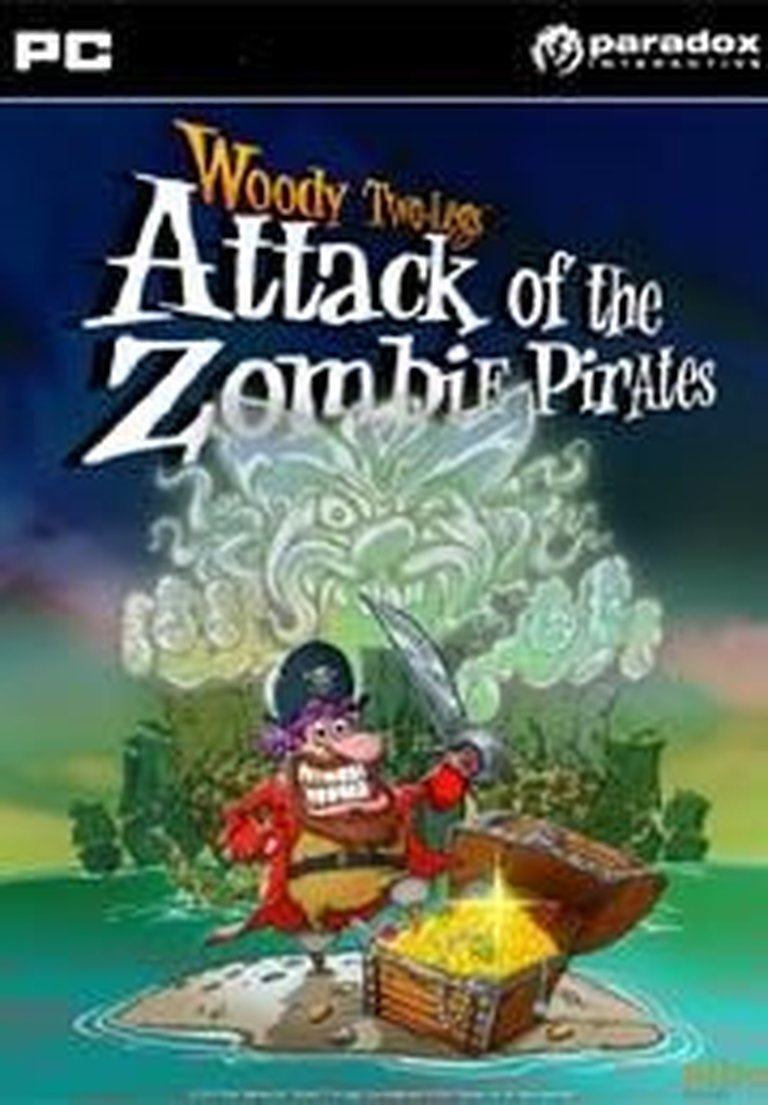
Description
Woody Two-Legs: Attack of the Zombie Pirates casts players as the infamous pirate Woody, who must defend a cursed treasure on a remote island from waves of undead pirates led by Mr. Jones. Set in a top-down naval shooter, players steer Woody’s ship, fire cannons at approaching enemy vessels, and prevent them from stealing the loot through strategic combat and power-up collection. The game features wave-based missions, escalating difficulty, superweapons, and an online leaderboard.
Gameplay Videos
Where to Buy Woody Two-Legs: Attack of the Zombie Pirates
PC
Woody Two-Legs: Attack of the Zombie Pirates Guides & Walkthroughs
Woody Two-Legs: Attack of the Zombie Pirates Reviews & Reception
gamesreviews2010.com : Woody Two-Legs: Attack of the Zombie Pirates is a casual score-chasing arcade shooter that offers players a swashbuckling good time.
Woody Two-Legs: Attack of the Zombie Pirates: Review
Introduction
In the bustling sea of 2010’s digital distribution, few games set sail with as much charming audacity as Woody Two-Legs: Attack of the Zombie Pirates. A top-down arcade shooter from Finnish developer Nitro Games—best known for their naval real-time strategy titles—this budget-priced gem ($4.99) emerged on Steam with a singular, delightful proposition: defend a treasure-laden island from zombie pirates. Armed with cannons and an arsenal of absurd power-ups, players guide Woody, the “least infamous pirate,” against his undead nemesis, Mr. Jones. While it may not chart unexplored waters, Woody Two-Legs delivers a formula of accessible chaos and swashbuckling humor that, much like its protagonist, punches above its weight. This review argues that the game succeeds not through innovation, but through masterful execution of its core loop, transforming a simple premise into an addictively replayable experience defined by its vibrant personality and razor-sharp focus.
Development History & Context
The Studio’s Vision
Nitro Games, founded in 2001 and renowned for the East India Company and Pirates of Black Cove series, approached Woody Two-Legs with a clear mandate: distill the essence of arcade shooters into a pirate-themed package. Lead Designer Kim Soares emphasized accessibility, aiming for a game that “anyone could pick up and play.” This vision was rooted in the burgeoning casual market of 2010, where digital storefronts like Steam democratized distribution, allowing niche titles like this to thrive at budget price points. The studio collaborated with Paradox Interactive for publishing, leveraging their expertise in strategy games to broaden the audience, though Woody Two-Legs diverged sharply into pure arcade action.
Technological Constraints & Execution
Built on the Blitz3D engine—a choice that constrained visuals but enabled smooth performance on modest hardware—the game ran efficiently on systems as low as a 2.0 GHz Core Duo with 2GB RAM and a 256MB NVIDIA 7800 GPU. This technical pragmatism ensured broad accessibility, critical for a game targeting casual players. The top-down perspective, described as “almost top-down,” balanced visibility with engagement, allowing players to navigate the chaotic naval battles without losing sight of the treasure. Nitro Games’ naval expertise shines in the ship physics: Woody’s vessel steers with satisfying agility, while cannon fire from both port and starboard sides adds strategic depth. The engine limitations, however, are evident in the 2D sprite-based enemies and static island environments, which prioritize gameplay fidelity over graphical spectacle.
The 2010 Gaming Landscape
Released on November 2, 2010, Woody Two-Legs sailed into a post-Call of Duty: Modern Warfare 2 and pre-Minecraft era dominated by blockbusters. Yet, it found its niche in the indie resurgence, where titles like Super Meat Boy proved that charm and mechanics could trump production value. Its Steam debut coincided with the platform’s growing legitimacy, and its $4.99 price point positioned it as an impulse buy. The game capitalized on enduring tropes—pirates, zombies, and wave-based defense—yet distinguished itself through humor and polish. As Mana Pool noted, its “initial difficulty” and unlockable “Hard and Nightmare modes” catered to both newcomers and veterans, a nod to the era’s rising demand for replayability.
Narrative & Thematic Deep Dive
Plot: The Treasure’s Curse
The narrative unfolds with the simplicity of a pirate shanty: Woody Two-Legs, a perpetually luckless buccaneer, stumbles upon a priceless treasure. His attempt to bury it on a remote island is thwarted when Mr. Jones, the treasure’s original (and undead) owner, dispatches his skeletal armada to reclaim it. Over five increasingly frantic missions, Woody must defend the island’s central treasure chest against waves of ghost ships, zombie galleons, and spectral corsairs. Each mission introduces new enemy archetypes—such as “crackers” (bosses) and faster skiffs—culminating in a showdown with Mr. Jones in Nightmare Mode. The plot is no epic, but it efficiently sets up a series of escalating skirmishes, turning each island into a self-contained arena of survival.
Characters & Tone
Woody embodies the lovable underdog: small in stature but tenacious in spirit. His lack of infamy, as the game repeatedly notes, humanizes him, making his triumphs against overwhelming odds feel earned. Mr. Jones, by contrast, is a one-dimensional but effective villain—his undead hordes and personal vendetta embodying themes of greed and retribution. Dialogue, sparse but impactful, leans into pirate parody with exclamations like “Avast! Me Hearties!” and “All legs on deck!” The humor is broad yet endearing, avoiding cynicism with Woody’s earnest determination. This tonal balance—zombie horror filtered through a cartoonish pirate lens—creates a whimsical atmosphere where cannonballs and ghostly moans coexist with lighthearted absurdity.
Thematic Undercurrents
Beneath the surface, the game explores themes of consequence and perseverance. Woody’s treasure is both a boon and a curse, symbolizing the dangers of unchecked ambition. The undead pirates, led by vengeful Mr. Jones, represent the inescapable past—their relentless waves mirroring the inevitability of karmic retribution. Yet, Woody’s persistence reframes this as a battle for redemption. By defending the treasure, he isn’t just hoarding gold; he’s proving his worth against a world that has underestimated him. The game’s replayability, tied to escalating difficulty, subtly reinforces this theme: each attempt is a chance to overcome past failures, turning defeat into a stepping stone toward mastery.
Gameplay Mechanics & Systems
Core Loop: The Dance of Defense
At its heart, Woody Two-Legs is a masterclass in streamlined design. Players control a nimble pirate ship from a top-down view, tasked with repelling waves of enemies converging on a treasure-laden island. The core loop revolves around three actions: steering Woody’s vessel to intercept attackers, firing cannons from both sides to destroy enemy ships, and maneuvering to collect power-ups. Enemy vessels approach from all cardinal directions, attempting to dock at the island and steal treasure. If they succeed, a “treasure meter” depletes; the game ends when the meter empties. This creates a constant tension between offense (destroying enemies) and defense (protecting the island), demanding spatial awareness and prioritization.
Combat & Progression
Combat is deceptively simple. Cannons fire unlimited cannonballs but feature a reload delay, encouraging tactical positioning rather than mindless spamming. Woody’s ship respawns instantly upon destruction with infinite lives, shifting focus from survival to resource management. As enemies sink, they drop four types of boxes:
– Good Boxes: Restorative power-ups (health, speed boosts, score multipliers).
– Bad Boxes: Debuffs (slowed movement, reversed controls, increased enemy aggression).
– Random Boxes: A high-risk/high-reward mix of good and bad effects.
– Money Boxes: Contain stolen loot, incentivizing retrieval to replenish the treasure meter.
These boxes add layers of strategy, forcing players to weigh the safety of maneuvering toward benefits against the danger of exposing the island. The game’s progression is structured across five islands, each introducing new enemy variants (e.g., faster skiffs, armored galleons). After every 20 waves, a boss—like the Kraken or ghostly galleon—appears, demanding pattern recognition and sustained firepower. Unlocking “Hard” and “Nightmare” modes intensifies enemy aggression and health, extending replayability for dedicated players.
Power-Ups & Innovation
The power-up system is the game’s standout feature. Beyond standard buffs, weapon modifiers transform cannonballs into fireballs or “blue balls” (likely ice-based), while superweapons include:
– Mines/Webs: Area-denial tools to trap enemies near the island.
– Vortex: An instant-sink ability for panicked moments.
– Dolphins: Homing missiles that track targets autonomously.
These abilities are found in “Random Boxes,” turning scavenging into a gamble. The game also includes an online leaderboard, tapping into the era’s competitive spirit. While not revolutionary, these systems elevate the arcade formula. As Brash Games noted, the “addictive” nature stems from the “tearing your hair out in frustration or cheering loudly” as waves ebb and flow—a testament to the tight combat loop.
World-Building, Art & Sound
Setting & Atmosphere
The game’s world is a distilled pirate fantasy: sun-drenched islands, azure waters, and a single, massive treasure chest as the focal point. Each level’s island varies subtly—some feature rocky outcrops, others palm-fringed shores—though the ocean remains a flat, unchanging expanse. This simplicity serves gameplay, ensuring no environmental distractions from the core conflict. The undead pirates introduce gothic elements: ghost ships with tattered sails, skeletal crews, and Mr. Jones’ decaying flagship. Yet, the tone remains lighthearted, with enemies bellowing comical threats and power-ups like “freeze rays” undercutting horror with absurdity. The result is a world where pirate tropes and zombie clichés coexist in a playable caricature.
Visual Design & Art Direction
Using Blitz3D, Nitro Games crafted a vibrant, cartoonish aesthetic. Woody’s ship is a cheerful, oversized sloop with exaggerated details, while enemies range from skeletal pirate sloops to ghostly galleons with glowing green auras. The 2D sprites blend seamlessly with 3D environments, creating a cohesive, stylized look. Colors are bold and saturated—turquoise waters, golden treasure, crimson cannonfire—evoking the exaggerated palette of Saturday morning cartoons. This art style aligns perfectly with the game’s humor, making even the grimmest undead pirate feel playful. However, the engine’s limitations are apparent in static water effects and minimal environmental animation. As GamePressure observed, the graphics are “simple but aesthetically pleasing,” prioritizing clarity over immersion.
Sound Design & Audio Cues
Sound elevates the pirate atmosphere, blending traditional shanties with orchestral bombast. A jaunty, accordion-driven soundtrack plays during lulls, intensifying into percussive chaos during boss fights. Sound effects are meticulously crafted: cannonbooms echo with satisfying weight, while enemy impacts trigger splashes and wood-cracking crunches. The undead moans and creaking ship hulls add just enough menace to balance the whimsy. Voice acting is minimal—limited to Woody’s battle cries and Mr. Jones’ taunts—but delivered with theatrical flair. This audio synergy makes every encounter feel cinematic, turning routine cannonfire into a symphony of destruction. As Christ Centered Gamer noted, the game is “easy on the system requirements” but rich in auditory charm, proving that sound can compensate for graphical modesty.
Reception & Legacy
Critical Acclaim at Launch
Upon release, Woody Two-Legs garnered respectable praise, particularly for its value proposition. MobyGames aggregates an 84% average from four critics: Brash Games lauded its “addictive” nature and “£3.49” price, calling it “a very good value game.” Christ Centered Gamer (88%) praised its accessibility and “easy on the wallet” appeal, while LKI.ru (85%) highlighted the “exciting” wave-based combat. Mana Pool (74%) tempered enthusiasm by noting the “rather short” campaign but conceded its “very good value” and replayability. Common threads emerged: the game’s affordability, tight mechanics, and humor resonated, though some critics lamented its lack of depth.
Player Response & Longevity
Steam’s user reviews present a more mixed picture, with 60% positive ratings from 46 reviews. Players lauded the “simple fun” and “great for quick sessions,” but criticism centered on its brevity and repetitive nature. One Steam user noted, “It’s fun for an hour or two, but the novelty wears off.” The online leaderboard, once a competitive draw, became defunct after GameSpy’s 2014 shutdown, diminishing its replayability. On GOG and other platforms, the game remains a niche curiosity, often bundled in “pirate games” compilations. Its legacy is not one of industry influence but of cult status among fans of arcade shooters and pirate lore.
Influence & Historical Placement
Woody Two-Legs occupies a unique space in 2010’s indie landscape—a bridge between classic arcade sensibilities and modern digital distribution. It shares DNA with titles like Age of Booty (2008) but distinguishes itself through zombified enemies and absurdist power-ups. While it didn’t spawn a franchise, it demonstrated that budget games could succeed with strong mechanics and personality. Its reception mirrors the era’s broader trends: critical acknowledgment for polish, player appreciation for value, and eventual obscurity as newer titles crowded the market. Nitro Games’ subsequent focus on strategy games further cemented Woody Two-Legs as a lighthearted detour rather than a defining work.
Conclusion
Woody Two-Legs: Attack of the Zombie Pirates is a testament to the adage that execution trumps ambition. It takes a simple premise—defend an island from zombie pirates—and polishes it into an addictive, charming experience defined by its accessible gameplay, vibrant art, and infectious humor. Nitro Games’ naval expertise shines in the tight ship controls and strategic power-up system, while the Blitz3D engine ensures smooth performance across modest hardware. The game’s short campaign and limited innovation prevent it from being a classic, but its budget price point and unlockable difficulties make it a quintessential “pick-up-and-play” title for 2010’s digital storefronts.
Critics rightly celebrated its value and replayability, though players noted its repetitive nature. Its legacy endures not as a genre-redefining work, but as a beloved cult game—proof that passion and polish can elevate modest concepts. For fans of pirate themes, zombie chaos, or arcade shooters, Woody Two-Legs remains a hidden gem. As Brash Games concluded, “you can’t go wrong” at its price. In the grand tapestry of video game history, this little pirate’s tale may not be the most epic, but it is undeniably one of the most fun.