
- Release Year: 2007
- Platforms: Windows
- Publisher: Empire Interactive Europe Ltd.
- Developer: Grabit
- Genre: Compilation
- Perspective: Top-down
- Game Mode: Single-player
- Gameplay: Match-3, Puzzle, Turn-based
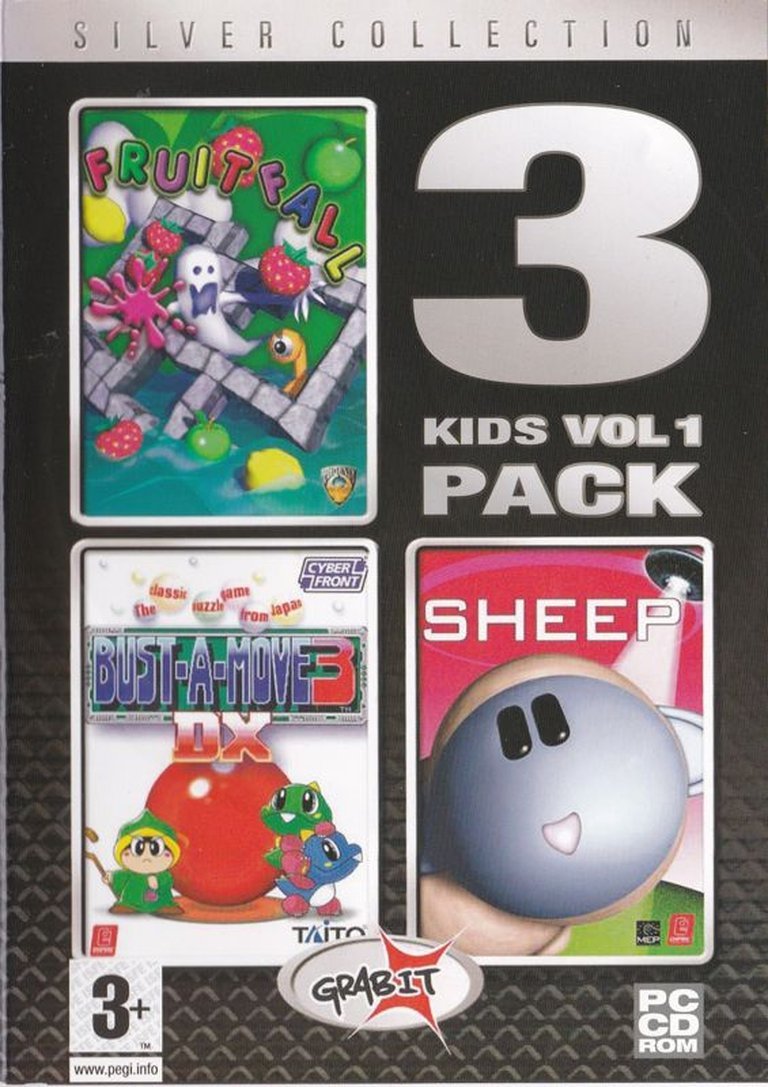
Description
Silver Collection: Kids Vol 1 Pack is a 2007 Windows compilation game featuring three family-friendly titles: Bust-A-Move 3, Fruit Fall, and Sheep. Designed with a PEGI 3 rating, it offers accessible puzzle and action gameplay experiences suitable for young players.
Silver Collection: Kids Vol 1 Pack: Review
Introduction
The year 2007 stands as a landmark in gaming history, a period defined by the triumphant arrival of masterpieces like Super Mario Galaxy and BioShock, titles that redefined creative and technical boundaries. Yet, while these AAA giants dominated headlines, a quieter, more pragmatic corner of the industry thrived: budget compilations for younger audiences. Among these, Silver Collection: Kids Vol 1 Pack—a curated bundle by Grabit and published by Empire Interactive Europe Ltd.—offers a fascinating microcosm of early-2000s casual gaming. This collection bundles three titles spanning a decade: the 1996 puzzle classic Bust-A-Move 3, the 2005 Fruit Fall, and the 2000 puzzler Sheep. While overshadowed by the era’s graphical showcase titles, this compilation represents a deliberate, if unheralded, artifact of gaming’s democratization. Its thesis lies not in innovation, but in accessibility: a curated capsule of child-friendly mechanics that prioritized fun and accessibility over spectacle in an increasingly complex industry.
Development History & Context
Grabit’s vision for Silver Collection: Kids Vol 1 Pack was deeply pragmatic. Founded during the compilation boom of the mid-2000s—a response to rising development costs—the studio aimed to repurpose proven, low-risk titles into affordable packages. The three included games were well-established: Bust-A-Move 3 (Taito, 1996) was a pillar of puzzle gaming, Fruit Fall (Midas, 2005) a modern match-three derivative, and Sheep (Ignition, 2000) a quirky action-puzzle title. Technologically, the compilation faced minimal constraints; each game ran on Windows with minimal graphical updates, leveraging their original assets to expedite production. This reflected a broader industry trend: 2007 saw the rise of casual gaming on PC and platforms like the Wii, where compilations thrived alongside digital storefronts. Yet, the landscape was dominated by consoles—the Wii’s motion controls, the PS3/Xbox 360’s HD arms race. In this context, Silver Collection felt like a relic: a Windows-centric package aimed at parents seeking safe, low-cost entertainment, even as the industry pivoted toward console-centric experiences. Its 2007 release coincided with a noted dip in Metacritic scores (as highlighted by industry analysis), suggesting consumer skepticism toward rushed or derivative content—a risk for compilations like this one.
Narrative & Thematic Deep Dive
Narrative depth is not the collection’s strength, but its thematic coherence lies in its child-centric simplicity.
– Bust-A-Move 3: Minimalist in plot, it centers on Bobble and Bub, two dinosaurs navigating a whimsical world of bubble-matching challenges. Themes revolve around playful problem-solving and achievement, with bright, non-threatening environments that reward skill without pressure.
– Fruit Fall: A pure match-three game, it eschews narrative entirely, focusing on cascading fruits and satisfying chain reactions. Its theme is tactile joy—colorful explosions of interactivity designed for instant gratification.
– Sheep: The most narrative-adjacent, it casts players as a shepherd guiding woolly flockers through obstacle courses. Themes of guidance and gentle persistence underscore its puzzles, with no dialogue beyond expressive bleats and visual cues.
Individually, these titles lack complex storytelling, but collectively they reinforce accessible themes: patience, spatial reasoning, and lighthearted engagement. There’s no unifying narrative arc, yet their shared ethos—prioritizing intuitive, non-verbal communication—creates a cohesive, child-friendly experience.
Gameplay Mechanics & Systems
The compilation’s gameplay diversity highlights its appeal, though execution varies by title.
– Bust-A-Move 3: The cornerstone of the bundle, it remains a masterclass in puzzle design. Players shoot colored bubbles to match three or more, with physics-based bounces adding strategic depth. Its modes (arcade, puzzle, versus) cater to different skill levels, and its controls—simple mouse/keyboard—are perfectly accessible. The system’s brilliance lies in escalating difficulty: early stages teach color-matching, while later stages demand precision and foresight.
– Fruit Fall: A derivative match-three, it swaps traditional grid layouts for a “gravity-drop” mechanic, where fruits fall vertically to create matches. While visually charming, its mechanics feel repetitive, lacking Bust-A-Move’s nuance. Its innovation lies in “fruit bombs” that clear large clusters, but the core loop lacks lasting engagement.
– Sheep: A unique action-puzzle, it combines pathfinding with environmental puzzles. Players use tools like trampolines and fans to guide sheep past wolves and hazards. Its systems emphasize experimentation—trial-and-error is key—but clunky controls occasionally frustrate. The “sheep AI” adds unpredictability, turning simple tasks into chaotic, humorous challenges.
The UI is uniformly simple, with large buttons and minimal menus, but the compilation lacks unified features (e.g., save states or high-score tracking across games). This fragmentation highlights its budget origins but also its focus on accessibility: each game stands alone, requiring no mastery of complex interfaces.
World-Building, Art & Sound
Visually, the collection leans into cartoonish charm, prioritizing clarity over detail.
– Bust-A-Move 3: Its 2D environments are a riot of pastels, with expressive dinosaur characters and bubbly backdrops. Art style defines mood—whimsical and inviting, with no menace to distract from puzzles.
– Fruit Fall: Vibrant fruits and bubbly sound effects create a playful atmosphere, though its static backgrounds lack dynamism.
– Sound design is uniformly upbeat: Bust-A-Move’s plinking bubbles and Sheep’s bleating sheep are iconic, while Fruit Fall’s fruit “swooshes” provide satisfying tactile feedback. None feature voice acting, relying instead on simple sound bites to guide players.
The absence of cohesive world-building is intentional—each title’s self-contained universe avoids overwhelming young players—but the consistent art direction (bright, rounded, non-threatening) creates a unified aesthetic. In an era of photorealistic violence, this visual simplicity felt refreshingly childlike, though it also dated the compilation against 2007’s graphical showcases.
Reception & Legacy
Upon release, Silver Collection: Kids Vol 1 Pack received scant critical attention, buried beneath the avalanche of 2007’s AAA titles. MobyGames lists no critic reviews, and the IMDb top games of 2007 omits it entirely—no surprise, given its niche focus. Commercial reception is undocumented, but compilations like this often thrived in bargain bins, targeting parents and budget-conscious families. Its legacy is indirect: the individual titles endured (e.g., Bust-A-Move remains a puzzle staple), but the compilation itself faded into obscurity. It reflects a pre-digital era of distribution, where physical bundles were the primary way to repurpose older games for new audiences. Compared to contemporaries like The Kids Collection (2003), it lacked a unifying hook, but its inclusion of Sheep—a cult favorite—gives it niche historical value. In retrospect, it’s a snapshot of an era where gaming’s mainstream explosion coexisted with uncompromisingly simple, accessible experiences.
Conclusion
Silver Collection: Kids Vol 1 Pack is a time capsule of a bygone era: a compilation that prioritized breadth and accessibility over innovation. While its three titles lack the narrative depth or technical prowess of 2007’s landmark releases, they exemplify the joy of uncomplicated gameplay. Bust-A-Move 3’s timeless puzzles, Fruit Fall’s casual charm, and Sheep’s quirky challenges collectively offer a glimpse into child-oriented gaming before the rise of mobile and digital storefronts. Its legacy is not in influence but in preservation—a testament to the era’s willingness to package proven, affordable fun. For modern audiences, it’s a curiosity, a reminder that gaming’s history is not solely defined by blockbusters but by the humble compilations that brought joy to bedrooms worldwide. In the pantheon of 2007, it may not have made waves, but its quiet competence ensures it remains a footnote in gaming’s democratization.