
- Release Year: 1996
- Platforms: DOS, Windows
- Publisher: Mindscape, Inc., SNEG Ltd., Strategic Simulations, Inc.
- Developer: Catware, Inc.
- Genre: Strategy, Tactics
- Perspective: Top-down
- Game Mode: LAN, Single-player
- Gameplay: Turn-based strategy
- Setting: Futuristic, Sci-fi
Description
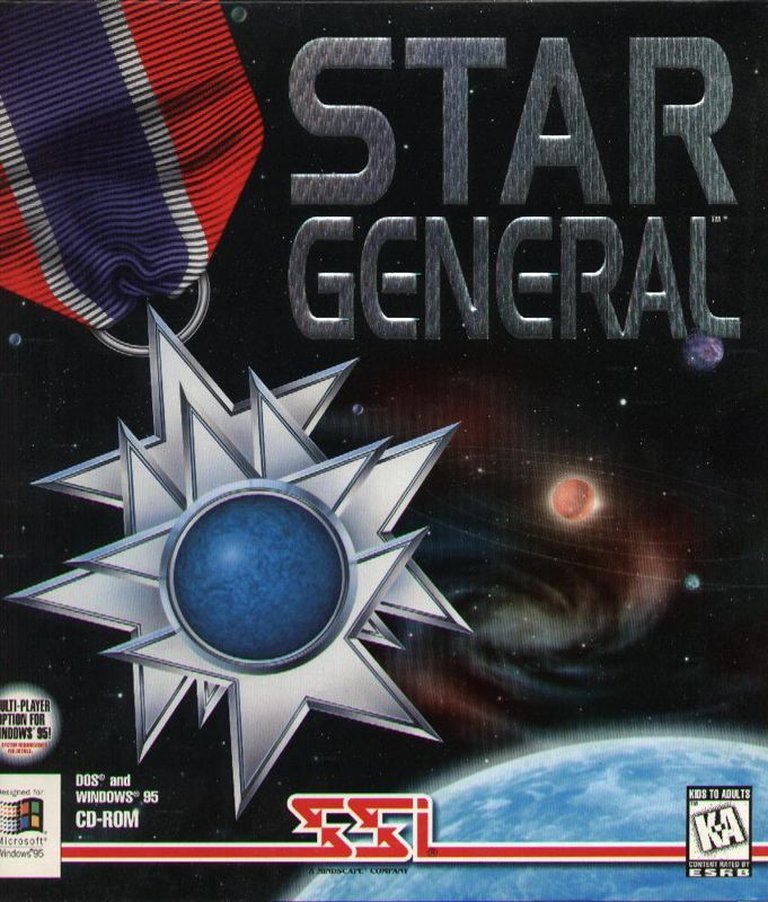
Star General is a turn-based strategy game set in a sci-fi universe where players command fleets as one of several alien races—including humans and Khalians—to conquer planets and dominate the local cluster. Drawing inspiration from Panzer General, it features space combat with ships rated in missile and beam values, alongside ground battles after planetary landings, alongside technology research, racial special units, and scalable scenarios from skirmishes to full galactic wars.
Where to Buy Star General
Star General Free Download
Star General Cracks & Fixes
Star General Patches & Updates
Star General Reviews & Reception
oldpcgaming.net : All told, Star General has a lot going for it, and it would have been even better had the AI and simplistic diplomacy been better programmed.
Star General Cheats & Codes
PC (v1.1)
Enter the key combination while in space view, then switch to any planet view and press [Enter].
| Code | Effect |
|---|---|
| Ctrl + Shift + F2 | Grants extra money. The longer the key combination is held, the more money will be generated. |
Star General: Review
Introduction
Released in December 1996 by Strategic Simulations, Inc. (SSI) and developed by Catware, Star General stands as a bold yet controversial entry in the storied “5-Star General” series, a lineage pioneered by the legendary Panzer General. Promising a grandiose leap from terrestrial battlefields to the cosmic expanse, it pitched players as galactic commanders across seven warring factions. Yet, while its predecessors like Fantasy General (1996) were celebrated for mastering accessibility and depth, Star General became a study in unfulfilled potential—a game that, despite its pedigree and innovative ideas, struggled under the weight of its own ambitions. This review dissects Star General‘s legacy, examining its development, gameplay, narrative, and reception to determine its true place in gaming history. Was it a flawed masterpiece or a cautionary tale of creative overreach?
Development History & Context
Star General emerged from the fertile ground of SSI’s late-1990s strategy boom, a period when the “General” series dominated wargaming. The project was spearheaded by Bill Fawcett, a designer with roots in military sci-fi literature, who co-authored “The Fleet” anthology series with David Drake. This literary connection was a deliberate choice; SSI licensed the Fleet universe to lend narrative authenticity to its space epic. Development was handled by Catware, a studio composed of industry veterans including programmers Matthew Fausey, Mike Isely, and David Potter, who tackled the technical challenge of adapting SSI’s proven hex-based engine to a three-dimensional galactic scale. Technologically, the game pushed late-1990s hardware: DOS and Windows versions supported 256-color graphics and CD-ROM audio, while AI programming by Frank Rinaldo aimed for opponents that could play “to death,” avoiding the artificial turn limits of earlier titles. Released alongside titans like Master of Orion II (1996) and Civilization II (1996), Star General arrived amid intense competition. SSI, riding high on Panzer General‘s commercial success, sought to replicate that formula but stretched its mechanics beyond their comfort zone. The result was a product burdened by the era’s constraints—limited memory management led to sluggish turns on large maps, and its hybrid systems never fully coalesced into a cohesive whole.
Narrative & Thematic Deep Dive
Star General‘s narrative foundation is rooted in David Drake and Bill Fawcett’s Fleet novels, a militaristic sci-fi saga of interstellar conflict. The game translates this into a galaxy-spanning war between seven distinct races: the human “The Fleet,” reptilian Dragonians, feline Hressa, insectoid Xritra, deceitful Cephalians, barbaric Khalians, and the fascist Schleinel Hegemony. Each faction possesses a unique special unit, such as the Khalians’ berserkers or the Hressa’s elite cataphracts, adding strategic flavor. However, the game delivers its story through scenario briefings and manual inserts rather than an overarching campaign. Players engage in isolated “Battles” or “Wars,” ranging from skirmishes to full galactic conquests. Thematically, Star General explores militarism and imperialism, with races vying for planets as resources. Yet the narrative lacks depth: dialogue is functional at best, and the races feel like reskinned archetypes rather than fleshed-out cultures. The Fleet license underpins the setting but remains superficially integrated, failing to evoke the series’ rich lore. This absence of a compelling story arc left players adrift, turning campaigns into abstract exercises in territorial control rather than epic sagas.
Gameplay Mechanics & Systems
Star General core gameplay mirrors Panzer General‘s turn-based hex system but adapts it for dual-layered warfare: space and planetary. In space, players maneuver fleets—90 unit types, from frigates to carriers—across hex grids featuring nebulae and cosmic strings that function like terrain. Combat resolves via missile/beam ratings analogous to “hard/soft assault” values. Ground battles unfold after planetary landings, with players deploying infantry, tanks, and mechs on separate hex-based maps. The game introduces innovative elements, such as a two-turn system (10 ground turns per space turn) and minimal research (four tech levels), but these are undermined by execution flaws. Ship customization is absent, and units feel generic. Production and resource management are simplistic: planets generate income via mines and factories, but the economy feels tacked-on. Diplomacy is rudimentary, offering little beyond temporary alliances. The AI, while capable of marathon sessions, often resorts to predictable tactics. Scenario design suffers from arbitrary turn limits and imbalanced objectives. Yet Star General shines in its scale: random-galaxy generation and multiplayer (LAN, modem, internet) offered replayability. For newcomers, its accessibility was a strength; veterans, however, lamented the loss of RPG-style unit progression from Panzer General. Ultimately, the game captured the General series’ spirit but diluted its strategic depth.
World-Building, Art & Sound
Star General creates a vivid, if inconsistent, sci-fi universe. The galaxy is dotted with planets featuring diverse terrain—deserts, jungles, and ice worlds—but planetary surfaces lack visual distinction. Space combat is visually compelling, with ships rendered as distinct 3D models using Virtual Engineered Technologies, though unit identification often proved confusing (e.g., transports vs. scouts). The art direction leans toward functional realism: battleships recall 1930s naval designs, with terms like “monitors” and “missile boats” evoking historical analogues. Environmental hazards like nebulae add tactical depth, but their graphical representation is repetitive. Sound design fares better: composer Danny Pelfrey’s saxophone-driven soundtrack and Rick Rhodes’ atmospheric cues evoke cosmic grandeur, though some tracks feel mismatched to gameplay. The Miles Sound System delivers crisp laser-fire and explosion effects, immersing players in combat. Yet the art never transcends its era, with dated pixel art and bland UI elements. World-building relies on manual lore rather than in-game storytelling, leaving races feeling archetypal. Despite these limitations, Star General‘s space vistas and soundscapes evoked a sense of scale rarely seen in 1996 wargames.
Reception & Legacy
Star General polarized critics upon release, earning a middling 69% average on MobyGames (based on 14 reviews). German magazine PC Player awarded a rare 100%, praising its “memorable galactic battles” and blend of fleet action and planetary conquest. Conversely, Computer Gaming World slammed it as “all flash and little gameplay,” lamenting its disjointed systems and shallow diplomacy. Sales were respectable—over 120,000 units by 1999—yet it lagged behind Panzer General‘s blockbuster numbers. Players were divided: some appreciated its accessibility, while veterans derided it as a “reskinned Panzer General” with little innovation. Retrospectively, Star General is viewed as a flawed experiment. Its legacy is twofold: it demonstrated the General engine’s limits, inspiring later, more refined titles like Pacific General (1997). Conversely, its hybrid space/ground concept anticipated modern 4X games, though never fully realized. Home of the Underdogs dismissed it as a “big letdown,” while Old PC Gaming noted that modern hardware could mitigate its technical flaws, making it “an extraordinary companion” for patient strategists. Ultimately, Star General remains a niche curiosity—a testament to SSI’s ambition but a reminder of genre growing pains.
Conclusion
Star General occupies a paradoxical space in gaming history: a game brimming with potential yet undone by inconsistent execution. Its strengths—innovative dual-layered warfare, ambitious scale, and faithful adaptation of the Fleet license—are overshadowed by crippling weaknesses: shallow narrative, imbalanced gameplay, and technical limitations. For fans of the General series, it offered a tantalizing glimpse into cosmic warfare but failed to capture the magic of its terrestrial predecessors. As a product of its time, it reflected both the creative heights and the industry’s growing pains of the mid-1990s. While its legacy is overshadowed by more polished titles, Star General remains an intriguing artifact—a flawed but earnest attempt to translate wargaming into the final frontier. Today, it stands as a curio, best appreciated by historians for its ambition and by masochistic strategists seeking a challenge. In the pantheon of great space games, it is not a star, but a fleeting asterisk—a reminder that even the best engines can’t always lift a concept beyond its grasp.