
- Release Year: 2007
- Platforms: Windows
- Publisher: Fully Ramblomatic
- Developer: Fully Ramblomatic
- Genre: Adventure
- Perspective: Fixed / flip-screen
- Game Mode: Single-player
- Gameplay: Interactive fiction, Puzzle elements, Text adventure
- Setting: Futuristic, Sci-fi
- Average Score: 70/100
Description
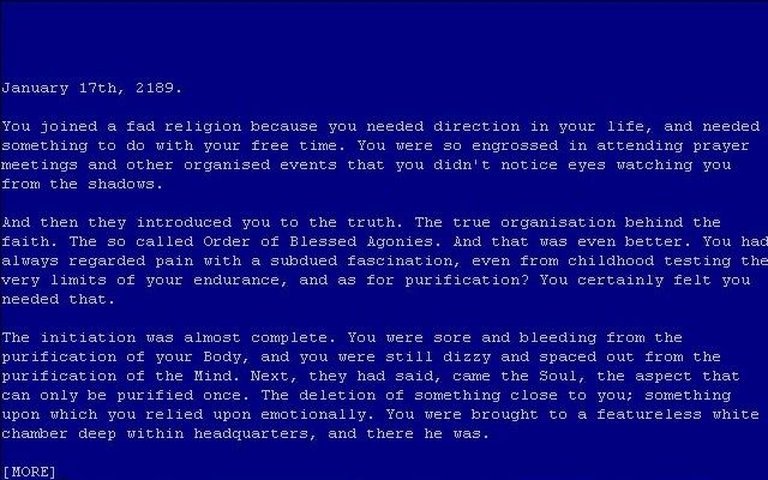
Countdown 2: The Soul is a text-based horror adventure game set in 2189 as part of the Chzo Mythos created by Ben “Yahtzee” Croshaw. Players take on the role of Delia Reneaux, a new acolyte in the Order of Blessed Agonies, a cult that believes purification comes through pain. After purging her body and mind, Delia must now purge her soul by killing her boyfriend Jason, an act that continues to haunt her. The game expands on events from Trilby’s Notes and 6 Days a Sacrifice, featuring a text parser interface where players navigate through locations by typing directional commands and interact with the world to uncover the dark mysteries surrounding the cult and its connection to the pain elemental Chzo.
Countdown 2: The Soul Guides & Walkthroughs
Countdown 2: The Soul Reviews & Reception
mobygames.com (70/100): First review of the year and I managed to speak about an indie game, an adventure one, a free one and last but not least a text parser one.
Countdown 2: The Soul: Review
Introduction
In the annals of interactive fiction, few works possess the haunting narrative cohesion and mythological depth of Ben “Yahtzee” Croshaw’s Countdown 2: The Soul. As the second act in his tripartite prelude to the seminal horror adventure 6 Days a Sacrifice, this text-adventure masterpiece transcends its minimalist presentation to weave a tale of psychological torment, cultist ritual, and cosmic dread. For connoisseurs of the Chzo Mythos, it is not merely a game but a critical lore fragment, bridging the tragic origin of John DeFoe’s Bridgekeeper ritual with the apocalyptic events of 2189. This review deconstructs The Soul‘s role within Croshaw’s grand design, examining its narrative ambitions, mechanical elegance, and enduring legacy as a testament to the power of pure text to evoke visceral terror.
Development History & Context
Emerging from the fertile mind of Ben “Yahtzee” Croshaw in 2007, Countdown 2: The Soul was conceived as a narrative appetizer for his magnum opus, 6 Days a Sacrifice. As the middle entry in a freeware trilogy—preceded by The Body and followed by The Mind—it served a dual purpose: satisfying fan curiosity during the protracted development of the final game while deepening the tapestry of the Chzo Mythos. Developed under the Fully Ramblomatic banner, the game was crafted using the Inform 7 engine, a choice that emphasized accessibility and parser-driven immersion. Its release coincided with a period where indie horror was gaining critical traction, though The Soul deliberately eschewed graphical sophistication, aligning with the traditions of classic text adventures like Zork. Croshaw’s vision was unapologetically purist: to explore trauma and indoctrination through the stark, unadorned medium of prose, requiring players to engage actively with the narrative environment rather than passively consume it. This deliberate archaism positioned The Soul as both a love letter to interactive fiction’s roots and a bold experiment in atmospheric storytelling.
Narrative & Thematic Deep Dive
The Soul thrusts players into the shattered psyche of Delia Reneaux, a young acolyte of the fanatical Order of Blessed Agonies. Set in 2189—the temporal anchor of 6 Days a Sacrifice—the game opens two weeks after Delia’s horrific initiation: the ritual murder of her boyfriend, Jason. The narrative dissects the aftermath with unflinching intimacy, exploring how religious dogma weaponizes guilt and suffering. The Order’s philosophy—that “purification can only happen through pain”—is embodied in Delia’s perpetual nightmares and existential despair, which manifest as the game’s driving horror. Her encounter with a spectral stranger in a tattered red robe introduces a Faustian bargain: steal a sacred blade in exchange for sanctuary, inadvertently setting events in motion that will shape the fate of the Chzo Mythos.
Croshaw’s dialogue is sparse yet incisive, using Delia’s internal monologue to dissect the mechanics of cult manipulation. The phrase “Violence isn’t always needed”—a rebuke when the player attempts to attack the stranger—underscores the game’s thematic core: the insidious nature of psychological coercion. The narrative is meticulously layered, revealing how Delia’s past as a depressed Optimology convert led her into the Order’s clutches while foreshadowing the Stranger’s pivotal role in 6 Days a Sacrifice. By connecting Delia’s trauma to John DeFoe’s Bridgekeeper ritual, The Soul becomes a critical link in the mythos, illuminating why Trilby was chosen as the Guide and how collective suffering fuels Chzo’s arrival. This is horror not of gore, but of moral compromise and the irreparable rifts carved by faith.
Gameplay Mechanics & Systems
As a pure text adventure, The Soul demands mastery of its minimalist command structure. The core loop revolves around navigating the Order’s compound using directional commands (“walk north,” “go up,” “take blade”) and interacting with objects via verb-object syntax. This simplicity, however, masks significant design choices. Movement is the dominant action—players traverse locales like construction sites and dormitories, with cardinal directions (northeast, southeast) often requiring painstaking navigation. While this immerses players in Delia’s aimless wandering, it risks monotony. The parser supports basic verbs (“touch” for dialogue, “hit” for combat) but rejects modern conventions (“use” yields “I don’t recognize the verb”), creating friction for players accustomed to contemporary interfaces.
The game’s puzzles are environmental rather than inventory-based, focusing on stealth and observation. For instance, locating the blade requires detecting subtle textual cues. However, the experience is hampered by technical quirks of the WinFrotz interpreter: screen corruption forces frequent toggling between “play” and “scrollback” modes, and text display errors can disrupt immersion. Despite these flaws, The Soul excels as a teaching tool for traditional IF, rewarding patience with its narrative depth. Its lack of graphics and sound shifts focus entirely to Croshaw’s prose, making every command a deliberate act of interpretation.
World-Building, Art & Sound
The game’s world-building is achieved through evocative descriptions rather than visual spectacle. The Order’s compound is rendered as a liminal space—a half-finished construction site littered with ritualistic artifacts, where steel scaffolding clashes with cultist iconography. This juxtaposition of industrial decay and religious fervor mirrors the fractured spirituality of its inhabitants. Croshaw’s prose is a masterclass in atmospheric dread: phrases like “tattered red robe” and “nightmares still haunt you” conjure visceral unease, turning sterile text into a psychological labyrinth.
Sound and visuals are entirely absent, relying on the player’s imagination to fill the void—a choice that heightens the horror. The WinFrotz interpreter’s stark white text on a blue background (reminiscent of old DOS systems) adds an uncanny, almost clinical detachment. This aesthetic paradoxically amplifies the narrative’s intimacy, forcing players to inhabit Delia’s isolation. The absence of traditional artistry becomes a strength, proving that in horror, what is unseen often terrifies more than what is rendered.
Reception & Legacy
Upon release, The Soul was met with niche enthusiasm but limited mainstream attention, typical of freeware interactive fiction. Contemporary reviews, like the seminal 2009 critique on MobyGames, praised its narrative integration within the Chzo Mythos while lamenting its parser’s technical limitations. Critics lauded its role as a lore keystone, particularly for grounding the events of 6 Days a Sacrifice in human tragedy. However, its text-only format alienated players seeking graphical engagement, relegating its audience to dedicated IF enthusiasts and mythos scholars.
Over time, The Soul’s reputation has solidified as a cult classic. It is now revered as a cornerstone of Croshaw’s oeuvre, essential for understanding the psychological underpinnings of the Chzo Mythos. Its influence persists in modern interactive fiction, demonstrating that parser-driven narratives can achieve profound emotional resonance. Games like The Sea Will Claim Everything (2012) cite its minimalist horror as an inspiration, proving that The Soul’s legacy lies not in commercial success, but in its unwavering commitment to narrative purity.
Conclusion
Countdown 2: The Soul stands as a testament to the transcendent power of interactive fiction. In an era dominated by hyper-visual epics, Croshaw’s austere masterpiece reminds us that horror thrives in the spaces between words and the shadows of imagination. While its parser-driven mechanics may frustrate modern players, and its technical quirks hinder immersion, the game’s narrative ambition is irrefutable. It is a vital, sorrowful chapter in the Chzo Mythos, transforming Delia Reneaux’s personal tragedy into a cosmic mythos about faith, suffering, and the cost of salvation.
For initiates of the Chzo cult, The Soul is indispensable—its bleak poetry and lore depth elevate it beyond a mere prequel. For others, it remains a challenging artifact, a stark reminder of an era when games dared players to confront darkness with nothing but text and their own conscience. In the pantheon of interactive fiction, The Soul is not just a game; it is a haunting, unforgettable ritual.