
- Release Year: 2007
- Platforms: Windows, Xbox 360
- Publisher: ZUXXEZ Entertainment AG
- Developer: Reality Pump Studios
- Genre: Action, RPG
- Perspective: Third-person
- Game Mode: MMO, Single-player
- Setting: Fantasy
- Average Score: 50/100
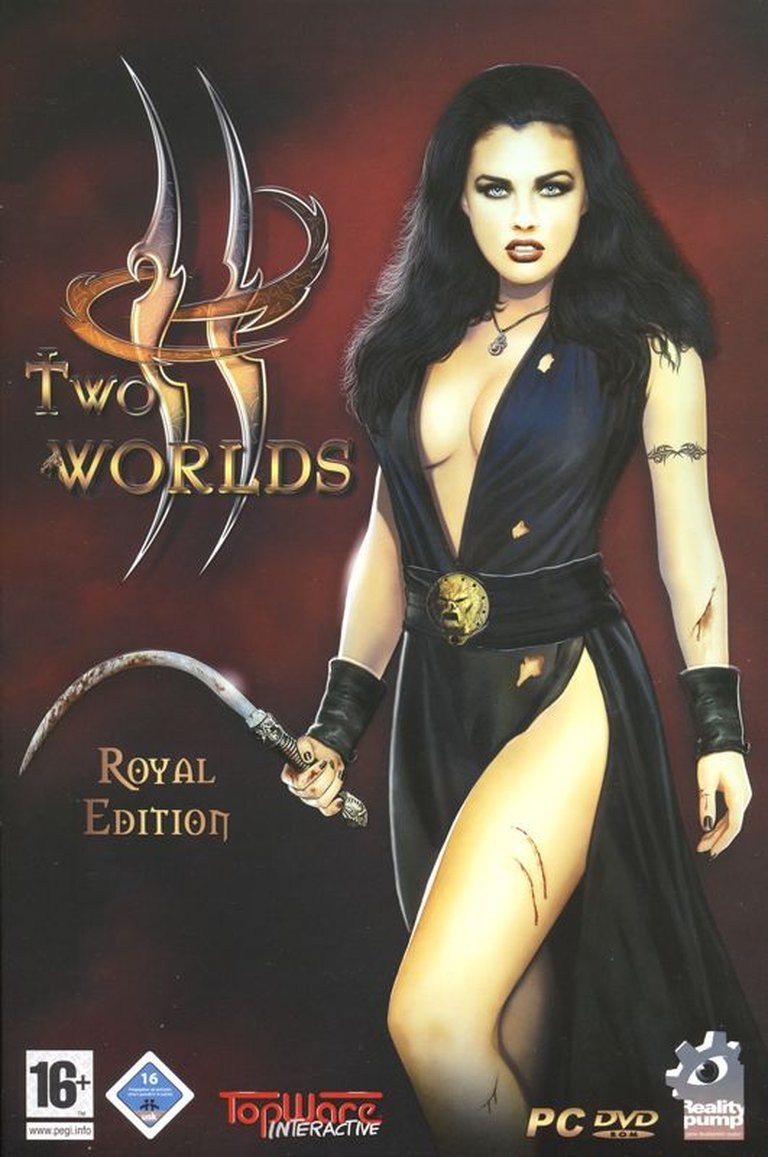
Description
Two Worlds (Royal Edition) is a high fantasy action role-playing game set in the expansive world of Antaloor, where players embark on a non-linear journey to rescue their sister from mysterious forces plotting to resurrect the fire god Aziraal by opening his tomb. The game features real-time 3D exploration, a flexible character progression system without fixed classes, and includes the base game along with exclusive physical and digital bonuses like a T-shirt, playing cards, a world map poster, and a bonus DVD with soundtrack and behind-the-scenes content.
Two Worlds (Royal Edition) Mods
Two Worlds (Royal Edition) Guides & Walkthroughs
Two Worlds (Royal Edition) Reviews & Reception
metacritic.com (50/100): There’s a lot to Two Worlds that will take you an eternity to complete. This is probably the biggest draw to the game that I can mention.
ign.com : Mediocrity, thy name is Two Worlds.
Two Worlds (Royal Edition) Cheats & Codes
PC
Press ~ to open the console. Type ‘TwoWorldsCheats 1’ to enable cheat mode.
| Code | Effect |
|---|---|
| TwoWorldsCheats 1 | Enable cheat mode |
| TwoWorldsCheats 0 | Disable cheat mode |
| AddGold [number] | Adds gold (replace [number] with desired amount) |
| SetGold [number] | Sets gold to a specific amount |
| AddSkillPoints [number] | Adds skill points |
| AddParamPoints [number] | Adds parameter points |
| AddExperiencePoints [number] | Adds experience points |
| ec.dbg levelup | Level up |
| ec.dbg addskillpoints | Add skill points |
| ec.dbg skills | All skills unlocked |
| Create [item name] | Spawn indicated item (requires a valid item name) |
| BonusCode 9728-1349-2105-2168 | Spawn Armor of Darkness |
| BonusCode 9470-4690-1542-1152 | Spawn Aziraal’s Sword of Fire |
| BonusCode 9470-6557-8820-9563 | Spawn Great Shield of Yatolen |
| BonusCode 9144-3879-7593-9224 | Spawn Spear of Destiny |
| BonusCode 9447-1204-8639-0832 | Spawn The Great Bow of Heaven’s Fury |
| Jump2 | Teleport to pointer location |
| ResetFog | Reveal map |
| physx.char.speed 30 | Run faster |
| Create Teleport_Activator | Spawn teleport activator |
| Create Lockpick | Spawn lockpick |
| Create Personal_Teleport | Spawn teleport stone |
| PhysX.Door.RemoveAll 1 | Walk through doors and walls (only works in versions earlier than v1.3) |
| GameRate | Slow or speed up game |
| Engine.Grassq [number] | Change size of 3D rendered grass |
| Engine.FOVUpdate | Update field of view changes |
| SetStrength [number] | Set strength |
| Engine.Shadows [0 or 1] | Toggle shadows |
| Engine.AutoDOF [0 or 1] | Toggle depth of field |
| Engine.GFadeFar | Fading of grass (far) |
| Engine.GFadeNear | Fading of grass (near) |
| ing_26 | Might of Nine restore 150hp |
| create Robe_0(00,9999,9999) | Spawn robe without hood (requires character level 00 or higher) |
| healH | Full Health |
| ec.SetDayLength [day length] [sunrise] [sunset] | Set length of day (default is ’60 60 205′) |
| Display.Show [0 or 1] | Toggle display statistics |
| Display.FPS [0 or 1] | Toggle framerate |
| ShowInterface [0 or 1] | Toggle complete Interface |
| Engine.UseStencilShadows [0 or 1] | Toggle stencil shadows |
| Engine.TrueWaterRef [0 or 1] | Toggle water reflections |
| Engine.WaterReflections [0 or 1] | Toggle water reflections |
| Engine.AutoDOFTolerance [0.1 – 1.0] | Set depth of field (default is 0.4) |
| Engine.FOV [angle*0.5] | Set field of view angle |
| Engine.TShadows [0 or 1] | Unknown (Toggle shadows?) |
| Engine.DisableCloth [0 or 1] | Unknown (Toggle cloth?) |
| Engine.DSystemActive [0 or 1] | Unknown (Toggle system active?) |
| Engine.Farplane | Unknown (Set far plane?) |
| Engine.AlphaFadeFar | Unknown (Toggle alpha fade far?) |
| Engine.AlphaFadeNear | Unknown (Toggle alpha fade near?) |
| Particles.ForceParticlesDrawSet | Unknown (Force particles draw set?) |
| Particles.SetMaxParticlesOnScene | Unknown (Set max particles on scene?) |
| Particles.SetMaxParticlesOnSceneHigh | Unknown (Set max particles on scene high?) |
| Particles.SetMaxParticlesOnSceneLow | Unknown (Set max particles on scene low?) |
| Engine.LOD0 | Unknown (Toggle LOD 0?) |
| Engine.LOD1 | Unknown (Toggle LOD 1?) |
Two Worlds (Royal Edition): Review
1. Introduction
In the shadow of The Elder Scrolls IV: Oblivion‘s dominance, Two Worlds emerged in 2007 as a bold, ambitious contender from Polish developer Reality Pump. Hyped as a sprawling open-world fantasy RPG capable of rivaling Bethesda’s masterpiece, it promised unparalleled freedom, deep lore, and systemic depth. Yet, its release became a cautionary tale of ambition outpacing execution. The Royal Edition, a lavish European release featuring physical extras like a T-shirt, playing cards, and a world map, encapsulated both the game’s promise and its pitfalls. This review deconstructs Two Worlds as a historical artifact—an RPG of immense scale marred by technical flaws, yet one that laid groundwork for its critically acclaimed sequel. Through exhaustive analysis of its development, narrative, mechanics, and legacy, we explore how a title once dismissed as a “clone” evolved into a cult classic.
2. Development History & Context
2.1. Studio and Vision
Reality Pump Studios, a Polish team with roots in real-time strategy titles like Earth 2160 and Knight Shift, spearheaded development under project leader Mirosław Dymek. Initially conceived as Polanie 3 or Knight Shift 2: Curse of Souls, the project underwent a radical transformation, shedding RTS elements to become a full-fledged RPG. Dymek’s vision was clear: create a non-linear competitor to Oblivion and Gothic 3, emphasizing player agency in a dynamic world. The studio leveraged its proprietary engine, built on Direct3D 9.0c and NVIDIA PhysX, to render Antaloor’s diverse landscapes—a technical gamble for a team transitioning from PC-centric development to the Xbox 360.
2.2. Technological Constraints and Challenges
Development was fraught with hurdles. The Xbox 360 port, Reality Pump’s first console project, suffered from a rushed timeline, leading to crippling performance issues. Frame rate drops, clipping bugs, and inconsistent collision detection plagued the launch, while older AMD GPUs caused crashes. The engine’s proprietary tree generator created dense vegetation but struggled with draw distances, revealing terrain gaps on multi-monitor setups. Post-launch patches (e.g., v1.2–1.7b) addressed stability, but initial versions felt like unfinished alpha builds. The ambition of a 40-square-kilometer seamless world, while admirable, often strained the engine’s capabilities, resulting in pop-in and texture streaming problems.
2.3. The 2007 Gaming Landscape
2007 was a pivotal year for RPGs. Oblivion had redefined open-world design, while The Witcher and Gothic 3 offered darker, more complex alternatives. Two Worlds entered this competitive field with a unique selling point: a classless system and faction-driven reputation mechanics. However, it was also overshadowed by higher-profile releases, and its marketing—positioning it as “Oblivion’s successor”—set unrealistic expectations. The Royal Edition’s physical trinkets (e.g., the Kilgorin letter opener) underscored publisher ZUXXEZ’s confidence, yet they also hinted at compensating for the game’s perceived shortcomings.
3. Narrative & Thematic Deep Dive
3.1. Plot and Characters
Set in the continent of Antaloor, Two Worlds follows an unnamed bounty hunter—the “Hero”—on a quest to rescue his sister, Kyra, from Gandohar, a necromantic emperor plotting to resurrect Aziraal, the god of fire. The narrative unfolds non-linearly, with the Hero’s actions shaping faction allegiances and world outcomes. Key characters include:
– Kyra: The emotional core, her abduction stems from a lineage tied to an ancient artifact, making her a vessel for Aziraal’s soul.
– Gandohar: A charismatic villain whose betrayal of the Hero reveals a tragic ambition—sacrificing Kyra to save Antaloor from divine chaos.
– Faction Leaders: From the Society’s mages (blue banners) to the Brotherhood’s mercenaries (red banners), each faction offers quests that intertwine with the main story.
3.2. Dialogue and Themes
The script blends high-fantasy tropes with awkward stiltedness, especially in English. Lines like “By the gods, what is this Taint?” became infamous for their wooden delivery. Themes of betrayal, sacrifice, and the cyclical nature of war permeate the plot. The game explores how power corrupts (Gandohar’s descent into tyranny) and how choices have consequences—aligning with the Necromancers locks out Society quests, altering the world’s fate. Reddit lore confirms the “evil” ending (where the Hero aids Gandohar) as canon, positioning the sequel as a redemption arc.
3.3. Factions and Consequences
Seven factions govern Antaloor’s politics:
– Brotherhood: Combat-focused, offering trainers and gear discounts.
– Society: Mages teaching elemental magic.
– Giriza: Thieves enabling stealth and black market access.
– Necromancers: Outcasts teaching dark magic, clashing with the Society.
Reputation earned through quests unlocks unique vendors, quests, and story branches. House Skelden and Karga Clan’s rivalry adds geopolitical depth, reflecting Antaloor’s fractured history (e.g., the 255 CE arrival of Clan Karga in Thalmont).
4. Gameplay Mechanics & Systems
4.1. Character Progression and Customization
Two Worlds eschews traditional classes in favor of free-form progression. Attribute points (Strength, Dexterity, Vitality, Willpower) and skill points (allocated to active/passive abilities) define builds. Skill changers in cities allow costly redistribution, enabling hybrid builds. Skills like Alchemy (for brewing potions) and Lockpicking offer depth, while spell “cards” let players customize effects (e.g., boosting fire damage or adding area-of-effect). This flexibility rewarded experimentation but could lead to overpowered combinations, particularly with Necromancy spells.
4.2. Combat and Exploration
Combat blends melee, ranged, and magic in real-time. Melee relies on combos and dodges (criticized as over-effective), while archery benefits from precise targeting. Magic’s five schools (Fire, Air, Earth, Water, Necromancy) require mana but scale destructively with investment. Mounted combat, though hyped, was notoriously unresponsive—horses often ignored directional input, forcing players to dismount for complex terrain. Exploration is Antaloor’s strongest suit: teleport stones enable fast travel, but the world rewards on-foot discovery. Enemies don’t respawn, creating a dynamic ecosystem where cleared zones remain empty. The Royal Edition’s emphasis on physical extras, like the world map, appealed to cartographically inclined players.
4.3. Crafting and Systems
Alchemy is a standout feature, requiring players to experiment with ingredients (plants, monster parts, minerals) to create potions, traps, and permanent stat-boosting elixirs. Unlike contemporaries, Two Worlds offers no recipes, encouraging trial-and-error. Inventory management is grid-based, with weapons/armor improvable by combining duplicates. The high difficulty’s permanent-death mode added tension, though most players exploited shrines for easy healing. Multiplayer, supporting 8-player co-op, featured separate characters and quests but suffered from peer-to-peer hosting instability.
5. World-Building, Art & Sound
5.1. Setting and Atmosphere
Antaloor is a meticulously crafted continent, divided by the River Gon into temperate north (forests, cathedrals) and arid south (deserts, ruins). Key locales include:
– Cathalon: The human capital, a hub of political intrigue.
– Oswaroth: The site of Aziraal’s tomb, now a decaying fortress.
– The Swallows: A toxic wasteland created by Gandohar’s Verita experiments in 320 CE.
The world’s depth is rooted in its lore, chronicled on the Two Worlds Wiki (e.g., the 345 CE timeline events).
5.2. Art and Visuals
Graphics were divisive. Antaloor’s scale and biodiversity were praised, but textures and animations felt dated even in 2007. Character models suffered from disproportionate heads, and environments exhibited pop-in. The Royal Edition’s bonus DVD highlighted concept art, underscoring the team’s vision despite technical limitations. Post-patch enhancements improved shadows and draw distance, but the game never matched Oblivion’s polish.
5.3. Sound Design
Harold Faltermeyer’s soundtrack (released as Two Worlds – The Album) blends orchestral, rock, and Gothic motifs. Tracks like “Siege of Cathalon” and “Play the Game” (sung by Kyra) elevated combat and exploration. Voice acting, however, was a nadir. English performances were lambasted for monotony and accents, while German dubs fared better. The clash between Faltermeyer’s score and the stilted dialogue created a dissonant experience, with NPCs often repeating lines ad nauseam.
6. Reception & Legacy
6.1. Critical and Commercial Response
Two Worlds polarized critics. PC reviews averaged 65% on Metacritic (GameSpot: 7.5/10; IGN: 7.3/10), praising depth but criticizing bugs. The Xbox 360 version fared worse (50%), with Eurogamer calling it “frustrating” and GameSpy deeming it “shockingly incompetent.” German outlets were kinder (80–93%), reflecting regional pride in developer Reality Pump. Sales were moderate (Xbox 360: ~0.7 million units), but legal battles between SouthPeak and TopWare over royalties strained the franchise. The Royal Edition’s physical appeal did little to salvage its reputation as a “flawed but ambitious” title.
6.2. Evolution of Reputation and Modding Community
Over time, Two Worlds gained cult status. Players nostalgic for its unfiltered RPG mechanics and modding community embraced it. Nexus Mods enhanced graphics and fixed bugs, while the Epic Edition (2008) bundled expansions like Tainted Blood and Curse of Souls. Reddit threads now celebrate its “so-bad-it’s-good” voice acting and quirky systems, acknowledging its influence on Two Worlds II (2010), which sold 1 million units in three weeks by addressing its predecessor’s flaws.
6.3. Industry Influence and Historical Significance
Two Worlds demonstrated the risks of competing with AAA giants while showcasing Eastern European developers’ ambition. Its classless system and factional reputation mechanics prefigured RPGs like The Witcher 3. Though it never achieved mainstream acclaim, its legacy endures in the Two Worlds series and as a case study in patch culture. The Royal Edition, with its tangible memorabilia, remains a collector’s item—a time capsule of an era when physical media augmented digital ambition.
7. Conclusion
Two Worlds (Royal Edition) is a paradox: a game of profound ambition executed with frustrating ineptitude. Its vast world, deep customization, and faction-driven narrative represent a bold vision for open-world RPGs, yet technical debt and poor polish relegate it to footnote status. The Royal Edition’s physical trinkets, while novel, symbolize the gap between its promise and reality—a lavish package masking an unrefined product. Yet, history has been kind. Its cult following, modding community, and role in birthing the superior Two Worlds II ensure its place in RPG history. For players willing to tolerate its quirks, Antaloor offers unparalleled freedom; for critics, it remains a cautionary tale of ambition unchecked. In the end, Two Worlds is less a rival to Oblivion and more a flawed sibling—burdened by its flaws but defined by its audacity. Verdict: A flawed masterpiece that laid the groundwork for redemption.