
- Release Year: 2014
- Platforms: PlayStation 4, Windows, Xbox One
- Publisher: Ubisoft Entertainment SA
- Developer: Ubisoft Montreal
- Genre: Action, Adventure, Stealth
- Perspective: Third-person
- Game Mode: Online Co-op, Single-player
- Gameplay: Assassination, Investigation, Open World, Parkour, Stealth, Time manipulation
- Setting: 19th century, France, French Revolution, Historical
- Average Score: 55/100
Description
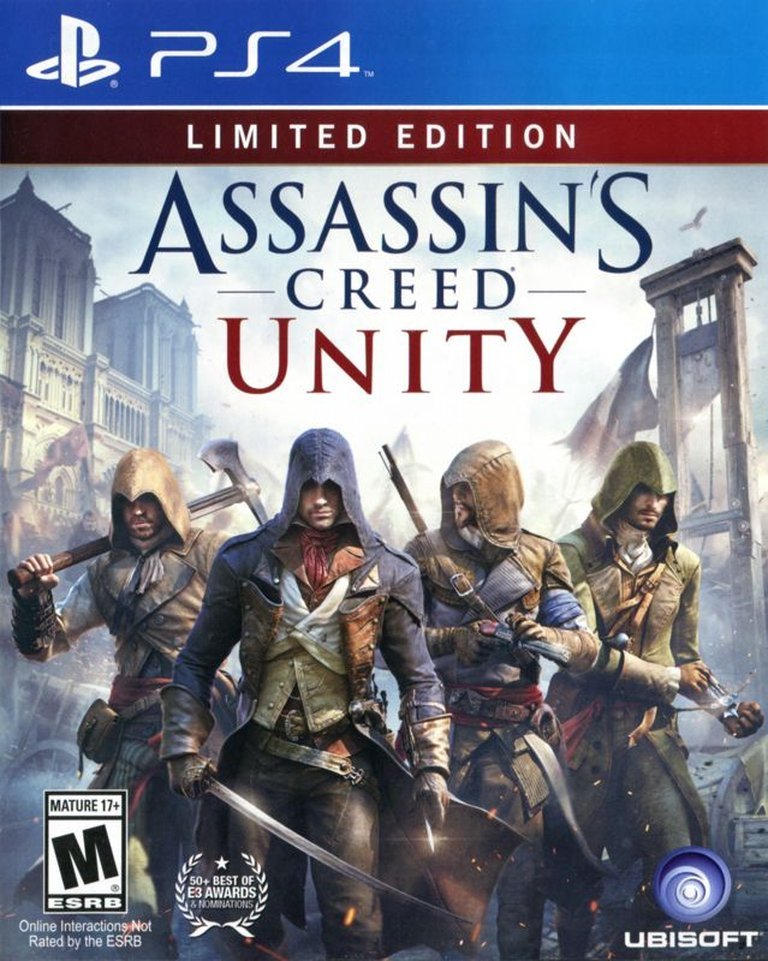
Set in revolutionary Paris during the French Revolution, Assassin’s Creed: Unity follows Arno Dorian, an assassin entangled in the city’s upheaval and conspiracy. The Limited Edition bundle includes the base game and exclusive access to the ‘Chemical Revolution’ mission, where players must rescue the kidnapped Antoine Lavoisier and recover a poison bomb formula. This enhanced edition offers a visually stunning depiction of 18th-century Paris, featuring intricate parkour mechanics, cooperative gameplay, and immersive historical missions that blend real events with fictional Templar-Assassin conflicts.
Gameplay Videos
Assassin’s Creed: Unity (Limited Edition) Guides & Walkthroughs
Assassin’s Creed: Unity (Limited Edition) Reviews & Reception
metacritic.com (50/100): Paris shows some promise, but it’s hard to enjoy a game when it’s so nauseating, even if it does suggest a return to the series’ best ideas.
ign.com : Assassin’s Creed Unity is a game of impossible peaks and disappointing valleys.
imdb.com (60/100): Promising project with a sad result!
Assassin’s Creed: Unity (Limited Edition): Review
Introduction
In the pantheon of ambitious yet flawed gaming epics, few titles embody the paradox of ambition and execution as starkly as Assassin’s Creed: Unity (Limited Edition). Released in November 2014 as the series’ eighth major installment, Unity promised a revolutionary leap into the heart of the French Revolution, leveraging the power of the PlayStation 4, Xbox One, and PC to deliver a 1:1 scale Paris teeming with life and historical detail. Yet, its launch became synonymous with technical catastrophe, spawning memes of decapitated nobles and floating heads while igniting debates about Ubisoft’s creative priorities and commitment to player experience. This Limited Edition bundle—featuring the base game and the “Chemical Revolution” mission—serves as a microcosm of the game’s dual legacy: a breathtaking digital tapestry of 18th-century Paris, marred by systemic bugs, narrative missteps, and design contradictions. This review dissects Unity not merely as a product, but as a cultural artifact—a testament to the series’ growing pains in the transition to “next-generation” gaming. Its thesis is clear: Unity is a flawed masterpiece, a game that redefined open-world ambition while exposing the perils of rushed development and fractured vision.
Development History & Context
The Montreal Mandate and Visionary Overreach
Ubisoft Montreal, the series’ spiritual home, spearheaded Unity‘s development, supported by a global coalition of studios across Toronto, Kyiv, Singapore, Shanghai, Annecy, Montpellier, Bucharest, Quebec, and Chengdu. This unprecedented collaborative effort aimed to leverage the new hardware’s capabilities, particularly crowd simulation and architectural fidelity. Creative Director Alexandre Amancio envisioned a game that would “avoid reducing history,” seeking to immerse players in the ideological chaos of the French Revolution while emphasizing personal stakes through Arno Dorian’s redemption arc. The team drew inspiration from fencing to overhaul combat, and invested heavily in the AnvilNext 2.0 engine to support 30,000 NPCs on-screen simultaneously, each with independent AI. However, these ambitions collided with brutal realities. The game’s development timeline, finalized in 2014, coincided with Ubisoft’s aggressive annual release cycle. A leaked March 2014 build revealed a product still in flux, prompting a delay from October to November 2014—a move Senior Producer Vincent Pontbriand framed as “honing details,” though industry observers noted the shift aimed to avoid competing with Titanfall and Destiny. The concurrent release of Assassin’s Creed Rogue (for previous-gen consoles) created a bizarre split, with Unity serving as the flagship for next-gen aspirations. This context reveals a studio stretched thin, struggling to balance technological innovation with narrative cohesion.
Gaming Landscape and Technical Constraints
2014 was a pivotal year for gaming, dominated by the console war between PlayStation 4 and Xbox One. Unity’s launch was mired in controversy when Pontbriand enforced 900p resolution parity across both platforms, citing CPU limitations for crowd rendering rather than hardware superiority. This decision backfired, fueling fan backlash and accusations of favoritism. The PC version, meanwhile, relied on Nvidia’s GameWorks technologies (TXAA, tessellation, PhysX), creating a visually stunning but notoriously demanding experience. Ubiquitous microtransactions, allowing players to bypass grinding with “Helix Credits,” further underscored the era’s shift toward monetization. Amidst this, Unity’s co-op multiplayer—a first for the series—was marketed as a revolutionary feature, promising shared missions and synchronized assassinations. Yet, its development, led by Benjamin Plich, prioritized four-player cooperation over narrative depth, resulting in missions that felt disconnected from Arno’s personal story. The “Chemical Revolution” DLC, included in the Limited Edition, epitomized this dissonance: a 20-minute Paris Story mission featuring Antoine Lavoisier that added little lore value, serving more as a pre-order bonus than a meaningful expansion. These choices reflected Ubisoft’s gamble: prioritize technical spectacle and multiplayer appeal over single-player refinement, a strategy that would define the franchise’s next half-decade.
Narrative & Thematic Deep Dive
The Fractured Saga of Arno Dorian
Unity’s narrative unfolds across two timelines: a fragmented modern-day framing device and the historical saga of Arno Dorian. In 2014, players are cast as an unnamed Abstergo “Initiate” hacking into the Helix memory database to locate a Sage’s corpse—a plot device reminiscent of Black Flag‘s modern-day segments but stripped of personality. The real story begins in 1776 Versailles, where Arno, orphaned after his Assassin father is killed by Shay Patrick Cormac (linking to Rogue), is adopted by Templar Grandmaster François de la Serre. This dual allegiance sets the stage for tragedy: Arno fails to deliver a warning letter, leading to de la Serre’s murder and Arno’s wrongful imprisonment in the Bastille. Escaping during the 1789 storming, he joins the Brotherhood under Pierre Bellec, embarking on a revenge-driven quest that exposes the Templar coup led by François-Thomas Germain—a Sage and extremist silversmith.
The narrative is a study in contrasts. Arno’s arc, mirroring Ezio’s rise but subverting it, emphasizes personal failure over triumph. His relationship with Élise de la Serre, the Templar’s daughter, drives the emotional core, yet their romance lacks the gravitas of Ezio and Caterina Sforza. Dialogue oscillates between wit (“Stay out of trouble… Don’t get caught”) and banality, with Élise’s letters feeling perfunctory. Characters like Bellec (a radical Assassin) and Mirabeau (a reformist Mentor) embody the Brotherhood’s ideological schism, but their arcs are truncated. Germain, the main antagonist, embodies the Templar’s “progress through control” mantra, yet his motivations—purging corrupt Templars—are compelling underdeveloped. The climax, where Germain kills Élise with the Sword of Eden and Arno avenges her in the Paris Temple, is visceral but narratively hollow. The ending, with Arno rebuilding the Brotherhood and placing Germain’s skeleton in the catacombs, feels abrupt, resolving little about the modern-day conflict. This thematic dissonance—between the game’s “unity” rhetoric and its fractured narrative—ultimately undermines its historical ambitions.
Historical Revisionism and Thematic Contradictions
Unity’s portrayal of the French Revolution is both meticulously researched and ideologically fraught. Ubisoft consulted historians like Laurent Turcot and Jean-Clement Martin, yet the narrative leans into revisionism. The Revolution is framed as a Templar-engineered chaos, with Germain manipulating events like the Reign of Terror to instill fear of democracy—a trope rooted in Abbé Barruel’s conspiracy theories. This simplifies the Revolution’s complexities, reducing sans-culottes to “extremists” and Robespierre to a puppet. Characters like Napoleon are depicted as charismatic pragmatists, downplaying their Jacobin ties. The “Murder Mysteries” side missions, while engaging, often perpetuate myths (e.g., the “genuine human hide” story about Saint-Just), showcasing how gameplay prioritizes sensationalism over accuracy.
Thematic contradictions abound. Arno’s Creed—”Nothing is true, everything is permitted”—clashes with his moralizing, while the Assassins’ advocacy for free will feels hollow given their hierarchical rigidity. The game’s title suggests unity between factions, but Arno’s path is defined by division: Assassins vs. Templars, personal revenge vs. brotherhood duty. Even the co-op missions, where players team up as “Arno clones,” underscore this irony—players control identical characters despite Ubisoft’s claim that customization fostered uniqueness. This thematic fragmentation extends to the modern-day framing, which is so perfunctory that Shaun Hastings’ snarky database entries feel like the only narrative lifeline. Ultimately, Unity struggles to reconcile its historical ambitions with its gameplay design, resulting in a story that educates but rarely inspires.
Gameplay Mechanics & Systems
Revolution in Motion: Parkour, Combat, and Stealth
Unity overhauled core mechanics with mixed success. Parkour, once fluid, became a point of frustration. New “Free-run up/down” commands promised vertical freedom, but Arno’s movement often felt clunky—circling windows, halting mid-climb, and refusing to descend. These issues, exacerbated by wonky collision detection, turned traversal from joy to chore. Combat, inspired by fencing, introduced a more aggressive system with parries and ripostes, but the removal of the counter button heightened difficulty. Enemies now mobbed Arno, overwhelming him with numbers, while finishing moves triggered slow-motion glitches that ruined immersion. Stealth saw marginal improvements: manual crouching and the Phantom Blade (a crossbow-hidden blade hybrid) added tactical layers, but guards’ AI remained inconsistent—sometimes ignoring blatant assassinations, other times pursuing relentlessly.
The “Black Box” mission design offered more freedom, allowing players to explore environments for assassination approaches, yet many targets felt underdeveloped. Murder Mysteries, while innovative—requiring clue collection and witness interrogation—were undermined by unintuitive controls. Co-op, the game’s flagship feature, enabled four-player drop-in/drop-out missions, but these felt disconnected from Arno’s story. Players controlled customized “Arnos” (nicknamed the “Baguette Boyband” by fans), completing Brotherhood missions that lacked narrative weight. Despite Ubisoft’s claim of 8,000 animations needed for female co-op characters (sparking the “#WomenAreTooHardToAnimate” controversy), the mode’s exclusion of women was seen as a missed opportunity for inclusivity.
Systems of Control: Progression, Customization, and Economy
Unity introduced a skill tree for Arno, allowing upgrades in stealth, melee, and ranged combat. This added depth, but progression felt imbalanced—early-game struggles only eased upon acquiring high-level gear near the end. Customization was robust: players could equip Arno with swords, axes, rifles, and cosmetic items, but quality tiers (up to “legendary”) created a grind. The Café Théâtre renovation system, where players invested in upgrades to generate passive income, was engaging yet underutilized. Companion App integration, initially tying collectibles to external apps, was later patched out, mitigating frustration.
Microtransactions (“Helix Credits”) allowed purchasing maps and gear, though all items were obtainable in-game. This dual system felt exploitative, especially as credits revealed collectible locations—a design choice undermining exploration. The economy skewed toward gear progression, with medicine becoming prohibitively expensive. These systems highlighted Unity’s identity crisis: a game preaching freedom while imposing arbitrary limits and paywalls. Despite its ambitions, Unity’s gameplay loop—climb, fight, assassinate—lacked the polish of Black Flag‘s naval combat or Revelations‘ hookblade traversal, leaving players grappling with mechanics that felt half-realized.
World-Building, Art & Sound
Paris: A Living, Breathing Revolution
Unity’s crowning achievement is its recreation of 18th-century Paris. Divided into seven districts (Le Marais, Quartier Latin, etc.) and featuring Versailles, the city is a marvel of architectural fidelity. Notre-Dame, painstakingly modeled over a year, boasts integrated interiors and exteriors—players can ascend its spires and descend into its crypts. Crowds of 30,000 NPCs populate the streets, each with routines like arguing, panicking during riots, or reacting to Arno’s actions. This density creates immersion: players can blend into mobs, steal purses, or witness historical events like the Storming of the Bastille. Dynamic weather, particularly rain, adds atmosphere, though effects are fleeting. “Time Anomalies” fracture reality, transporting Arno to the Belle Époque (Eiffel Tower) or WWII (Nazi-occupied Paris), showcasing temporal dissonance. Yet, this ambition came with compromises: NPC faces repeated frequently, and background dialogues felt recycled (e.g., “thieves always steal from the same lady”). The “Chemical Revolution” mission, set in a lab, was visually flat, underscoring the DLC’s perfunctory nature.
Art Direction and Sound: Beauty and Blandness
Artistically, Unity is breathtaking. Gothic cathedrals and Haussmannian boulevards evoke Baroque grandeur, while interiors—from opulent salons to squalid slums—contrast sharply. Character models are detailed (Élise’s animations are particularly striking), but combat finishers suffer from graphical hitches. The Limited Edition’s “equipping screen,” allowing weapon/outfit rotation, highlights customization depth. Sound design is mixed. Sarah Schachner’s score is serviceable but unmemorable, lacking the anthemic motifs of earlier games. Voice acting is uneven: Dan Jeannotte’s Arno charms with sarcasm, but English accents replace French ones, flattening characters. Crowd ambiance excels, with French phrases and church Latin enhancing authenticity, yet character dialogues lack sync with gestures. The Phantom Blade’s crossbow zip and sword clinks provide satisfying audio feedback, but the silence during Arno’s post-assassin “Eagle Pulse” memory reads feels jarring. Overall, Unity’s world-building is its triumph—a Paris that feels alive, even as its narrative and mechanical flaws undermine the experience.
Reception & Legacy
Launch Controversy and Critical Schism
Unity launched amid a maelstrom. Critical reviews were mixed, with Metacritic scores hovering around 70–72/100. Praise centered on graphics (“a huge graphical step on par with next-gen”), Parisian atmosphere, and customization. IGN (7.8/10) lauded its “gorgeous, entertaining” setting, while Game Informer (8/10) noted “decent voice acting” and “challenging gameplay.” However, combat and mission design drew ire: Destructoid (7/10) called it “a step back,” and Polygon (6.5/10) criticized “unrefined stealth.” The Limited Edition’s “Chemical Revolution” DLC was dismissed as “poorly executed,” failing to justify its “Limited Edition” moniker.
Technical issues dominated discourse. Frame rate drops, texture glitches (e.g., floating heads), and co-op bugs were pervasive. Kotaku dubbed it “a new low for the series,” and Ubisoft CEO Yannis Mallat apologized, offering free DLC (Dead Kings) and a free game (e.g., Black Flag) to season pass holders. Controversies flared: Ubisoft’s claim that female co-op characters were “too hard to animate” sparked backlash, while platform parity debates erupted. French politician Jean-Luc Mélenchon criticized the game’s “counter-revolutionary clichés,” arguing it smeared the Revolution. Despite this, Unity sold over 10 million units by 2020, driven by its setting and brand power—a testament to Ubisoft’s marketing prowess.
Evolving Legacy and Historical Irony
Over time, Unity’s reputation has nuanced. While its launch bugs remain infamous, its Paris model gained unexpected relevance: after Notre-Dame’s 2019 fire, Ubisoft donated €500,000 and offered Unity for free, using its scans as reference. Fan communities embraced its glitches as memes (“glitches galore”), while co-op’s “Baguette Boyband” became a beloved AU. Narrative critiques persist—historians note its oversimplification of the Revolution—but its architectural preservation efforts are now seen as a cultural service. Syndicate (2015), its sequel, addressed many complaints (e.g., tighter combat, female co-op), yet Unity remains a cautionary tale about ambition. It redefined open-world scale but exposed Ubisoft’s annual-release pitfalls. Its legacy is dual: a technical cautionary tale and a historical time capsule, forever remembered for its broken promise and its enduring, haunting beauty.
Conclusion
Assassin’s Creed: Unity (Limited Edition) stands as a monument to gaming’s potential and perils. It is a game of breathtaking ambition—Paris recreated with meticulous detail, revolutionary co-op, and a narrative steeped in historical turmoil—yet one undone by its own contradictions. Its technical flaws, narrative dissonance, and design missteps reflect the growing pains of a franchise in transition, caught between creative vision and corporate demands. Yet, Unity endures as a cultural artifact: a digital cathedral that preserved Notre-Dame, a flawed masterpiece that redefined open-world ambition, and a cautionary reminder that history is not just recreated, but remembered. For players, it offers a paradox: a flawed journey through a revolution that, in its imperfections, feels more human than flawless. Unity is not just a game; it’s a testament to the messy, beautiful process of making history—digital or otherwise. In the end, its verdict is clear: deeply flawed, undeniably ambitious, and unforgettable.