
- Release Year: 2022
- Platforms: Windows
- Publisher: Main Tank Software LLC
- Developer: Main Tank Software LLC
- Genre: Action
- Perspective: Side view
- Game Mode: Online PVP, Single-player
- Gameplay: Flying, Platform, Power-ups, Shooting
- Setting: Futuristic, Sci-fi
- Average Score: 60/100
Description
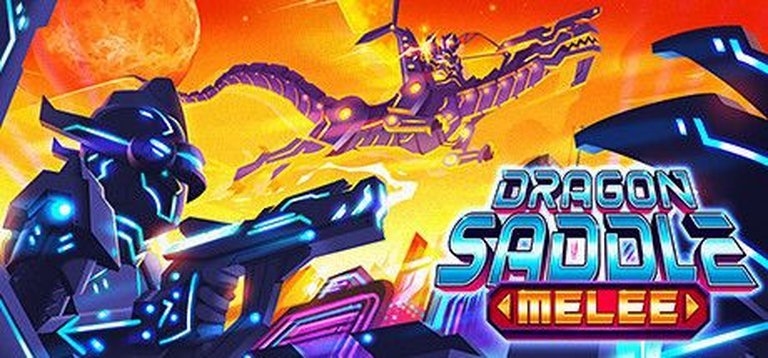
Dragon Saddle Melee is a 2D scrolling action platformer set in a chaotic sci-fi dimension where players ride dragons in aerial combat across neon-lit arenas. The game combines classic arcade mechanics inspired by Joust with modern features like power-ups granting new projectiles, portal-sealing objectives, and fast-paced multiplayer battles where players survive by flying strategically, eliminating opponents through aerial collisions or projectile attacks, and collecting upgrades amidst chaotic platform-based combat.
Dragon Saddle Melee Reviews & Reception
thegamingoutsider.com (60/100): A charming and energetic throwback.
mkaugaming.com (60/100): Main Tank Software did a good job, but sadly, it could also be quickly forgotten.
Dragon Saddle Melee: Review
Introduction
In the neon-drenched chaos of a digital arena, where dragons clash under the relentless pull of gravity, Dragon Saddle Melee emerges—a modern tribute to the golden age of arcade gaming. Released on January 26, 2022, by indie studio Main Tank Software LLC, this title promises a high-flying reimagining of the 1980s classic Joust, swapping ostriches for mythical beasts and adding contemporary multiplayer chaos. Yet, beneath its vibrant surface lies a game of charming simplicity and profound limitations. This review argues that while Dragon Saddle Melee excels as a nostalgic, accessible burst of arcade action, its lack of depth, structural flaws, and repetitive design ultimately confine it to a niche footnote in gaming history—a fleeting spectacle rather than a timeless classic.
Development History & Context
Born from the solo vision of developer Chris MTS (of Main Tank Software LLC), Dragon Saddle Melee was crafted as a love letter to the Joust era. MTS explicitly cited the Williams arcade game as a core inspiration, noting in a Steam Community discussion: “DSM definitely takes some inspiration from Joust. I grew up playing it a lot as a kid.” This reverence extended beyond gameplay, as the studio sought to distill the essence of 80s coin-op thrills—chaotic, high-stakes survival—into a modern package.
Technologically, the game leveraged Unity, enabling efficient development and cross-platform potential (though it remained PC-exclusive at launch). This choice reflected pragmatic constraints: Unity minimized production costs while supporting the game’s modest system requirements, ensuring accessibility on most modern PCs. The release arrived in a crowded indie landscape, where titles like Super Smash Bros. Melee and Disney Melee Mania dominated the multiplayer-brawler genre. Priced at $4.99—akin to a retro arcade quarter—it positioned itself as a budget-friendly, low-barrier entry point. Yet, its timing was precarious; as one reviewer noted, the game’s “fleeting leisure” status was amplified by a small player pool and a market saturated with similar throwbacks.
Narrative & Thematic Deep Dive
Dragon Saddle Melee eschews traditional narrative in favor of pure arcade abstraction. The official description—”In a weird dimension of chaos, the player on dragonback hops from platforms and flies around to eliminate opponent dragons”—establishes a premise devoid of plot or dialogue. There are no characters beyond silent dragon-riders, no factions beyond “player” and “enemy,” and no story progression beyond wave-based survival. This minimalism is intentional, mirroring the narrativeless ethos of 80s arcade games like Joust or Asteroids.
Thematically, the game’s focus is on primal competition and entropy. The “weird dimension of chaos” serves as a justification for the game’s mechanics—a lawless arena where survival demands mastery of physics and opportunism. Power-ups introduce a layer of strategic escalation, turning the battlefield into a Darwinian scramble for advantage. Underpinning this is a subtle commentary on digital evolution: dragons, once mythic beasts, are reduced to pixelated puppets in a neon-drenched arena, reflecting how retro aesthetics can hollow out myth into mere spectacle. The absence of narrative, while faithful to its inspirations, underscores the game’s one-dimensional appeal—it is an experience of moment, not meaning.
Gameplay Mechanics & Systems
At its core, Dragon Saddle Melee is a masterclass in distilled mechanics: players flap dragons’ wings to navigate, falling when inactive, and eliminate foes by landing atop them (a direct homage to Joust’s “jousting” mechanic). This deceptively simple loop is expanded through two key systems:
- Combat & Power-Ups: Melee attacks are supplemented by collectible projectiles—bows, shotguns, shields, and speed-boosts—that spawn randomly. These add strategic depth, allowing comebacks or dominating play. However, their implementation feels uneven. As one reviewer noted, power-ups “are not too powerful as to cause players to dominate the game by just using powerups,” but their randomness can disrupt momentum.
- Wave Structure: Matches progress through 20+ waves, each with escalating objectives: defeating enemies, closing portal spawners, or avoiding deadly energy beams. This variety prevents monotony, yet the order is rigid, creating predictability. The AI, meanwhile, is a double-edged sword—competent in early waves but prone to glitches (e.g., dragons flying into platforms) later on, frustrating players seeking consistent challenge.
Critical flaws mar the experience:
– Friendless Multiplayer: Automated matchmaking lacks party options, forcing players to rely on “sheer luck” to squad up. As The Gaming Outsider lamented, “there is no way to play Dragon Saddle Melee with your friends other than sheer luck.” This isolates the game’s social core.
– UI and Control: While responsive, controls suffer on controllers (menu navigation unsupported) and keyboard, with side-to-side flight feeling “frustrating.” The “gap in height between the small bounce and the high bounce” (per a Steam user) also creates inconsistent physics.
– Lives and Spectating: Starting with 5 lives, defeated players spectate passively, allowing leaders to rack up points unopposed—a design that undermines competitiveness.
Ultimately, these systems create a tight, engaging loop that curdles into repetition without friends or variation.
World-Building, Art & Sound
Dragon Saddle Melee’s aesthetic is a neon-drenched love letter to 80s retrofuturism. The single arena—reminiscent of a synthwave dreamscape—features a neon purple grid on black, with dragons and platforms bathed in electric blues, pinks, and cyans. This visual language evokes classic arcade cabinets like Tron, but its execution is divisive. Critics praised the dragons’ “responsive animations,” yet derided the background as “quite drab” and “overuse of neon lighting” that “makes it hard to focus.” This starkness, while functional for distinguishing friend from foe, lacks the environmental dynamism of its inspirations.
Sound design, however, is a triumph. The soundtrack—upbeat synthwave with pulsating bass—perfectly complements the aerial combat. But it’s the sound effects that steal the show: explosions, dragon shrieks, and the concussive thwump of energy beam deaths create an “adrenaline push” (per The Gaming Outsider). As one review urged, “Play Dragon Saddle Melee with a good set of headphones.” This audio cohesion elevates the chaos, transforming repetitive gameplay into a sensory spectacle. The art and sound together form a cohesive identity—nostalgic, energetic, yet visually shallow.
Reception & Legacy
At launch, Dragon Saddle Melee received lukewarm reception, averaging a middling 6.0/10 across outlets. Critics lauded its accessibility and multiplayer thrills but lamented its longevity. The Gaming Outsider called it “a charming, energetic throwback” but noted it “could just be a fleeting leisure,” while MKAU Gaming deemed it “ideal for retro lovers” but warned of its forgettable nature. Commercially, it struggled with a small player base, exacerbated by the lack of a lobby system. Its legacy remains faint: absent from major awards or retrospectives, it exists as a cult curiosity for Joust fans.
Influence on the industry is negligible. While its neon aesthetic echoes modern titles like Hotline Miami, the game’s structural flaws—limited modes, AI quirks—deterred imitation. It highlights a recurring indie challenge: how to honor retro roots without reinvention. Its place in history is defined by what it could have been—a modern Joust—rather than what it achieved.
Conclusion
Dragon Saddle Melee is a paradox: a perfectly executed tribute that feels profoundly incomplete. It nails the core arcade thrill—chaotic, skill-based, and dripping with nostalgia—but falters in execution. The lack of variety, friendless multiplayer, and shallow world-building prevent it from transcending its niche. For veterans of Joust, it offers a fleeting, satisfying echo of a bygone era; for newcomers, it’s a curious but forgettable diversion. Its legacy is one of unrealized potential—a neon-dragon that flies high but never soars. In the annals of gaming history, it stands as a cautionary tale: homage without innovation is a one-act play.