
- Release Year: 2007
- Platforms: Windows
- Publisher: Crunchy Leaf Games
- Developer: Bird in Sky
- Genre: Action, Role-playing (RPG)
- Perspective: Top-down
- Game Mode: Single-player
- Gameplay: Mission-based, Open World, Point-and-click adventure, Ship management, Space flight, Story-driven, Trading
- Setting: Futuristic, Sci-fi
- Average Score: 71/100
Description
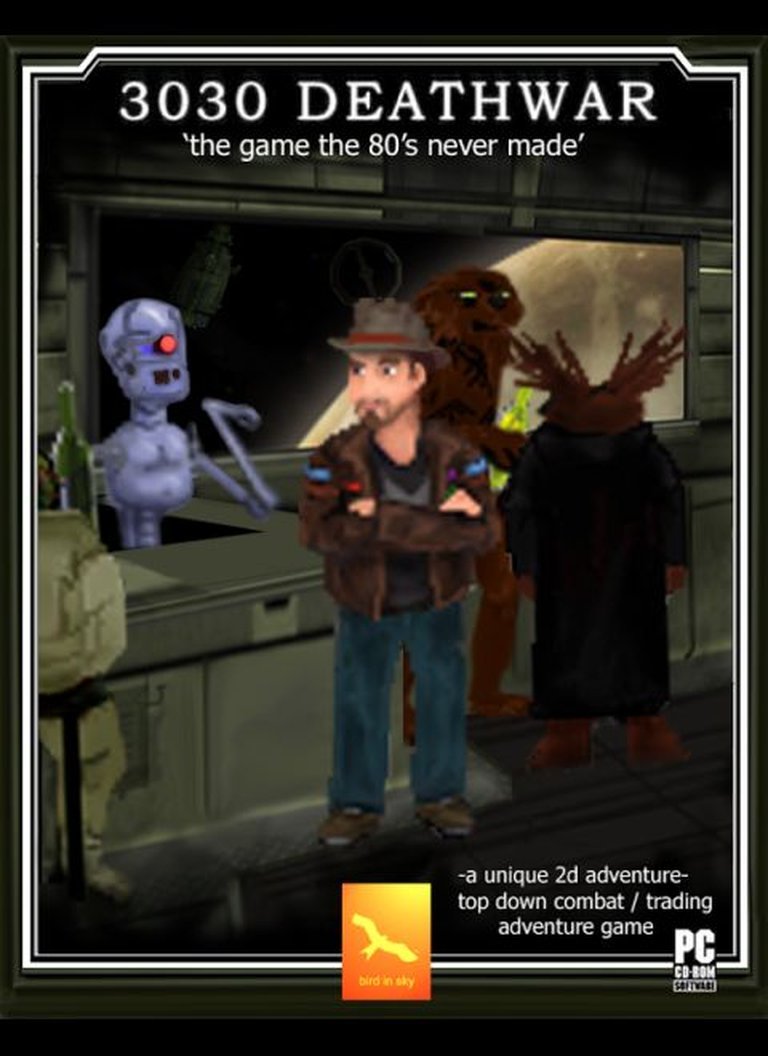
Set in the year 3029, 3030 Deathwar is a top-down open-world 2D space RPG where humanity and friendly alien species survive aboard ships and stations after the ‘Cleaners’—mysterious nano-machines—rendered planets uninhabitable. Players assume the role of rogue adventurer John Falcon, who joins the Taoists to combat the Cleaners and uncover their conspiracy. The game features free exploration of star systems, planets, and stations, with activities including trading, pirate hunting, derelict/whormhole exploration, and diverse missions ranging from assassination to cargo transport. Players can purchase and customize ships (fighter, trader, interceptor, or all-rounder) with weapons, thrusters, shields, and other upgrades, and interact with station-based characters in a point-and-click style to advance a 10-act story.
Gameplay Videos
Where to Buy 3030 Deathwar
PC
3030 Deathwar Cracks & Fixes
3030 Deathwar Guides & Walkthroughs
3030 Deathwar Reviews & Reception
metacritic.com (78/100): The minor issues encountered while playing 3030 Deathwar Redux are just that: minor. If you like space exploration with a decent story, then this is easily the adventure for you.
store.steampowered.com (85/100): If you like space exploration with a decent story, then this is easily the adventure for you.
p2pgames.blogspot.com (62.5/100): A sluggish, boring pace and high initial difficulty hurt this space adventure.
3030 Deathwar: Review
In the vast, often sterile expanse of space-themed video games, 3030 Deathwar emerges as a scrappy, idiosyncratic anomaly—a love letter to the golden age of ’90s space sims and point-and-click adventures, forged in the crucible of indie ambition. Originally released in 2007 by British duo Bird in Sky (Matt Griffiths and Mic Newsam), this 2D open-world RPG languished in obscurity, hampered by technical quirks and a market saturated with photorealistic 3D blockbusters. Yet, through iterative re-releases—first in 2014 with Max Dohme’s mod-driven overhaul, and culminating in the definitive Redux edition (2017)—it evolved into a cult phenomenon. 3030 Deathwar Redux defies its humble origins to deliver a universe teeming with personality, humor, and unbridled creativity. This review dissects its journey from flawed prototype to cherished cult classic, exploring how its synthesis of space exploration, noir storytelling, and adventure-game quirkiness carved an enduring niche in gaming history.
Development History & Context
3030 Deathwar was born from a clear, ambitious vision: to merge the emergent freedom of space-trading sims like Elite and Frontier: First Encounters with the narrative charm of LucasArts adventures (e.g., Indiana Jones and the Fate of Atlantis). Developed by the tiny British studio Bird in Sky, the 2007 release was a passion project executed with limited resources. Its 2D sprite-based aesthetic and top-down perspective were deliberate nods to ’90s classics, but they also reflected technological constraints—mid-2000s PCs struggled to render the scale Griffiths and Newsam envisioned, while their custom engine prioritized moddability over polish.
The game’s initial reception was muted. Released into a market dominated by 3D AAA titles like EVE Online and X3: Reunion, it attracted niche praise for its scope but was criticized for its punishing difficulty and archaic UI (e.g., complex docking sequences requiring precise keyboard inputs). A turning point came in 2014, when modder Max Dohme collaborated with Griffiths to launch a re-release. This iteration rebalanced combat, added resolution options, and streamlined controls, laying groundwork for Redux.
Redux (2017), co-published with Crunchy Leaf Games, arrived amid the indie renaissance and Steam’s Early Access boom. Though shackled to the 2007 codebase (preventing a full rework), it introduced expanded lore, graphical enhancements (parallax scrolling, animated billboards), and new mechanics like space races and planetary landings. Its success—over 40,000 copies sold and a 94% Steam rating—proved that passion projects, when refined, could thrive against AAA competition. As Griffiths noted, the goal was always to capture the “freedom of Frontier with the soul of Monkey Island,” a vision Redux finally realized.
Narrative & Thematic Deep Dive
3030 Deathwar unfolds in 3029, a galaxy reshaped by the “Cleaners”—self-replicating nanobots that eradicated planetary life, forcing survivors into space stations and ships. Players assume John Falcon, a perpetually broke rogue adventurer whose quest to reclaim his impounded ship entangles him in a conspiracy involving the Taoists, an anarchist faction fighting the Cleaners. The narrative, structured in 10 acts, is a masterclass in genre-blending: a cynical space-noir (The Maltese Falcon meets Blade Runner) leavened with slapstick absurdity.
Falcon epitomizes the “slacker noir” archetype—a perpetually tipsy anti-hero with a penchant for bad decisions, whose deadpan delivery (“John Falcon is the name I go by these days“) masks a hidden resilience. His foil is Kent Robot, a 500-year-old ASCII-faced droid who channels Star Trek: TNG’s Data and Adventure Time’s BMO. Kent’s obsession with detective work (e.g., investigating station murders) and deadpan quips (“in your own time“) provide emotional anchor amid cosmic chaos.
Supporting characters embody the game’s thematic duality. Vasquez, the alcoholic engineer, embodies working-class resilience; Frank the Mechanic, a cage-fighter turned pawn, critiques systemic exploitation. Dialogue crackles with meta-humor—references to Red Dwarf and Beverly Hills Cop—while deeper themes emerge: quarantine lockdowns satirize pandemic-era control, and the Cleaners’ ecophagy echoes real-world climate anxieties. The Redux finale, inspired by Red Letter Media’s film analysis, elevates the plot from farce to tragedy, proving that even a B-movie premise can resonate with thematic weight.
Gameplay Mechanics & Systems
3030 Deathwar’s genius lies in its dual-loop design:
1. Top-Down Space Sim: Players pilot customizable ships across 30 star systems, engaging in trading, bounty hunting, and derelict salvaging. Ships range from nimble interceptors to hulking miners, each upgradeable with weapons, shields, and tools like tractor beams. Combat is arcadey but strategic—missiles require careful aiming, while shields recharge dynamically. Yet the original version’s balance flaws (e.g., prohibitively expensive upgrades) and interstellar travel times (up to 10 minutes per jump) tested patience. Redux mitigated this with faster “split-drives” and rebalanced progression.
2. Side-Scrolling Adventure: Docking at stations shifts the view to a Sam & Max-style interface. Players converse with NPCs, trade goods, and accept missions—ranging from cargo delivery to photographing planets. Environmental puzzles (e.g., hacking PAC-MAN machines) reward lateral thinking, while side quests (e.g., rescuing stranded pilots) inject variety.
Redux introduced innovations: tractor beams enable space rescues (echoing Desert Strike), and gunplay adds visceral thrills. However, new additions like planet landings feel undercooked. The economy, driven by regional shortages (e.g., Delavian Chocolate as pirate contraband), is functional but shallow compared to Elite Dangerous. Ultimately, the game excels in player freedom—whether hunting pirates, running contraband, or joining the Taoists—but rarely rewards risk-taking beyond narrative progression.
World-Building, Art & Sound
The “Safe Zone” galaxy is a triumph of world-building. Stations like YSA and Walker Base are microcosms of post-apocalyptic society: quarantine zones with artificial gravity (achieved via rotating docks), Ukiyo-e wall hangings, and floating noodle bars. Derelict ships ooze Alien-esque dread, while hidden wormholes and pirate stations reward explorers. The Redux edition’s parallax scrolling breathes life into space, with nebulae and animated billboards replacing static voids.
Art direction is a loving homage. Ship designs nod to The Last Starfighter and Space Quest, while station interiors reference Flashback and Beneath a Steel Sky. Easter eggs abound—grffiti from Sam & Max, a Street Fighter II arcade cabinet—rewarding genre-savvy players. Sound, however, is a mixed bag. The Redux soundtrack, curated by The Kyoto Connection, blends electronica and traditional Japanese melodies, evoking Blade Runner’s melancholy. Yet voice acting is absent, relying on text dialogue that ranges from witty to groan-worthy. Environmental effects (e.g., engine hums) are serviceable but unremarkable.
This synthesis of retro aesthetics and modern polish creates a universe that feels both lived-in and inviting. As one Steam user noted, “Every station feels like a stop in Firefly’s ’Verse.”
Reception & Legacy
3030 Deathwar’s journey mirrors its narrative: a struggle against obscurity. The 2007 release earned middling scores (62% on MobyGames) with outlets like Out Of Eight criticizing “insane travel times” and “overly difficult pirates.” The 2014 re-release improved but remained niche. Redux (2017), however, catalyzed a cult following. Critics lauded its ambition: COGconnected called it “a triumphant return to form” (85%), while GameGrin praised its “stunning universe” despite thin gameplay (60%). Steam’s 94% positive rating (1,038 reviews) reflects player adoration, with many citing its humor and freedom as redeeming flaws.
Commercially, Redux surpassed expectations, selling over 40,000 copies. Awards like “Space Game of the Decade” (Space Game Junkie) cemented its legacy. Influentially, it proved hybrid genres could thrive—inspiring Shortest Trip to Earth and reviving interest in 2D space sims. Yet its impact extends beyond gameplay: its community-driven lore (e.g., Steam guides dissecting Taoist philosophy) exemplifies indie games as collaborative art. As developer Matt Griffiths reflected, “Redux wasn’t just a patch—it was a dialogue with players.”
Conclusion
3030 Deathwar Redux is a testament to the power of iterative design and unbridled passion. Its flaws—the occasionally clunky UI, uneven pacing, and underdeveloped mechanics—are eclipsed by its sheer personality. Like John Falcon’s patched-up shuttle, the game is more than the sum of its parts: a chaotic, heartfelt ode to sci-fi’s past that feels refreshingly original in the present.
For players seeking a universe rich with humor, mystery, and freedom, 3030 Deathwar is essential. It rewards patience with moments of brilliance—a dramatic space battle, a Kent Robot quip, a derelict ship’s tragic backstory. In an era of sanitized open worlds, its scrappy imperfections are virtues. As history will remember it, 3030 Deathwar didn’t just revive a genre; it redefined what an indie space odyssey could be.
Final Verdict: 8/10 – A flawed gem that shines brighter than most polished pretenders. Essential for adventurers willing to embrace its quirks.