
- Release Year: 2007
- Platforms: Windows
- Publisher: dtp Vertrieb und Marketing GmbH
- Developer: City Interactive S.A.
- Genre: Action
- Perspective: 1st-person
- Game Mode: Single-player
- Gameplay: Shooter
- Average Score: 70/100
Description
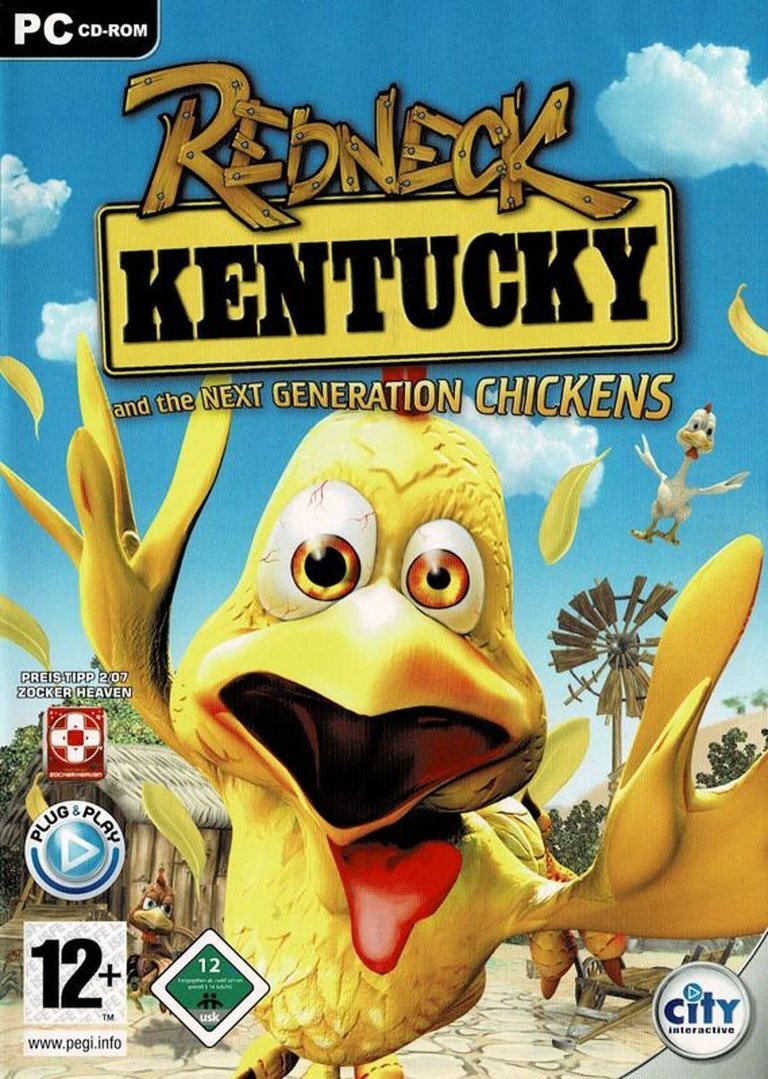
In ‘Redneck Kentucky and the Next Generation Chickens’, players assume the role of a hero combating an army of harmless-looking chickens plotting global domination across seven themed levels including farms and graveyards. This first-person arcade shooter expands on the classic Moorhuhn formula by allowing players to freely navigate environments while using four weapons to eliminate poultry within time limits. Bonus items like point multipliers and slow-motion effects enhance gameplay, alongside unique challenges such as ghost chickens requiring flashlight visibility for elimination.
Gameplay Videos
Where to Buy Redneck Kentucky and the Next Generation Chickens
PC
Redneck Kentucky and the Next Generation Chickens Free Download
Redneck Kentucky and the Next Generation Chickens Mods
Redneck Kentucky and the Next Generation Chickens Guides & Walkthroughs
Redneck Kentucky and the Next Generation Chickens Reviews & Reception
mobygames.com (70/100): It’s a dumb arcade shooter where you blow up chickens. Its cheap and brings a few good hours of fun and laughs.
Redneck Kentucky and the Next Generation Chickens Cheats & Codes
PC
Open the game files and navigate to the system folder. Edit the ‘User.ini’ file, find the line ‘# Tilde = ConsoleToggle’, remove the ‘#’ to make it ‘Tilde = ConsoleToggle’, and save the file. In-game, press the [~] (tilde) key to open the console.
| Code | Effect |
|---|---|
| Loaded | gives all guns and ammo. |
| Fly | activate flight mode. |
| Walk | cancels fly and ghost, returning you to normal land. |
| Ghost | pass through walls. |
| Teleport | teleport to where your cursor is pointing. |
| SetGravity # | set the gravity level (# = value). |
| SetJumpZ # | set jump height (# = value). |
| SetSpeed # | set movement speed (# = value). |
| PlayersOnly | only player moves, disables AI. |
| allammo | 999 rounds for all weapons. |
| Allweapons | unlock all weapons. |
| ChangeSize # | change player size (# = 0.25 to 2). |
| Stat fps | display FPS on screen. |
| Behindview 1 | switch to third-person view. |
| Behindview 0 | switch to first-person view. |
| Slomo # | change game speed (# = value). |
| Map # | load a level (# = level name from the “maps” folder). |
Redneck Kentucky and the Next Generation Chickens: Review
Introduction
In the pantheon of video game absurdity, few titles capture the chaotic spirit of early 2000s shovelware quite like Redneck Kentucky and the Next Generation Chickens. Released in 2007 by Polish studio City Interactive, this first-person shooter tasks players with thwarting a poultry apocalypse by blasting feathered fiends across seven increasingly deranged levels. At first glance, it seems like a disposable Moorhuhn clone with a 3D facelift—a disposable footnote in gaming history. Yet, its legacy has defied expectations, evolving from critical derision to a cult favorite on Steam. This review argues that beneath its rough-hewn exterior lies a surprisingly polished, self-aware arcade shooter that exemplifies a specific era of experimental game design—one where humor and simplicity trumped graphical fidelity. By dissecting its development, mechanics, and cultural impact, we uncover a game that, for all its flaws, embodies the unbridled joy of digital mayhem.
Development History & Context
City Interactive (later CI Games) was best known for grim military sims like Battlestrike: Force of Resistance and Code of Honor series, making Redneck Kentucky a jarring tonal departure. Developed under the creative direction of Piotr Michalak and a team of 47 Polish developers, the game leveraged Unreal Engine 2—a choice that allowed for competent visuals but constrained its ambition. The engine’s Karma physics and SpeedTree tech added weight to explosions and foliage, yet the team prioritized accessibility over realism, targeting the burgeoning casual market.
The 2007 gaming landscape was dominated by the rise of digital distribution and casual gaming. Moorhuhn’s stationary bird-shooting formula had European audiences hooked, but City Interactive sought innovation by adding player mobility—a twist that forced the game to compete with full-fledged FPS titles like Call of Duty 4. This created a fundamental tension: it was neither a simple arcade game nor a robust shooter, straddling a niche that appealed to neither hardcore nor casual audiences. Despite its Polish origins, the game localized for Germany (published by dtp Vertrieb), reflecting a strategy to capitalize on Europe’s affinity for absurdist humor. The result was a product defined by its contradictions: a technically competent game built on a shoestring budget, with a vision that was both commercially savvy and artistically idiosyncratic.
Narrative & Thematic Deep Dive
The plot is, fittingly, poultry-grade: chickens—dubbed the “Next Generation”—plot world domination, and players assume the role of a redneck protagonist tasked with stopping them. City Interactive leans into the absurdity with deadpan delivery, offering no backstory beyond the in-game manual’s premise. The narrative emerges from environmental storytelling: levels like a haunted graveyard or a dilapidated farm imply a rural America besieged by feathered insurgents. Characters are non-existent beyond the player avatar, who remains a silent, weapon-wielding everyman. Dialogue is sparse, limited to grunts and taunts like “Multikill!” upon slaughtering multiple chickens, reinforcing the game’s arcade ethos.
Thematic depth lies in its satire of rural stereotypes and apocalyptic tropes. Chickens are portrayed as both menial pests and existential threats, mirroring real-world anxieties about invasive species. The “ghost chickens” in the graveyard level—visible only with a flashlight—symbolize the unseen dangers lurking beneath bucolic facades. By weaponizing redneck tropes (shotguns, overalls, pickups), the game subverts expectations, framing its protagonist as an accidental hero. Though not a narrative masterpiece, this self-aware absurdity gives the game a tongue-in-cheek charm, acknowledging its silliness without winking at the audience.
Gameplay Mechanics & Systems
Redneck Kentucky’s core loop is deceptively simple: players navigate time-limited levels, using four weapons (shotgun, rifle, minigun, rocket launcher) to score points by shooting chickens and bonus items. The Moorhuhn DNA is evident in the point-scoring system, but the addition of free movement elevates the experience. Chickens patrol predictable paths, but their numbers and speed demand strategic positioning, turning each level into a frantic dance of evasion and precision.
Weapon variety defines the combat: the shotgun excels at close-range flocks, while the rifle rewards headshots with multipliers. Miniguns shred clusters but overheat, and rocket launchers excel against armored variants but risk friendly fire. Bonus items add depth—eggs grant points, clocks extend time, and “slow motion” power-ups enable bullet-time for clutch shots. However, the game’s brevity (completable in 60–90 minutes) and repetition undermine longevity.
The Unreal Engine 2 backbone ensures competent controls, but the interface is clunky. Health and ammo meters are tucked away in corners, and weapon-switching feels sluggish. Difficulty spikes in later levels, as chickens spawn in overwhelming numbers and “flying potatoes” (literal projectiles) punish aggressive play. Yet, the gunplay itself is satisfying—impact feedback and ragdoll physics make each kill viscerally rewarding. While basic, the mechanics create an addictive loop of risk and reward, exemplifying the arcade ideal: easy to learn, hard to master.
World-Building, Art & Sound
The game’s seven levels are a love letter to rural Americana, albeit filtered through a cartoonish lens. From sun-scorched farms to misty graveyards, each locale blends exaggerated terrain with interactive props. The graveyard’s crumbling tombstones and the farm’s rusting tractors create a lived-in atmosphere, though textures are dated. Art director Piotr Michalak’s team prioritized vibrancy over realism, using bright, saturated colors to emphasize the chaos. Chickens are rendered with goofy menace—some wear tiny hats, others explode in showers of feathers—ensuring they’re both targets and caricatures.
Sound design is the game’s unsung hero. Composer Bjørn Lynne delivers a twangy, instrumental country soundtrack that evokes southern Gothic vibes, punctuated by squawks, clucks, and explosions. The voice acting (credited to Brian Sommer) is minimal but effective, with grunts and yelps that amplify the redneck caricature. Spatial audio, enhanced via OpenAL, immerses players in the chaos, making chicken flocks sound like a feathered mob. While not technically groundbreaking, the art and sound synergy creates a cohesive, absurd world where every explosion feels like a punchline.
Reception & Legacy
Upon release, Redneck Kentucky was met with tepid applause. German critics slammed it as a shallow Moorhuhn clone, with GameStar scoring it 33% and PC Action dismissing its “spielerische Langeweile” (gameplay boredom). Even positive reviews like Onlinewelten.de’s 61% acknowledged its niche appeal, calling it a “guter Zeitvertreib” (good pastime). Players mirrored this ambivalence, with MobyGames’ average rating of 3.6/5 citing “short and basic” flaws.
Yet, the game’s legacy has undergone a remarkable renaissance. Steam’s modern user reviews are “Very Positive” (95% approval), with players praising its “dumb arcade” charm and $0.99 price point. This resurgence stems from its accessibility and humor—traits that resonate in an era of overstuffed AAA titles. Culturally, it influenced the Chickens Madness series (2020) and inspired mod communities, who added widescreen fixes and FOV sliders via ini edits. While it didn’t redefine the FPS genre, it remains a testament to City Interactive’s versatility, proving that even a studio known for gritty shooters could deliver a feathered farce. In the canon of absurd gaming, it stands alongside Carmageddon and Postal as a beloved, if flawed, oddity.
Conclusion
Redneck Kentucky and the Next Generation Chickens is a game of delightful contradictions: a polished product from a budget studio, a narrative vacuum with thematic depth, and a critical flop that became a cult classic. Its gameplay—simple yet satisfying—exemplifies the arcade spirit, while its art and sound elevate its absurd premise. Flaws like brevity and repetition are mitigated by its self-aware humor and accessibility, making it a perfect palate cleanser in a crowded gaming landscape.
Ultimately, Redneck Kentucky occupies a unique niche in history: it’s a time capsule of mid-2000s experimentalism, where developers could take risks on absurd premises without AAA budgets. Its legacy isn’t in innovation but in authenticity—a game that unapologetically delivers on its promise: blasting chickens for laughs. For players seeking unpretentious fun, it remains a feathered gem. For historians, it’s a reminder that the most enduring games often come from the most unexpected places.