
- Release Year: 2022
- Platforms: Windows
- Publisher: Ilan Manor
- Developer: Ilan Manor
- Genre: Role-playing, RPG
- Perspective: 1st-person
- Game Mode: Single-player
- Gameplay: Action, RPG
- Setting: Cyberpunk, dark sci-fi
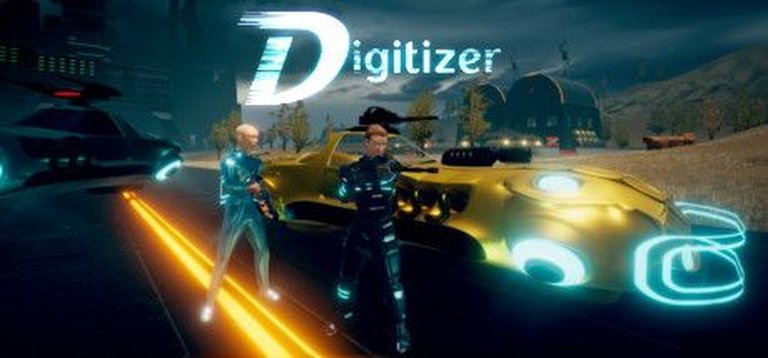
Description
Digitizer is a first-person action RPG set in a post-capitalist open-world where government control has collapsed, leaving poor survivors in anarchy while the wealthy reside in a fortified high-tech city above. Players must choose their side among multiple factions, engaging in combat, crafting, and vehicle navigation while making pivotal story decisions that will shape the game’s conflicted outcome in this cyberpunk/dark sci-fi universe.
Where to Buy Digitizer
PC
Digitizer: Review
Introduction
In the saturated landscape of modern open-world RPGs, few titles emerge as unapologetically ambitious as Digitizer. A five-year labor of love from Israeli solo developer Ilan Manor, this cyberpunk odyssey arrives not with the budget of a AAA studio but with the raw, uncompromising vision of a singular artist. Set in a fractured, post-capitalist future where the wealthy fortify themselves in a gleaming sky-city while the poor languish in an anarchy-ridden wasteland, Digitizer thrusts players into a world teetering on the brink of existential transformation. Its central premise—a technology offering eternal digital life at the cost of biological existence—poses a haunting question: Is survival worth surrendering humanity itself? This review argues that Digitizer, despite its technical imperfections and structural limitations, stands as a fascinating and provocative artifact of independent game development—a flawed, deeply personal examination of technological transcendence, class warfare, and the very definition of self.
Development History & Context
The genesis of Digitizer is inseparable from its creator, Ilan Manor, who served as sole developer, artist, writer, and publisher over a grueling five-year development cycle. This solitary endeavor, executed primarily in Israel, positions Digitizer as a testament to indie tenacity, with Manor leveraging the Unity engine to build a complex world despite limited resources. The game’s narrative, explicitly described by Manor as a “future prediction of our own world,” reflects a deliberate attempt to extrapolate contemporary socio-economic fractures into a dystopian future. Released on April 7, 2022, Digitizer entered a market dominated by behemoths like Elden Ring and Dying Light 2, yet its niche cyberpunk themes and solo focus distinguished it as a passion project. Manor’s commitment to authenticity is evident in casting professional voice actors (including Dale Allan, Georgiana Anghel, and Bobby Ashworth) for the 14-hour combined narrative (10-hour main story, 4-hour side stories)—a costly investment underscoring the game’s narrative ambitions. Technologically, Unity’s constraints are palpable: the game requires a robust minimum spec (Intel i7, GTX 1070) to run adequately, with performance hiccups and visual inconsistencies betraying its solo origins. Yet these limitations also amplify the achievement: a fully realized open world, branching dialogue systems, and faction-driven conflict built almost entirely by one hand.
Narrative & Thematic Deep Dive
Digitizer’s narrative is its crowning achievement, a stark, philosophical exploration of humanity’s technological future. Set in a world where government collapse has stratified society into the tech-fortified elite and the anarchic poor, the game centers on the “Digitizer” technology—a revolutionary invention offering eternal life in a simulated reality in exchange for biological existence. This binary dilemma forms the game’s moral core: players must choose between supporting the technology’s inventor and the city council (advocating digital transcendence) or joining the resistance (fighting to preserve the “old world” order). The narrative unfolds not through cutscenes but through branching dialogues with voiced NPCs, immersing players in ideological debates. Characters like Waisman (a tech advocate) and Anastasia (a resistance leader) embody conflicting philosophies—transhumanism versus humanism—forcing players to confront ethical weight. Themes are relentlessly contemporary: the ethics of AI consciousness, the dehumanization of class inequality, and the seductive dangers of escapism. Manor’s writing, though occasionally heavy-handed, avoids simplistic binaries, presenting both factions with valid rationales. The ultimate choice—digital eternity or biological impermanence—resonates beyond the game, mirroring real-world debates about virtual reality and mind uploading. This narrative depth, bolstered by professional voice acting, elevates Digitizer from a simple RPG to a philosophical treatise.
Gameplay Mechanics & Systems
Digitizer’s gameplay attempts to blend multiple systems into a cohesive whole, yielding a mixed bag of innovations and frustrations. At its core is an action-RPG framework with first/third-person perspectives, emphasizing player choice in combat and progression. Combat is versatile: players wield ranged (pistols, rifles), melee (blades, clubs), and vehicle-mounted machine guns, enabling tactical flexibility. However, the execution is rudimentary; gunplay lacks punch, melee combat feels weighty, and enemy AI is inconsistent. Driving mechanics, while serviceable for traversal, suffer from physics quirks and limited environmental interactivity.
RPG systems are more robust, with stats, perks, and skills offering meaningful progression. Character customization allows switching clothing and gear, influencing faction reputation. A deep inventory system incorporates weight calculations, trade, and crafting—resources can be scavenged to create weapons, ammo, or upgrades, adding strategic depth. Vehicle upgrades at workshops further enhance customization, though progression can feel grindy.
The open world, while atmospheric, suffers from repetitive design: enemies and NPCs respawn endlessly every few game days, undermining the sense of player impact. Fast travel and discovery systems mitigate this, but exploration often feels sparse. Dialogue is the standout feature; branching conversations with NPCs influence faction relationships without cutscenes, making choices feel organic. Despite these strengths, the gameplay lacks the polish of AAA titles—animations are stiff, UI is cluttered, and enemy encounters grow repetitive. Still, the systems serve the narrative, reinforcing themes of survival and consequence.
World-Building, Art & Sound
Digitizer’s world-building is a masterclass in atmosphere-driven storytelling. The post-capitalist setting is visually and thematically bifurcated: the high-tech “City” above gleams with sterile futurism, while the wasteland below is a neon-drenched, industrial hellscape. This contrast powerfully symbolizes the game’s central conflict—utopia versus dystopia, privilege versus desperation. Manor’s art direction leans into cyberpunk tropes, with rain-slicked streets, decaying infrastructure, and holographic billboards creating a lived-in sense of decay. Character designs (e.g., the cybernetically enhanced elites and scavenger-clad survivors) reinforce class divides, while environmental details—abandoned vehicles, graffiti, flickering streetlights—ground the world in tangible grime.
Sound design is a double-edged sword. Professional voice acting elevates interactions, with nuanced performances that breathe life into characters. Dialogue, though occasionally stilted, effectively conveys moral ambiguity. However, environmental audio is undercooked; ambient sounds lack depth, and the musical score is forgettable. Sound effects for combat and crafting are functional but unremarkable. Despite these audio limitations, the world’s atmosphere is palpable. The oppressive silence of the wasteland, punctuated by distant gunfire and static-filled radio chatter, immerses players in its desolation. This synergy of art and mood makes Digitizer’s world one of its most enduring qualities—a place where every visual and auditory element reinforces its grim, thought-provoking themes.
Reception & Legacy
Upon release, Digitizer received scant critical attention. Metacritic lists no critic reviews, with a “tbd” Metascore, while Steam’s sparse seven user reviews (as of data cutoff) reflect its niche status. Early player feedback was polarized: some praised its narrative ambition, faction choices, and voice acting, while others criticized its technical flaws, repetitive combat, and unrefined open world. Commercial performance appears modest, with Steam sales hovering around $7.49–$14.99, typical for indie titles without mainstream marketing.
Legacy-wise, Digitizer occupies a unique space in game history. As a solo-developed RPG tackling complex themes, it joins the ranks of passion projects like Underrail or Consortium, but with less influence due to its obscurity. Its legacy is not in innovation but in audacity: Manor proved one person could craft a sprawling, narrative-driven RPG with meaningful choices. Thematically, it resonates with contemporary discussions about AI and virtual reality, though it hasn’t sparked industry-wide discourse. For a small cult following, it represents the epitome of DIY game development—a labor of love that prioritizes ideas over polish. While unlikely to shape future games, Digitizer endures as a testament to indie resilience, a flawed yet fascinating artifact of solo ambition.
Conclusion
Digitizer is a paradox: a technically imperfect, structurally flawed game that shines through sheer narrative and thematic ambition. Ilan Manor’s solo vision yields a world rich with ideas, where the ethical dilemma of digital immortality overshadows gameplay inconsistencies. The branching dialogue, faction-driven story, and atmospheric cyberpunk setting elevate it beyond a mere action-RPG, transforming it into a philosophical exploration of humanity’s future. While combat, visuals, and world density suffer from budgetary constraints, the game’s intellectual core remains potent. For players willing to embrace its rough edges, Digitizer offers a rewarding, thought-provoking experience—one that challenges assumptions about life, technology, and survival. In the annals of game history, it may not be a classic, but it is a vital, brave outlier: a solo developer’s unflinching vision of a world on the edge, forever questioning what it means to be human.