
- Release Year: 1998
- Platforms: PlayStation, Windows
- Publisher: Dice Multi Media Europe B.V., Psygnosis Limited
- Developer: Magenta Software Ltd.
- Genre: Action
- Perspective: Behind view
- Game Mode: Co-op, Single-player
- Gameplay: Aviation, Flight, Shooter
- Setting: Futuristic, Sci-fi
- Average Score: 40/100
Description
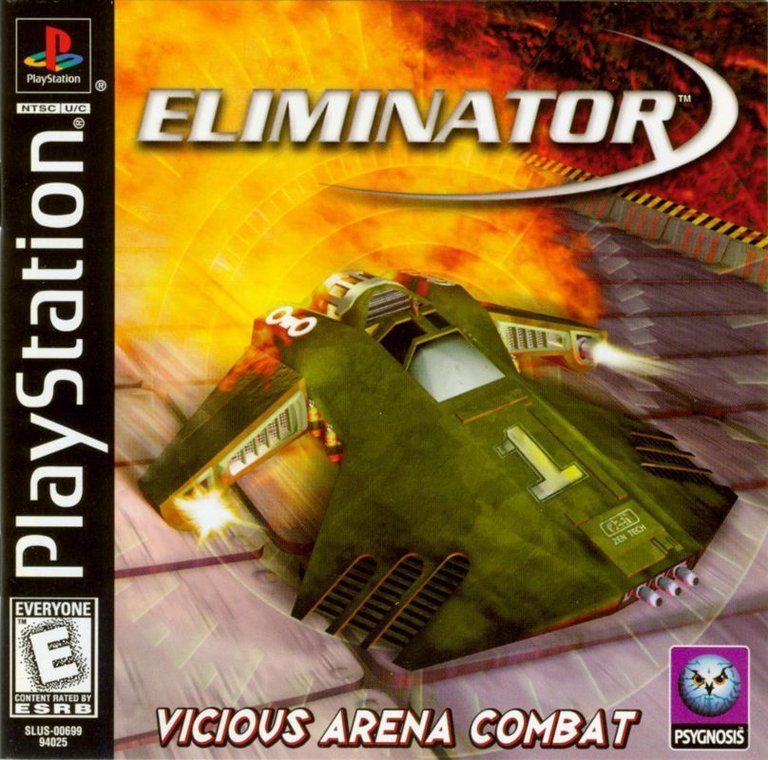
Eliminator is a sci-fi action shooter that tasks players with piloting experimental hovering craft through challenging courses, dodging obstacles, destroying opponents, and racing against an on-board bomb that threatens to end the game. As players progress, they can upgrade their craft and navigate increasingly difficult levels.
Where to Buy Eliminator
PC
Eliminator Free Download
Eliminator Guides & Walkthroughs
Eliminator Reviews & Reception
ign.com (40/100): Simplistic design and ho-hum gameplay keep Eliminator from being a wise buying choice.
Eliminator Cheats & Codes
PlayStation
Enter codes at the ‘ID’ selection screen or via a cheating device.
| Code | Effect |
|---|---|
| WAKYLEVL | Bonus level / Secret Level |
| NEWWEELS | Cadillac ship / Cadillac Car / Enable Secret Craft |
| CLEVALAD | Invincibility / Invulnerability |
| GUNCRAZY | All primary weapons full / Max Primary Weapons / Access All Crafts & Primary Weapons |
| MAXMEOUT | All secondary weapons full / Max Secondary Weapons / Access All Crafts & Secondary Weapons |
| WAITABIT | All time pick-ups ten minute / All Time Pickups worth 10 Minutes / Max Out Time |
| 80114272 0258 | Player 1: Infinite Health / Infinite Health P1 |
| 800f43b4 4649 | Infinite Time |
| xyxyxyxz | Beats all stages, then shows the ending video and such |
| toughguy | Harder Difficulty |
| zzzzxxxy | Infinite Health, Max All Weapons |
| chemwrks | The Asylum – Arena |
| bltitan | The Asylum – Bonus Run |
| itscrate | The Asylum – Guardian |
| indepths | The Cage – Arena |
| blatol | The Cage – Bonus Run |
| octopusi | The Cage – Guardian |
| martians | The Chasm – Arena |
| blmars | The Chasm – Bonus Run |
| meanmech | The Chasm – Guardian |
| darkvoid | The Fortress – Arena |
| blspace | The Fortress – Bonus Run |
| thequeen | The Fortress – Guardian |
| redworld | The Maze – Arena |
| blio | The Maze – Bonus Run |
| bernihot | The Maze – Guardian |
| frstbyte | The Monastery – Arena |
Eliminator: Review
Introduction
In the annals of PlayStation history, amidst the towering achievements of Final Fantasy VIII and Metal Gear Solid, lies a curious artifact: Eliminator. Released in 1999 by Psygnosis, this vehicular combat shooter promised a heady mix of high-stakes survival and futuristic spectacle. Yet, today it stands as a largely forgotten footnote, buried under a mountain of mediocre reviews and overshadowed by its more accomplished brethren. This review seeks to exhume Eliminator from its obscurity, dissecting its ambitious premise, flawed execution, and ultimately, its place in the transitional era of late-90s gaming. While its core concept—a prisoner forced to pilot a bomb-laden craft through lethal arenas—holds a glimmer of promise, Eliminator succumbs to a trifecta of issues: punishing difficulty, dated mechanics, and a lack of depth. It is a game that tantalizes with potential but ultimately frustrates, serving as a stark reminder of the perils of rushed development in an overcrowded market.
Development History & Context
Eliminator emerged from the studios of Magenta Software Ltd., a UK-based developer with a modest portfolio, under the watchful eye of Psygnosis. The latter, renowned for its high-profile PlayStation exclusives like Colony Wars and Wipeout, seemed an unlikely patron for such a title. Development began in 1998, positioning the game as a budget-friendly arcade experience. The creators’ vision, as articulated in previews, was grim and visceral: players would be thrust into a dystopian future as prisoners of war forced to pilot experimental hovercrafts in lethal televised combat arenas, with a literal bomb strapped to their craft as a constant threat.
Technologically, Eliminator was constrained by the PlayStation’s aging hardware and the PC’s burgeoning 3D acceleration standards. Its development timeline coincided with a pivotal moment for Sony’s console, which was entering its twilight years, and for PC gaming, which was rapidly evolving beyond early 3D experiments. Psygnosis, despite its reputation, was simultaneously juggling several projects, and Eliminator appears to have received less polish than its flagship titles. The game’s release in early 1999—months after landmark titles like Tomb Raider: The Last Revelation and Resident Evil 3—further highlights its rushed, derivative nature. It arrived not as an innovator but as an also-ran, attempting to capitalize on the arena combat trend popularized by games like Forsaken without offering a compelling reason for gamers to choose it over established competitors.
Narrative & Thematic Deep Dive
The narrative of Eliminator is a lean, dystopian affair, stripped of nuance but effective in establishing its desperate tone. The premise, detailed in the NTSC-U manual, is straightforward yet grim: in a fractured future, prisoners of war are conscripted into “The Elimination,” a televised death match repurposed as a weapons-testing ground. The player, a captive, is forced to pilot one of four experimental craft—each with distinct ratings in shields, speed, and weapons—through eight increasingly lethal arenas. The central conflict is twofold: survive the labyrinthine levels while racing against a literal ticking time bomb embedded in the craft, and decimate waves of robotic foes to unlock laser barriers.
Characterization is minimal, with the player’s avatar serving as little more than a conduit for violence. The four craft names (Redeemer, Freedom, Liberty, Survivor) carry ironic weight, hinting at false hope within a system designed for annihilation. Dialogue is nonexistent, replaced by environmental storytelling: the sterile, oppressive arenas, the relentless hum of the bomb, and the staccato blasts of weaponry. Thematically, the game explores dehumanization and institutional cruelty, framing survival as both a physical and psychological ordeal. The bomb is a masterstroke of tension, transforming each level into a frantic race against annihilation. However, this potential is squandered by repetition. The narrative’s bleakness, initially intriguing, devolves into monotony as arenas blend together, and the lack of character or plot progression reduces the experience to a cycle of violence and escape. The Civil War backstory feels tacked on, a flimsy justification for the carnage rather than a foundation for deeper engagement.
Gameplay Mechanics & Systems
At its core, Eliminator presents a hybrid of vehicular combat and maze navigation. Players pilot their hovercraft through expansive 3D arenas, utilizing a combination of primary and secondary weapons to destroy enemies and unlock paths. The controls, while initially promising, reveal critical flaws. The manual boasts features like strafing, weapon cycling, and a “revolutionary targeting system,” yet reviews uniformly condemn the analog controls as “fuzzelig” (fuzzy) and imprecise. Digital controls, ironically, are cited as more reliable, a damning indictment of the game’s design. The targeting system, intended to simplify dogfights, often leads to frustration, as enemies exploit its quirks to evade fire.
The time-bomb mechanic is the game’s most compelling feature, creating a relentless sense of urgency. Each arena must be cleared within a strict time limit, with power-ups extending the clock. This pressure elevates the frantic pace, but it also amplifies the game’s punitive difficulty. As noted by Bravo Screenfun, “extreme time pressure and a frustrating targeting mechanism ensure frustration.” Level design exacerbates this, with narrow corridors and cheap enemy placements that feel less like deliberate challenge and more like design oversights. Progression is linear, with eight main arenas (Penitentiary, Maze, Asylum, etc.) and eight bonus stages, but repetition is inescapable. The 12 ballistic weapons and 30 enemy types offer superficial variety, but enemy AI is uniformly dumb, reducing encounters to mindless shooting sprees.
Multiplayer, the game’s touted two-player split-screen mode, fares no better. Three duel zones (Pit, Dome, Labyrinth) task players with finding and using Warp Bombs to destroy each other’s bases. The concept is sound, but the imprecise controls and laggy frame rate render it a frustrating experience. As Game Over Online bluntly states, “this game is not fun, it just repetitive.” Ultimately, Eliminator’s gameplay systems lack refinement, sacrificing depth for a veneer of arcade action that wears thin within hours.
World-Building, Art & Sound
The sci-fi world of Eliminator is a patchwork of familiar tropes, realized through functional but unremarkable art direction. The eight arenas—ranging from lava-filled chasms to metallic fortresses—adhere to a gritty, industrial aesthetic, drawing clear inspiration from films like Escape from New York. Environmentally, they are vast but sparse, lacking the detail to feel truly lived-in. Textures are flat and repetitive, and enemy designs are uninspired, consisting of generic drones and boss characters that fail to evoke menace. The PSXDataCenter manual’s claim of “vast playing arenas” rings hollow, as levels often feel constrained by their design, prioritizing tight corridors over exploration.
Sound design is similarly middling. The soundtrack, composed by Aziz Ibrahim, is a rare bright spot, offering driving, industrial-tinged tracks that complement the game’s high-energy pace. However, sound effects are perfunctory, with explosions and weapon fire lacking punch. The constant ticking of the bomb is the most effective audio cue, a relentless reminder of impending doom. Voice acting is absent, replaced by synthesized beeps and static that further isolate the player. While the game’s atmosphere is adequately grim, it never transcends its budget constraints. The visual presentation, while technically competent for the era, fails to stand out, with flickering textures and pop-in issues on PlayStation. In a year defined by graphical leaps, Eliminator’s presentation feels dated, contributing to its overall sense of being a half-realized product.
Reception & Legacy
Upon release, Eliminator was met with a wave of critical indifference, if not outright hostility. Aggregated scores tell a stark story: a 46% average on MobyGames (based on 23 reviews) and a dismal 34% on GameRankings. Critics uniformly panned its execution, despite acknowledging its premise. GameSpot derided it as a game that would “starve you for entertainment,” while IGN lamented its “skin-deep gameplay” in the shadow of Psygnosis’ own Colony Wars: Vengeance. German publications like PC Joker praised its “ansprechende Präsentation” (appealing presentation) but lambasted the “überladene Tastatursteuerung” (overloaded keyboard controls) on PC. The most scathing critiques came from Playstation Pro, which infamously opined that “crap games like this will force the young and impressionable into a world of class A drugs,” while PC Games (Germany) awarded it a paltry 18%, calling it a “sinnloses Intro” (senseless intro).
Commercially, Eliminator disappeared without a trace. Its low budget and lack of marketing ensured it remained a niche title, overshadowed by 1999’s blockbuster releases. Player reviews on MobyGames average a tepid 2.3/5, reflecting the sentiment that it was a rental at best. Legacy-wise, Eliminator left no discernible footprint on the gaming industry. It did not innovate or inspire subsequent titles, instead fading into obscurity as a cautionary tale of rushed development. Its only legacy is its infamy among retro gamers, cited as a prime example of Psygnosis’ missteps. The Eliminator name, once tied to the innovative 1981 Sega arcade game, became associated with mediocrity, a distinction the 1999 title has never escaped.
Conclusion
Eliminator is a game of missed opportunities. Its core concept—prisoners battling for survival in bomb-laden craft—brims with potential, promising tension and high-octane action. Yet, under the weight of imprecise controls, punishing difficulty, and repetitive design, this potential is squandered. It is a product of its time: a late-90s budget title attempting to ride the coattails of trends without the polish or innovation to stand out. The narrative’s bleakness, while initially compelling, never deepens, and the gameplay systems, once promising, devolve into frustration. Visually and aurally, it is competent but forgettable, a relic of an era when 3D graphics were still finding their footing.
In the grand tapestry of video game history, Eliminator serves as a footnote—a reminder that even promising ideas can falter without execution. It is not a “so bad it’s good” curiosity but rather a frustrating experience that highlights the gap between ambition and reality. For historians, it offers a glimpse into the transitional period of late-90s PlayStation and the pressures of publisher-driven development. For gamers, however, it remains a title best left unplayed. Eliminator is, in the end, a cautionary tale: a game that eliminates its own fun through a combination of hubris and haste, leaving little but a faint echo of what could have been.