
- Release Year: 2001
- Platforms: DOS, Windows
- Publisher: Electronic Arts, Inc.
- Genre: Compilation
- Perspective: Top-down
- Game Mode: LAN, Online PVP
- Gameplay: Base building, Real-time strategy, Resource Management
Description
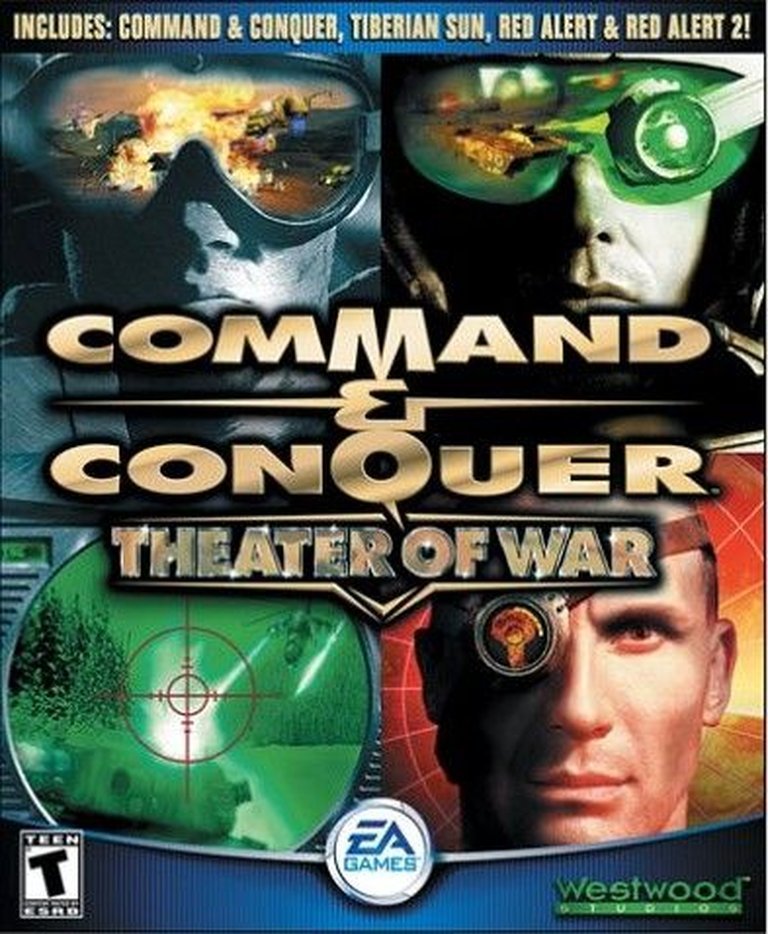
Command & Conquer: Theater of War is a 2001 Windows compilation that brings together four foundational real-time strategy games: the original Command & Conquer (1995), Command & Conquer: Red Alert (1996), Command & Conquer: Tiberian Sun (1999), and Command & Conquer: Red Alert 2 (2000). Set in alternate near-future timelines, the games depict global conflicts such as the war between the Global Defense Initiative and the Brotherhood of Nod over the alien resource Tiberium, and the struggles between the Allies and the Soviet Union. Unlike other compilations, this collection exclusively includes base games without expansion packs.
Command & Conquer: Theater of War Reviews & Reception
retro-replay.com : Theater of War’s core gameplay remains tight, nostalgic, and endlessly replayable.
Command & Conquer: Theater of War Cheats & Codes
Saturn
Enter the codes with the Controller while the game is going on. Do not pause the game.
| Code | Effect |
|---|---|
| Y, A, B, B, A, Down, A, B, B, A, Down, Up | Build Up Code |
| Y,A,B,B,A,DOWN,A,B,B,A,DOWN,UP | Commando and Rocket Launcher |
| X, Y, Z, Right, Down, Left, Up, Right, Down, Left, Up, X | Laser Code |
| Up, Down, Right, Left, A, Up, Down, Right, Left, A | Map Code |
| Right, Left, A, B, C, Z, Y, X, Right, Left | Money Code |
Nintendo 64
Enter the code on the third NOD mission, hold Z,L, and R and type the code
| Code | Effect |
|---|---|
| Left Right Up B Up Down A B A B B | Clears fog of war |
| Up Down Left Right Right Up Down Left B B B A B B A A | Enemies can’t build any units |
| Up Up Up Up Up Up Up Up Down Down B | Free Buildings |
| Up Up Up Up Up Up Up Up Down Down A | Free Infantry |
| Up Up Up Up Up Up Up Up Down Down A B | Free Tanks |
| Up Down Down Up Left A B | No health limits |
| Down Down Down Down Up Left B B B B A | Unlimited money |
PlayStation
Press Start to pause the game, then press
| Code | Effect |
|---|---|
| Right, Down, Down, Left, L1, Left, Right, Down, Left | $5000 |
| Right, Down, Left, Left, Down, Right, Right, Down, Left, X, Square, Circle | Call in an Air Strike |
| Right, Down, Left, Left, Down, Right, Right, Down, Left, X, Square, Triangle | Ion Cannon |
| Right, Down, Left, Left, Down, Right, Right, Down, Left, X, Up, X | Nuclear Missile |
| Circle, Circle, Circle, Up, Circle, Square, R1, Circle, Circle, Circle | View Entire Map |
PC
When in MS-DOS or DOS go in the C&C directory and type in
| Code | Effect |
|---|---|
| C&C FunPark | Gives hidden levels with dinosaurs and barbed wire in 2 Player mode |
Command & Conquer: Theater of War: Review
Introduction
In the annals of real-time strategy (RTS) history, few franchises command the reverence and influence of Command & Conquer. As the genre exploded in the mid-1990s, Westwood Studios’ magnum opus not only defined RTS conventions but elevated it through cinematic storytelling and asymmetrical warfare. Command & Conquer: Theater of War, released in 2001, stands as a pivotal artifact—a compilation bundling four seminal titles: Tiberian Dawn (1995), Red Alert (1996), Tiberian Sun (1999), and Red Alert 2 (2000). This anthology is more than a mere nostalgia trip; it is a curated museum of design evolution, narrative ambition, and technological ambition. Yet, by excluding expansion packs, it forces us to confront a question: Does this “pure” core experience represent the franchise’s zenith, or is it an incomplete tribute? This review argues that Theater of War is an indispensable historical document, preserving the raw, revolutionary essence of Command & Conquer while serving as both a primer for newcomers and a time capsule for veterans.
Development History & Context
Westwood Studios, the creative architects behind Command & Conquer, emerged from the ashes of the influential Dune II (1992). Frustrated by licensing constraints, the team sought to create an original RTS that transcended its IP roots. As recounted in historical records, they deliberately abandoned the “sand” motif of Dune, envisioning a near-future conflict fueled by alien resources (Tiberian Dawn) and alternate-history Cold War tensions (Red Alert). Released in 1995, the original game debuted on MS-DOS and Windows, leveraging CD-ROM technology for its groundbreaking full-motion video (FMV) sequences—a radical departure from in-engine cutscenes. This decision birthed a signature franchise trait: campy, character-driven narratives starring actors like Joseph Kucan (as the iconic villain Kane) and Eric Gooch (as GDI commander Michael McNeil).
Technologically, the games spanned a transformative era. Tiberian Dawn and Red Alert relied on sprite-based graphics and rudimentary networking, while Tiberian Sun (1999) introduced an isometric 3D engine with dynamic terrain and lighting—a quantum leap in visual fidelity. By Red Alert 2 (2000), the series embraced vibrant, cartoonish aesthetics and refined multiplayer via LAN and modem connections. Westwood’s acquisition by Electronic Arts in 1998 injected corporate polish but preserved the studio’s creative autonomy until its dissolution in 2003. Theater of War arrived as EA capitalized on the franchise’s cultural saturation, bundling these four titles without expansions (Covert Operations, Counterstrike, Firestorm, Yuri’s Revenge) to streamline accessibility. This omission, while pragmatic, inadvertently framed the compilation as a “pure” origin story—a testament to the core games’ unassailable design.
Narrative & Thematic Deep Dive
Theater of War presents two divergent narrative threads, each a masterclass in thematic storytelling. The Tiberium universe (Tiberian Dawn and Tiberian Sun) offers a grim eco-apocalypse. Tiberian Dawn introduces Tiberium, a crystalline extraterrestrial mineral that corrupts Earth’s ecology while serving as a valuable resource. This duality fuels the global conflict between the UN-backed Global Defense Initiative (GDI) and the mystical Brotherhood of Nod, led by the messianic Kane. Kane’s rhetoric frames Tiberium as a catalyst for human evolution, while GDI’s mission emphasizes containment—a clash between progress and preservation. The narrative unfolds through FMV cutscenes, blending geopolitical intrigue with supernatural cultism. Characters like GDI’s General Mark Jamison and Nod’s Seth embody ideological rigidity, with Kane’s enigmatic presence elevating the story beyond simple good-versus-evil.
Tiberian Sun, set in 2030, deepens the lore with a Tiberium-ravaged planet. GDI now governs “Blue Zones” (uncontaminated havens), while Nod rules “Yellow Zones” (post-industrial wastelands). The sequel introduces Dr. Ignatio Mobius (Tiberium’s discoverer) and cyborg assassin Oxanna Kristos, exploring themes of transhumanism and corporate exploitation. Kane’s “ascension” and GDI’s ion superweapons underscore a cycle of escalation, culminating in a prophetic finale that hints at alien origins.
The Red Alert series (Red Alert and Red Alert 2) pivots to absurdist alternate history. Red Alert posits a world where Albert Einstein’s time-travel experiment erases Adolf Hitler, unleashing Soviet Premier Joseph Stalin’s global conquest. Allies (USA, UK, Germany) face Soviets with pulp-fiction flair, featuring Tesla coils, psychic soldiers, and hammy performances by actors like Kari Wuhrer (Tanya) and Andrew Divoff (Stalin). Thematically, it satirizes Cold War paranoia, reducing ideological warfare to camp melodrama. Red Alert 2 amplifies this with a Soviet invasion of the US, introducing psychic manipulator Yuri and absurd units like Soviet war bears. The Allies’ President Dugan and Soviet Premier Romanov embody cartoonish caricatures, yet their conflict resonates with real-world anxieties about proxy wars and technological overreach.
Both universes share thematic DNA: moral ambiguity, the cost of war, and the blurring of heroism and villainy. Kane’s charisma and Yuri’s megalomania ensure the narratives remain etched in memory, even as their dialogue (“Peace through superior firepower!”) becomes cultural touchstones.
Gameplay Mechanics & Systems
Theater of War showcases the Command & Conquer formula in its purest form. Core gameplay revolves around base-building and resource management, executed with a deceptively simple elegance. Players deploy a Mobile Construction Vehicle (MCV) to erect structures, which unlock units, technologies, and superweapons. Resource gathering differs by universe: Tiberium games use toxic crystals harvested by harvesters, while Red Alert relies on ore and gems. This economic loop creates tense risk-reward decisions, as players must balance expansion with defense—a dynamic refined across the compilation.
Combat adheres to a rock-paper-scissors philosophy. GDI’s slow, armored juggernauts (e.g., Mammoth Tanks) counter infantry but are vulnerable to air units, while Nod’s stealthy buggies and laser-focused tanks favor hit-and-run tactics. Tiberian Sun innovates with subterranean units (e.g., Nod’s Subterranean APC) and environmental hazards, such as Tiberium storms that damage units. Red Alert 2 introduces quirky asymmetry: the Allies’ Chrono Legionnaires erase units from existence, while the Soviets’ Tesla Troops fry infantry with electricity. The factional distinctions ensure variety, though Red Alert’s Soviet horde tactics occasionally devolve into brute-force attrition.
UI and controls remain consistent, with a sidebar housing unit commands—a landmark design choice that became a genre staple. Tiberian Sun’s interface is cluttered but functional, while Red Alert 2’s streamlined approach prioritizes accessibility. Multiplayer, enabled via LAN or modem, was revolutionary at launch. Westwood’s inclusion of dual CD-ROMs allowed friends to play without additional purchases—a pioneering move popularized by the slogan “A second copy, so you and your friend can destroy each other.”
Innovations like Tiberian Sun’s day/night cycles and Red Alert 2’s naval warfare add depth, but the absence of expansions (e.g., Firestorm’s cyborgs, Yuri’s Revenge’s psychic faction) leaves gaps in strategic diversity. Still, the core gameplay remains a masterclass in scalable complexity, offering both strategic depth and chaotic fun.
World-Building, Art & Sound
The compilation’s world-building is a triumph of speculative fiction. Tiberian Dawn’s post-Tiberium earth is a haunting tableau of mutated landscapes and decaying cities, while Tiberian Sun’s world is a neon-drenched dystopia with hover tanks and cyborgs. Red Alert’s alternate history evokes 1950s Cold War aesthetics, with Allied Tesla-coil factories and Soviet propaganda posters. Red Alert 2 amplifies this with retro-futurism, such as the Empire State Base and Soviet dreadnoughts. Each universe is meticulously crafted, with lore delivered through mission briefings, unit descriptions, and FMV vignettes.
Art direction evolved from pixelated sprites to pre-rendered 3D. Tiberian Dawn and Red Alert feature charmingly crude but atmospheric sprites, while Tiberian Sun uses isometric 3D for dynamic terrain and unit animations. Red Alert 2 adopts a vibrant, comic-book style, with exaggerated unit designs (e.g., the Chrono Commando) and expressive UI elements. Cutscenes, grainy by modern standards, retain their B-movie charm—Kane’s monologues and Tanya’s quips are etched in collective memory.
Sound design is the compilation’s unsung hero. Frank Klepacki’s compositions are legendary: Tiberian Dawn’s “No Mercy, No Regret” industrial beats and Red Alert’s “Hell March” (a metal anthem with marching cadences) defined RTS audio. Unit voice commands (“Soviet commando, reporting for duty!”) and environmental audio (Tiberium hums, explosions) immerse players. The FMV soundtracks, though dated, enhance the narrative’s theatricality.
Reception & Legacy
Theater of War arrived amid the franchise’s commercial zenith, with Command & Conquer titles selling over 10 million copies by 1999. Individual games earned critical acclaim: Tiberian Dawn holds a 94% Metacritic score, Red Alert boasts 90%, and Tiberian Sun and Red Alert 2 hover around 84–86%. The compilation, however, received muted attention—reviewers lamented the exclusion of expansions but praised its value for newcomers.
Its legacy is twofold: as a historical artifact and as a genre blueprint. The compilation preserved Westwood’s original design ethos, influencing RTS classics like StarCraft and Company of Heroes. FMV storytelling, once derided, is now celebrated for its audacity. The GDI/Nod dynamic and rock-paper-scissors combat remain archetypes.
However, Theater of War also highlights the franchise’s evolution. Later titles like Generals (2003) abandoned FMVs for 3D engines, and Tiberian Twilight (2010) alienated fans by removing base-building. The compilation’s “pure” core became a benchmark for remasters—culminating in Command & Conquer: Remastered Collection (2020), which addressed many of its technical shortcomings.
In the broader industry, Theater of War exemplifies how compilations can immortalize a series. It introduced generations to Command & Conquer’s magic, ensuring its relevance when EA later open-sourced the games in 2025.
Conclusion
Command & Conquer: Theater of War is a paradox: an incomplete anthology that feels remarkably complete. By omitting expansions, it strips the series to its essence, revealing the brilliance of Westwood’s foundational design. The four titles within showcase RTS in its prime—where asymmetrical warfare, FMV narrative, and addictive resource loops merged into a cultural phenomenon.
Yet, its omissions are undeniable. Firestorm’s CABAL storyline and Yuri’s Revenge’s psychic faction are missed, and the compilation’s lack of modern multiplayer support (LAN/Modem only) limits its replayability for contemporary audiences. These flaws, however, do not diminish its historical significance. Theater of War is a time capsule, preserving the raw, unfiltered spirit of Command & Conquer—a series that dared to blend strategy with soap opera, pixelated sprites with cinematic ambition.
For historians, it is a vital artifact charting the genre’s evolution. For gamers, it is a gateway to a golden age of RTS, where a single “just one more mission” could consume entire weekends. In a world of microtransactions and live-service games, Theater of War stands as a testament to purity. It is, and always will be, a “theater” of war worth revisiting.
Verdict: Essential. Though imperfect, Theater of War remains a cornerstone of gaming history—a compilation that honors the past while inspiring the future.