
- Release Year: 1994
- Platforms: Amiga, DOS, Windows
- Publisher: Crucial Entertainment Limited, Impressions Games, Rebellion Developments Ltd.
- Developer: Impressions Games
- Genre: Strategy, Tactics
- Perspective: Top-down
- Game Mode: Hotseat, Online PVP, Single-player
- Gameplay: Base building, Real-time strategy, Resource Management, Siege, Tactical Combat
- Setting: Europe, Medieval
- Average Score: 83/100
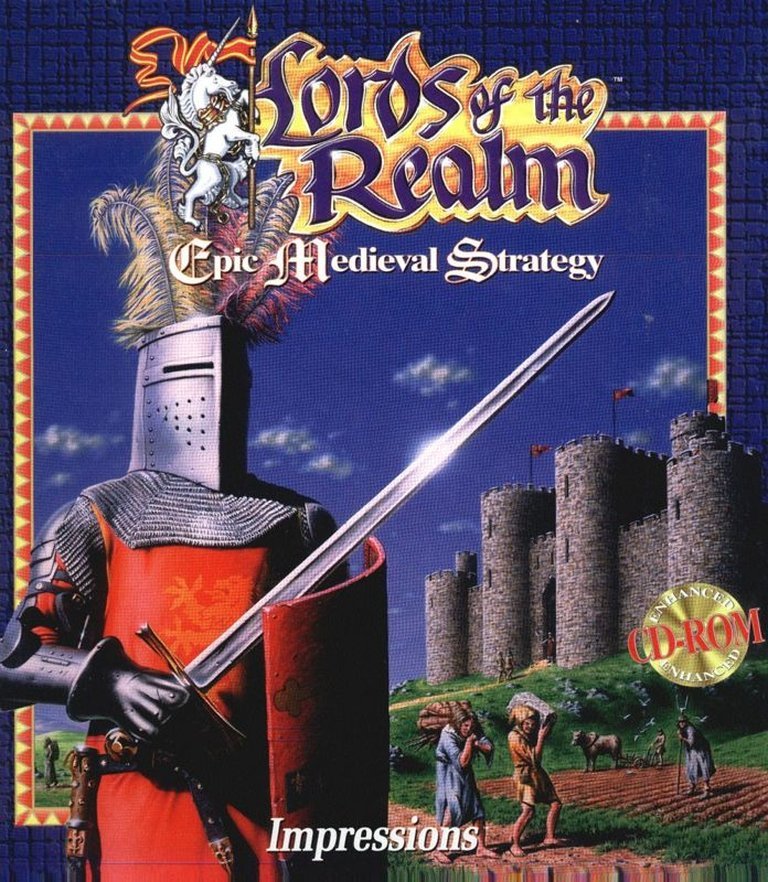
Description
Set in 1268 A.D. during a power vacuum in medieval England, Lords of the Realm challenges players to compete with five rival lords for the crown through feudal governance, resource management, and strategic warfare. Players must keep serfs fed and happy while assigning them to farming, herding, castle-building, and military service, then design or use historical blueprints to construct fortresses, besiege enemy castles, and command tactical land battles in real-time to claim the kingdom.
Gameplay Videos
Where to Buy Lords of the Realm
Lords of the Realm Free Download
Lords of the Realm Patches & Updates
Lords of the Realm Guides & Walkthroughs
Lords of the Realm Reviews & Reception
gamesreviews2010.com (85/100): Lords of the Realm is a timeless classic that offers a deep and engaging strategy experience.
Lords of the Realm Cheats & Codes
PC
Type ‘nazis on parade’ during gameplay.
| Code | Effect |
|---|---|
| nazis on parade | Instant castle |
Lords of the Realm: Review
Introduction
In the annals of strategy gaming, few titles capture the brutal elegance of medieval governance with the same visceral impact as Lords of the Realm. Released in 1994 by Impressions Games, this seminal work masterfully blended turn-based empire management with real-time tactical combat, creating a hybrid that would influence generations of developers. Set against the turbulent backdrop of 1268 England—a kingdom reeling from the power vacuum left by the Barons’ War—the game thrusts players into the role of a noble vying for the vacant throne. Its legacy as a precursor to the Total War series is undeniable, yet Lords of the Realm stands on its own merits as a meticulous, ambitious simulation of feudal life. This review deconstructs its enduring genius, contextualized within its era and amplified by its lasting impact on strategy gaming.
Development History & Context
The Studio and Vision
Impressions Games, founded by David Lester in 1989, was already a respected name in strategy development thanks to the Caesar series. For Lords of the Realm, Lester partnered with Christopher J. Foster (serving as both producer and designer) to craft a game that eschewed the “spreadsheet syndrome” of earlier titles. Their vision was unapologetically historical: to simulate the precarious balance of medieval power through granular resource management, castle architecture, and brutal warfare. As Lester noted in retrospective interviews, the goal was to make “animal husbandry fun”—a testament to their commitment to immersive, systems-driven design.
Technological Constraints and Innovation
Developed primarily for MS-DOS, the game operated within the technological confines of 1994. It utilized 256-color VGA graphics at 320×200 resolution, with isometric overhead maps for strategic county management and pseudo-3D renderings for castle sieges. The Amiga port (released later in 1994) leveraged hardware audio but suffered from slower performance due to platform limitations. Crucially, the real-time battle engine—allowing players to pause and issue commands—was a bold departure from the rigid turn conventions of its contemporaries. This system, though rudimentary by modern standards, laid groundwork for the pausable real-time tactics popularized by later titles.
The Gaming Landscape of 1994
1994 was a watershed year for strategy games. X-COM: UFO Defense and Ultimate Underworld redefined tactical depth, while Dune II cemented the real-time strategy genre. Lords of the Realm occupied a unique niche, positioning itself as a “historical simulator” that appealed to both wargamers and casual strategists. Its inclusion of a 34-page historical booklet, England Under Edward I (written by Jennifer Hawthorne), underscored Impressions’ commitment to authenticity—an unusual move for the era that lent the game scholarly credibility.
Narrative & Thematic Deep Dive
The Power Vacuum of 1268
The game’s narrative is deceptively simple: the English throne lies empty, and six lords (including the player) vie for supremacy. Yet beneath this hook lies a rich tapestry of feudal intrigue. Each AI-controlled opponent—such as “The Knight” or “The Countess”—embodies archetypal medieval rivalries: aggression, cunning, and betrayal. The game’s dialogue, delivered through messenger dispatches, reflects the era’s precarious diplomacy, with alliances forming and fracturing based on shifting power dynamics.
Themes of Feudal Realism
Lords of the Realm excels in its thematic authenticity. The core loop—managing serfs, balancing food rations, conscripting armies, and quelling revolts—mirrors the brutal arithmetic of medieval governance. Taxation sliders directly impact peasant happiness; over-conscripting troops risks rebellion; and poor harvests can trigger famines. These systems are not mere mechanics; they are narrative engines. For instance, rationing food to save gold for weapons might stave off invasion but could spawn “armies of thieves” from discontented peasants—a tangible consequence of player decisions.
Historical Context as Narrative Device
The bundled England Under Edward I manual is a masterstroke of world-building. It contextualizes gameplay within real feudal structures: crop rotation schedules, castle evolution from motte-and-bailey to concentric designs, and the socio-economic role of guilds. This transforms county management from abstract micromanagement into a visceral engagement with history. Even the game’s German campaign (included in later releases) expands this scope, reflecting the fragmented Holy Roman Empire’s political chaos.
Gameplay Mechanics & Systems
The Turn-Based Strategic Layer
Each turn represents a season, demanding long-term planning. Players allocate serfs to 16 fields (for grain, cattle, sheep), manage taxation (via sliders), and recruit nobles. Resource balancing is punishingly granular: food surpluses fuel population growth, while gold funds military buildup. Transporting resources between counties via slow-moving wagons introduces strategic depth—caravans can be intercepted, forcing players to weigh risk against reward.
Real-Time Tactical Combat
Battles switch to a real-time mode where units (representing 10+ soldiers) clash on tactical maps. Players command infantry, archers, knights, and siege engines, with terrain like marshes offering tactical advantages (e.g., funneling enemies into arrow fire). The ability to pause commands (“RTS done right,” as one reviewer noted) allowed for methodical strategy, while auto-resolve catered to players preferring abstraction. Unit morale, influenced by payment and battlefield losses, adds realism—unpaid knights may desert mid-battle.
Castle Building and Sieges
The castle design tool is both creative and functional. Players construct fortresses using historical blueprints or custom layouts, with moats, towers, and drawbridges impacting siege defense. Sieges themselves unfold in phases: bombardment with catapults, followed by infantry assaults. The pseudo-3D view during these sequences provides a dramatic perspective, though its limitations (e.g., no interior detail) highlight the era’s constraints.
Flaws in the System
Despite its brilliance, the game has systemic flaws. The interface lacks a “county flipping” feature, forcing players to exit to the main map between counties—a tedious process in the late game when managing 32 counties. AI opponents exhibit predictable personalities, and diplomacy is superficial—flattery followed by betrayal is the dominant strategy. Additionally, automated stewards are incompetent, failing to manage production beyond farming, leading to preventable famines.
World-Building, Art & Sound
Setting and Atmosphere
The game’s England map, divided into 32 counties, is a masterclass in atmospheric design. Seasonal changes (wheat swaying in summer, fields wilting in winter) and environmental details like forests and roads create a lived-in world. Each county’s unique resources (e.g., fertile soil vs. mineral-rich hills) encourage varied playstyles, fostering replayability.
Visual Direction
Graphics are functional yet evocative. Isometric county maps use color to denote land fertility, while unit sprites (archers, knights) are distinct if small. The real-time battlefields, though simplistic, convey scale through hordes of pixelated soldiers. Cutscenes—rendered in 256 colors—highlight key events like coronations or betrayals, adding narrative polish.
Sound Design
MIDI music composed by Jason P. Rinaldi attempts medieval ambiance but is marred by a critical flaw: each county screen triggers a new track, creating jarring auditory whiplash during rapid micromanagement. Sound effects—clashing swords, arrow volleys—are sparse but effective. The Amiga port’s hardware audio offers richer tones but suffers from performance issues.
Reception & Legacy
Critical Acclaim at Launch
Lords of the Realm was a critical darling upon release. PC Gamer awarded it 91%, praising its “delicate balance between micro and macro-management.” Computer Gaming World lauded its “fresh approach,” noting it made “animal husbandry fun.” It was nominated for CGW’s 1994 Strategy Game of the Year (losing to X-COM). Critics particularly celebrated the hybrid gameplay and historical depth, though some criticized the steep learning curve and interface limitations.
Commercial Success and Evolution
The game sold steadily, aided by its Amiga port and later Windows re-releases (1997). Its influence was immediate: it popularized the “grand strategy + real-time tactics” hybrid, directly inspiring the Total War series. Lords of the Realm II (1996) expanded on its formula with deeper diplomacy and larger sieges, while Lords of Magic (1997) spun it into a fantasy setting. The series concluded with Lords of the Realm III (2004), which shifted to full real-time strategy but retained economic simulation.
Enduring Legacy
Decades later, Lords of the Realm is revered as a foundational text in historical strategy. Modern re-releases on Steam and GOG (with DOSBox compatibility) ensure its accessibility. It is frequently cited as an “underrated classic” (The Escapist) for its nuanced portrayal of feudal power dynamics. Though its AI and interface feel dated, its core loop—managing serfs, building castles, and waging war—remains compelling. Community-driven patches continue to address legacy issues, from multiplayer fixes to Windows 10 compatibility, underscoring its dedicated fanbase.
Conclusion
Lords of the Realm is a landmark achievement in strategy gaming, a game that turned the dry mechanics of feudalism into a gripping, interactive epic. Its fusion of turn-based strategy, real-time tactics, and historical simulation was ahead of its time, and its influence echoes in titles from Total War to Crusader Kings. While its interface and AI show their age, the game’s core genius—making the minutiae of medieval governance feel consequential and immersive—has aged gracefully. It is not merely a classic; it is a masterclass in marrying historical authenticity with compelling gameplay. For anyone seeking to understand the roots of modern strategy, Lords of the Realm remains not just worthy of the throne, but essential to the genre’s history.