
- Release Year: 2015
- Platforms: PlayStation 4, Windows, Xbox One
- Publisher: Square Enix Co., Ltd.
- Genre: Compilation
- Perspective: Third-person
- Game Mode: Single-player
- Average Score: 74/100
Description
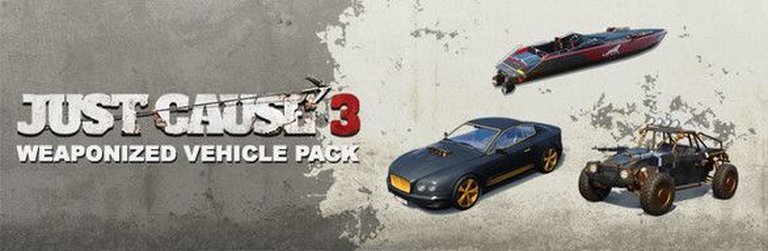
Just Cause 3: Weaponized Vehicle Pack is a downloadable content expansion for the open-world action-adventure game Just Cause 3, set in the fictional Mediterranean island nation of Medici. Players assume the role of Rico Rodriguez as he battles the oppressive dictator General Sebastiano Di Ravello, utilizing grappling hooks, wingsuits, and parachutes to traverse a vast, destructible environment. This DLC introduces three new armed vehicles—the Combat Buggy, Mini-Gun Racing Boat, and Rocket Launcher Sports Car—enhancing Rico’s ability to orchestrate chaotic mayhem across the island.
Gameplay Videos
Just Cause 3: Weaponized Vehicle Pack Mods
Just Cause 3: Weaponized Vehicle Pack Reviews & Reception
ign.com : A wide-open playground primed for explosive action.
metacritic.com (74/100): It’s a monument to excess. It’s Hot Shots. It’s Charlie Chaplin in The Dictator, if Charlie Chaplin had rocket-powered C4 in his boots.
Just Cause 3: Weaponized Vehicle Pack Cheats & Codes
PC
Go to the teleportation terminals and press the buttons in the specified order. Note: These are cheat codes for the base game of Just Cause 3, not specifically the Weaponized Vehicle Pack.
| Code | Effect |
|---|---|
| 1, 4, 3, 4, 2, 1 | Warp through a wormhole to the other side of the map |
| 1-4-3-4-2-1 | Teleport to Costa Sud |
| 2-3-3-2-2-3 | Teleport to Feno |
| 2-1-4-1-2-4 | Teleport to Trio |
| 1,0,3,0,1,3 | Teleport to Trio |
| 0,3,2,3,1,0 | Teleport to Costa Sud |
| 0,2,1,2,2,1,1,2 | Teleport to Feno |
PS4
Go to the teleportation terminals and press the buttons in the specified order. Note: These are cheat codes for the base game of Just Cause 3, not specifically the Weaponized Vehicle Pack.
| Code | Effect |
|---|---|
| 1-4-3-4-2-1 | Teleport to Costa Sud |
| 2-3-3-2-2-3 | Teleport to Feno |
| 2-1-4-1-2-4 | Teleport to Trio |
Just Cause 3: Weaponized Vehicle Pack: Review
Introduction
In the pantheon of open-world chaos, Just Cause 3 stands as a monument to unbridled destruction, where Rico Rodriguez’s grappling hook, wingsuit, and penchant for mayhem transform the Mediterranean island of Medici into a playground of explosive catharsis. As the third installment in Avalanche Studios’ franchise, Just Cause 3 (2015) refined the series’ signature blend of physics-defying traversal and over-the-top action, though it was not without its narrative shortcomings and technical hiccups. The Weaponized Vehicle Pack, released shortly after the base game, arrives as a targeted expansion doubling down on the core appeal: absurd, weaponized machinery designed to amplify the sandbox’s potential for creative havoc. This review examines the Pack’s three signature additions—the Combat Buggy, Mini-Gun Racing Boat, and Rocket Launcher Sports Car—as both mechanical upgrades and cultural artifacts of an era when DLC was a primary driver of player engagement. While the Pack excels in delivering high-octane spectacle and integrating seamlessly into Just Cause 3’s systems, its legacy is ultimately defined by how it exemplifies the DLC model’s strengths and limitations within a larger, flawed masterpiece.
Development History & Context
Avalanche Studios, the Swedish developer behind the Just Cause series, crafted Just Cause 3 as a refinement of its 2010 predecessor. Development began in 2012, with New York’s satellite studio handling the project while the main Swedish team focused on Mad Max. The studio emphasized verticality, volumetric terrain, and expanded destruction, leveraging next-gen hardware to create Medici’s 400-square-mile playground. The Weaponized Vehicle Pack emerged as part of the game’s post-launch support strategy, alongside larger expansions like Sky Fortress and Mech Land Assault. It was developed concurrently with the base game to ensure compatibility with its physics engine and traversal systems.
Technologically, the Pack operated within the constraints of Just Cause 3’s engine, which, while capable of spectacular destruction, struggled with performance on consoles due to its ambitious scale. Avalanche addressed this by weaponizing existing vehicle archetypes—buggies, speedboats, and sports cars—rather than introducing entirely new mechanics. This approach ensured integration with systems like the grappling hook and Rebel Drop.
The 2015 gaming landscape was saturated with open-world titles, including Fallout 4 and Metal Gear Solid V, making DLC a critical tool for retention. The Pack’s standalone release ($3.99 on PS4, bundled in the Ultimate Mission pack for Xbox One) reflected a trend of monetizing “specialized” content. However, it also sparked controversy, as users reported confusion over access codes and activation issues, highlighting the logistical pitfalls of early digital distribution.
Narrative & Thematic Deep Dive
The Weaponized Vehicle Pack contributes no new narrative; it exists purely as gameplay augmentation within Just Cause 3’s established framework. The base game’s plot—a trite tale of Rico liberating Medici from dictator General Di Ravello—serves only as a pretext for chaos. The Pack’s vehicles embody this ethos: they are extensions of Rico’s anarchic tools, devoid of backstory beyond their militarized purpose.
Thematic resonance lies in their symbolism. The Combat Buggy, with its rugged durability, represents guerrilla warfare’s asymmetric tactics; the Mini-Gun Racing Boat evokes a blend of leisure and lethality, mirroring Medici’s idyllic façade hiding authoritarian brutality; the Rocket Launcher Sports Car epitomizes excess, turning luxury into a weapon. These vehicles reinforce the game’s central theme: freedom through destruction. However, their absence from the main narrative underscores a missed opportunity. Unlike Grand Theft Auto’s story-driven vehicles, the Pack’s offerings feel disconnected from character development, existing solely as toys for Rico’s sandbox rebellion.
Gameplay Mechanics & Systems
The Weaponized Vehicle Pack excels by enhancing Just Cause 3’s core gameplay loops. Each vehicle introduces unique tactical options while integrating seamlessly with existing mechanics:
-
Combat Buggy: A rugged off-road vehicle equipped with a rear-mounted minigun. Its slow acceleration allows for precision strafing, making it ideal for hit-and-run attacks on military convoys. The buggy’s durability compensates for its size, enabling players to ram through enemy lines while mowing down infantry. It pairs perfectly with the grappling hook, allowing Rico to tether enemies to the buggy for chaotic drag kills.
-
Mini-Gun Racing Boat: A speedboat featuring a hull-mounted minigun and rapid acceleration. Designed for aquatic combat, it shines in coastal regions like Costa del Porto, where players can strafe shoreline bases or outmaneuver patrol boats. Its high-speed handling makes it less stable than the buggy, rewarding skilled players who master its drifts. The boat’s inclusion expands the game’s underutilized sea combat, offering a faster alternative to the slower, more armored naval vehicles.
-
Rocket Launcher Sports Car: A sleek, high-performance vehicle with a roof-mounted rocket launcher. Blending speed with heavy artillery, it excels at long-range destruction. Players can use it to obliterate infrastructure from a distance or engage in high-speed chases, toggling between driving and firing. Its fragility encourages hit-and-run tactics, aligning with Just Cause 3’s emphasis on creative risk-taking.
All three vehicles are accessible via Rebel Drop after completing the game’s intro missions, a design choice that prevents early disruption to the difficulty curve. They lack unique mods but benefit from the base game’s infinite ammo for hijacked vehicles, encouraging experimentation. User feedback from Steam forums highlighted accessibility issues—some players reported needing separate activation codes—underscoring a disconnect between the Pack’s design and its delivery.
World-Building, Art & Sound
The Pack’s vehicles amplify Medici’s Mediterranean-inspired aesthetic while leaning into the series’ exaggerated tone. Art director Zach Schläppi’s vision for Medici—dominated by oppressive greys, yellows, and reds—contrasts sharply with the vehicles’ vibrant militarization. The Combat Buggy’s rugged, battle-scarred texture evokes guerrilla craftsmanship, while the Rocket Launcher Sports Car’s glossy red finish parodies supercar excess. This duality reinforces the game’s visual thesis: beauty and violence coexist.
Sound design reinforces the Pack’s destructive identity. The Combat Buggy’s minigun emits a guttural roar, the Mini-Gun Racing Boat’s engine whines with aquatic ferocity, and the Rocket Launcher Sports Car’s rockets deliver satisfying, concussive booms. These effects harmonize with Henry Jackman’s bombastic score, creating a cohesive audiovisual experience that prioritizes sensory impact over realism.
Reception & Legacy
The Weaponized Vehicle Pack arrived with muted fanfare, as its release coincided with the base game’s lukewarm critical reception (Metacritic: PC 74/100, PS4 73/100, Xbox One 71/100). Critics praised Just Cause 3’s chaos but derided its narrative and technical flaws. While the Pack garnered no standalone reviews, player discussions on Steam and PSN reveal a consensus: it was a “fun but unessential” addition. PSN users rated it 4.41/5 stars, with comments praising its creativity but lamenting its price point.
Commercially, the Pack succeeded as a niche DLC, bundled in the 2017 Ultimate Mission pack alongside larger expansions. Its legacy lies in exemplifying the era’s DLC model—specialized, low-risk content that extended player engagement without altering the core experience. It also foreshadowed Just Cause 4’s vehicle-focused DLCs, like the 2019 Shark & Bark Pack, which iterated on the formula with even more outlandish designs.
Conclusion
The Just Cause 3: Weaponized Vehicle Pack is a microcosm of the series’ strengths and weaknesses. It delivers on its promise of enhanced chaos with three distinct, mechanically robust vehicles that deepen the sandbox’s creative potential. The Combat Buggy’s tactical versatility, the Mini-Gun Racing Boat’s aquatic flair, and the Rocket Launcher Sports Car’s high-speed destruction offer memorable moments that align with Just Cause 3’s identity. However, its lack of narrative substance and minor technical quirks prevent it from being essential.
As a historical artifact, the Pack reflects the 2015 gaming landscape: a period where DLC thrived on specialization, and Avalanche Studios doubled down on what made Just Cause unique—unfettered freedom through absurdity. While it doesn’t redefine the series, it remains a joyful, if fleeting, expansion that exemplifies the cathartic joy of turning a Mediterranean paradise into a playground of mayhem. For fans of Just Cause 3, it’s a worthwhile addition; for newcomers, it’s a glimpse into the franchise’s uncompromising commitment to explosive fun.