
- Release Year: 2021
- Platforms: Nintendo Switch, PlayStation 4, Windows Apps, Windows, Xbox Cloud Gaming, Xbox One, Xbox Series
- Publisher: Humble Bundle, Inc.
- Developer: Pocket Trap
- Genre: Action, Role-playing (RPG), Sports
- Perspective: Diagonal-down
- Game Mode: Co-op, Single-player
- Gameplay: Arcade, RPG, Sport
- Average Score: 88/100
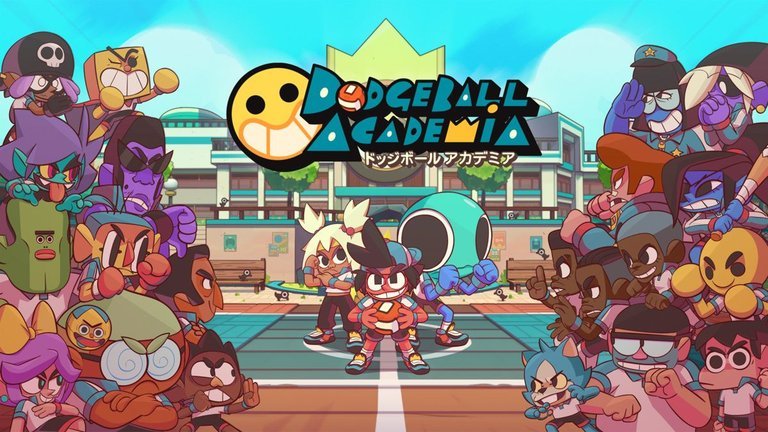
Description
Dodgeball Academia is an action RPG sports game that immerses players in an academy setting where dodgeball is the central competitive activity. Combining fast-paced dodgeball mechanics with RPG progression elements, players train as students to master skills, unlock abilities, and compete in intense matches. The game features direct control gameplay, supports both single-player campaigns and local multiplayer for up to two players, and was released across multiple platforms including Windows, PlayStation 4, Xbox One, Nintendo Switch, and Xbox Series in August 2021.
Gameplay Videos
Where to Buy Dodgeball Academia
Dodgeball Academia Mods
Dodgeball Academia Guides & Walkthroughs
Dodgeball Academia Reviews & Reception
opencritic.com (90/100): Boredom is never allowed thanks to entertaining characters, diverse team compositions, and a steady difficulty curve
metacritic.com (84/100): At the end of the day, though, Dodgeball Academia hits all the right notes to become a smash hit multimedia entity.
reddit.com (79/100): When it’s all said and done though, Dodgeball Academia is much better than I was expecting. I enjoyed the style, the zaniness, the characters, and only got frustrated by the gameplay a couple of times.
imdb.com (100/100): This game had no right to go this hard
Dodgeball Academia: Review
Introduction
In the ever-expanding landscape of indie game innovation, few concepts are as gloriously absurd as a sports RPG centered on dodgeball. Dodgeball Academia, a vibrant creation from Brazilian developer Pocket Trap, arrives with a seemingly chaotic premise: a world where magical dodgeball is the pinnacle of academic and athletic achievement. Yet beneath its zany exterior lies a meticulously crafted fusion of genres, blending the frantic, reflex-based action of dodgeball with the character progression and narrative depth of classic JRPGs. Released in August 2021 to widespread critical acclaim, the game quickly became a cult favorite, praised for its infectious charm, artistry, and audacious premise. This review delves into the multifaceted brilliance of Dodgeball Academia, examining its development journey, narrative tapestry, innovative gameplay, and enduring legacy. Our thesis is that while the game occasionally stumbles in execution, its triumphant synthesis of disparate genres, heartfelt storytelling, and boundless creativity cements it as a standout title in modern indie gaming—a testament to the power of passion over polish.
Development History & Context
Dodgeball Academia emerged from the fertile ground of Pocket Trap, a Brazilian studio founded by Ivan Freire and Henrique Alonso, with Freire serving as lead art director and co-creator. The project’s genesis was deeply personal, rooted in Freire’s childhood nostalgia for classic dodgeball titles like Super Dodge Ball (1990) and other Japanese arcade games. As Henrique Alonso revealed in an interview with PC Invasion, these conversations sparked a desire to revitalize the dormant dodgeball genre with “a modern twist.” The team’s love for sports anime—particularly Dragon Ball, Captain Tsubasa, and SLAM DUNK—further shaped the game’s tone, blending hyper-athletic spectacle with heartfelt character arcs. This fusion was also influenced by Camelot’s Mario Tennis and Mario Golf RPGs, which seamlessly married sports mechanics with progression systems and story modes.
Technically, the game was built on the Unity engine, a pragmatic choice for a mid-sized team seeking visual richness without proprietary constraints. Development was fraught with challenges, most notably the delicate balance between dodgeball’s real-time, action-oriented flow and RPG stat-based progression. Alonso candidly admitted that the team prototyped extensively, even experimenting with turn-based mechanics before rejecting them to preserve the “feel” of dodgeball as a visceral sport. The result was a combat system where every throw, catch, and dodge carried weight, while RPG elements like leveling and gear selection offered strategic depth.
Released on August 5, 2021, Dodgeball Academia debuted across PC, PlayStation 4, Xbox One/Series X|S, and Nintendo Switch, with day-one inclusion in Xbox Game Pass. This multiplatform launch occurred amidst a crowded indie renaissance, competing with titans like Hades and Psychonauts 2. Yet its Brazilian identity became a unique selling point, infusing the game with local flavors (e.g., dodgeball’s popularity in Brazilian schools) and cultural references that resonated globally. The 145-person development roster, including collaborations with studios like Gixer Games for 3D modeling, underscored a labor of love—proof that small teams could deliver experiences with outsized personality and ambition.
Narrative & Thematic Deep Dive
At its core, Dodgeball Academia is a coming-of-age fable wrapped in the guise of a sports epic. Players step into the shoes of Otto, a spirited youth who flees his referee destiny to enroll in the eponymous academy, where dodgeball transcends sport—it’s a way of life, a source of power, and the key to unlocking hidden truths. The narrative unfolds across eight episodes, each a self-contained adventure contributing to a larger arc of friendship, rivalry, and self-discovery. While the plot—a tale of an underdog rising through tournament ranks to save the academy from a rogue AI—adheres to familiar tropes, it’s elevated by Pocket Trap’s masterful execution and emotional sincerity.
The game’s character ensemble is its narrative cornerstone. Otto, inspired by Freire’s late dog, is a plucky protagonist whose journey from novice to champion is anchored by relatable determination. Surrounding him is a riot of archetypes reimagined through a lens of whimsy and heart: Boris, the monstrous powerhouse with a soft spot for his goblin sister Vampy; Balloony, a teal-skinned student whose literal balloon head deflates with disappointment; Suneko, the brooding rebel allergic to dairy; and Mina, a lightning-wielding prodigy. These characters avoid one-dimensionality through subtle storytelling—e.g., Balloony’s reliance on air tanks in dormitories or Suneko’s lactose intolerance—revealing their inner worlds without exposition. Their interactions crackle with humor and warmth, driven by snappy dialogue that blends fourth-wall-breaking gags with genuine pathos.
Beneath the cartoonish exterior, the game explores nuanced themes. The central conflict—Nino, a “Badass Normal” without powers, versus Boris, a powerhouse who claims no innate abilities—delves into meritocracy versus privilege. Boris’s assertion that strength comes from “hard work, not magic” sparks Nino’s crisis of identity, culminating in a misguided rebellion that questions whether talent or effort defines worth. This theme is amplified by the game’s treatment of disability: Fortunato, a wheelchair-using professor, is integrated into the campus’s design, with elevators and ramps reflecting institutional accessibility—a subtle nod to inclusivity. Yet the narrative isn’t without flaws. The stakes rarely escalate beyond “save the academy,” and some character arcs (e.g., Nino’s) feel rushed. Moments of tonal whiplash, such as the abrupt shift from lighthearted hijinks to a robot invasion, further fracture cohesion. Still, the narrative’s charm lies in its sincerity, transforming tropes into endearing vignettes that celebrate friendship and perseverance.
Gameplay Mechanics & Systems
Dodgeball Academia’s genius lies in its seamless marriage of dodgeball and RPG mechanics, creating a gameplay loop that is both accessible and deceptively deep. Matches unfold on divided courts where three-player teams compete to eliminate opponents by hitting them with balls, but the implementation transcends simplicity. Core actions—throwing, catching, dodging—form a rhythmic dance: charging throws for elemental effects (e.g., Otto’s fireballs that inflict burn damage), catching to build “Focus” for special abilities, and timing dodges to evade volleys. This real-time combat demands reflexes, while RPG elements introduce strategic layers.
Character progression is robust and customizable. Each of the six playable characters has unique stats (Strength, Agility, Technique) and “Balltimates” (super moves like Otto’s fiery Kamehameha or Mina’s lightning storm). Leveling up unlocks enhanced abilities: Otto evolves from needing to charge throws to having auto-fire at max level, with agility/strength bonuses when last standing. Gear and food further augment stats, allowing min-maxing for different playstyles. Team composition becomes tactical—pairing Balloony’s healing foam with Suneko’s area control creates synergy, while Mina’s stuns enable crowd control.
Yet the system reveals cracks under scrutiny. Critics from Video Chums and Play Critically noted that strategy often devolves into “overpower with raw strength,” as elemental dodgeballs negate character uniqueness. Status effects like Bubblegum (sticking players) or Ice (slowing movement) feel incidental when balls offer the same effects. The AI’s predictability and repetitive enemy rosters exacerbate monotony, with late-game battles feeling bloated by identical matchups. Additionally, controlling a three-person team sans AI can be cumbersome—switching between characters mid-match disrupts flow, and counters/catches are inconsistently viable against CPU opponents.
These flaws are mitigated by the game’s strengths. The “Balltimates” are spectacular, with screen-filling animations that reward skill. The versus mode, though local-only, offers chaotic multiplayer fun. Side quests and minigames (e.g., cooking classes) break up the grind, while the steady difficulty curve ensures accessibility. While the loop risks repetition, its core satisfaction—landing a perfect throw or unleashing a timed Balltimate—remains potent.
World-Building, Art & Sound
Dodgeball Academia’s world is a triumph of environmental storytelling, transforming a single academy campus into a living, breathing ecosystem. The campus itself is a character, divided into distinct zones: the bustling central square, the serene forest with obscuring tall grass, the high-tech dormitories, and the competitive arenas. Each location brims with details that reward exploration—e.g., air tanks hint at Balloony’s needs, handicap parking spots reflect Fortunato’s presence, and hidden passages reveal lore snippets. This meticulous world-building grounds the absurdity in tangible realism, making even fantastical elements feel earned.
The art direction, spearheaded by Ivan Freire, is a vibrant tapestry of influences. Character designs fuse 90s Cartoon Network (Powerpuff Girls) with anime (Dragon Ball), resulting in a menagerie of memorable figures: Otto’s sunburn-like red skin, Vampy’s goblin-esque ears, and the School Monitor’s toothy, Blue Meanie-esque grin. Environments pop with bold colors and dynamic lighting, from the neon-lit dorms to the sun-drenched courts. The isometric perspective showcases intricate animations—Balloony’s head deflating, Suneko’s rebellious slouch—that inject life into every frame. This visual flair extends to UI elements, with clean, thematic menus and health bars resembling dodgeball scores.
Sound design amplifies the artistry, blending energetic synth tracks with anime-inspired leitmotifs (e.g., a heroic theme for Otto). Sound effects are crisp and impactful: the “thwack” of a ball impact, the fizz of Balloony’s healing foam, and the explosive boom of Balltimates. Voice acting, primarily in Portuguese with English subtitles, adds authenticity, with performances ranging from Boris’s gruff growl to Otto’s earnest enthusiasm. Music shifts dynamically—upbeat during matches, serene during exploration—enhancing immersion. While minor frame drops occur in crowded overworlds, the overall presentation is polished, with the art and sound coalescing to create a cohesive, enchanting universe.
Reception & Legacy
Dodgeball Academia was embraced by critics and players alike upon release, with an OpenCritic score of 78% and 81% recommendation rate. Reviews highlighted its unique charm: Way Too Many Games called it “one of the best indie games of the year,” praising its “arcade-like dodgeball matches with JRPG mechanics,” while Siliconera lauded its “smart” borrowing from classics while transcending them. The Nintendo Switch version was particularly celebrated for its “pick up and play” portability. User reviews on Steam and Metacritic were equally glowing, with an 8.3/10 user score, praising the “art style,” “characters,” and “fun factor.”
Yet reception wasn’t unanimous. Nintendo Life awarded it 60%, criticizing the “interminable” dialogue and repetitive dodgeball, while PC Invasion felt the story “never reached fantastical heights.” Mixed reviews centered on gameplay repetition and narrative shallowness. Commercially, the game benefited from Xbox Game Pass inclusion and multiplatform availability, though exact sales figures remain undisclosed. Culturally, it became a beacon for Brazilian game development, showcasing local talent on a global stage. Its legacy is multifaceted: it revitalized interest in dodgeball games, inspired genre-blending indies, and fostered a devoted fanbase clamoring for a sequel. Pocket Trap has hinted at future expansions, with discussions of potential spin-offs focused on multiplayer or new story arcs. The game’s influence is evident in the growing number of niche-sports RPGs, proving that even absurd concepts can yield enduring, innovative experiences.
Conclusion
Dodgeball Academia is a game of unbridled joy and audacious ambition—a diamond in the rough that shines brightest when embracing its chaotic heart. Its synthesis of dodgeball and RPG mechanics is a masterstroke, marrying reflex-based action with strategic depth, while its art direction and sound design create a world bursting with personality. Though hampered by repetitive gameplay, a derivative narrative, and occasional technical hiccups, the game’s emotional core—its celebration of friendship, perseverance, and the absurdity of sports—transcends its flaws. For fans of RPGs, sports games, or anyone seeking a dose of unpretentious fun, Dodgeball Academia is an essential play. It is not a flawless masterpiece, but it is an unforgettable one—a testament to indie gaming’s capacity to surprise, delight, and inspire. As Pocket Trap’s Brazilian pearl continues to enchant players, it stands as a vibrant reminder that sometimes, the most brilliant ideas are born from the most ridiculous premises. Here’s hoping for more lessons at the academy—because in the world of Dodgeball Academia, even imperfections can be champions.