
- Release Year: 1994
- Platforms: PC-98, Windows
- Publisher: NEC Avenue, Ltd., NEC Interchannel, Ltd.
- Developer: Headroom, Longshot LLC
- Genre: Simulation
- Perspective: 1st-person
- Game Mode: Single-player
- Gameplay: Business simulation, Character progression, Life simulation, Managerial
- Setting: Fantasy
Description
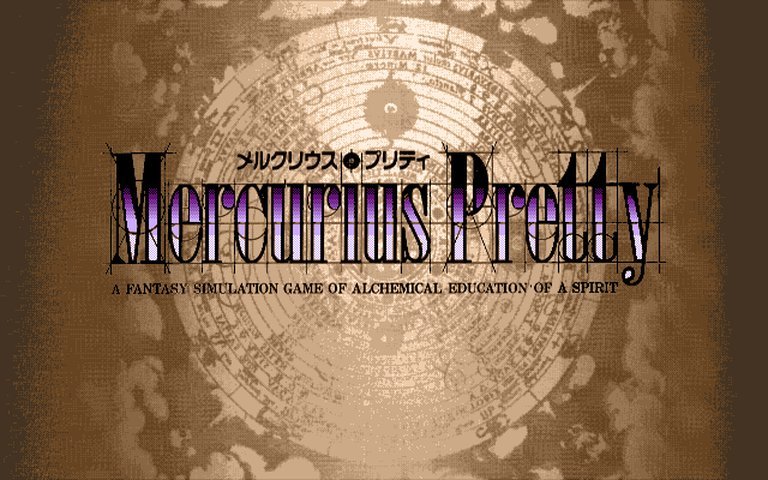
Mercurius Pretty is a raising simulation game set in a medieval fantasy world where players raise a homunculus, a female fairy-like creature, by managing her daily activities like praying, reading, or resting to develop attributes such as spirituality and knowledge. The goal is to guide her through exams and onto specialized paths (spiritual, combat, or magic-related) while managing her mood, health, and gradual transformation into a human form.
Gameplay Videos
Mercurius Pretty Cracks & Fixes
Mercurius Pretty: A Forgotten Alchemical Masterpiece
Introduction
Released in December 1994 for the NEC PC-98, Mercurius Pretty stands as one of the most distinctive and underrated entries in the “raising simulation” genre. While overshadowed contemporaneously by titles like Princess Maker, this alchemical fantasy from Headroom and Longshot LLC offers a hauntingly intimate experience centered on nurturing a homunculus—a fairy-like entity confined to a glass bottle. Its 95-day time limit, branching narrative paths, and 30+ endings create a uniquely poignant journey through creation, growth, and loss. Though constrained by technological limits of its era, Mercurius Pretty transcends its flaws with a mesmerizing blend of meticulous stat management, ethereal artistry, and philosophical depth. This review dissects its legacy, mechanics, and enduring significance as a cult masterpiece of Japanese simulation games.
Development History & Context
The Studio and Vision
Developed by the renowned studio Headroom (creators of Birth and Graduation) and Longshot LLC, Mercurius Pretty was published by NEC Avenue and NEC Interchannel. The project emerged from a desire to subvert the raising-simulation formula by stripping away RPG elements like combat or exploration, focusing instead on the delicate, daily management of a magical being. As described in NamuWiki, the creators envisioned a “homunculus-raising simulation” where alchemy served as both gameplay mechanic and narrative core—a stark contrast to the princess-centric fantasies dominating the genre.
Technological Constraints and Era
Built for the NEC PC-98, a Japanese PC popular in the early 1990s, the game leveraged the platform’s graphical capabilities to render anime-style character designs and CG sequences. A Windows port followed in 1996, but as noted by NamuWiki, it suffered from technical issues and omitted some endings. The 1994 release placed it alongside simulations like Princess Maker 2, yet its alchemical setting and shorter 95-day lifespan (vs. Princess Maker’s 8-year cycles) carved a distinct niche. The dreamlike virtual crystal sequences, while constrained by low-resolution assets, demonstrated ambitious storytelling ambitions within the hardware limits.
Gaming Landscape
The early 1990s saw the rise of Japanese simulations, where players managed lives through stat-driven choices. Mercurius Pretty differentiated itself by eschewing traditional coming-of-age narratives in favor of an otherworldly creator-creation dynamic. Its release in Korea as Fairy Legend (2000) by Softmax expanded its reach, though it remained a cult curiosity outside Japan—a fate shared with many niche PC-98 titles.
Narrative & Thematic Deep Dive
Plot and Character Arcs
The narrative unfolds across 95 days as the player, an alchemist’s apprentice, raises a homunculus in a bottle. The homunculus evolves through four growth stages, with her final form and destiny determined by player choices. The 33 endings (30 in the PC-98 version) span bittersweet to triumphant outcomes: she may become a transcendent being guiding stars (The One Who Guides the Stars), a vampire (Vampire), or even a timeless artifact (Crystal Statue). NamuWiki lists endings like The One Who Creates Time, where the homunculus, revealed as Mitis the maid, confesses her love—a meta-narrative twist implying cyclical time and sacrifice.
Dialogue and Interaction
Interactions with the homunculus hinge on “Emotion” and “Obedience” stats. As detailed in NamuWiki, dialogue options (e.g., “Listen,” “Praise”) yield varying results based on her mood (normal, sad, angry). Low obedience triggers dismissive dialogue (“How dare you lecture me?”), while high obedience yields subservience (“I’ll obey your every word”). These moments humanize the homunculus, making her eventual departure a gut-wrenching choice between control and freedom.
Thematic Resonance
At its core, Mercurius Pretty interrogates creation and humanity. Alchemy, the central metaphor, represents both manipulation and transcendence. The homunculus’s journey from bottled curiosity to autonomous being mirrors humanity’s quest for meaning. Virtual crystals—dream sequences where she experiences past/future lives—bluntly question free will: are her memories real, or implanted by the alchemist? Endings like Virtual Crystal (where she dissolves into a crystal) and A Scene from a Dream (where she questions her reality) underscore the tragedy of manufactured consciousness.
Gameplay Mechanics & Systems
Core Stat Management
Players allocate four daily actions to activities that raise stats:
– Learning: Books (e.g., Bible for Divinity, Combat Manual for Combat) require minimum stat thresholds.
– Summoning Spirits: Calling Nymph, Sylphid, Salamanda, or Gnome risks stat boosts or demonic penalties.
– Kunst: The homunculus crafts items (pebbles to diamonds) for income, with “Skill” dictating value.
– Virtual Crystals: Dream sequences (e.g., Green Crystal, Angel’s Crystal) alter stats and unlock endings.
Mood and Fatigue
“Emotion” depletes with study but rises via conversation or crystals. “Fatigue” requires rest or crystals to manage, ignoring it risks illness. NamuWiki notes that high emotion can trigger unscheduled conversations, adding unpredictability.
Growth and Endings
The homunculus’s form evolves based on stat differentials:
– Stage 3/4: Divided into “Wild” (physical/magic-focused), “Medium” (balanced), or “Intellectual” (mind/spirit-focused).
– Endings: Triggered by thresholds (e.g., Fairy Queen requires high Divinity; Reaper needs low Emotion). Hidden “Love” stats (influenced by Emotion + Obedience) enable true endings like The One Who Creates Time.
Flaws
As Backloggd reviewer quettatonia notes, the game’s limited event variety and rigid “Skill-centric” economy (for Kunst income) restrict replayability. NamuWiki laments unrealized potential, like the underutilized virtual crystal storylines.
World-Building, Art & Sound
Atmosphere and Setting
The medieval fantasy world blends alchemy laboratories with ethereal dreamscapes. Confined to a bottle, the homunculus exists in a liminal space—part pet, part child, part experiment. This claustrophobia contrasts with the grandeur of her potential endings (e.g., Ouroboros, where she becomes a guardian deity).
Visual Design
Character art by Hirofumi Nakamura (Gunbird, Sengoku Ace) features delicate linework and expressive sprites. CGs for virtual crystals, per NamuWiki, are “gorgeous,” depicting homunculus-centric vignettes: a sword duel in ruins (Crystal of the Sword) or an angelic encounter (Angel’s Crystal). Growth-stage transitions—from fairy to human—are animated with subtle, poignant grace.
Sound Design
Noriyuki Iwadare’s (Lunar: Silver Star Story) soundtrack blends whimsical jingles for daily tasks (e.g., Kunst crafting) with melancholic melodies for endings. Sound effects mirror alchemy’s mystique, from clinking bottles to summoning incantations. As one Backloggd review notes, the music is “cute and catchy,” yet never overwhelms the game’s fragile mood.
Reception & Legacy
Launch Reception
Critically, Mercurius Pretty was overshadowed by Princess Maker. NamuWiki notes its “poorer event volume” and “inferior art” compared to contemporaries. Korean players, however, embraced it as Fairy Legend, praising its imaginative premise. Commercially, it remained niche, a fate common to PC-98 titles outside Japan.
Enduring Legacy
Over time, it gained recognition as a “hidden gem.” Its influence persists in simulations prioritizing narrative over action:
– Korean Impact: Softmax’s Fairy Legend series (1996–2000) rebranded Headroom’s Pixie Garden as pseudo-sequels, spreading the homunculus-raising concept.
– Genre Innovation: Its stat-driven, branching endings predated modern narrative games like Life is Strange. Dreamcast sequel End of the Century (2000) expanded the universe but retained the original’s core philosophy.
– Cult Status: Forums and wikis (e.g., NamuWiki) host deep-dive analyses, debating hidden mechanics like the “Love” stat and meta-narrative of Mitis’s identity.
Conclusion
Mercurius Pretty is a flawed, achingly beautiful relic of simulation gaming’s golden age. Its alchemical heart beats with ambition, offering a meditation on creation that few peers have matched. While technical constraints and repetitive gameplay limit accessibility, its 33 endings and ethereal artistry reward patient players. As a historical artifact, it stands alongside Princess Maker as a foundational text in raising simulations, albeit one with a darker, more philosophical soul.
Verdict: 4.5/5
For enthusiasts of niche Japanese games, Mercurius Pretty is a must-play—a forgotten masterpiece where every stat raise, every crystal dream, and every ending carries the weight of a creator’s love and loss. Its legacy endures not in commercial success, but in the quiet resonance of a homunculus’s journey from bottle to transcendence.