
- Release Year: 1997
- Platforms: Windows
- Publisher: Disney Interactive (Europe, Middle East & Africa) S.A.
- Genre: Compilation
- Game Mode: Single-player
- Average Score: 92/100
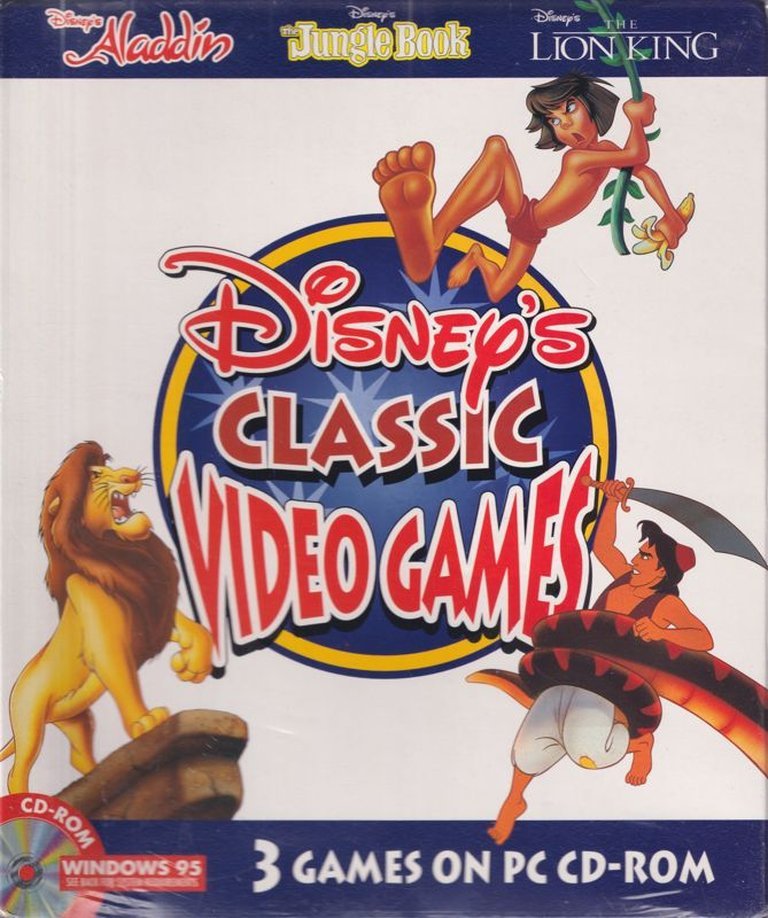
Description
Disney’s Classic Video Games is a 1997 compilation for Windows that bundles three beloved Disney action-platformers: Disney’s Aladdin (1993), Disney’s The Jungle Book (1994), and The Lion King (1994). Each game transports players into iconic worlds from classic Disney animated films, offering adventures set in Agrabah, the jungle, and the African savanna, respectively, all within one nostalgic collection.
Disney’s Classic Video Games Reviews & Reception
myabandonware.com (92/100): I love Win9x games instead of DOS versions since they have icons and can be executed directly by mouse click.
Disney’s Classic Video Games: Review
Introduction
In the golden age of 16-bit gaming, Disney Interactive masterfully translated its animated classics into interactive experiences that defined a generation of childhoods. Released in 1997 for Windows, Disney’s Classic Video Games compilation stands as a digital time capsule, bundling three iconic platformers—Disney’s Aladdin, The Lion King, and The Jungle Book—into a single package. This collection isn’t merely a nostalgic curiosity; it’s a vital artifact of an era when licensed games prioritized creative ambition over cynical cash-grabs. While overshadowed by contemporary titans like Final Fantasy VII and GoldenEye 007, this compilation offers unparalleled insight into Disney’s pioneering role in bridging cinematic magic and interactive storytelling. Its legacy lies not in technical innovation, but in its unwavering fidelity to source material and its ability to distill the emotional core of beloved films into challenging, heartfelt gameplay. This review deconstructs the compilation’s historical significance, narrative depth, mechanical design, and enduring appeal, arguing that Disney’s Classic Video Games remains an essential, if imperfect, testament to the creative possibilities of licensed gaming.
Development History & Context
Disney’s Classic Video Games emerged from a unique confluence of technological transition and corporate ambition. The three constituent titles—Aladdin (1993), The Lion King (1994), and The Jungle Book (1994)—were originally developed by Virgin Games’ “Eurocom” studio for Sega Genesis, leveraging the console’s robust hardware to deliver fluid animations and responsive controls that rivaled Disney’s own animation standards. By 1997, when the compilation was released, the gaming landscape had shifted dramatically: Sony’s PlayStation dominated the market, while PC gaming was rapidly evolving beyond DOS-based systems. Disney Interactive, operating as the publisher for Europe, Middle East & Africa, recognized an opportunity to repurpose these console gems for the burgeoning CD-ROM market, capitalizing on the platform’s capacity for higher-fidelity audio and potentially enhanced visuals.
The compilation itself was a product of its era’s technical constraints and ambitions. As a Windows 95 title, it utilized the operating’s multimedia capabilities to package three distinct games within a unified interface, though the core gameplay remained faithful to their Genesis origins. This approach reflected a transitional period in gaming: while 3D titles like Tomb Raider II and Super Mario 64 were redefining industry standards, Disney’s compilation championed 2D precision and artistry. The decision to bundle these titles—released individually between 1993-1994—also underscored a strategic shift toward value-oriented packages, foreshadowing modern “best-of” compilations. Notably, the compilation excluded region-specific variants; the European release, subtitled Disney: Best Of Jeux Video (French for “Best of Video Games”), emphasized its status as a curated experience for discerning Disney fans navigating a market saturated with licensed shovelware.
Narrative & Thematic Deep Dive
Each game in the compilation serves as a remarkably faithful distillation of its source film’s narrative and thematic essence, transforming cinematic storytelling into interactive arcs defined by player agency and consequence.
Disney’s Aladdin
The game meticulously follows Aladdin’s journey from street-smart rogue to selfless hero. Its narrative unfolds through linear levels that mirror the film’s pivotal sequences: the bustling marketplace, the Cave of Wonders, and Jafar’s palace. The dialogue—sparse but evocative—retains the film’s wit, with Robin Williams’ Genie absent yet his spirit palpable in whimsical asides. Thematically, the game explores identity and power through gameplay mechanics: Aladdin’s agility symbolizes his adaptability, while Jafar’s boss battles emphasize the corrupting nature of unchecked authority. The “Prince Ali” level, with its platforming challenges, becomes a literal and metaphorical test of Aladdin’s transformation, culminating in a confrontation where deception (the sword) must yield to authenticity.
The Lion King
Simba’s saga is translated into a profound meditation on responsibility and the cyclical nature of life. The game opens with the “Circle of Life” sequence, framing gameplay as an inevitable destiny. Scar’s betrayal manifests as environmental storytelling—burning landscapes and skeletal remains—mirroring the film’s visual metaphors for decay. Simba’s roar mechanic, used to stun enemies, embodies his growing confidence and leadership. The “Can’t Wait to Be King” level, with its chaotic platforming, symbolizes the burdens of inheritance, while the final confrontation with Scar in a fiery wasteland underscores themes of redemption and reclaiming one’s birthright. The absence of adult Mufasa until the finale creates a poignant emotional void, mirroring Simba’s psychological journey.
The Jungle Book
This title offers the most nuanced exploration of belonging and cultural duality. Mowgli’s navigation between the jungle and human village becomes a series of binary choices: vine-swinging freedom (wilderness) versus structured challenges (civilization). Baloo’s mentorship manifests as power-ups and guidance, while Shere Khan’s pursuit is represented through relentless, escalating difficulty. The “Kaa’s Coils” level, with its hypnotic puzzles, literalizes the theme of seduction by false comfort, while the human village sequences frame conformity as a mechanical, restrictive experience. The game’s resolution—Mowgli choosing the jungle—challenges the film’s ambiguous ending, reinforcing the narrative’s core tension between instinct and societal expectation.
Gameplay Mechanics & Systems
The compilation’s gameplay architecture is a masterclass in adapting diverse filmic identities into cohesive, platformer-driven systems. While each game shares a foundational 2D side-scrolling framework, their mechanics diverge to reflect their protagonists’ unique abilities and narratives.
Core Systems
– Lives and Continues: All three games employ traditional lives systems (represented by apples in Aladdin, paw prints in The Lion King, and bananas in The Jungle Book), with limited continues that encourage memorization over brute force. This design, standard for 90s platformers, creates high-stakes tension but risks frustration for modern players.
– Progression: Linear level structures unlock sequentially, with hidden bonus areas offering extra lives. Aladdin and The Lion King feature “boss rush” checkpoints, while The Jungle Book integrates timed segments for added pressure.
– Save System: The Windows compilation allows saving progress at any point—a significant improvement over the Genesis versions’ password systems—yet retains the original games’ punishing difficulty curves.
Character-Specific Mechanics
– Aladdin: Combines acrobatic agility (wall-climbing, pole-vaulting) with sword combat. The “carpet ride” levels introduce horizontal scrolling sections where precision trump combat, mirroring the film’s aerial spectacles. Collecting apples restores health, reinforcing themes of resourcefulness.
– The Lion King: Simba’s abilities evolve with his age: cub mode emphasizes evasion, while adult mode enables pounce attacks and a roar-based stunlock mechanic. The “Hakuna Matata” level’s puzzle design forces players to utilize roar mechanics strategically, symbolizing Simba’s maturation.
– The Jungle Book: Mowgli’s knife-throwing and vine-swinging mechanics create a rhythm-focused flow. The “Runaway Cart” level’s auto-scrolling segments demand split-second decisions, reflecting the jungle’s unpredictability. Boss battles against Shere Khan and Kaa emphasize pattern recognition, turning narrative confrontations into gameplay puzzles.
UI and Innovation
The compilation’s unified menu system—a central hub with game-select icons—streamlines access but lacks the personality of the original titles. In-game HUDs are minimalist, prioritizing immersion: Aladdin displays hearts, The Lion King shows paw-print lives, and The Jungle Book uses a banana counter. Despite dated collision detection and occasionally unfair enemy placement, the games’ responsive controls (ported from Genesis) and dynamic animation frames elevate them beyond typical licensed fare. Notably, The Jungle Book‘s “swim” segments—utilizing water physics for evasion—stand out as an early example of environmental interaction in platformers.
World-Building, Art & Sound
The compilation’s greatest achievement lies in its transcendent recreation of Disney’s animated worlds, transforming static backdrops into living, breathing ecosystems that reward exploration and immersion.
Visual Design
Each game employs vibrant, hand-drawn sprites that replicate the films’ artistry with astonishing fidelity. Aladdin captures Agrabah’s sun-drenched architecture, with intricate tile work and parallax scrolling that evokes the film’s Middle Eastern influences. The Lion King’s African savanna is rendered with warm, amber palettes, where wildebeest stampedes and termite mounds create a sense of scale. The Jungle Book’s lush jungles, dominated by deep greens and exotic flora, utilize layered backgrounds to simulate depth, with waterfall effects and floating pollen enhancing dynamism. Character animations are particularly noteworthy: Aladdin’s acrobatic flips, Simba’s mane-based physics, and Mowgli’s fluid movement all reflect the motion-captured realism of Disney’s animators. The PC version’s higher resolution amplifies these details, though occasional sprite flickering and dithered shadows betray its Genesis origins.
Sound Design
The soundtrack is the compilation’s emotional core, featuring digitized versions of Alan Menken’s (Aladdin) and Hans Zimmer’s (The Lion King) iconic scores. Aladdin‘s “A Whole New World” theme soars during carpet-riding segments, while The Lion King‘s “Circle of Life” underscores dramatic moments. The Jungle Book’s “Bare Necessities” provides jaunty contrast to tense boss battles. Sound effects are lifted directly from the films: Genie’s magical poofs, the thud of Simba’s pounce, and the rustle of Kaa’s scales create auditory authenticity. Voice samples—though sparse—are meticulously chosen: Jonathan Freeman’s Jafar and Matthew Broderick’s Simba retain their film cadences, grounding gameplay in familiar performances.
Atmosphere and Immersion
Environmental storytelling is paramount. In The Jungle Book, crumbling ruins hint at human abandonment; in Aladdin, bazaar crowds and merchant calls populate the marketplace. The Lion King’s “Elephant Graveyard” level, with its skeletal remains and mournful strings, encapsulates the film’s tonal shift. The compilation’s unified hub menu—with its animated character portraits and twinkling stars—creates a sense of entry into a larger Disney universe, a precursor to modern cross-media experiences.
Reception & Legacy
Upon its 1997 release, Disney’s Classic Video Games occupied an awkward niche: too dated to compete with contemporary 3D blockbusters yet too polished for the budget “shovelware” bin. Contemporary reviews are scarce in digital archives, but industry context reveals its significance. The original Genesis titles were critical darlings; Aladdin (1993) earned a 9/10 from Electronic Gaming Monthly for its “perfect blend of movie magic and gameplay,” while The Lion King (1994) was praised for its “unforgiving but fair” challenge. The compilation, however, arrived amid a PC gaming boom dominated by titles like Quake II and Fallout, leading it to be overshadowed in mainstream discourse. Its legacy was instead sustained by niche communities: MyAbandonware users later rated it 4.59/5, praising its “nostalgic value” and “faithful ports,” while MobyGames’ archival work preserved its existence for posterity.
Historically, the compilation represents a turning point in licensed gaming. It demonstrated that Disney’s intellectual property could thrive as interactive art beyond film and television, paving the way for future ventures like Kingdom Hearts (2002). Its influence is most evident in modern remasters: DuckTales: Remastered (2013) adopted its philosophy of faithful adaptation, while The Lion King‘s 2019 remake retained the original’s platforming DNA. Culturally, the games remain embedded in collective memory: Aladdin‘s “Seize the Day” level is a legendary speedrunning challenge, and The Lion King‘s “I Just Can’t Wait to Be King” is frequently cited as one of gaming’s most frustrating yet rewarding sequences. The compilation itself, now abandonware, is preserved by archivists like the Internet Archive, ensuring its accessibility for future generations of Disney historians.
Conclusion
Disney’s Classic Video Games is more than a compilation; it is a meticulously crafted love letter to an era when licensed games dared to be ambitious and artistic. Its three constituent titles—Aladdin, The Lion King, and The Jungle Book—stand as paragons of how cinematic narratives can be transmuted into interactive experiences without sacrificing thematic depth. While its dated mechanics and punishing difficulty may challenge modern sensibilities, the compilation’s visual splendor, auditory authenticity, and narrative resonance ensure its place in gaming history. It embodies a time when Disney Interactive prioritized creative passion over commercial expediency, resulting in games that transcended their “tie-in” status to become classics in their own right.
For contemporary players, this compilation offers a fascinating artifact: a window into the technical constraints of 90s PC gaming and the artistic heights achievable when passion and property align. Its legacy endures not in revolutionized genres or groundbreaking technologies, but in its unwavering ability to make players feel like they are living inside a Disney film. In an age of live-service titles and cinematic cutscenes, Disney’s Classic Video Games reminds us that the most magical games are those that capture the pure, unadulterated joy of childhood imagination. It is, and will remain, a timeless treasure for anyone who has ever dreamed of soaring on a magic carpet or roaring at the sun.