
- Release Year: 2005
- Platforms: Dreamcast, GP32, Linux, Windows Mobile, Windows
- Publisher: Psilocybin Development
- Developer: Psilocybin Development
- Genre: Puzzle
- Perspective: Top-down
- Game Mode: Single-player
- Gameplay: Arcade, Grid-based, Puzzle, Strategy, Timed
- Setting: Sky
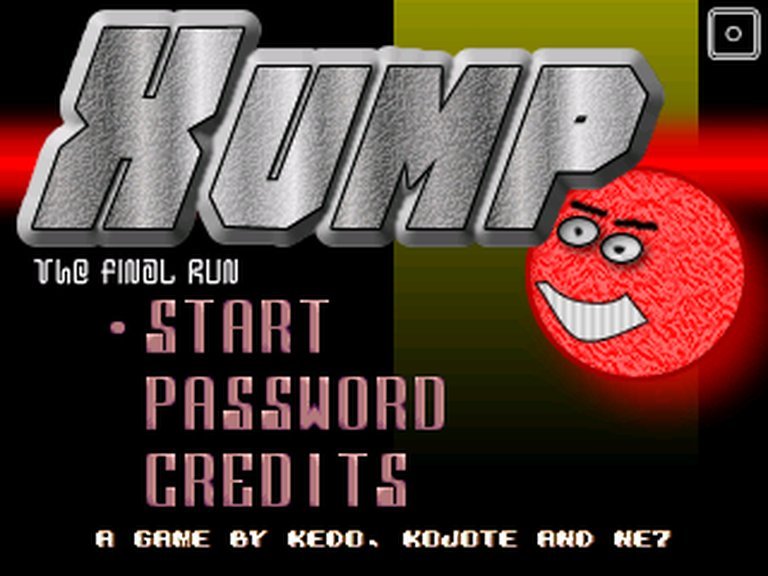
Description
Xump: The Final Run is a top-down, arcade-style puzzle game set on sky-based platforms where players control a bot named Xump to clear all dissolving blue tiles by moving over them. Each tile can only be stepped on once, requiring strategic planning within time limits. Levels feature solid grey obstacles, teleporters, dark blue tiles needing two visits, and directional arrows that push the bot in specific directions. Originally released in 2005 by Psilocybin Development and later enhanced with improved graphics, new levels, music, and multi-platform support by Retroguru.
Xump: The Final Run Reviews & Reception
atarilynxvault.com : Make no mistake this is a fun game. Frustrating at times but fun. What puzzle game isn’t frustrating? It’s all part of the challenge.
Xump: The Final Run: Review
Introduction
In the pantheon of puzzle games, few titles embody the elegant brutality of spatial reasoning and temporal pressure quite like Xump: The Final Run. Born from the mind of Psilocybin Development in 2005 and subsequently reborn under the meticulous stewardship of Retroguru in 2013, this deceptively simple top-down puzzler has carved a unique niche in gaming history. At its core, Xump tasks players with guiding a diminutive bot across precarious grids of dissolving tiles, a premise that belies a labyrinthine depth of strategic complexity. This review will dissect the game’s evolution, from its origins as a niche Linux release to its status as a multi-platform phenomenon celebrated for its ruthless efficiency and minimalist genius. Through an analysis of its development narrative, thematic undercurrents, granular gameplay mechanics, and enduring legacy, we will argue that Xump: The Final Run stands not merely as a pastime, but as a masterclass in distilled interactive design—a testament to how constraint breeds creativity.
Development History & Context
The Genesis of Xump
Xump: The Final Run emerged from the independent scene in 2005, developed by the Swedish studio Psilocybin Development. Its initial release—spanning Linux, GP32, Dreamcast, Windows, and Windows Mobile—arrived during an era dominated by 3D epics and cinematic narratives. In this landscape, Xump was a stark anomaly: a 2D puzzle game with no pretense of storytelling or graphical spectacle. Its design philosophy was rooted in the traditions of classic arcade puzzlers like Chip’s Challenge and the Commodore 64’s Sensitive (1990), emphasizing pure mechanical purity over narrative embellishment. The game’s constraints were deliberate: single-screen levels, tile-based movement, and punishing time limits. This minimalist ethos reflected the ethos of early indie development, where accessibility and replayability trumped production value.
The Retroguru Renaissance
The pivotal turning point came in 2013 when Retroguru, a collective dedicated to reviving retro gaming sensibilities, undertook a comprehensive overhaul. Led by producer Shahzad Sahaib (Kojote) and code architect Gisberto Rondinella (nop90), the project transcended a simple remaster. “Improved in almost every aspect you can imagine,” as the Retroguru website proclaims, the 2013/2014 iteration reimagined Xump as a multi-platform juggernaut. New graphics by Virgile Metier (thUg) and Christian Hildenbrand (Daydream) injected vibrancy into the pixel-art landscapes, while Johan Letfors (Vedder) and Andrew Lemon (ne7) composed nine chippy, 8-bit soundtracks that evoked the golden age of home computing. The level design, spearheaded by Denny Müller (Mulle), expanded to 48 meticulously crafted stages, each a crucible of escalating pressure. Crucially, Retroguru’s commitment to preservation was absolute: the Atari Lynx 2019 physical release by Songbird Productions, complete with cartridge, manual, and box, embodied this ethos, ensuring Xump endured on even the most obscure hardware.
Technological Constraints and Ingenuity
Development across its 20+ platforms—from the Nintendo 3DS and PlayStation Portable to the Raspberry Pi and TI-Nspire CX—was a testament to the team’s adaptability. Engineered using SDL and SDL_Mixer, the game operated within the constraints of limited hardware (e.g., the Atari Lynx’s 64KB RAM) yet delivered fluid, responsive gameplay. Innovations like the “Scale2x” antialiasing algorithm, recoded by Yannick Erb, demonstrated how technical limitations could fuel creativity. The result was a game that felt native to each system, from the Dreamcast’s CRT flicker to the PSP’s analog nub, proving that Xump’s brilliance lay not in graphical fidelity, but in its universal, platform-agnostic design.
Narrative & Thematic Deep Dive
The Absence of Story, Presence of Theme
Xump: The Final Run eschews traditional narrative in favor of environmental storytelling. The premise is starkly utilitarian: a human named Holger dispatches a bot named Xump to “clean up deserted space fields” littered with hazardous tiles. As the manual notes, this is “a very dangerous task for a human being,” positioning Xump as a disposable sacrificial entity—a digital worker consigned to lethal labor. This setup is less a plot than a thematic framework, exploring themes of alienation, expendability, and the dehumanization of labor. Xump, a “yellow ball of metal” (Atari Lynx Vault), has no dialogue or agency; it is a tool in Holger’s unseen hands, its suffering (i.e., frequent deaths) framed as collateral damage for a master’s convenience.
Symbolism and Subtext
The game’s mechanics reinforce this subtext. Blue tiles—representing “dissolving” hazards—must be eradicated, mirroring industrial cleanup operations. Mines, requiring a double tap, symbolize latent risks demanding cautious interaction, while teleporters and arrows introduce chaos that reflects the unpredictability of hazardous work environments. Even the time limit becomes thematic: a constant pressure mirroring the relentless pace of labor under capitalism. When Xump perishes by falling off a grid or lingering too long, the “death” is not a tragedy but an operational failure. The “well done” bonus for flawless completion, granting an extra life, underscores this transactional relationship: productivity is rewarded, but the worker remains perpetually replaceable.
Minimalism as Narrative Power
What Xump lacks in explicit story, it compensates for in thematic resonance. The absence of cutscenes or dialogue forces players to project their own interpretations onto Xump’s plight. Is it a commentary on gig economy exploitation? A meditation on AI servitude? The game’s refusal to spoon-feed answers makes it a Rorschach test for player experience, proving that narrative depth can emerge from mechanical constraint as readily as from prose.
Gameplay Mechanics & Systems
Core Loop: The Dance of Dissolution
At its heart, Xump is a spatial ballet. Players navigate a 20×12 grid of tiles, each with distinct properties:
– Blue Tiles: The primary objective. Stepping on them once dissolves them, but revisiting a cleared tile results in death. This creates a “pathfinding puzzle” where routes must be optimized to avoid backtracking.
– Grey Tiles: Immutable barriers that form the level’s architecture. They serve as safe zones but can trap players if cornered.
– Dark Blue Tiles: Mines that require a double tap to clear. Passing over them without disarming triggers an explosion, demanding precise timing.
– Arrows: One-way directional forces that propel Xump in predetermined directions, often into peril.
– Teleporters: Instantaneous transporters that can save or doom players by relocating them to cleared or hazardous zones.
The interplay of these elements forms the game’s signature tension. Each level is a chess match against the clock, where a single miscalculation—misjudging a teleporter’s destination, lingering too long on a mine, or misreading an arrow’s pull—spells instant demise.
Innovation and Refinement
Retroguru’s overhaul refined the original’s formula with systemic elegance:
– Password System: A retro-styled alphanumeric code allows resuming progress, a nod to 1990s design that mitigates frustration.
– Easter Eggs: Hidden themes (e.g., alternative visual palettes) and 32 “classic” levels from the 2005 release reward exploration, adding replay value for dedicated players.
– Controls: Responsive and platform-agnostic—joysticks, gamepads, or mouse inputs ensure accessibility. Movement can be “glided” for speed or “tapped” for precision, accommodating different playstyles.
Flaws and Frustrations
The game’s difficulty curve, while intentional, can be punishing. Early levels teach mechanics through gentle pressure, but by stage 20, combinations of mines, teleporters, and arrows create “gotcha” moments that feel unfair. The time limit, while heightening tension, occasionally reduces strategy to guesswork. Yet these flaws are integral to Xump’s identity; its “frustrating fun” (Atari Lynx Vault) derives from the razor’s edge between mastery and failure.
World-Building, Art & Sound
Atmosphere Through Absence
Xump’s world is one of desolation. Space fields “somewhere in the sky” (MobyGames) are rendered as voids punctuated by grids, emphasizing isolation. The absence of background storytelling—no cities, no civilizations, no Horace—heightens the game’s existential bleakness. Xump is alone, a speck of color against an indifferent cosmos.
Artistic Direction: Pixel-Perfect Clarity
Retroguru’s visual overhaul transformed the original’s functional graphics into a vibrant, cohesive style:
– Themes: The default pixel theme by Virgile Metier (thUg) uses bold primary colors and sharp contrasts, making hazards immediately identifiable. Alternative themes, such as Daydream’s “Pixel” variant, offer stylistic variety while maintaining clarity.
– Animation: Fluid tile-dissipation effects and Xump’s bobbing gait add life to the grid. Level-transition cutscenes, described as “pretty and colourful” (Atari Lynx Vault), provide fleeting respite from the mechanical rigor.
Sound Design: Chippy Tension
The soundtrack, composed by Johan Letfors and Andrew Lemon (ne7), is a triumph of minimalist composition. Nine chiptune tracks—ranging from upbeat melodies to ominous drones—sync dynamically with level intensity. Sound effects (tile steps, mine clicks, falls) provide tactile feedback, while the ability to mute music (via the Atari Lynx’s OPT1 button) respects player preference. The result is an auditory experience that enhances, rather than distracts from, the puzzle-solving.
Reception & Legacy
Launch and Critical Silence
Xump: The Final Run’s 2005 release was met with critical silence, overshadowed by mainstream AAA titles. Its niche platforms (e.g., GP32, Windows Mobile) limited its visibility. The 2013/2014 Retroguru revival fared better, praised for its portability and purity but lacking widespread acclaim. Notably, no critic reviews appear on MobyGames or Backloggd, reflecting its status as a cult favorite. However, the Atari Lynx physical release garnered community reverence, with a detailed review on Atari Lynx Vault awarding it an 8.0/10 for its addictive design and “classic puzzler” credentials.
Enduring Influence and Cult Status
Xump’s legacy lies in its demonstration of platform-agnostic design. Its port to over 20 systems—from the Dreamcast to the TI Nspire CX—showcased how complex mechanics could transcend hardware barriers. It influenced indie puzzlers like Run Sausage Run! (2017) and Run, Panda, Run! (2013), which adopted its “run-and-dissolve” ethos. More profoundly, it exemplified the “retro renaissance” ethos, proving that 2D, time-pressured puzzles could thrive in an era of open worlds.
Preservation as a Testament
The game’s meticulous preservation by Retroguru—complete with source code transparency and community-driven ports—ensures its survival. Physical releases like the Atari Lynx cartridge (2020) and the inclusion in compilations (e.g., Atari Lynx Collection 1) cement its status as a historical artifact. As the Lynx manual declares, Xump is “freeware,” but its cultural value is priceless: a digital fossil of gaming’s formative years.
Conclusion
Xump: The Final Run is more than a game; it is a philosophical statement. In its pixels, its puzzles, and its punishing design, it distills the essence of interactive entertainment into its purest form: a dialogue between player and system, where victory is earned through intellect and resilience. Psilocybin Development’s original vision, amplified by Retroguru’s reverence for the past, created a title that is both a relic and a revelation. Its narrative, distilled to a single bot’s Sisyphean labor, resonates with modern anxieties about labor and automation. Its gameplay, a symphony of spatial logic and temporal pressure, remains as engaging today as in 2005. While it may lack the graphical grandeur of its contemporaries, Xump compensates with an intellectual grandeur that few can match. For historians, it is a case study in minimalist design; for players, it is a digital crucible that forges sharper minds. In the annals of gaming history, Xump: The Final Run stands not as a footnote, but as a monument to the power of play in its most distilled, essential form. It is, quite simply, a masterpiece of constraint.