
- Release Year: 2000
- Platforms: Windows
- Publisher: ITE Media ApS (Interactive Television Entertainment), MediaHouse Ltd.
- Developer: ITE Media ApS (Interactive Television Entertainment)
- Genre: Educational, Puzzle
- Perspective: Side view
- Game Mode: Single-player
- Gameplay: Game show, Life, Mini-games, quiz, Social simulation, Tile matching puzzle, trivia
- Setting: Fantasy
- Average Score: 83/100
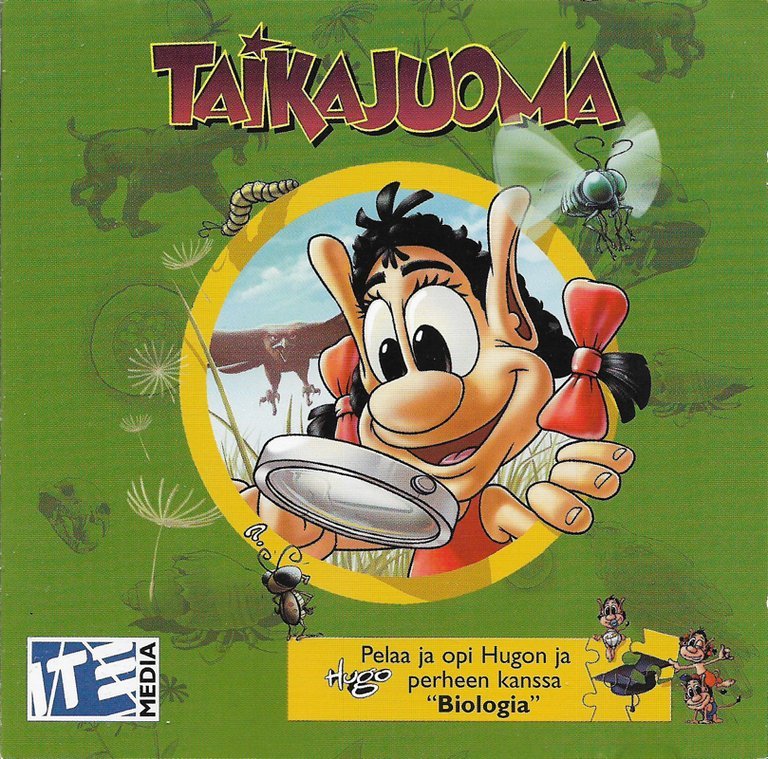
Description
Hugo: The Secrets of the Forest is an edutainment adventure set in a fantasy forest where Hugo’s troll child, Rut, and a literate hedgehog work together to save petrified rabbit children by collecting ingredients for a magical remedy potion. The game features non-linear gameplay with educational minigames focused on biology and ecology, such as guiding a near-sighted swallow to eat insects and memorizing animal sequences, offering three difficulty levels to accommodate various players.
Gameplay Videos
Hugo: The Secrets of the Forest Free Download
Hugo: The Secrets of the Forest Cheats & Codes
PC
Insert Codes in Options
| Code | Effect |
|---|---|
| 4124463113 | Access Level 2 |
| 6873716457 | Access Level 3 |
| 1655668841 | Access Level 4 |
| 1522121211 | Access Level 5 |
| 8415516487 | Access Level 6 |
| 4124472636 | Access Level 7 |
| 4164141264 | Access Level 8 |
| 5873571426 | Access Level 9 |
| 2526216546 | Access Level 10 |
| 1547385756 | Access Level 11 |
| 8416877318 | Access Level 12 |
Hugo: The Secrets of the Forest: Review
Introduction
In the pantheon of edutainment games, few franchises embody the blend of accessibility and educational ambition quite like Hugo. Originating in Denmark as a revolutionary interactive TV show in 1990, the Hugo franchise leveraged telephone-based gameplay to immerse young audiences in the adventures of a lovable troll. Among its many adaptations, Hugo: The Secrets of the Forest (2000) stands as a poignant, if underappreciated, entry. This PC-exclusive title shifts the franchise’s focus from high-stakes rescues to ecological exploration, weaving biology lessons into its whimsical narrative. While it lacks the arcade thrills of earlier Hugo games, its commitment to non-linear learning and gentle challenges makes it a fascinating artifact of early 2000s educational software. This review dissects its design legacy, thematic depth, and place in Hugo’s broader evolution, arguing that it represents a mature, if niche, exploration of how games can foster curiosity about nature without sacrificing fun.
Development History & Context
Hugo: The Secrets of the Forest emerged during a transitional period for the Hugo franchise. Developed by Interactive Television Entertainment (ITE Media ApS), the Danish studio behind the original TV series, the game was released in 2000 for Windows—coinciding with the franchise’s shift from floppy-disk era action-adventures to CD-ROM-based edutainment. ITE, founded in 1988 by Ivan Sølvason, had pioneered interactive television through the Skærmtrolden Hugo show, where children controlled Hugo via telephone keypad inputs. By 2000, however, the TV format was waning, and ITE pivoted to expand Hugo’s reach into educational gaming, capitalizing on the growing home PC market.
The game’s development reflected pragmatic constraints. With a modest team of 19 credited individuals—including producer René Bidstrup, creative director Pele Madsen, and manuscript authors Madsen, Pernille Falk Byriel, and Lars Ostenfeld—ITE leveraged existing assets like the Bink Video middleware for cutscenes. The art direction blended 2D animation (by Rasmus Andreasen and Jan Krogh Larsen) with anime-inspired aesthetics, while programming focused on simplicity to run on low-spec systems (Pentium 166MHz, 32MB RAM). This context is critical: The Secrets of the Forest was not a AAA production but a deliberate effort to repurpose Hugo’s charm for a new medium—educational software. Its design mirrored the franchise’s core ethos: make learning feel like play. Yet, this focus also limited its ambition; as ITE later phased out edutainment for pure entertainment, the game became a footnote in Hugo’s history, overshadowed by console releases like Hugo: The Evil Mirror (2003).
Narrative & Thematic Deep Dive
Unlike previous Hugo games where Hugo the troll rescues his family from the witch Scylla, The Secrets of the Forest centers on his son, Rut, and an unlikely ally—a hedgehog. The narrative unfolds in a fantasy forest where Scylla has petrified rabbit children while gathering magical ingredients for a beauty treatment. Rut witnesses this and discovers a dropped scroll containing a map and a recipe for a counter-potion. With the hedgehog—who can read the scroll—they embark on a quest to find ingredients, motivated by both altruism (freeing the children) and self-interest (clearing the hedgehog’s blocked burrow).
This premise is a masterclass in thematic subtlety. The game uses Scylla’s villainy as a metaphor for ecological disruption: her indiscriminate harvesting of rare fungi and forest resources parallels real-world exploitation. The potion ingredients—rooted in biology (e.g., specific plants, animal parts)—transform the fetch-quest into a disguised lesson about interdependence in ecosystems. Dialogue, though sparse, reinforces this: the hedgehog’s pragmatic narration contrasts with Rut’s youthful idealism, emphasizing cooperation as a solution. Notably, the story avoids violence; Scylla is never confronted, her malice stemming from vanity rather than malice, aligning with the game’s meditative tone. The non-linear structure—players can tackle ingredient-gathering in any order—mirrors ecological systems’ complexity, where actions have ripple effects. This narrative depth elevates The Secrets of the Forest beyond typical edutainment, framing biology as a puzzle of harmony rather than rote memorization.
Gameplay Mechanics & Systems
At its core, The Secrets of the Forest is a collection of eight biology-themed minigames accessed through a hub-and-spoke map. Gameplay emphasizes variety and skill-building, though repetition and simplicity temper its appeal.
-
Core Mechanics: Each minigame teaches a specific biological concept:
- Swallow Navigation: Guide a near-sighted bird to eat insects, reinforcing predator-prey dynamics.
- Animal Memory: Memorize and sequence animal appearances, fostering observation skills.
- Anthil Construction: Build an anthill by matching parts, introducing social insect behavior.
- Karate vs. Viruses: Use martial arts (a nod to Hugo’s comedic action roots) to “defeat” germs, personifying disease.
- Food Chains: Match animals to their correct diets, illustrating trophic levels.
- Seabed Hiding: Spot camouflaged creatures, teaching adaptation.
- Metamorphosis Aid: Help a stick insect become a frog, demonstrating life cycles.
- Fly Collection for Swallows: Time swallows’ flight paths to capture flies, linking to flight physics.
-
Innovations & Flaws: The non-linear progression allows players to choose difficulty (Easy, Medium, Hard), adjusting complexity without overwhelming young audiences. Lives are generous (typically three per minigame), and failure triggers charming, cartoonish consequences—e.g., a stick insect stuck in mid-transformation. However, the lack of a unified score system and minimal narrative integration between minigames create disjointedness. UI is functional but dated, with mouse-point-and-click controls feeling sluggish by 2000 standards. Educational value is clear but shallow; while minigames introduce concepts, they rarely expand on them, relying more on rote association than critical thinking.
-
Progression: Players collect ingredients (e.g., “Moonpetal,” “Dragon’s Breath”) after completing minigames, with the potion’s synthesis as a final reward. This loop is satisfying but rudimentary, lacking the mechanical depth of contemporary titles like Putt-Putt Saves the Zoo.
World-Building, Art & Sound
The Secrets of the Forest excels in creating an immersive, pastoral fantasy world that feels both alive and inviting. The forest setting is rendered with an anime-inspired vibrancy: lush green canopies, sun-dappled clearings, and whimsical flora (e.g., glowing mushrooms, talking flowers) evoke Scandinavian folklore’s warmth. Biomes range from mossy groves to riverbanks, each visually distinct and teeming with creatures—deer, foxes, and fireflies—that reinforce the biological themes. Scylla’s absence from the main adventure is a deliberate choice; her influence is felt through corrupted areas (e.g., withered patches), subtly teaching environmental impact without overt villainy.
Art direction marries 2D sprites with pre-rendered backgrounds, creating a storybook aesthetic. Character designs retain Hugo’s signature charm: Rut inherits his father’s wide-eyed curiosity, while the hedgehog’s grumpy pragmatism adds humor. Animation is fluid, with minigames like Swallow Navigation showcasing dynamic bird flight patterns. Sound design complements this: chirping birds, rustling leaves, and a jaunty, folk-tinged soundtrack composed by Christian Steen Jensen create a meditative ambiance. Voice acting (in Danish and localized versions) is energetic, with Rut’s exclamations and the hedgehog’s dry wit enhancing immersion. Yet, audio lacks variety; tracks loop frequently, and minigame sound effects (e.g., “swoosh” for fly-catching) are repetitive. Overall, the world-building succeeds by making biology tangible, transforming abstract concepts into a tactile, engaging environment.
Reception & Legacy
Hugo: The Secrets of the Forest received a muted but positive critical reception. MobyGames aggregates a lone critic review: CyberMycha awarded it 83%, praising its “engaging minigames” and suitability for young learners, though noting its niche appeal. Player reviews were less kind, averaging 2.1/5 on platforms like MyAbandonware, with complaints about “broken” gameplay and dated mechanics. Commercially, the title struggled in a market dominated by mainstream edutainment like Reader Rabbit; its release in multiple countries (Denmark, Russia, Germany) via publishers like MediaHouse Ltd. failed to replicate Hugo’s earlier blockbuster status—e.g., Hugo 3’s 1996 German sales peak.
Its legacy is two-fold. Within the Hugo franchise, it marked a pivot toward pure edutainment, foreshadowing titles like Hugo: Heroes of the Savannah (2001). However, its greatest influence lies in its educational philosophy: by embedding science in playful, non-linear tasks, it anticipated modern “sandbox learning” games. Culturally, it resonated in Scandinavia as a bridge between TV and PC gaming, preserving Hugo’s identity as a “friendly troll” educator. Yet, the franchise’s shift toward mobile and slot games (e.g., Hugo Troll Race in 2011) rendered The Secrets of the Forest a relic. Today, it survives on abandonware sites, cherished by retro gamers for its earnestness but largely forgotten by mainstream audiences—a testament to the ephemeral nature of edutainment in an industry that prioritizes spectacle.
Conclusion
Hugo: The Secrets of the Forest is a flawed but fascinating artifact of educational gaming history. It lacks the adrenaline of Hugo’s TV-inspired action games and the polish of contemporary edutainment, yet its heart is undeniable: a gentle, biology-fueled adventure that treats learning as exploration. The minigames, while simplistic, offer clever, context-based lessons, and its non-linear structure respects young players’ agency. Visually and sonically, it captures the whimsy of the Hugo universe, proving that even on a modest budget,ITE could craft a cohesive world. Yet, its legacy is bittersweet. Released at the cusp of the 3D gaming revolution, it was overshadowed by flashier titles, and its niche educational focus limited its commercial impact.
For modern audiences, The Secrets of the Forest serves as a reminder of gaming’s potential as a teaching tool—a philosophy now revived in games like Kerbal Space Program. While it may not redefine the medium, it stands as a charming, earnest experiment: a game where the real magic isn’t in rescuing princesses, but in nurturing curiosity about the natural world. In the Hugo saga, it remains a quiet standout—a forest of hidden lessons, waiting for patient explorers.