
- Release Year: 2000
- Platforms: Windows
- Publisher: Joe’s Games
- Developer: Joe’s Games
- Genre: Simulation
- Perspective: Top-down
- Game Mode: Single-player
- Gameplay: Air traffic control, Real-time, Vehicle Management
- Setting: Contemporary
Description
Air Command 2.0 is a realistic air traffic control simulation where players manage aircraft operations at an international airport, guiding planes safely to their destinations by adjusting altitude, speed, authorizing landings and takeoffs. As a sequel to the original Air Command, this 2000 release was rewritten for 32-bit Windows with enhanced graphics, background music, and pilot voices, and includes an airport editor for creating custom airports.
Air Command 2.0: Review
Introduction
In the sprawling landscape of 2000s PC gaming, where blockbuster shooters and sprawling RPGs dominated the zeitgeist, a quiet revolution was unfolding in the unlikeliest of genres: air traffic control simulation. Air Command 2.0, developed by the independent studio Joe’s Games, stands as a testament to the power of niche innovation. As the sequel to the 1996 original and predecessor to the 2001 follow-up, this title represents a pivotal moment in the simulation subgenre—a genre defined not by explosive action, but by the cerebral tension of orchestrating the ballet of modern aviation. While its peers engaged in interstellar warfare or medieval conquests, Air Command 2.0 dared players to find thrill in the mundane, glory in precision, and narrative in the cacophony of a busy airport terminal. This review will argue that Air Command 2.0 is a historically significant artifact—a meticulously crafted simulation that pushed the boundaries of its genre on the burgeoning Windows 32-bit platform, demonstrating that compelling gameplay could arise not from conflict, but from the elegant, high-stakes choreography of flight paths and radio callsigns.
Development History & Context
Air Command 2.0 emerged from the crucible of early Windows gaming, a product of Joe’s Games—a small, passionate development studio helmed by Joe Jaworski. Released in 2000 as shareware, the game was a complete rewrite of its 1996 predecessor, specifically engineered for the 32-bit Windows environment. This technological shift was paramount, as it allowed the developers to transcend the limitations of the earlier 16-bit era, enabling more robust graphics, smoother performance, and the integration of multimedia elements like background music and digitized pilot voices.
The development team comprised 22 contributors, including Joe Jaworski as the lead and John Head, a retired Chief RAPCON (Radar Approach Control) and Chief Air Traffic Control Training consultant, lending an unprecedented layer of authenticity. This wasn’t merely a game; it was a simulation informed by real-world expertise, a rarity in the genre at the time. The constraints of the era were evident: the game utilized a “Fixed / flip-screen” perspective, a nod to older simulations but also a practical limitation for rendering complex airspaces on contemporary hardware. The shareware model—a common tactic for indie studios to circumvent publishing gateways—allowed players to sample the core experience before purchasing the full version, a strategy likely crucial for reaching its dedicated niche audience.
The gaming landscape of 2000 was dominated by titles like Command & Conquer: Red Alert 2 and the nascent hype for Halo, yet simulations maintained a devoted, albeit smaller, following. Air Command 2.0 arrived amidst this ecosystem, not as a blockbuster, but as a highly specialized offering. Its vision was clear: to deliver a realistic, immersive air traffic control experience that leveraged the new capabilities of Windows 2000 and ME, while democratizing the genre with its bundled airport editor—a feature that empowered users to create their own scenarios and airports, fostering a community-driven longevity rare for the period.
Narrative & Thematic Deep Dive
As a simulation, Air Command 2.0 eschews traditional narrative in favor of emergent storytelling—the plot is woven from the player’s decisions and the consequences of their command. The central narrative arc is the player’s ascent from novice to veteran air traffic controller within a contemporary international airport. There are no named protagonists or antagonists; instead, the narrative tension arises from the unspoken pressure of responsibility. Each aircraft is a vessel carrying lives, and every command issued is a calculated risk. The game masterfully cultivates this theme through its mechanics: a missed clearance for takeoff could lead to a collision, a misjudged altitude change might cause a mid-air incident, and the ever-ticking clock amplifies the weight of each decision.
The dialogue is sparse but impactful, primarily delivered through the 20 credited pilot voices—including Joe Jaworski himself and a host of other contributors. These radio transmissions (“United 123, cleared for takeoff,” “Speedbird 456, descend and maintain 5,000 feet“) are the game’s prose, creating a rich tapestry of human interaction amidst the technical jargon. They underscore the theme of human fragility within a system of cold, unforgiving physics. The underlying narrative is one of order versus chaos: the player must impose order on the chaos of incoming and outgoing traffic, managing fuel levels, weather patterns, and aircraft spacing. This theme extends to the game’s setting—a contemporary airport—which serves as a microcosm of global connectivity. The airport editor further deepens this, allowing players to construct their own narratives by creating unique challenges or serene hubs, turning the game into a sandbox for stories of triumph or disaster.
Gameplay Mechanics & Systems
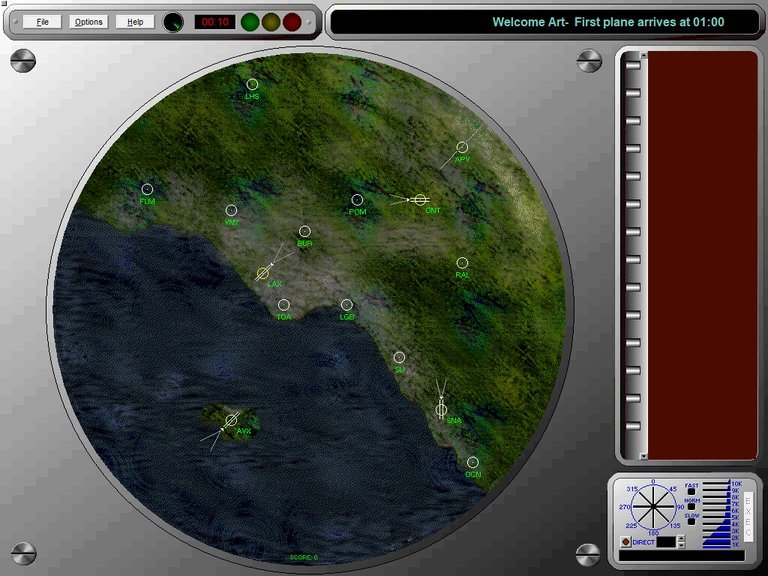
At its core, Air Command 2.0 is a real-time puzzle game disguised as a simulation. The player assumes the role of an air traffic controller, tasked with directing aircraft to their destinations while ensuring safety above all else. The core gameplay loop is deceptively simple yet deeply engaging: players issue clearances for altitude changes, speed adjustments, and runway assignments, executing landings and authorizing takeoffs through a “Point and select” interface. The 1st-person perspective immerses the player directly in the control tower, while the top-down view provides a strategic overview of the airfield and surrounding airspace.
Compared to its predecessor, Air Command 2.0 introduced significant enhancements. The move to 32-bit Windows enabled a more fluid simulation, with improved graphics that rendered aircraft and runways with greater clarity. The addition of background music and pilot voices created a palpable atmosphere, transforming sterile interactions into a dynamic, lived experience. The most groundbreaking feature, however, was the bundled airport editor. This tool allowed players to design custom airports from scratch, altering runway layouts, terminal designs, and approach vectors. This wasn’t just a novelty; it was a revolutionary element that extended the game’s lifespan exponentially, encouraging creativity and community sharing—a forward-thinking move that predated modern user-generated content trends.
The game’s systems are built on a foundation of realistic, if simplified, physics. Aircraft behave with believable inertia, and fuel consumption adds a layer of urgency to arrivals. The “Menu structures” interface, while dated by today’s standards, was efficient for its time, allowing quick access to clearance options and radar views. The pacing is relentless; the simulation runs in real-time, meaning seconds matter, and delays in commands can cascade into near-misses or full-blown disasters. This creates a potent feedback loop: success is measured by the smooth flow of traffic, while failure is a visceral, often audible, catastrophe. The shareware model also cleverly gated complexity, with the full version likely featuring more aircraft types, weather conditions, and airport layouts, incentivizing players to master the basics before tackling advanced scenarios.
World-Building, Art & Sound
The world of Air Command 2.0 is meticulously crafted to evoke the reality of an international airport circa 2000. The setting is contemporary, grounding the simulation in a recognizable, albeit idealized, version of the world. The airport itself is the primary character—a hub of controlled chaos with runways, taxiways, terminals, and radar screens. The “Fixed / flip-screen” visual style, while limiting, effectively conveys the segmented nature of air traffic control, with different views for the tower, radar, and ground control. The art direction prioritizes clarity over spectacle; aircraft are distinct silhouettes, and the color palette is utilitarian, dominated by greys and tans to mimic real-world airport environments. This functional aesthetic serves the gameplay, ensuring that players can instantly identify aircraft types and monitor their positions without visual clutter.
Sound design is where Air Command 2.0 truly excels and establishes its atmosphere. The background music—an ambient, synth-driven score—evokes the tension of a busy control room, rising and falling with the traffic density. But it’s the pilot voices that bring the world to life. The 20 credited voice actors deliver their lines with a mix of professionalism and subtle urgency, creating a living, breathing airspace. The radio chatter—the overlapping requests, acknowledgments, and occasional distress calls—forms a sonic tapestry that reinforces the game’s themes of human connection and systemic pressure. The whine of jet engines during takeoffs and the thud of landing gear add tactile realism, immersing the player in the sensory experience of aviation. Together, the art and sound transform a potentially sterile simulation into a compelling, atmospheric experience, proving that immersion in simulation doesn’t require photorealism, but authenticity and sensory detail.
Reception & Legacy
Upon its release in 2000, Air Command 2.0 garnered no mainstream critical reviews, a fate common to niche shareware titles of the era. Its commercial impact remains undocumented, but its legacy endures within the simulation community. As a shareware product, it likely cultivated a dedicated following, appreciated for its authenticity and the creative freedom offered by the airport editor. The game’s historical significance lies in its role within the Air Command series, bridging the gap between the rudimentary 1996 original and the more refined Air Command 3.0. It demonstrated that air traffic control simulations could thrive on modern Windows platforms, paving the way for future titles like Flight Simulator add-ons and dedicated ATC games.
Influence-wise, Air Command 2.0’s most enduring contribution is its airport editor. The concept of user-generated content in simulations was nascent in 2000, and this feature empowered players to become co-creators, fostering a community that shared custom airports and scenarios. This prefigured the modding cultures of later games like Microsoft Flight Simulator and X-Plane. While it didn’t spawn a direct line of sequels, it cemented the Air Command brand as a respected name in the genre. Its legacy is one of quiet innovation—a title that prioritized depth and realism over mass appeal, proving that there was a passionate audience for the cerebral satisfaction of guiding thousands of tons of metal through the sky with nothing but a radio and a radar screen.
Conclusion
Air Command 2.0 is more than a relic of early PC gaming; it is a masterclass in niche simulation design. Released in 2000, it leveraged the technical capabilities of 32-bit Windows to deliver a deeply authentic and engaging air traffic control experience, enhanced by real-world consultation and multimedia immersion. Its gameplay, centered on the high-stakes puzzle of directing aircraft, offers a unique brand of tension—one rooted in responsibility rather than violence. The bundled airport editor was a visionary feature that extended the game’s life and community engagement, embodying the spirit of user-generated content years before it became mainstream.
While it lacks the narrative fireworks or blockbuster status of its contemporaries, Air Command 2.0’s historical importance cannot be overstated. It stands as a testament to the power of simulation to create compelling, memorable experiences through realism and mechanical depth. Its legacy lives on in the dedicated communities that continue to cherish its airport editor and the broader genre it helped legitimize. For players willing to embrace the cerebral challenge of the control tower, Air Command 2.0 remains not just a game, but a time capsule—a perfectly preserved moment when the quiet hum of an airport terminal was the most thrilling soundtrack in gaming.