
- Release Year: 2023
- Platforms: Windows Apps, Windows, Xbox One, Xbox Series
- Publisher: Bethesda Softworks LLC
- Genre: Action, rhythm
- Perspective: Third-person
- Game Mode: Single-player
- Gameplay: Combat, rhythm
- Average Score: 90/100
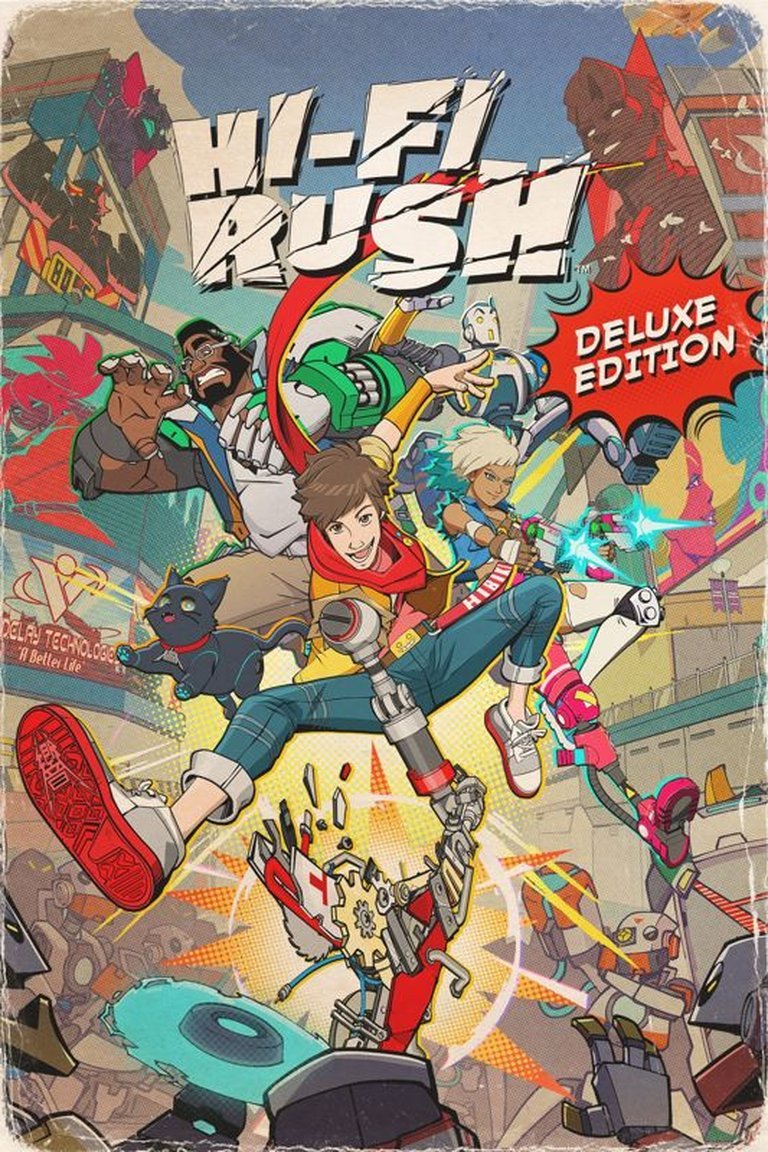
Description
Hi-Fi Rush is a rhythm-based action game where players control Chai, a ‘future rock star’ whose music player is accidentally implanted in his chest during experimental cybernetic surgery at Vandelay Technologies. This grants him the ability to fight and perceive the world in sync with the beat of the game’s soundtrack. Labelled a defect, Chai is hunted by the corporation and joins forces with newfound allies to take down its executives, embarking on a journey through vibrant, stylized environments that blend platforming, combat, and rhythm-based challenges.
Gameplay Videos
Hi-Fi Rush (Deluxe Edition) Mods
Hi-Fi Rush (Deluxe Edition) Guides & Walkthroughs
Hi-Fi Rush (Deluxe Edition) Reviews & Reception
metacritic.com (80/100): It’s a hack and slash with a combination of platforming for the whole family. From the start, its presentation, its plot and even its controls say it all. Its playtime is perfect, and you can play it as many times as you want. However, the button-matching stages can be tedious if you struggle to keep up, as well as a couple of bosses whose mechanics are unclear during the battle. Otherwise, Hi-Fi Rush is just flawless.
ign.com : Stylish-action that marches to the beat of its own drum.
imdb.com (90/100): So much heart
inverse.com (100/100): The Most Important Game of 2023 Is an Instant Classic
pcgamer.com : Despite it’s killer opening act, Hi-Fi Rush fails to sustain its blend of rhythm and action all the way until the end.
Hi-Fi Rush (Deluxe Edition): A Rhythmic Revolution
Introduction
In a gaming landscape often dominated by sequels and live-service titles, Hi-Fi Rush emerged in January 2023 as a bolt of lightning—a vibrant, genre-defying anomaly that felt like a love letter to the creative spirit of the sixth console generation. Developed by Tango Gameworks, the studio renowned for the grim psychological horror of The Evil Within, this title was a radical departure, blending rhythm-based combat with cel-shaded artistry and infectious punk-rock energy. The Deluxe Edition bundles the base game with cosmetic upgrades and a starter gear pack, but its true value lies in the complete experience of a title that defied expectations. From its surprise shadowdrop announcement to its bittersweet legacy as the last Tango project under Microsoft before studio closure and revival, Hi-Fi Rush stands as a testament to the power of bold innovation. This review deconstructs how a game about a rockstar with a music player fused to his chest became a masterclass in marrying gameplay, narrative, and audio into a singular, unforgettable symphony.
Development History & Context
Hi-Fi Rush’s genesis was as audacious as its gameplay. Conceived in 2017 by Tango Gameworks director John Johanas shortly after completing The Evil Within 2, it began as a passion project to pivot the studio away from its survival horror roots. Johanas pitched it as a “dream game” inspired by the frenetic, self-aware energy of Edgar Wright’s films—specifically Shaun of the Dead—blending rhythm mechanics with character action. With executive producer Shinji Mikami’s blessing, a small team developed an internal demo, leveraging Unreal Engine 4 to prototype the world’s synchronization to music. The project remained shrouded in secrecy; Bethesda and Tango feared the tonal shift from horror to comedy would alienate fans. This secrecy reached its zenith when the game was announced and released simultaneously on January 25, 2023, during the Xbox Developer Direct—a move that capitalized on its surprise factor and Xbox Game Pass accessibility. Technically, the game’s constraints were minimal; Unreal Engine 4 facilitated smooth 60 FPS performance across Xbox Series X/S and PC, though its artistic ambition demanded meticulous animation blending to maintain the “everything on beat” philosophy. The gaming landscape of 2023, saturated with gritty realism and live-service games, made Hi-Fi Rush’s unapologetic optimism a breath of fresh air. Its PS5 port in March 2024 expanded its reach, but its legacy was complicated by Microsoft’s closure of Tango Gameworks in May 2024—a fate swiftly reversed when Krafton acquired the studio and IP in August 2024, ensuring the franchise’s future.
Narrative & Thematic Deep Dive
At its core, Hi-Fi Rush is a satirical rebellion against corporate dystopia. The plot follows Chai, a quippy 25-year-old with a disabled right arm and delusions of rockstar grandeur, who volunteers for Vandelay Technologies’ Project Armstrong—a cybernetic limb program. When his music player is accidentally embedded in his chest during surgery, Chai gains synesthetic abilities, perceiving the world through rhythm. Labeled a “defect” by CEO Kale Vandelay (voiced with hammy relish by Roger Craig Smith), he becomes fugitive number one. His escape draws him into a resistance led by Peppermint (Erica Lindbeck), a tech-savvy rebel with a hidden connection to Vandelay’s founding family. Joined by Macaron (Gabe Kunda), a disgruntled ex-R&D head, his sardonic robot partner CNMN (Sunil Malhotra), and security chief Korsica (Sarah Elmaleh)—who undergoes a heel-face turn after Kale betrays them—the crew uncovers SPECTRA, an AI designed to manipulate consumer behavior via cybernetic implants.
The narrative excels in its thematic duality. On one hand, it lampoons tech-bro capitalism: Kale’s motivation—ensuring customer loyalty to boost profits—reduces mind control to a petty business tactic, undercutting apocalyptic expectations. Vandelay’s internal chaos, epitomized by rival executives like the rage-fueled QA head Rekka or the profit-obsessed CFO Roquefort, satirizes corporate incompetence. On the other hand, it champions human connection. Chai’s arc from self-absorbed wannabe to a team player underscores that “together, we’re unstoppable,” while Peppermint’s journey to reconcile with her mother, Roxanne (the company’s founder), adds emotional weight. Dialogue crackles with meta-humor (“Yep, that’s me. And you’re probably wondering how I ended up here”) and self-awareness, never letting the satire curdle into cynicism. The post-game SPECTRA hub missions, revealing a backup AI modeled after Kale, extend the themes of legacy and control, leaving room for future sequels.
Gameplay Mechanics & Systems
Hi-Fi Rush’s genius lies in its seamless integration of rhythm and action. Every element—Chai’s attacks, enemy movements, environmental hazards, and even cutscene animations—syncs to the beat of licensed tracks (e.g., Nine Inch Nails’ “1,000,000” or The Black Keys’ “Lonely Boy”) and an original score. Combat is a fluid dance: Chai’s guitar weapon combos automatically align with the BPM, but landing attacks “on beat” amplifies damage and triggers flashy finishers. The system layers depth through:
– Combo Mechanics: Light and heavy attacks string into combos, graded from D to S. S-ranks transform Chai’s scrap guitar into a real one and trigger crowd chants (“Chai! Chai! Chai!”).
– Parrying and Stuns: A parry system, signaled by visual/audio cues, allows players to cancel enemy attacks, while a stun meter forces vulnerability after a flurry of hits.
– Team Synergy: Allies Peppermint, Macaron, and Korsica tag in for context-sensitive attacks (e.g., Peppermint shooting shields, Macaron breaking armor). Color-coded enemies necessitate specific partners, encouraging tactical diversity.
– Progression: Upgrades are purchased with “Gears,” earned through combat or exploration. Chips grant abilities like extended air combos or healing, while permanent health/special meter upgrades are hidden as collectibles.
The game’s structure mirrors an album: 12 “Tracks” (levels) bookend boss fights against Vandelay’s executives. Minigames—rhythm-based QTEs or platforming sections—reinforce the musical theme without feeling tacked on. Yet, systems like the Rhythm Tower (a 60-floor survival mode) and post-game SPECTRA rooms add replayability, though late-game repetition in enemy variety and level design (e.g., repetitive factory settings) slightly dulls the shine. UI is clean, with a beat metronome assist for rhythm-challenged players, and the “Streamer Mode” replacing licensed tracks to avoid copyright issues showcases thoughtful design.
World-Building, Art & Sound
Vandelay’s campus is a character unto itself—a neon-drenched, retro-futuristic playground where architecture mimics musical instruments. Each division reflects a subgenre: Rekka’s QA wing (industrial rock), Zanzo’s R&D lab (experimental jazz), and Mimosa’s concert hall (electro-pop). The art direction, blending Jet Set Radio-style cel-shading with Edgar Wright’s rapid-fire cuts and zooms, creates a living cartoon. Environments pulse with personality: steam vents puff on the beat, trees sway rhythmically, and Vandelay’s corporate propaganda posters mock consumerism. Animation is arguably the game’s technical zenith—Chai’s idle finger-snapping, 808 the robotic cat’s expressive movements, and boss fights with kaleidoscopic flair (e.g., Rekka’s wrestling-inspired theatrics) make every frame a delight.
Sound design is equally meticulous. The original score by Shuichi Kobori (former Konami composer) and Reo Uratani (ex-Capcom) blends garage rock and synthwave, but licensed tracks elevate encounters: Kale’s boss fight to Nine Inch Nails’ “The Perfect Drug” or Roquefort’s duel to Wolfgang Gartner’s “5th Symphony.” Audio cues—like the chime of a parry or the thud of a Beat Hit—are tactile, while Chai’s internal heartbeat ties the music to his physiology. Even silence has purpose: missing a QTE in Korsica’s fight mutes the track, emphasizing loss. The result is a world where sound and sight are inseparable, making exploration and combat a multisensory feast.
Reception & Legacy
Hi-Fi Rush was met with universal acclaim. On Metacritic, it holds scores of 90 (PC), 87 (Xbox), and 88 (PS5), with critics praising its “oozing style” (Video Games Chronicle) and “instant classic” status (Hardcore Gamer). IGN lauded its “harmonious fusion of rhythm and action,” while The Guardian called it a “pleasurable world to exist in.” Sales were bolstered by Game Pass, reaching 2 million players by March 2023 and 3 million by August. Awards followed, including BAFTA for Animation and “Best Audio Design” at The Game Awards 2023, cementing its technical and artistic merits.
Yet, its legacy is intertwined with turmoil. Tango Gameworks’ closure by Microsoft in May 2024—despite Hi-Fi Rush’s critical success—sparked outrage. Johanas later revealed a sequel pitch was rejected, as Microsoft prioritized established franchises. However, Krafton’s August 2024 acquisition revived both the studio and the IP, with plans for future Hi-Fi Rush titles. This saga underscored the game’s cultural impact: it became a symbol of creative risk in a risk-averse industry, influencing titles like Hades II to embrace bold aesthetics. Culturally, it also sparked trends in “rhythm-adjacent” mechanics and renewed interest in cel-shaded art.
Conclusion
Hi-Fi Rush is more than a game—it’s a symphony of joy and rebellion. Its rhythm-action fusion is executed with unparalleled precision, its world brims with life, and its characters feel like old friends. While minor flaws like repetitive level design and a limited soundtrack prevent perfection, they are mere footnotes to a title that redefines genre boundaries. The Deluxe Edition’s cosmetic extras are icing on the cake, but the core experience remains the star. As Chai and his friends watch the sunset, guitars in hand, Hi-Fi Rush delivers a poignant message: in a world obsessed with profit and control, creativity and camaraderie are the ultimate rebellions. It is not merely a great game but a vital one—a reminder that video games can be as infectious, heartfelt, and unapologetically fun as a power chord blast from a favorite song. For Tango Gameworks, this was a swan song turned rebirth anthem; for players, it’s a must-play masterpiece.