
- Release Year: 2004
- Platforms: Macintosh, Windows
- Publisher: 1C Company, Activision Publishing, Inc., Vivendi Universal Games, Inc.
- Developer: WayForward Technologies, Inc.
- Genre: Action
- Perspective: Side view
- Game Mode: Single-player
- Gameplay: Mini-games, Platform, Puzzle elements
- Setting: Fantasy
- Average Score: 81/100
Description
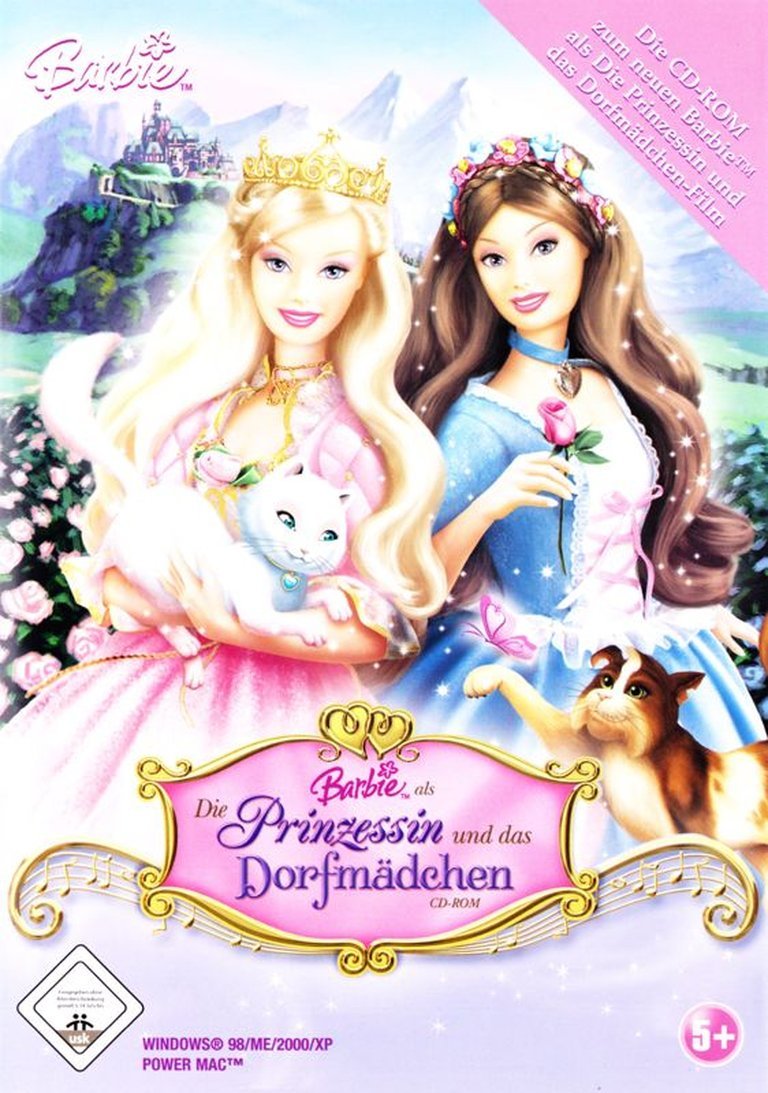
Based on the classic fable The Prince and the Pauper, Barbie as The Princess and the Pauper allows players to guide Erika, a humble pauper, and Princess Anneliese through a fantasy royal realm. Players must help Erika prove her worthiness to become queen by exploring diverse locales including a hamlet, castle, and forest, solving puzzles, completing innovative chores like gathering apples and spinning wool, and engaging in creative activities such as decorating the castle for the coronation ceremony.
Gameplay Videos
Where to Buy Barbie as The Princess and the Pauper
PC
Barbie as The Princess and the Pauper Free Download
Barbie as The Princess and the Pauper Guides & Walkthroughs
Barbie as The Princess and the Pauper Reviews & Reception
metacritic.com (83/100): the game has some depth to it that is quite welcoming as it plays out like a puzzle game mixed with platforming and yes, it works.
myabandonware.com (79/100): I remember playing the fuck out of this game when I was a kid! I have been trying to figure out what game it was for the past five years and finally found it and I want to cry! ;v;
Barbie as The Princess and the Pauper Cheats & Codes
Game Boy Advance
Enter passwords at the password screen or use with a cheat device.
| Code | Effect |
|---|---|
| Old Man, Cat, Dog, Old Man | Unlocks Level 2 |
| Old Man, Barbie, Old Man, Cat | Unlocks Level 3 |
| Cat, Barbie, Cat, Old Man | Unlocks Level 4 |
| Cat, Barbie, Brown Haired Girl, Barbie | Unlocks Level 5 |
| Cat, Brown Haired Girl, Old Man, Cat | Unlocks Level 6 |
| Barbie, Cat, Brown Haired Girl, Cat | Unlocks Boss 1 |
| Princess Anneliese, Serafina, Erika, Wolfie | Unlocks Arcade Level |
| Serafina, Wolfie, Erika, Preminger | Unlocks Boss 1 |
| Preminger, Erika, Serafina, Wolfie | Unlocks Boss 2 |
| Preminger, Serafina, Princess Anneliese, Serafina | Unlocks Boss 3 |
| Erika, Serafina, Princess Anneliese, Wolfie | Unlocks Boss 4 |
| Erika, Princess Anneliese, Princess Anneliese, Man | Unlocks Last Boss |
| Preminger, Wolfie, Erika, Serafina | Unlocks Level 1-2 |
| Wolfie, Preminger, Serafina, Preminger | Unlocks Level 1-3 |
| Preminger, Wolfie, Serafina, Wolfie | Unlocks Level 1-4 |
| Princess Anneliese, Preminger, Wolfie, Erika | Unlocks Level 2-1 |
| Preminger, Princess Anneliese, Wolfie, Erika | Unlocks Level 2-2 |
| Preminger, Serafina, Preminger, Erika | Unlocks Level 2-3 |
| Serafina, Erika, Preminger, Wolfie | Unlocks Level 2-4 |
| Wolfie, Preminger, Wolfie, Erika | Unlocks Level 3-1 |
| Serafina, Preminger, Erika, Serafina | Unlocks Level 3-2 |
| Erika, Wolfie, Serafina, Princess Anneliese | Unlocks Level 3-3 |
| Erika, Serafina, Erika, Preminger | Unlocks Level 3-4 |
| Wolfie, Serafina, Preminger, Serafina | Unlocks Level 4-1 |
| Preminger, Serafina, Princess Anneliese, Preminger | Unlocks Level 4-2 |
| Wolfie, Serafina, Erika, Serafina | Unlocks Level 4-3 |
| Serafina, Preminger, Wolfie, Preminger | Unlocks Level 4-4 |
| Barbie, White Cat, Brown Hair Girl, Brown Cat | Unlocks All 4 Arcade Games |
| F96A20FE 1DFD09E5 | Activates Debug Menu (Press Start+Select) |
| 87CE5C4D D1C06B9A | Activates Debug Menu (Press Start+Select) |
| 9080177CCA41 | Master Code (Must Be On) |
| 89961800200F | Master Code (Must Be On) |
| B24B1A0F40BF | Master Code (Must Be On) |
| 15207C17518E | 1 Item To Collect |
| 95897120758E | 1 Item To Collect |
| 316043AD45A7 | Skip Level (Press R+Up) |
| 675F3C56E1DF | Skip Level (Press R+Up) |
| 0D363C16D14E | Unlocks Arcade Games |
| 829D5C1398CC | Unlocks Arcade Games |
Barbie as The Princess and the Pauper: Review
Introduction
In the pantheon of licensed video games, few franchises have navigated the treacherous waters of adaptation as consistently as Barbie. Yet, amidst the sea of rushed tie-ins, Barbie as The Princess and the Pauper (2004) emerges as a rare gem—a game that transcends its origins to become a charming, thoughtfully crafted adventure. Based on the celebrated 2004 musical film—an adaptation of Mark Twain’s The Prince and the Pauper—this title, developed by WayForward Technologies for Windows and Macintosh, invites players into a world of doppelgängers, royal intrigue, and self-discovery. While its target audience was young girls, its blend of accessible puzzles, vibrant storytelling, and thematic depth offers a surprisingly nuanced experience. This review deconstructs the game’s legacy, dissecting its narrative, mechanics, artistry, and enduring appeal to argue that, despite its humble origins, Barbie as The Princess and the Pauper stands as a testament to licensed-game excellence and a poignant exploration of identity and class.
Development History & Context
To appreciate Barbie as The Princess and the Pauper, one must situate it within the creative and industrial currents of 2004. Developed by WayForward Technologies—a studio known for licensed titles like Shantae and Batman: The Brave and the Bold—the game was published by Vivendi Universal Games, Activision, and 1C Company, reflecting a multi-pronged distribution strategy. Under the direction of Cathy Siegel (Director of Development) and a team including Brenda Lindsay (Producer) and Ellen Kirk (Art Director), WayForward aimed to capture the film’s essence while adapting its interactive potential. The technological constraints of the era were evident: built for Windows XP and macOS, the game utilized 2D scrolling graphics and CD-ROM media, prioritizing accessibility over technical spectacle.
The 2004 gaming landscape was dominated by licensed titles, often criticized for being derivative. Yet, WayForward infused innovation by integrating platforming, puzzle-solving, and life-simulation elements. As Glenn Seidel and Munn Kee (Game Designers) crafted the mechanics, the studio leveraged its expertise in creating family-friendly adventures. The game’s release coincided with the Barbie film’s cult status—praised for its feminist twist on Twain’s tale—and this synergy likely influenced its design. By emphasizing collaboration and creativity over combat, Barbie as The Princess and the Pauper defied the era’s trend of violent or simplistic adaptations, carving a niche for itself.
Narrative & Thematic Deep Dive
At its core, the game follows the film’s plot: Princess Anneliese (a blonde Barbie) and the brunette pauper Erika—indentured to dressmaker Madame Carp—discover their uncanny resemblance. When the kingdom’s corrupt adviser, Preminger, schemes to eliminate Anneliese and seize power, the two switch places. Erika must prove her worthiness to be queen while Anneliese, disguised as Erika, navigates poverty and forges alliances. This duality is not merely a plot device but a thematic exploration of class inequality and identity. The game’s tasks—gathering apples, spinning wool, solving riddles—are microcosms of societal roles: Erika’s labors highlight the drudgery of the working class, while Anneliese’s royal duties underscore the burdens of privilege.
Dialogue, though simplistic, reinforces these themes. Characters like Julian (Anneliese’s tutor) and King Dominick (Erika’s love interest) champion self-determination over duty, challenging the rigid hierarchy. When Erika sings, “I am a girl like you,” it becomes an anthem of solidarity, emphasizing shared humanity over superficial differences. The narrative cleverly subverts fairy-tale tropes: Erika rejects Dominick’s proposal to pursue her musical dreams, only to return later on her terms—a subtle critique of passive princess narratives. Preminger’s villainy, voiced with theatrical malice by Martin Short in the film, translates into-game as an antagonist who exploits systemic corruption, making his defeat a victory for justice. Ultimately, the game’s message is one of empowerment: Erika and Anneliese succeed not through magic, but through empathy, intelligence, and collaboration.
Gameplay Mechanics & Systems
Barbie as The Princess and the Pauper eschews traditional combat in favor of multi-faceted, non-violent gameplay. Players guide Erika through three distinct realms—the village, forest, and castle—each teeming with puzzles and mini-games. Core mechanics include:
- Task-Based Progression: Completing five innovative “queenly tasks” (e.g., decorating the castle with stained glass windows) drives the narrative. Each task requires collecting items like flags, flowers, and emblems, unlocking unique rewards. This loop incentivizes exploration and rewards curiosity.
- Mini-Games: These bite-sized activities—orchard apple-picking, wool-spinning, and riddle-solving—are ingeniously integrated into the world. For instance, spinning wool isn’t a minigame but a step toward creating fabric for the coronation, blending learning with purpose.
- Character Collaboration: Though Erika is the primary protagonist, Princess Anneliese’s wisdom guides her, fostering a sense of partnership. The Game Boy Advance version allowed playing as Anneliese or cats Wolfie and Serafina, but the PC version focuses on Erika’s journey.
- Accessibility: Designed for ages 6-10, the game features forgiving difficulty, intuitive controls, and a linear structure. As GameZone noted, it’s “chock full of interesting things to do,” with challenges that encourage problem-solving without frustration.
However, the lack of post-game content—such as redecorating rooms freely—is a missed opportunity, as noted in contemporary reviews. Overall, the systems prioritize player agency within a structured framework, making it an ideal entry point for young gamers.
World-Building, Art & Sound
The game’s world-building is a triumph of atmospheric design. Environments—Gothic castles, rustic villages, and enchanted forests—are rendered in vibrant 2D, with a color palette that evokes both medieval fantasy and Barbie’s signature pink-and-gold aesthetic. Art Director Ellen Kirk’s team, including artists like Julius Norman and Yong Park, ensured every locale felt distinct: the castle’s opulent halls contrast with the forest’s mossy tranquility, while Madame Carp’s shop brims with rich textures. This attention to detail immerses players, even if the perspective remains a simple side-scrolling view.
Sound design similarly elevates the experience. Composer Tom Zehnder’s score, though not as iconic as the film’s songs by Amy Powers and Megan Cavallari, employs whimsical melodies and ambient cues that enhance exploration. Sound effects—like jingling coins or rustling leaves—add tactile depth. While the game doesn’t feature full vocal performances, its use of the film’s instrumental tracks and the lullaby Erika sings to escape the dungeon ties it narratively to the source material. This synergy creates a cohesive world where art and sound serve the story, reinforcing themes of harmony and discovery.
Reception & Legacy
Upon release, Barbie as The Princess and the Pauper garnered critical acclaim, particularly for its thoughtful design. GameZone awarded the PC version 83%, praising its “interesting things to do” and child-friendly approach. Critics highlighted its ability to make young players feel “included in the adventure,” with mini-games that balanced education and entertainment. The Game Boy Advance iteration also fared well, earning 75-90% from outlets like Cheat Code Central, which noted its “puzzle game mixed with platforming” worked “quite welcoming” for its demographic.
Commercially, the game benefited from the Barbie film’s popularity, becoming a staple in children’s software collections. Its legacy, however, lies in its enduring cultural resonance. In abandonware communities and forums, players reminisce about its role in their childhoods, with comments like “I loooooooooooooooooooove this game” underscoring its emotional impact. The film, meanwhile, is hailed as one of Barbie’s best, securing a cult following for its feminist themes—a reputation that bolsters the game’s nostalgic appeal.
Influence-wise, Barbie as The Princess and the Pauper set a precedent for licensed games by prioritizing narrative and creativity over mechanics. WayForward’s later work, such as Shantae, would build on this foundation, blending accessible gameplay with rich storytelling. Though not a revolutionary title, its success demonstrated that licensed games could honor their source material while offering unique interactive experiences.
Conclusion
Barbie as The Princess and the Pauper is far more than a simple movie tie-in; it is a masterclass in licensed-game design. By weaving Twain’s classic tale into a tapestry of puzzles, mini-games, and heartfelt storytelling, WayForward crafted an experience that resonates with both children and adults. Its exploration of class, identity, and empowerment—coupled with accessible gameplay and vibrant art—elevates it above its peers. While minor flaws, like limited post-game content, prevent perfection, they are negligible against the game’s charm and depth.
In the annals of video game history, Barbie as The Princess and the Pauper occupies a unique space: it is a relic of an era when licensed games dared to be thoughtful, and a testament to the enduring power of storytelling. For those seeking a journey that is both enchanting and meaningful, this game remains not just a relic of childhood, but a timeless adventure. As Erika and Anneliese’s double wedding reminds us, true royalty lies not in birthright, but in the bonds we forge and the dreams we pursue. And in this, the game succeeds brilliantly.