
- Release Year: 2000
- Platforms: Windows
- Publisher: Hasbro Interactive, Inc.
- Developer: VR-1, Inc.
- Genre: Sports, Strategy, Tactics
- Perspective: Top-down
- Game Mode: Online PVP
- Gameplay: Dribbling, Passing, Shooting, Stats, Turn-based
- Setting: Sports
- Average Score: 58/100
Description
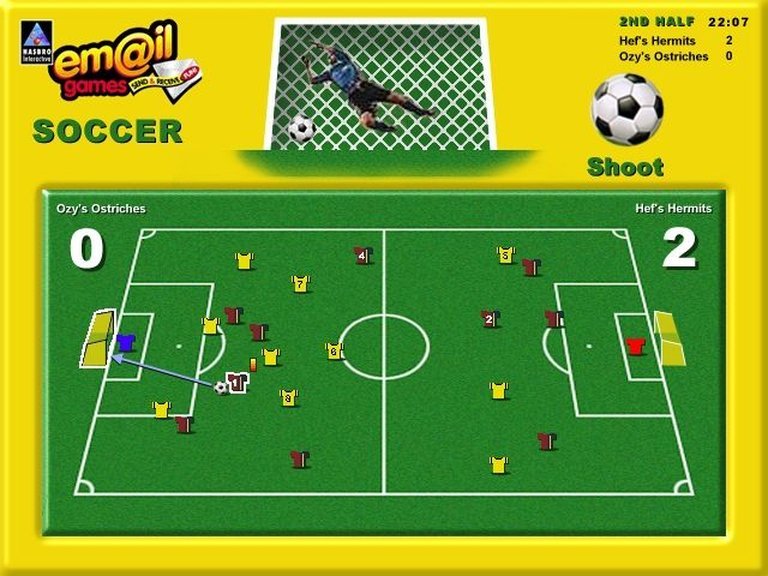
Em@il Games: Soccer is a turn-based play-by-email football game released in 2000, where players manage a simplified soccer team by choosing formations, shirt designs, and team names. Each player has stats for pace, defence, offence, and stamina, and actions like passing, dribbling, or shooting are performed via mouse clicks, with defensive actions handled automatically. Gameplay alternates between players via email, continuing until possession is lost.
Em@il Games: Soccer Reviews & Reception
retro-replay.com : It’s a perfect blend of quick decisions and strategic depth—no two matches ever play out the same.
Em@il Games: Soccer: A Niche Artifact of Asynchronous Gaming History
Introduction
In an era defined by hyper-realistic sports simulations and instant online multiplayer, Em@il Games: Soccer stands as a curious relic—a turn-based soccer experience delivered through email. Released on January 17, 2000, by Hasbro Interactive and developed by VR-1, Inc., this Windows-exclusive title belongs to a fleeting experiment in asynchronous gaming, where moves were dispatched via email and opponents responded at their leisure. While its premise may seem archaic today, the game’s blend of minimalist strategy, asynchronous play, and accessible mechanics offers a fascinating window into the early internet’s potential for reimagining traditional formats. This review argues that despite its simplicity and niche appeal, Em@il Games: Soccer is a historically significant artifact—a testament to the creativity of developers leveraging emerging technology to create unique social experiences, even as its limitations underscore the challenges of bridging analog sensibilities with digital potential.
Development History & Context
Em@il Games: Soccer emerged from the ambitious Em@il Games series, an initiative by Hasbro Interactive to adapt classic board and casual games for email-based play. The series, launched in 1999 with titles like Scrabble and Battleship, sought to capitalize on the nascent internet culture of the late 1990s, where email was a primary digital medium. VR-1, Inc., the developer, was known for experimenting with multiplayer formats, and their vision for Soccer was to distill the sport into its strategic essence—stripping away real-time action for a methodical, “chess-like” exchange.
Technologically, the game operated within severe constraints. Email transfers demanded lightweight file sizes and minimal complexity, necessitating a top-down, 2D interface with sparse graphics. The 2000 gaming landscape was dominated by the sixth-generation console wars (PlayStation 2, Dreamcast, Xbox) and the rise of broadband, but asynchronous play was still in its infancy. While games like Ultima Online and EverQuest were pioneering real-time MMOs, Soccer’s email-based approach harked back to bulletin board systems (BBS) and play-by-mail (PBM) games of the 1980s. This context highlights its niche appeal: it wasn’t competing with FIFA or Pro Evolution Soccer but offering an alternative for time-strapped players seeking depth without synchronization.
Narrative & Thematic Deep Dive
Em@il Games: Soccer deliberately eschews traditional narratives, focusing solely on the abstract purity of sport. There are no named players, no backstories, and no scripted dramas—only anonymous teams defined by four core stats: pace, defence, offence, and stamina. Each match is a self-contained vignette, a microcosm of tactical rivalry where “story” emerges organically from player choices. The absence of injuries, substitutions, or individual identities underscores a thematic emphasis on collective strategy over heroism. This reductionism mirrors the idealized vision of soccer as a “beautiful game”—pure, egalitarian, and governed by logic rather than spectacle.
The game’s “characters” are the players themselves, albeit generic. A forward with high pace becomes a lightning threat, while a defender with sturdy stats forms an immovable barrier. Their interactions—passes, dribbles, shots—become the dialogue, with the email interface acting as the narrator. The turn-based structure transforms each match into a psychological duel, where anticipation and patience are as crucial as stats. This minimalism is both a strength and a limitation: it frees players to project their own narratives onto the experience but lacks the emotional resonance of character-driven sports games like FIFA’s career modes. Ultimately, Soccer’s narrative is one of emergent storytelling—a testament to how constraints can foster creativity.
Gameplay Mechanics & Systems
At its core, Em@il Games: Soccer is a masterclass in distilled mechanics. Players begin by customizing their team (name, formation, shirt design) before engaging in turn-based matches. Each turn offers three actions: pass (click a teammate), dribble (click open field), or shoot (click the goal). The resolution system elegantly balances simplicity and depth: the game compares the ball-carrier’s stats (pace, offence, stamina) against nearby opponents’ defence and pace. Success retains possession; failure triggers an email transfer to the opponent.
This loop creates a tense, rhythmic cadence. A successful dribble might lead to a high-stakes shot, while a risky pass could invite interception. The automatic defense—where tackling and marking are handled by AI—streamlines play but sacrifices realism for focus. Stats influence outcomes subtly: a low-stamina player fumbles under pressure, while a high-offence forward increases shot accuracy. The UI is admirably intuitive, relying on mouse clicks to map actions spatially. However, the absence of player names or substitutions can feel impersonal, and the lack of real-time feedback (e.g., visual cues for possession loss) may frustrate those accustomed to dynamic sports sims.
Innovatively, the email integration was ahead of its time, foreshadowing modern asynchronous games like Words with Friends or Chess.com. Yet its turn-by-turn pacing—matches could span days—highlighted the trade-off between deliberation and engagement. For its era, Soccer was a bold experiment in translating soccer’s chaos into methodical strategy, albeit one limited by the era’s technology and audience expectations.
World-Building, Art & Sound
The game’s world is a functional abstraction: a top-down green pitch with minimalist player sprites, a goalpost, and occasionally a boundary line. This visual restraint, born from email-transfer constraints, prioritizes clarity over spectacle. Players are represented as colored dots or simple icons, with customizable shirt designs offering the only personal flair—a nod to team identity in otherwise anonymous matches. The static, diagrammatic aesthetic mirrors the game’s strategic ethos, focusing on spatial positioning over graphical fidelity.
Sound design is virtually non-existent, as confirmed by sources like Retro Replay. The absence of crowd noise or commentary underscores the game’s quiet, cerebral atmosphere, where tension stems from the email inbox’s anticipation rather than auditory cues. This harks back to early text-based adventures, where imagination filled sensory voids. While the art won’t impress modern players, its efficacy lies in utility: the clear, low-bandwidth visuals ensure that the emailed match reports remain readable even on slow connections. It’s a world built for strategy, not immersion—a choice that aligns with the game’s turn-by-turn philosophy.
Reception & Legacy
Upon release, Em@il Games: Soccer received lukewarm reviews, with a critic average of 58% on MobyGames. PC Gaming World (60%) acknowledged it was “not the most obvious subject for an email game” but conceded it “isn’t” entirely “naff.” GameStar echoed this, praising its budget-friendly appeal but noting motivation waned due to “simplen Spielkonzepte.” The harshest criticism came from PC Joker (55%), which dismissed its “mausgesteuerten Mini-Progis” as “billig” (cheap) and argued that email gaming was obsolete in an age of internet servers.
Commercially, the game was a niche product. As part of the Em@il Games series, it lacked the mass appeal of console titles and was overshadowed by contemporaries like FIFA 2000 or Pro Evolution Soccer 2. Its legacy, however, lies in its pioneering role as an asynchronous multiplayer experiment. It predates the mobile gaming boom by years and demonstrates how email could facilitate social gaming before smartphones and apps. While it didn’t influence mainstream sports titles, its emphasis on turn-based strategy and asynchronous play resonates in modern indie games like A Dark Room or Terraforming Mars. For historians, it’s a snapshot of the internet’s formative era—a reminder that innovation often emerges from limitations.
Conclusion
Em@il Games: Soccer is a flawed but fascinating artifact of gaming history. Its stripped-down mechanics, email-based delivery, and asynchronous design represent a bold attempt to reimagine soccer for the digital age. While critics rightly noted its simplicity and graphical limitations, the game’s genius lies in its restraint: by removing real-time action and narrative fluff, it distilled soccer to its strategic core. It’s a title for patient thinkers, not adrenaline junkies—a niche that feels increasingly relevant in today’s fragmented gaming landscape.
Verdict: Em@il Games: Soccer holds a modest but vital place in video game history. It may not be a classic, but as a curiosity of early internet culture and a precursor to asynchronous multiplayer, it deserves recognition. For modern players, it’s a charming relic—proof that innovation can thrive even in constraints. In the grand scheme of football gaming, it’s not a Pele or Maradona, but it’s the scrappy midfielder who enables the stars: essential, often overlooked, but undeniably part of the team.