
- Release Year: 2007
- Platforms: Windows
- Publisher: Midway Home Entertainment, Inc., The Codemasters Software Company Limited
- Developer: Turbine
- Genre: MMO
- Perspective: Third-person
- Game Mode: MMO
- Gameplay: Character progression, Item collection, MMORPG
- Setting: Fantasy, Middle-earth
- Average Score: 83/100
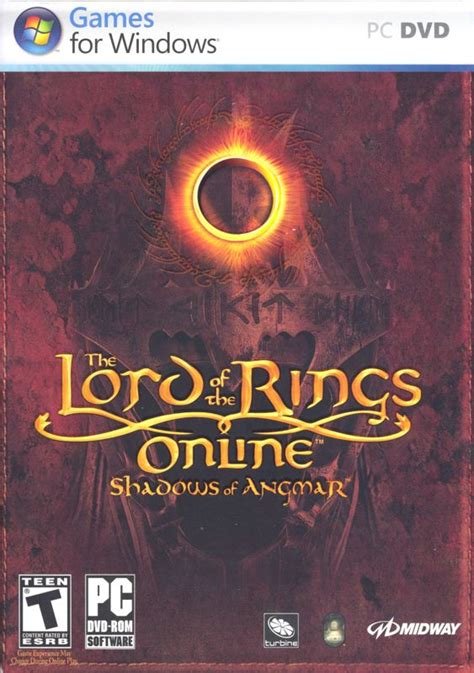
Description
The Lord of the Rings Online: Shadows of Angmar (Special Edition) is an MMORPG set in J.R.R. Tolkien’s iconic Middle-earth during the events of The Lord of the Rings. Players explore regions like the Shire, Rivendell, and Bree, while engaging in quests and battles against the forces of the Witch-king in the land of Angmar. The special edition includes the base game, 30 days of free play, a ‘Making of’ DVD, soundtrack, exclusive in-game items such as ‘The Glass of Aglarel’, and physical extras like a manual and maps of Middle-earth.
The Lord of the Rings Online: Shadows of Angmar (Special Edition) Guides & Walkthroughs
The Lord of the Rings Online: Shadows of Angmar (Special Edition) Reviews & Reception
metacritic.com (86/100): With Turbine’s long-standing MMORPG expertise powering proceedings and one of the most welcoming communities in gaming, LOTRO presents a stunning and evocative world of Tolkien magic to explore – if you’re any kind of fan, it would seem pretty much an essential purchase.
ign.com : Turbine’s latest MMORPG delivers.
eurogamer.net : How did it all go so right?
The Lord of the Rings Online: Shadows of Angmar (Special Edition): Review
Introduction
In 2007, while World of Warcraft reigned supreme over the MMORPG landscape, a challenger emerged that dared to carve its own path in the hallowed grounds of Middle-earth. The Lord of the Rings Online: Shadows of Angmar wasn’t merely another fantasy MMO; it was a meticulous, lovingly crafted digital pilgrimage through J.R.R. Tolkien’s legendary world. The Special Edition, packed with physical treasures and in-game artifacts, served as a gateway for players to not just play, but inhabit the Shire, Bree, and the foreboding peaks of Angmar. With its blend of faithful lore, innovative systems, and accessibility for newcomers to the genre, Shadows of Angmar proved that a revered intellectual property could transcend mere licensing to become a living, breathing testament to Tolkien’s vision. This review deconstructs its legacy, dissecting its design, narrative, and enduring impact on gaming history.
Development History & Context
Developed by Turbine, Inc., the studio behind Dungeons & Dragons Online, Shadows of Angmar was the culmination of years of ambition to adapt Tolkien’s complex world into a massively multiplayer framework. Released on April 24, 2007, it faced the monumental task of competing with WoW’s dominance while staying true to Tolkien’s source material. Turbine’s team, led by executive producer Jeffrey Steefel, leveraged their expertise in persistent-world design to create a world that felt both expansive and intimate. Technologically, the game pushed boundaries for its era, utilizing the Havok physics engine for dynamic environmental interactions and middleware like Kynapse for advanced NPC behaviors. The Special Edition was a calculated move to entice collectors and newcomers alike, with publisher Midway Games handling North American distribution and Codemasters managing European releases. The game’s design philosophy emphasized accessibility—solo-friendly progression, minimal grinding, and a robust trait system—reflecting Turbine’s awareness of WoW’s accessibility barriers. This context was crucial: Shadows of Angmar wasn’t just a game but a statement, proving that licensed MMOs could innovate within the genre’s conventions while honoring their source material.
Narrative & Thematic Deep Dive
Shadows of Angmar’s narrative ambition was staggering, weaving its epic tale through Tolkien’s established timeline with remarkable fidelity. The story begins in The Fellowship of the Ring’s early chapters, with players assuming the role of a hero caught in the machinations of Sauron’s resurgence. Unlike many MMOs that shoehorn players into central roles, LOTRO positions players as pivotal but secondary figures, aiding Gandalf, Aragorn, and other canonical heroes in their struggle against Angmar’s forces. The core narrative, spanning “Books” I through VIII, follows a deliberate arc: from thwarting the Blackwold brigands in the Bree-lands (Book I) to battling the Witch-king’s lieutenant, Mordirith, in the ruins of Carn Dûm (Book VIII). Each book introduced new antagonists—Skorgrím Dourhand, Ivar the Blood-hand—and moral dilemmas, such as the tragic fall of Amarthiel (Sara Oakheart), a champion corrupted by her ring, Narchuil.
Free post-launch updates expanded this narrative exponentially. Book IX (“Shores of Evendim”) introduced the ruins of Annúminas, while Book XIII (“Doom of the Last-King”) delved into the icebound wastes of Forochel, each adding layers of political intrigue and personal sacrifice. Themes permeate every quest: the fragility of hope (symbolized by the in-game “Glass of Aglarel”), the burden of history, and the cyclical nature of evil. Even side quests, like helping hobbit farmers or escorting dwarven caravans, reinforced the world’s texture. The game’s dialogue, penned by Chris Pierson (a Babylon 5 writer), balanced epic grandeur with folksy charm, making NPCs feel like genuine inhabitants of Middle-earth rather than quest dispensers. This deep narrative integration wasn’t just a strength; it was a revolutionary approach, proving that MMO stories could resonate emotionally beyond kill-ten-rats tropes.
Gameplay Mechanics & Systems
At its core, Shadows of Angmar refined MMO staples while introducing distinct innovations. Character progression eschewed the grind-heavy models of its contemporaries. Experience was primarily earned through quests, with minimal reward for mindless mob farming. Players chose from four races (Hobbit, Elf, Dwarf, Man) and seven classes (Guardian, Champion, Hunter, Burglar, Captain, Lore-Master, Minstrel), each with unique roles. For instance, the Burglar—a rogue class—focused on control and debuffs rather than pure damage, while the Lore-Master summoned animal companions and wielded crowd-control abilities. The trait system, tied to “deeds,” allowed for meaningful customization. Completing deeds—such as slaying 100 trolls or exploring every landmark—granted titles (e.g., “Troll-slayer”) and traits that boosted stats or unlocked new abilities. This encouraged exploration and replayability without feeling punitive.
Crafting was similarly inventive. Players selected vocations (e.g., Explorer, Woodsman) comprising three interdependent professions. For example, a Metalsmith might require Prospecting (gathering ore) and Smelting (refining) but would need to interact with Weaponsmiths to craft finished blades. This fostered player interdependence, a deliberate nod to Tolkien’s themes of community. Combat, while traditional, benefited from tactical depth: positioning and morale mechanics (building “hope” to unlock powerful skills) added nuance. The game’s most groundbreaking feature was Monster Play (PvMP). In the Ettenmoors, players could switch roles, controlling Nazgûl, Orcs, or Wargs to fight against Free Peoples. This balanced PvP system let casual players engage without grinding, using “Destiny Points” to upgrade monster abilities. Even innovations like the Skirmish system—introduced later—allowed solo players to AI-controlled “soldiers” for instant group content. These systems collectively made Shadows of Angmar accessible yet richly layered.
World-Building, Art & Sound
Turbine’s recreation of Middle-earth was a masterclass in environmental storytelling. The game’s nine launch zones—ranging from the idyllic Shire to the frozen wastes of Forochel—felt distinct and geographically authentic. The Shire’s rolling hills and cozy hobbit holes, Bree’s rain-slicked streets, and Angmar’s fortress-flooded mountains all breathed with life. Art direction balanced Tolkien’s descriptions with subtle nods to Peter Jackson’s films (despite lacking film licenses), resulting in Orcs that evoked Weta Workshop’s designs and Rangers clad in weathered cloaks. Lighting and weather systems amplified atmosphere: mist-shrouded Trollshaws at dusk, orcs torching farms in Bree, or the auroras dancing over Evendim.
Sound design was equally immersive. Composer Chance Thomas’s score evoked Howard Shore’s work, with leitmotifs for each region (e.g., a gentle harp for the Shire, ominous strings for Angmar). Ambient sounds—the clatter of dwarf forges in Thorin’s Hall, the wind howling over the Misty Mountains—further deepened immersion. Voice acting was sparse but impactful, with Gandalf’s (voiced by Harry Chase) and Strider’s lines anchoring key moments. Even the Special Edition’s physical artifacts—a parchment map of Angmar, the in-game “Cloak of the Peacekeeper”—extended the world beyond the screen. This commitment to sensory fidelity made Middle-earth not just a setting but a character, one players could lose themselves in for hours.
Reception & Legacy
Upon release, Shadows of Angmar was hailed as a triumph. Critics lauded its faithfulness to Tolkien’s lore, with Eurogamer calling it “the best game for anyone new to MMOGs,” and GameSpy awarding it “PC MMO of the Year.” The Special Edition’s physical extras bolstered its appeal, while the free 30-day trial lowered barriers to entry. Commercially, it sold over 250,000 copies by year-end, carving a niche as WoW’s most sophisticated rival. Players praised the solo-friendly design and community kinships (guilds), though some criticized dated graphics and occasional group-finding challenges.
Over time, its legacy evolved. The transition to free-to-play in 2010, with expansions like Mines of Moria (2008) and Riders of Rohan (2012), revitalized the game, introducing races like High Elves and systems like mounted combat. Standing Stone Games (formed from Turbine’s MMO division) continues to support it, with expansions as recent as 2024. Critics revisited it with fondness, with Metacritic users scoring it 7.7/10, noting its “cozy” Tolkien authenticity. Its influence permeated the genre: the trait system and deed-based progression became templates for other MMOs, while its emphasis on narrative over combat foreshadowed story-driven titles like Final Fantasy XIV. Today, it stands as a testament to licensed gaming’s potential, proving that a beloved IP, handled with reverence and innovation, can achieve longevity rarely seen in the volatile MMO market.
Conclusion
The Lord of the Rings Online: Shadows of Angmar remains a landmark achievement, a game that transcends its era to offer one of the most authentic and immersive Middle-earth experiences ever crafted. Its Special Edition, with its map and soundtrack, was more than a collector’s item—it was an invitation to step into Tolkien’s world. While its graphics show their age and its F2P model later introduced friction, the core design—quest-driven progression, meaningful traits, and Monster Play—remains remarkably engaging. Shadows of Angmar succeeded where many licensed games fail: it didn’t just exploit Tolkien’s legacy; it elevated it, weaving his themes of hope and camaraderie into every system. For players who wandered the Shire’s lanes or battled atop Carn Dûm, it wasn’t just a game—it was a journey. In an industry often defined by fleeting trends, LOTRO’s enduring presence is a tribute to its unwavering commitment to Middle-earth, securing its place not just in gaming history, but in the annals of Tolkien’s own enduring legacy.