
- Release Year: 1997
- Platforms: PlayStation, SEGA Saturn, Windows
- Publisher: Success Corp., Technical Group Laboratory, Inc.
- Developer: Technical Group Laboratory, Inc.
- Genre: Role-playing (RPG), Strategy, Tactics
- Perspective: Isometric
- Game Mode: Single-player
- Gameplay: Character movement, Character progression, Combat, Spell casting
- Setting: Fantasy
Description
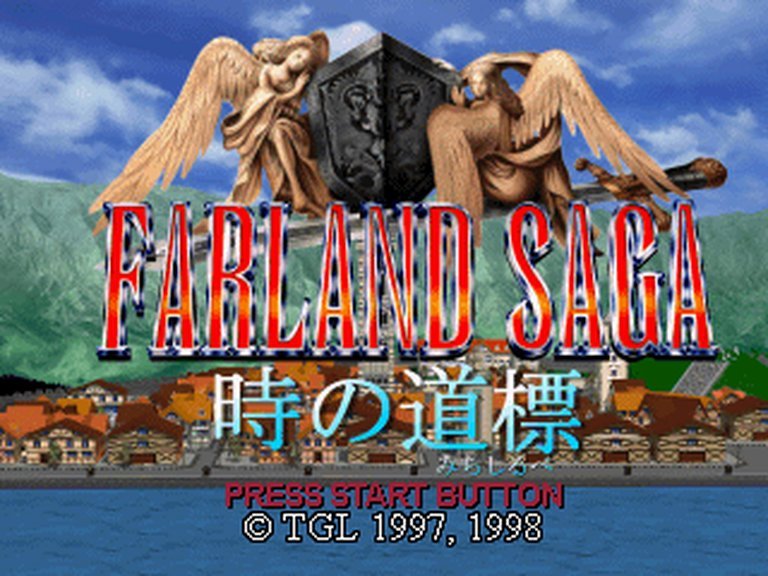
Set in a fantasy world eight years after a great war between humans and magical beings, ‘Farland Saga: Toki no Michishirube’ follows mercenary Kalin and amnesiac wanderer Al as they embark on an adventure after joining a local guild. This direct sequel to the first Farland Saga game is an anime-style strategy RPG featuring large-scale tactical battles on isometric battlefields, where players command characters in physical combat and spellcasting, with customizable character progression via freely distributable experience points.
Gameplay Videos
Farland Saga: Toki no Michishirube Guides & Walkthroughs
Farland Saga: Toki no Michishirube Reviews & Reception
retro-replay.com : With its blend of epic storytelling, strategic depth, and rich visual style, Toki no Michishirube is the essential addition to any RPG collection.
Farland Saga: Toki no Michishirube Cheats & Codes
NTSC-J PlayStation 1
Enter these codes using a CodeBreaker device.
| Code | Effect |
|---|---|
| 801CBEE4 423F 801CBEE6 000F |
Infinite Money |
Sega Saturn
Enter these codes using a Pro Action Replay/GameShark device.
| Code | Effect |
|---|---|
| F6000914 C305 + B6002800 0000 | Master Code (must be on) |
| 160B5858 000F + 160B585A 423F | Unlimited Money |
| 160B9B40 0064 | All Characters Level Up Every Battle |
| 360BB5A7 0001 + 160BB5A8 0902 + 160BB5AA 0903 + 160BB5AC 0904 + 160BB5AE 0905 + 160BB5B0 0906 + 160BB5B2 0907 + 160BB5B4 0908 + 160BB5B6 0909 + 360BB5B8 0009 | Unlimited Item Recovery |
PC / Generic
Enter one of the following player names to activate the corresponding cheat.
| Code | Effect |
|---|---|
| !STRIKE! | Press S while bowling for a strike |
| !LEVELS! | Level select |
Farland Saga: Toki no Michishirube: Review
Introduction
In the annals of Japanese tactical RPGs, few names evoke as much niche reverence as Farland Saga: Toki no Michishirube—a game that emerged from the fertile soil of the late 1990s PC boom to become a cult masterpiece. As the direct sequel to 1996’s Farland Saga, this 1997 Windows release (later ported to Sega Saturn in 1998 and PlayStation in 1999) solidified Technical Group Laboratory, Inc.’s (TGL) reputation as craftsmen of complex, narrative-driven strategy. Eight years after a cataclysmic war between humans and magical folk, Toki no Michishirube (translating to “The Signpost of Time”) thrusts players into a world scarred by peace, where the echoes of conflict resonate through the lives of its characters. This review posits that while the game is tethered by the technological constraints of its era, its unparalleled depth of tactical combat, rich character customization, and poignant storytelling elevate it to an enduring classic—a signpost pointing toward the potential of anime-inspired strategy RPGs.
Development History & Context
TGL’s Vision and Studio Identity
Developed by the prolific TGL, Toki no Michishirube was the culmination of the studio’s decade-long expertise in Japanese PC RPGs. Founded in 1985, TGL had already established the Farland Saga universe with its predecessor, leveraging a team of core creators including programmer Koji Yamamoto, designer Masaaki Arihara, and the indomitable artist Kazue Yamamoto. Yamamoto’s character designs—distinct for their expressive, watercolor-like softness—became the series’ visual signature, blending the whimsy of Shōnen manga with the gravitas of high fantasy. The game was published domestically by TGL and later by Success Corp. for its console ports, reflecting a deliberate push to capitalize on the burgeoning Japanese console market.
Technological Constraints and Innovations
Crafted for Windows 95/98, the original game operated within the limitations of early 32-bit systems. Memory constraints dictated compressed sprite animations and modest polygonal models for 3D environments, yet TGL ingeniously used isometric perspectives to simulate depth without taxing hardware. The absence of voice acting was mitigated through dynamic text boxes and expressive character portraits, a choice that fostered player imagination. Notably, the Sega Saturn port (1998) expanded on this with enhanced color palettes and smoother transitions, though it retained the core tactical framework. By 1999, the PlayStation release further refined the UI, adding clearer menu navigation—small but critical accessibility tweaks for console audiences.
The Gaming Landscape of 1997
In 1997, the Japanese PC RPG scene was a competitive crucible dominated by titles like Nippon Ichi Software’s Tactical Ogre and Atlus’ Tetrisphere, both of which emphasized grid-based combat. Toki no Michishirube distinguished itself by merging tactical depth with anime storytelling, a hybrid approach that prefigured later successes like Final Fantasy Tactics (1997). However, its niche appeal—rooted in complex stat systems and Japanese-language narratives—limited its mainstream impact in the West, where Western RPGs like Baldur’s Gate (1998) reigned. Yet, within Japan, its reputation grew through magazine features and community-driven translations, cementing TGL as a studio for hardcore strategy RPG enthusiasts.
Narrative & Thematic Deep Dive
Plot: A Legacy of Peace and Unresolved Tensions
Set eight years after the war between humans and magical beings, the narrative opens with the death of Brian, one of the war’s great heroes, leaving Kalin—the girl he raised in the war’s aftermath—adrift in a world at peace. Kalin’s quest for identity as a mercenary intertwines with Al, an amnesiac boy with cryptic origins, as they accept guild contracts to survive. The plot escalates from pirate-ship raids to continent-spanning political intrigue, exposing the fragility of peace. Themes of displacement and legacy permeate the story: Kalin grapples with Brian’s shadow, while Al’s fragmented past mirrors the fractured coexistence of humans and magical folk.
Character Archetypes and Relationships
The narrative thrives on its character dynamics. Kalin embodies the “chosen legacy,” her journey from orphan to mercenary symbolizing post-war resilience. Al functions as the “mystery catalyst,” his amnesia serving as a narrative device to explore prejudice and hidden lineage. Supporting characters—a grizzled guildmaster, a scholarly mage, and vengeful pirates—are archetypes elevated by Yamamoto’s art, which infuses even minor NPCs with personality. Dialogue is sparse but potent, using stilted formalities to reflect medieval feudalism and emotional outbursts during key plot twists.
Thematic Resonance: Time as a Signpost
The title Toki no Michishirube (“Signpost of Time”) encapsulates the game’s core theme: history as both guide and trap. Kalin’s mentorship under Brian represents a direct line to the past, while Al’s memory loss symbolizes the erasure of magical history. Pirates, initially presented as villains, reveal themselves as victims of societal neglect, complicating the binary of “good vs. evil.” This moral ambiguity is rare for the era, positioning the game as a subtle critique of wartime trauma and the myth of “just” conflict.
Gameplay Mechanics & Systems
Core Tactical Engine: Isometric Warfare
At its heart, Toki no Michishirube is a tactical RPG built on isometric battlefields. Players maneuver parties of up to six characters across grid-based maps, with elevation and terrain influencing spell range and attack efficacy. Physical attacks, archery, and elemental spells form the combat triad, each requiring strategic positioning—e.g., fire spells ignite wooden decks, while ice spells freeze water hazards. Turn-based mechanics demand foresight, with units possessing limited movement points and attack ranges that encourage flanking and cover tactics.
Character Progression and Customization
A standout feature is the free-form experience point (XP) distribution system. After battles, XP is pooled and allocated manually to any party member, enabling radical role shifts: Kalin can evolve from a swordswoman to a sorceress, or Al from a scout to a tank. Class promotions occur at specific XP thresholds, unlocking new skills and stat bonuses. This freedom contrasts sharply with contemporaries like Final Fantasy Tactics, where classes are rigidly defined. However, the lack of an auto-battle option for repetitive encounters highlights the game’s demanding pace—a double-edged sword for accessibility.
UI and Innovations
The PC interface, utilitarian but functional, presents character stats, item inventories, and spell lists in side-scrolling menus. Sega Saturn and PlayStation ports streamlined this with larger, more navigable icons. Critically, the game introduced a reputation system tied to guild contracts: completing high-risk missions unlocks elite quests and unique gear, adding meta-strategic depth. Yet, the absence of a minimimap on larger maps could disorient players, a flaw mitigated only by the inclusion of a “fog of war” toggle that revealed explored territories.
World-Building, Art & Sound
Setting: A Fantasy World Scarred by Peace
The game’s fantasy realm, Farland, is meticulously layered. Post-war coexistence between humans and magical folk is fragile, with guilds acting as neutral arbiters of conflict. Locations range from coastal pirate strongholds to enchanted forests, each map doubling as a narrative device—e.g., ancient ruins hint at magical history, while bustling towns underscore economic disparity. Environmental storytelling is subtle: crumbling statues in war-torn zones and overgrown pirate vessels reinforce the theme of peace as a recent, fragile construct.
Art Direction: Anime Aesthetics Meets Tactical Realism
Kazue Yamamoto’s art defines the game’s visual identity. Character portraits, rendered in soft, pastel hues, convey emotion through subtle eye movements and hand gestures. Battle sprites, though low-resolution, animate fluidly—sword slashes blur, spellcasters gesture with arcane intensity. The isometric perspective showcases varied tilesets: sand-swept beaches, moss-covered dungeons, and snow-capped mountains. While the Saturn and PlayStation ports enhanced detail with richer textures, the original’s pixel art retains a timeless charm.
Sound Design: Ambient Tension and Melodic Resonance
The soundtrack, composed by Tenpei Sato (as noted in archival sources), oscillates between melancholic piano motifs and orchestral battle hymns. Sound effects—clashing steel, spell detonations, and pirate cannon fire—are crisp and weighty, anchoring tactical actions in visceral feedback. Voice acting is minimal but impactful, reserved for critical plot moments to heighten drama. This restraint fosters immersion, letting music and ambiance fill emotional gaps—a masterclass in “less is more” audio design.
Reception & Legacy
Initial Reception and Commercial Performance
Upon release, Toki no Michishirube garnered modest acclaim in Japanese gaming magazines, with F.E.A.R. praising its tactical depth and character customization. However, its niche appeal—Japanese-language-only text and complex systems—limited Western exposure. Console ports fared better, with the Saturn version enjoying cult status among importers. Commercially, it was overshadowed by RPG titans like Final Fantasy VII (1997), but its dedicated following ensured steady sales throughout the late 1990s.
Evolution of Reputation
Over time, the game’s reputation shifted from “hidden gem” to “genre touchstone.” Online communities like the Farland Saga Wiki celebrated its innovative XP system and narrative nuance, while retrospectives highlighted its influence on titles like Tactics Ogre: The Knight of Lodis (2002). Modern analyses often compare it to Fire Emblem, noting its emphasis on character bonds (albeit indirectly through shared XP). The 2010s saw fan translations breathe new life into the PC version, introducing it to global audiences who lauded its “uncompromising” design.
Influence on the Industry
Toki no Michishirube’s legacy lies in its synthesis of anime storytelling with hardcore strategy. Its free-form progression system anticipated the “buildcraft” ethos of Path of Exile (2013), while its thematic focus on war’s aftermath foreshadowed the narratives of NieR: Automata (2017). TGL’s subsequent work, Farland Odyssey (1999), refined its systems, but Toki no Michishirube remains the series’ apex—a testament to how technical limitations can, paradoxically, foster creativity.
Conclusion
Farland Saga: Toki no Michishirube is a relic of an era when Japanese PC RPGs prioritized depth over accessibility, and narrative ambition over mass-market appeal. Its tactical combat remains brilliantly complex, its character customization unprecedented for its time, and its themes of legacy and peace resonate with haunting clarity. Flaws—like a punishing difficulty curve and archaic UI—mitigate its perfection but not its significance. For historians, it’s a vital node in tactical RPG’s evolution; for players, it’s a challenging, rewarding journey into a world where every choice echoes through time. In the pantheon of anime-inspired strategy, Toki no Michishirube stands not merely as a signpost of its past, but as a beacon for those who crave games that demand both intellect and heart. Verdict: An enduring masterpiece of niche design.