
- Release Year: 2004
- Platforms: Windows
- Publisher: Novitas Publishing GmbH
- Developer: Michael Molkenthin
- Genre: Action, Simulation
- Perspective: Both 1st-person and 3rd-person
- Game Mode: Single-player
- Gameplay: Combat, Ship Customization, Space Exploration, Trading
- Setting: Futuristic, Sci-fi
- Average Score: 63/100
Description
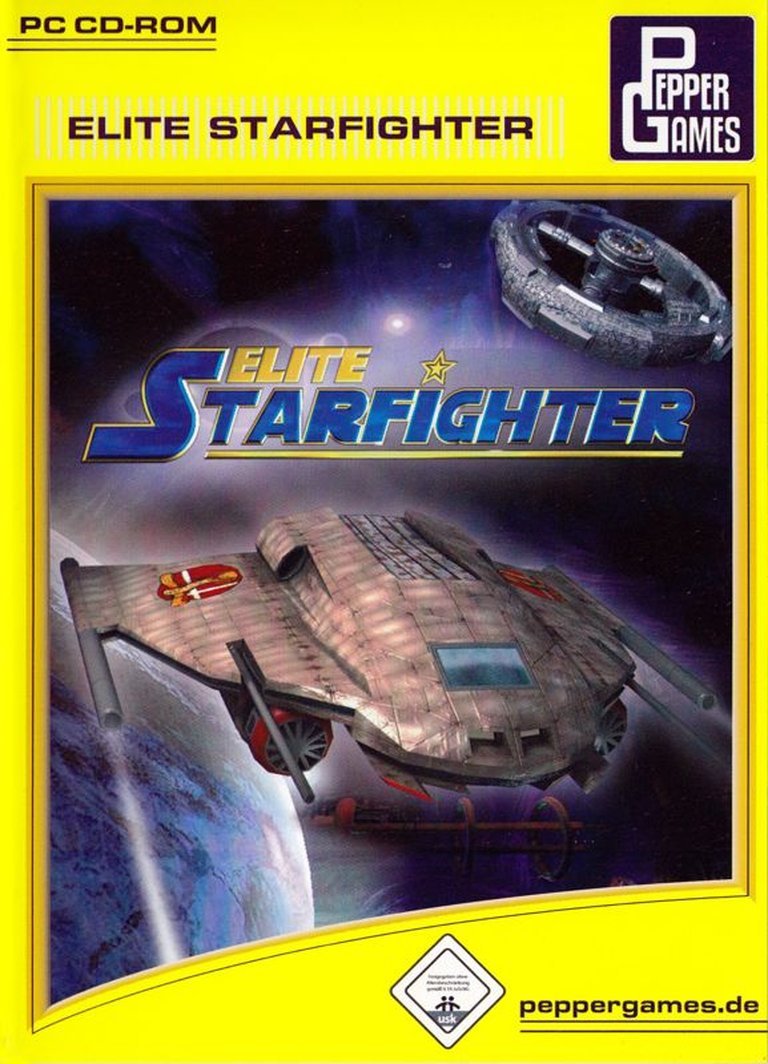
Elite Starfighter is a faithful remake of the classic 1984 Elite, retaining its core mechanics while updating technical aspects. Set across approximately 2000 procedurally generated star systems, players engage in space trading, combat, and ship upgrades. Each system features a space station for restocking goods, which can be traded at dynamic prices, or players may opt for piracy by seizing merchant vessels while battling AI pirates. The ultimate goal is to achieve the highest rank: Elite.
Gameplay Videos
Elite Starfighter Patches & Updates
Elite Starfighter: Review
Introduction
In the pantheon of space simulation games, few titles command the reverence of Elite (1984), a groundbreaking creation by David Braben and Ian Bell that defined the genre with its open-ended universe, procedural generation, and wire-frame 3D graphics. Two decades later, Elite Starfighter (2004) arrived as a German-developed homage to this landmark title, promising to resurrect the spirit of interstellar trading, piracy, and exploration for a modern audience. Yet, while its fidelity to the original’s core mechanics is undeniable, Elite Starfighter exists as a curious artifact—a product of passion constrained by ambition and timing. This review dissects Elite Starfighter as both a loving tribute to a classic and a cautionary tale about the challenges of remaking revolutionary games in an era of rapidly evolving expectations. Through rigorous analysis of its development, gameplay, reception, and legacy, we will uncover whether this forgotten title deserves a place among the stars or remains a footnote in the annals of space simulation history.
Development History & Context
Elite Starfighter emerged from the independent studio Game Development M. Molkenthin, a small German team helmed by programmer Michael Molkenthin and producer Markus Junghans (“Feldi”). Their vision was unapologetically nostalgic: to recreate the essence of Braben and Bell’s 1984 masterpiece with updated technical underpinnings. The game was published by Novitas Publishing GmbH in November 2004, a period when the space sim genre was dominated by modern titans like Freelancer (2003) and the burgeoning X²: The Threat (2003). These titles offered complex narratives, multiplayer features, and photorealistic visuals—advancements that made Elite Starfighter’s stripped-down approach feel archaic before it even launched.
The developers adhered closely to the original’s design philosophy, as noted in the MobyGames description: “Except for technical aspects, it stays very close to the original, meaning there are no missions and no multiplayer.” This fidelity extended to core systems like the 2,000-procedurally generated star systems and the 21 space stations for trade. However, the team’s resources were palpably limited. The credits list only 10 individuals, including 3D designer Daniel Renner (“the duke”) and sound designer AUMESO, with Sponsors like SAITEK hinting at industry partnerships rather than blockbuster budgets. Technologically, the game boasted 3D graphics and first/third-person perspectives, but these were pale shadows of contemporary benchmarks. The gaming landscape of 2004 demanded narrative depth and multiplayer integration—features Elite Starfighter consciously omitted, positioning itself as a purist’s relic rather than a forward-thinking evolution. In this context, it was less a sequel and more a digital time capsule, one that struggled to find relevance amidst genre innovations it chose to ignore.
Narrative & Thematic Deep Dive
Elite Starfighter’s narrative approach is a direct inheritance from its progenitor: it is virtually nonexistent. The original Elite (1984) famously included Robert Holdstock’s novella The Dark Wheel, which contextualized the player’s actions within a rich universe of political intrigue and moral codes. Elite Starfighter, by contrast, offers no such literary or cinematic framing. As the MobyGames summary bluntly states, the game focuses on “exploration of about 2000 star systems” with no missions, no overarching plot, and no named characters beyond the player’s anonymous commander. This absence is both its greatest strength and its most glaring flaw.
Thematically, the game echoes Elite’s core tenets: untrammeled freedom and ruthless capitalism. Players begin as a humble trader in a “Cobra MK4” vessel (a nod to the original’s Cobra Mark III), tasked with accumulating wealth through trade or piracy. The universe is a meritocracy where rank—starting from “Harmless” and ascending toward the coveted “Elite”—is earned through combat prowess and financial success. This minimalist setup allows emergent storytelling, where each hyperspace jump or dogfight becomes a personal legend. Yet, without the original’s novella or scripted events, Elite Starfighter lacks thematic depth. The Thargoids, the insectoid antagonists from Elite, are entirely absent, robbing the game of its cosmic mystery. The 21 space stations, with their randomly generated commodity prices, evoke a sense of a living economy, but their static, text-based interactions (per the MobyGames description) feel transactional rather than immersive. Ultimately, the game’s narrative is a vacuum—a blank canvas for player-driven exploits that, while authentic to Elite’s spirit, fails to engage modern audiences accustomed to layered storytelling and character-driven arcs.
Gameplay Mechanics & Systems
Elite Starfighter’s gameplay is a meticulous recreation of Elite’s loops, updated with 3D graphics but retaining the original’s stark simplicity. The core cycle remains: hyperspace to a new system, dock at a station, trade goods or upgrade the ship, and engage in combat. Trading involves 21 commodities with prices that fluctuate randomly, creating risk-reward calculations for profit-maximizing pilots. Alternatively, players can adopt a life of piracy, seizing merchant vessels—a high-risk, high-reward path that invites retaliation from AI pirates and police. This duality of trader and buccaneer is the game’s most enduring mechanic, harking back to the original’s open-ended freedom.
Combat is equally foundational: ships maneuver in 3D space, with energy management dictating shield strength and weapon firing. Upgrades like better lasers and shields are purchased incrementally, with progression tied to accumulating credits. The UI, however, reflects the game’s budgetary constraints. As noted in reviews from GameStar and PC Action, the interface relies on “unmotivated text menus,” a stark contrast to the polished HUDs of contemporaries like X²: The Threat. The docking process, a signature challenge in Elite, remains a test of precision, but critics lamented its tediousness in 2004. Systems like fuel scooping (for refueling from stars) and hyperspace jumps are present but feel unrefined, with the latter occasionally stranding players in “witch-space” if interrupted by Thargoid ambushes—a feature inexplicably omitted here.
Innovations are scarce. The game’s procedural generation of star systems is a faithful nod to Braben and Bell’s algorithm, but with only 2,000 systems (versus Elite’s 8 galaxies), it feels smaller. Multiplayer and missions are absent, as the developers prioritized purity over evolution. While this appeals to purists, it left Elite Starfighter feeling like a museum piece in a genre moving forward. As Gamesmania.de scathingly noted, “The genre has evolved since Elite… The competition offers more handlungsspielraum [room for maneuver] and exciting missions.”
World-Building, Art & Sound
Elite Starfighter’s greatest achievement is its faithful recreation of Elite’s universe, albeit through a less polished lens. The 2000 star systems evoke the original’s sense of boundless exploration, with procedurally generated planets and stations maintaining the same procedural DNA that made Elite a landmark in 1984. The game’s setting is a sandbox of pure possibility—a galaxy where players carve their own destinies through trade or combat, free from narrative shackles. This minimalist world-building, however, is a double-edged sword. Without the Federation-Empire political tensions or Thargoid threats of later Elite titles, Elite Starfighter feels empty, a void filled only by the player’s ambition.
Artistically, the game is a study in contrasts. The 3D models for ships and stations are functional but rudimentary, with the Cobra MK4 vessel appearing blocky and uninspired compared to the sleek designs of Freelancer. Environments are sparse—planets are distant orbs, and space stations are generic, rotating hubs lacking personality. The MobyGames credits list “Wolfgraphics” for cover design, but in-game visuals feel dated even for 2004. Sound design follows a similar pattern. Background music is noted as “Work in Progress” in the credits, and reviews imply it is forgettable, with SFX failing to evoke the tension of combat or the awe of space. The absence of atmospheric audio cues—like the iconic Blue Danube waltz during docking in Elite—robs key moments of emotional weight.
Yet, for all its technical shortcomings, Elite Starfighter captures a certain retro charm. The wire-frame aesthetic of Elite is replaced with basic polygons, but the core sensation of piloting a lone ship through the void remains potent. In this, the game succeeds as a time capsule, offering a glimpse into the raw, unadorned freedom that captivated players in 1984. It is a world of ideas, not details—a testament to how Elite’s legacy transcended its primitive presentation.
Reception & Legacy
Upon its November 2004 release, Elite Starfighter was met with a collective shrug from critics and players alike. Its MobyGames score of 5.8/10 and a paltry 47% critic average (based on five reviews) underscored its status as a niche curiosity. German publications were particularly unimpressed: GameStar awarded it 41%, calling it a “remake of the original Elite… with all its for modern times gravierende Macken [grave flaws],” while PC Action dismissed it as a fleeting novelty. Gamesmania.de was equally scathing, arguing that for €15, players could buy superior titles like I-War 2 or Freelancer. The few positive notes came from outlets like Game Captain (59%), which acknowledged its appeal for “old sacks” (veteran players) seeking nostalgia but cautioned against high expectations.
Commercially, Elite Starfighter vanished without a trace. Its MobyGames page shows only three player ratings and no significant sales milestones, a stark contrast to the original Elite, which sold over a million copies across platforms. Its legacy is equally muted. While it remains a footnote in the Elite series, it is not entirely forgotten. On abandonware sites like MyAbandonware, it endures as a downloadable curiosity, with patches and texture mods available for preservation. Its true significance, however, lies in what it represents: an earnest but failed attempt to recapture the magic of 1984 in an era demanding innovation.
Influence is virtually nonexistent. Unlike Elite, which inspired titans like Wing Commander: Privateer, EVE Online, and No Man’s Sky, Elite Starfighter left no ripples. It serves instead as a contrast to the franchise’s own evolution: Frontier: Elite II (1993) introduced Newtonian physics and seamless planetary landings, while Elite Dangerous (2014) embraced multiplayer and a 1:1 scale Milky Way. Elite Starfighter’s stubborn refusal to adapt rendered it a historical curiosity—a reminder that reverence alone cannot sustain a game in a competitive industry.
Conclusion
Elite Starfighter is a paradox: a loving tribute to a revolutionary game that, by clinging too tightly to its source material, becomes a relic of what could have been. Its faithful recreation of Elite’s core mechanics—trading, piracy, and procedural exploration—offers a pure, unfiltered taste of 1984’s sandbox freedom. Yet, in a 2004 gaming landscape defined by narrative depth and technical polish, its stripped-down design feels archaic, its absence of missions and multiplayer a fatal flaw. The game’s lukewarm reception and commercial obscurity underscore the challenges of remaking a genre-defining classic without evolving its DNA.
Historically, Elite Starfighter occupies a unique space: it is both a testament to Elite’s enduring influence and a cautionary tale about the perils of nostalgia. For players yearning to experience the original’s unvarnished joy, it provides a functional, if imperfect, portal to the past. For the industry, it serves as a reminder that innovation—rooted in respect but not bound by it—is the true path to legacy. In the end, Elite Starfighter is not a great game, but it is a fascinating one. It is a ghost in the machine of space simulation history—a flicker of a bygone era, preserved for those who remember the stars as wire-frame wonders and dreamt of earning the rank of “Elite.”