
- Release Year: 1996
- Platforms: Macintosh, Windows 16-bit, Windows
- Publisher: Davidson & Associates, Inc.
- Developer: Funnybone Interactive
- Genre: Educational
- Perspective: 1st-person
- Game Mode: Single-player
- Gameplay: Building, Crafting, Creativity, logic, Puzzle
- Setting: Toyland
- Average Score: 88/100
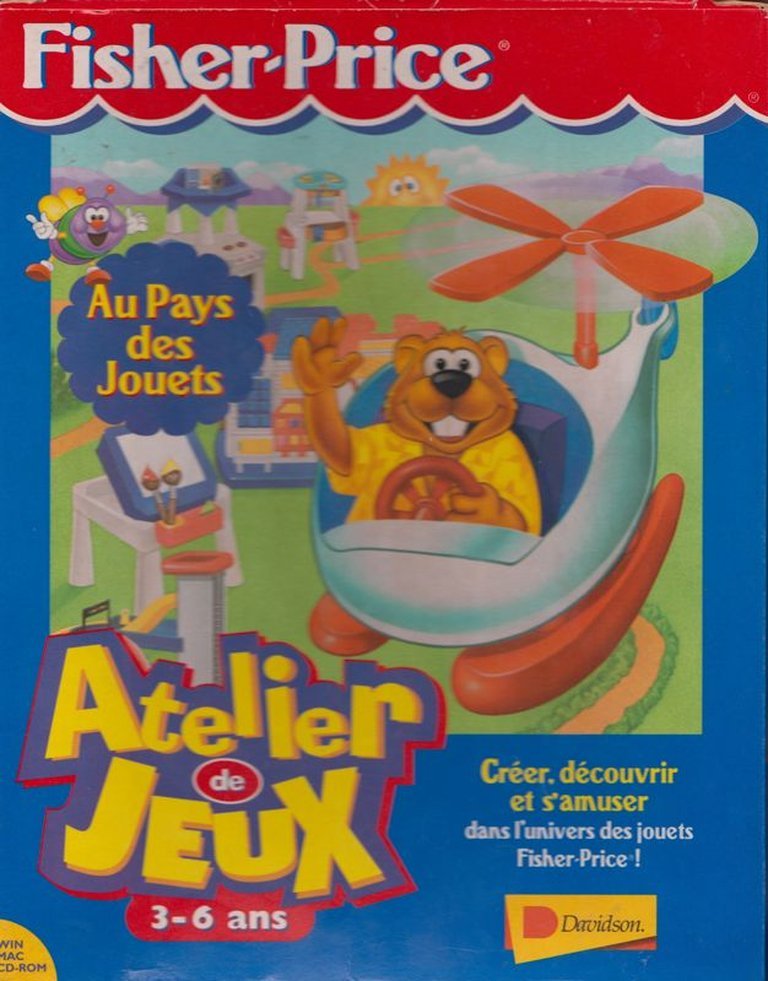
Description
Fisher-Price: Learning in Toyland is an educational game for preschoolers hosted by Gotcha Gopher and Bippity Bug, featuring six interactive activities set in a playful Toyland environment. Players build vehicles and woodworking creations, solve transport puzzles, learn letters/numbers/animal sounds, bake cookies, and engage in coloring, crafts, and block-building games to develop early math, logic, reading, and problem-solving skills.
Gameplay Videos
Fisher-Price Learning in Toyland Free Download
Fisher-Price Learning in Toyland: A Nostalgic Masterpiece of Edutainment
Introduction
In an era when educational software often sacrificed engagement for pedagogy, Fisher-Price Learning in Toyland (1996) emerged as a beacon of playful learning. Developed by Funnybone Interactive and published by Davidson & Associates, this CD-ROM anthology transformed iconic Fisher-Price toys into vibrant digital playgrounds. Guided by the chirpy Gotcha Gopher and his companion Bippity Bug, the game offered six meticulously crafted activities that seamlessly blended skill-building with unbridled creativity. Decades later, Learning in Toyland remains a paragon of early childhood design—a testament to how structured learning and imaginative play can coexist. This review argues that despite its simplicity, the game’s masterful balance of guided challenges, free-form creation, and sensory-rich interactions established a blueprint for educational gaming that still resonates today.
Development History & Context
Learning in Toyland emerged from the fertile ground of the mid-1990s edutainment boom, when developers like Humongous Entertainment and Davidson & Associates dominated the market. Funnybone Interactive, a studio founded in 1994, specialized in Fisher-Price licensed titles, leveraging the brand’s universal recognition to create accessible digital experiences. The game was spearheaded by Creative Director Susan Swanson-Decker and Senior Supervisor Wesley Hodges, with a team of 38 artists, designers, and programmers including talents like Michael Carangelo and Peggy Smith.
Technologically, the game was constrained by the era’s hardware—Windows 3.x and 16-bit systems, CD-ROM media, and mouse-only input. Yet these limitations became strengths. The CD-ROM format allowed for rich audio and sprite-based animations, while the first-person perspective simplified navigation for toddlers unused to complex controls. The gaming landscape of 1996 was saturated with edutainment titles, but Learning in Toyland stood out by focusing on tactile, toy-inspired interactions rather than abstract drills. Its vision was clear: to translate the sensory joy of physical toys into a digital medium, where clicking a virtual hammer produced satisfying sound effects and drilling a wooden plank emitted realistic sparks.
Narrative & Thematic Deep Dive
Though sparse in plot, Learning in Toyland weaves a subtle narrative through its characters and setting. Gotcha Gopher—a perpetually cheerful, oversized gopher in a mechanic’s overalls—and Bippity Bug, a bespectacled insect companion, serve as patient guides. Their dialogue is a masterclass in child-centric design: instructions are clear (“Click the hammer here!”), praise is effusive (“You’re a super chef!”), and corrections are gentle (“Oops! Let’s try that again”). This dynamic frames Toyland as a nurturing kingdom where mistakes are opportunities, not failures.
The overarching theme is learning through agency. Each activity area—Big Action Garage, All-in-1 Workshop, Fliptrack Mountain, etc.—represents a “neighborhood” in Toyland, encouraging exploration. Though no overarching story exists, mini-narratives emerge organically: delivering presents in Fliptrack Mountain becomes a quest; baking cookies in the All-in-1 Kitchen transforms into a celebration of creativity. This structure reinforces autonomy, subtly teaching that learning is a journey driven by curiosity. Themes of responsibility are also embedded, most notably in the Workshop’s cleanup phase, where players must vacuum sawdust—a clever metaphor for task completion.
Gameplay Mechanics & Systems
Learning in Toyland’s brilliance lies in its six activities, each targeting distinct developmental skills while maintaining consistent mechanics.
- Big Action Garage: Players assemble vehicles (cars, trucks, planes) by matching body parts, wheels, and ornaments to a blueprint. The freeform “Crazy Car” mode lets kids invent whimsical creations and print them, blurring digital-physical boundaries.
- All-in-1 Workshop: A woodworking simulator where players drill, hammer, and screw pieces in marked spots. The cleanup phase with a vacuum teaches spatial awareness and sequencing.
- Fliptrack Mountain: A logistics puzzle where players select the correct vehicle (car, boat, train, helicopter) to transport items based on terrain, fostering problem-solving and cause-effect reasoning.
- Talking Smart Street: An interactive soundboard where letters, numbers, and animals trigger vocalizations or noises, reinforcing literacy and auditory recognition.
- All-in-1 Kitchen: A recipe-following game where players mix, roll, cut, and decorate cookies. The freeform mode emphasizes creativity over precision.
- 3-in-1 Creativity Table: Combines guided coloring, shape-based crafts, and block-matching puzzles, honing fine motor skills and artistic expression.
UI Design: The interface is minimalist and tactile. Oversized buttons, bold icons, and immediate audio feedback eliminate frustration. Freeform modes in every activity encourage experimentation, while guided modes provide structure. A minor flaw noted in reviews is the lack of verbal cues for “Yes/No” quit prompts—a rare oversight in an otherwise intuitive design.
World-Building, Art & Sound
Toyland is a triumph of sensory design, mirroring the Fisher-Price aesthetic with its primary-color palette, chunky geometry, and soft pastel shadows. Each location evokes physical toys: the Garage resembles a plastic playset with ramps and cranks; the Workshop’s wood textures mimic real lumber. Characters like Gotcha Gopher use exaggerated expressions (wide eyes, gestures) to convey emotion, while environments are intentionally uncluttered to focus attention on interactive elements.
Sound design is equally meticulous. Tools emit distinct clicks and clangs; animal sounds are authentic (barking dogs, mooing cows); and Gotcha Gopher’s voice—warm and encouraging—provides constant guidance. The audio-visual synergy creates an immersive feedback loop: drilling sparks with a “zzzt” sound reinforces action-reasoning, while the vacuum’s whirr in the Workshop adds playful realism.
Reception & Legacy
Upon release, Learning in Toyland was lauded for its educational efficacy and entertainment value. Critics awarded it an 88% average (All Game Guide: 90%, Review Corner: 87%), praising its ability to “empower kids, giving them control over their environment” (All Game Guide). Parents noted it was a “great buy” compared to purchasing individual Fisher-Price toys, which cost $30+ each. Players rated it 4.4/5, with one reviewer recalling, “My kids continue to return to this game even beyond its targeted age range.”
Its legacy endures in three key ways:
1. Influence on Edutainment: The game’s hybrid of guided tasks and free-form play became a template for later titles like Fisher-Price’s Wild Western Town (1997).
2. Cultural Artifact: As a “bonus disc” in Little People Christmas Activity Center, it introduced generations to digital learning.
3. Timeless Design: Modern parents still seek it out for its non-digital feel, with forums debating solutions to run it on Windows 10 via emulators like OTVDM.
Conclusion
Fisher-Price Learning in Toyland is more than a relic; it is a benchmark in educational game design. Its activities—rooted in toy-like interactivity—transcend technological limitations, proving that engagement hinges on empathy for young learners. The game’s greatest triumph is its dual commitment: teaching skills through structured challenges while nurturing creativity through open-ended play. For a generation raised on Reader Rabbit and Myst, Learning in Toyland offered something rarer: the joy of unscripted discovery. In a landscape often obsessed with metrics and gamification, its legacy is a gentle reminder that the most effective learning begins not with tests, but with a gopher’s smile and the satisfying click of a well-placed screw.