
- Release Year: 2011
- Platforms: Windows
- Publisher: City Interactive S.A.
- Genre: Compilation
- Perspective: First-person
- Game Mode: Single-player
- Gameplay: First-person shooter
Description
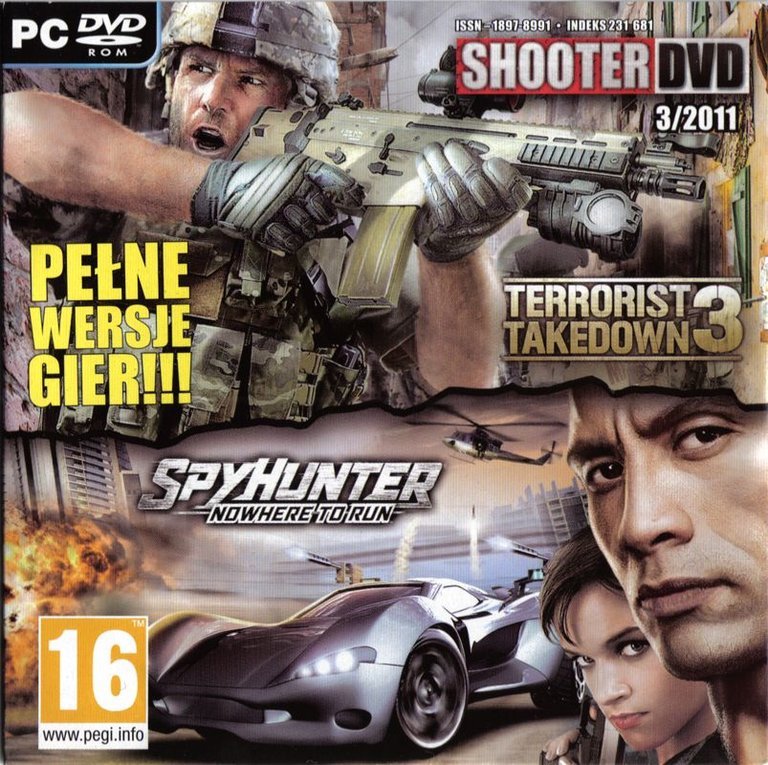
This 2011 Windows compilation bundles two first-person shooters: SpyHunter: Nowhere to Run, a high-octane action racing game where players control both the iconic G-6155 Interceptor vehicle and Agent Alec Sector on foot in a fight against global terrorism; and Terrorist Takedown 3, a tactical shooter focused on counter-terrorism operations with intense combat scenarios.
Gameplay Videos
SpyHunter: Nowhere to Run / Terrorist Takedown 3 Cracks & Fixes
SpyHunter: Nowhere to Run / Terrorist Takedown 3 Guides & Walkthroughs
SpyHunter: Nowhere to Run / Terrorist Takedown 3 Cheats & Codes
PlayStation 2
Enter codes using a cheat device (CodeBreaker, GameShark, Action Replay MAX).
| Code | Effect |
|---|---|
| B4336FA9 4DFEFB79 FDEA60C6 4388887E C80BB560 696BB339 216320EB 9062078A | Enable Code (Must Be On) |
| EC878264 1456E60A | All levels/cheats/movies open |
| 1CA427B4 1456E7A6 | Hover Car Mode |
| CDWY-K2B6-MY5JG 4PZ1-Z15E-3G0KB | Master Code – Must Be On |
| DAGU-743T-00HDN MV76-E3KP-VYTZA REHE-PABJ-KWV90 | Unlock All Levels |
| 6GB1-AGG6-K2P30 AC7D-U3DC-M7JN5 R9JJ-MNEG-JKKR4 | Unlock All Bonus Levels |
| 9C7A5D3D 63546047 | Unlock Bonus Level Bomb Challenge |
| 3A981FF7 A10ED601 | Unlock Bonus Level Boat Challenge |
| 2763FE21 351A83EB | Unlock Bonus Level Tank Challenge |
| BAD43206 53D13A58 | Unlock Bonus Level Motorcyle Challenge |
| 63B80212 E42257BB | Unlock Bonus Level Survival Challenge |
| C05913F2 B5B429F6 | Unlock Bonus Level Slo Mo Challenge |
| E8CF763D 32441AB3 | Unlock Bonus Level Spy Hunter Arcade |
| 5836DEAB F1D35982 | Unlock Weapon Micro |
| C77DBC31 07AB395B | Unlock Weapon Tactical |
| DF374081 37C07CB5 | Unlock Weapon Vindicator |
PC
Enter codes as a profile name.
| Code | Effect |
|---|---|
| GDOG57 | Infinite ammunition and infinite health |
| MAKING | The Making Of Spy Hunter FMV sequence |
| MODEL | The Making Of Spy Hunter FMV sequence |
| GUNN | Saliva: Spy Hunter Theme FMV sequence |
| SALIVA | Saliva: Your Disease FMV sequence |
| SCW823 | Spy Hunter Concept Art FMV sequence |
| WWS413 | Early Test Animatic FMV sequence |
SpyHunter: Nowhere to Run / Terrorist Takedown 3: Review
Introduction
The Spy Hunter franchise, born in 1983’s arcade cabinets, defined the vehicular combat genre with its transforming Interceptor and relentless, top-down action. Decades later, the 2011 compilation SpyHunter: Nowhere to Run / Terrorist Takedown 3 bundles two titles: Terminal Reality’s ambitious yet flawed Nowhere to Run (2006) and City Interactive’s generic Terrorist Takedown 3 (2010). This pairing epitomizes a curious era of tie-in games and budget shooters—a time when star power and licensing outpaced cohesive design. While Nowhere to Run leverages Dwayne Johnson’s charisma to explore on-foot espionage, Terrorist Takedown 3 exemplifies the hollow spectacle of its era. Together, they form a fractured artifact: a cautionary tale of misaligned ambition and the diminishing returns of rushed adaptations. This review dissects the compilation’s historical context, narrative depth, mechanical execution, and enduring legacy, revealing how two distinct products reflect the industry’s turbulent mid-2000s landscape.
Development History & Context
SpyHunter: Nowhere to Run: The Orphaned Tie-In
Terminal Reality’s Nowhere to Run emerged from chaos. Originally conceived as a tie-in to a Spy Hunter film starring Dwayne Johnson, the project languished in “development hell” as the movie stalled indefinitely. With no script or film to anchor it, the studio crafted a standalone game using Terminal Reality’s Infernal Engine (repurposed from RoadKill). As lead artist Adam Norton recalled, “We didn’t get anything from the movie at all. We kept being told they had a script, then they didn’t, then a new writer…” This uncertainty forced a two-year development cycle, far exceeding typical 12-18 month timelines for the era.
Publisher Midway Games prioritized brand extension over creative coherence, insisting on including Johnson’s likeness and motion-captured wrestling moves to capitalize on his rising stardom. The result was a hybrid of driving, on-foot combat, and pseudo-cinematic spectacle. Terminal Reality worked in isolation from the film’s studio, creating levels and narratives that felt disjointed. As level designer Ryan Darcey admitted, “It was chaos. We were trying to make a game with a transforming car, but marketing kept saying, ‘This is too sci-fi.’” The final year was a crunch-filled scramble to assemble smoke-and-mirror levels that satisfied quarterly reviews but lacked polish.
Terrorist Takedown 3: The Budget Shooter Staple
In stark contrast, Terrorist Takedown 3 represents the nadir of mid-2000s budget gaming. Developed by City Interactive S.A., it belongs to their Terrorist Takedown series—a string of generic first-person shooters released annually between 2004 and 2010. These games were defined by minimal investment: recycled assets, linear corridors, and simplistic mechanics targeting low-cost digital distribution. By 2010, the series was a well-worn template, with Terrorist Takedown 3 offering no innovation beyond superficial anti-terrorist tropes. Its inclusion in the 2011 compilation alongside Nowhere to Run underscores the era’s bundling practices, where commercially questionable titles were packaged to maximize value perception.
The gaming context of 2011 was pivotal. The mid-2000s saw a surge in licensed games and tie-ins, many of which prioritized exploitation over quality. Nowhere to Run’s failure exemplified this: a star-driven project undone by misaligned development goals. Meanwhile, City Interactive’s shooters thrived in the bargain bin, appealing to undiscerning audiences seeking quick thrills. This compilation thus captures two sides of a transitional period—one where ambition clashed with execution, and another where cost-cutting reigned supreme.
Narrative & Thematic Deep Dive
Nowhere to Run: Betrayal, Espionage, and the Weight of Orphaned Lore
Nowhere to Run replaces the franchise’s silent protagonist with Alex Decker (voiced and mocapped by Johnson), a government agent from the International Espionage Service (IES). The narrative unfolds as a revenge saga: after NOSTRA agents seize IES cargo and Decker’s Interceptor, he spends a year hunting for his stolen vehicle and missing partner, Karin. The plot is a pastiche of spy tropes—hostage situations, train chases, and aerial dogfights—but lacks the franchise’s signature suave tone. Instead, it embraces a “darker and edgier” approach, with on-screen violence and emotional stakes (e.g., Karin’s disappearance).
Key themes revolve around betrayal and obsession. Decker’s quest for the Interceptor becomes a metaphor for reclaiming agency, symbolizing how NOSTRA stripped him of his tools and identity. The game’s most compelling moments stem from its character-driven moments, such as Decker’s rage when confronting NOSTRA leader Gomez. Yet the unresolved ending—where Decker and Karin pursue Gomez in a flying Interceptor—leaves threads dangling, a consequence of the orphaned movie tie-in. This narrative fragmentation mirrors the game’s development: a story built without a foundation, relying on Johnson’s charisma to mask inconsistencies.
Terrorist Takedown 3: A Hollow Echo of Modern Warfare
Terrorist Takedown 3 offers no thematic depth. As a budget FPS, its narrative is a perfunctory “good vs. evil” scenario: players face nameless terrorists in unnamed locales, with no subtext beyond shoot-or-be-shot. The absence of memorable characters or plot reflects City Interactive’s approach: functional, forgettable storytelling designed to service action. If Nowhere to Run is a flawed novel, Terrorist Takedown 3 is a pamphlet—brief, utilitarian, and instantly disposable.
Shared Themes: Isolation and Futility
Both games share a subtle undercurrent of isolation. Decker operates alone in Nowhere to Run, his world collapsing around him, while Terrorist Takedown 3’s faceless protagonist is a cipher. In both, victory feels pyrrhic: Decker loses allies, and the budget shooter’s “win” resets to the next level. This futility underscores the compilation’s meta-commentary on their own fates: products squeezed by external pressures (film delays, budget constraints), their narratives as fragmented as their development.
Gameplay Mechanics & Systems
Nowhere to Run: A Fractured Identity
The core gameplay of Nowhere to Run is its greatest strength and weakness. Terminal Reality attempted a hybrid of driving and on-foot action, but the two systems clash violently.
- Driving Segments: The Interceptor retains series staples like machine guns, missiles, and transformations (car → boat → motorcycle). Combat is satisfying, with new “Switch Blade” spikes allowing players to shred enemy tires. Levels feature chases against NOSTRA’s armored fleet, evoking the franchise’s arcade roots. However, the absence of power-ups—a series staple—strips progression, leaving players with incremental weapon upgrades.
- On-Foot Segments: These, where Johnson’s wrestling moves shine, are the game’s undoing. Combat is clunky, with cover mechanics that feel half-baked and weapon handling that lacks precision. Levels often force players into tedious firefights, spawning enemies in predictable waves. As critic Chris McCarver noted, “The out-of-place on-foot gameplay” drains momentum, turning high-octane chases into stop-and-shoot slogs.
- Innovation and Flaw: The motion-captured moves (body slams, throws) are a novelty but lack depth. Level design favors spectacle over substance—e.g., a dam-crossing sequence where rising water creates artificial tension. The result is a game that fights itself: when driving, it’s Spy Hunter; on-foot, it’s a subpar third-person shooter.
Terrorist Takedown 3: The Definition of Generic
As a budget FPS, Terrorist Takedown 3 offers no innovations. Players navigate linear corridors, mow down terrorists, and occasionally use vehicles or turrets. Mechanics are rudimentary: health regenerates, weapons are basic (AK-47s, grenades), and AI is predictable. The game attempts variety with stealth segments or vehicle sections, but these are poorly implemented, feeling tacked on rather than integrated. Its “system” is one of repetition: clear room → move to next objective → repeat.
Compilation Dynamics: A Mismatched Pairing
Bundling these games highlights their mechanical divergence. Nowhere to Run’s ambition contrasts with Terrorist Takedown 3’s apathy. Where the former tries (and fails) to blend genres, the latter doesn’t try at all. The compilation’s appeal lies in this contrast: a showcase of mid-2000s design extremes. Yet neither game’s mechanics aged well; Nowhere to Run’s driving sequences retain charm, while its on-foot combat feels archaic, and Terrorist Takedown 3 remains a relic of a bygone era.
World-Building, Art & Sound
Nowhere to Run: Spectacle Without Substance
- Setting and Atmosphere: The world is a mosaic of spy-movie clichés—docks, secret bases, and speeding trains. Terminal Reality leveraged the Infernal Engine for cinematic flair, with dynamic camera angles during chases and explosions. However, environments lack cohesion; freighter chases feel disconnected from urban shootouts.
- Art Direction: Character models are detailed (especially Johnson’s likeness), but environments are bland. The Interceptor is a highlight, with sleek transformations that justify its sci-fi pedigree. Enemy designs are generic, though NOSTRA’s agents benefit from varied outfits.
- Sound Design: The score by Kyle Richards, Cris Velasco, and Sascha Dikiciyan is tense, blending orchestral themes with electronic beats. Johnson’s performance is the game’s standout, infusing Decker with charisma. Sound effects—from revving engines to weapon fire—are impactful, though repetitive.
Terrorist Takedown 3: Aesthetic Neglect
- Art and Sound: With no source details, we infer generic visuals: drab urban maps, repetitive character models, and muddy textures. Sound design is functional but forgettable—generic gunfire, flat voice acting, and unremarkable music. It’s the audiovisual equivalent of fast food: serviceable but devoid of identity.
Compilation Aesthetics: From Ambition to Apathy
Nowhere to Run’s art and sound elevate its flaws, creating moments of spectacle (e.g., a train climax set against stormy skies). In contrast, Terrorist Takedown 3’s minimalism reflects its budget origins. Together, they illustrate how art direction can salvage mediocre gameplay (as in Nowhere to Run) or amplify it (as in the budget shooter).
Reception & Legacy
Nowhere to Run: Critical Scorn and Johnson’s Fury
Nowhere to Run was a critical disaster. Metacritic scores averaged 51/100, with reviews panning its gameplay and praising only Johnson’s performance. Game Informer infamously scored it 3/10, calling it “a broken-down lemon.” Critics like IGN (6/10) acknowledged its ambition but cited “uninspiring on-foot segments.” The Detroit Free Press dismissed it as a “one-night rental,” while The Times lamented that “cinematic feel came at the expense of gameplay.”
Dwayne Johnson later joked about the reception at The Game Awards 2017, flipping off the camera while referencing the 3/10 score. His reaction underscored the game’s cultural infamy—a cautionary tale of star power failing to compensate for design flaws. Commercially, it underperformed, becoming a bargain-bin staple.
Terrorist Takedown 3: The Forgotten
Terrorist Takedown 3 received no critical attention, and its inclusion in the 2011 compilation went unnoticed. MobyGames shows a player average of 2.0/5 based on one rating, reflecting its obscurity. It exemplifies the era’s budget FPS glut—games released, forgotten, and buried.
Compilation Legacy: A Curiosity
The compilation itself is a footnote. Bundling a polarizing title with a forgotten shooter, it highlights how Midway/City Interactive packaged missteps as value. Yet Nowhere to Run has endured as a cult curiosity—studied for its development chaos and Johnson’s involvement. Terrorist Takedown 3 remains a relic of a bygone era, its legacy tied only to the Terrorist Takedown series’ obscurity.
Conclusion
SpyHunter: Nowhere to Run / Terrorist Takedown 3 is a time capsule of mid-2000s gaming’s excesses and limitations. Nowhere to Run is a fascinating failure—a hybrid game undone by its orphaned narrative and clashing mechanics, yet elevated by Johnson’s charisma and Terminal Reality’s technical prowess. Terrorist Takedown 3 is a non-entity, a generic FPS that adds little to the compilation beyond bulk.
Together, they reflect an industry in transition: one where licensed games like Nowhere to Run could leverage star power but faltered without cohesive vision, and budget titles like Terrorist Takedown 3 thrived in the margins. The compilation’s legacy is dual: Nowhere to Run as a case study in development hubris, and the bundle as a reminder of gaming’s more mercenary era. For historians, it’s a flawed artifact; for players, it’s a cautionary tale. In the end, this compilation is less a cohesive product and more a fractured mirror—reflecting ambition, apathy, and the enduring allure of the Spy Hunter myth, even in its most diminished form.