
- Release Year: 2014
- Platforms: Android, Linux, Windows, Macintosh, Browser
- Publisher: DeXP, MyLifeGame.Ru
- Developer: DeXP
- Genre: Adventure
- Perspective: First-person
- Gameplay: Visual novel
- Average Score: 53/100
Description
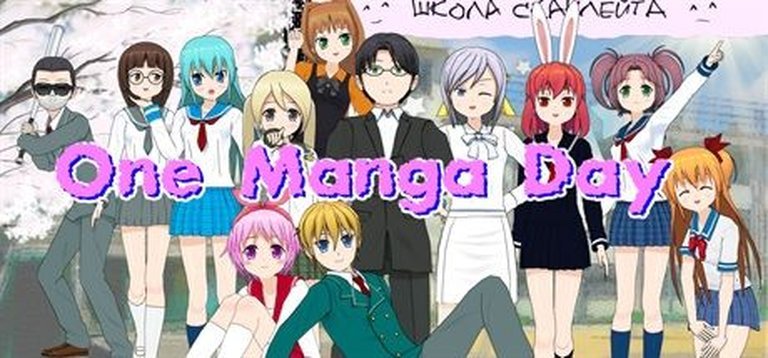
One Manga Day is a 1st-person visual novel featuring an anime/manga art style that plunges players into the intricate and challenging world of manga translation. The game centers on the premise of a single individual dedicated to translating Japanese comics into English, exploring the professional hurdles, the nuanced relationships within his team, and the overarching question of whether a translator’s life can remain straightforward amid such complexities.
Gameplay Videos
Where to Get One Manga Day
PC
Patches & Mods
Guides & Walkthroughs
Reviews & Reception
steambase.io (61/100): One Manga Day has earned a Player Score of 61/100, calculated from 965 total reviews which give it a rating of Mixed.
imdb.com : No user reviews available; users are invited to be the first to rate this video game.
store.steampowered.com (60/100): All reviews are Mixed, with 60% of the 965 user reviews for this game being positive.
mobygames.com (40/100): Players’ average score is 2.0 out of 5 (based on 1 rating with 0 reviews).
One Manga Day: A Deep Dive into a Niche Visual Novel
1. Introduction
In the vibrant, often chaotic landscape of independent game development, visual novels occupy a unique and increasingly prominent space. They are stories first, games second, thriving on narrative depth, character interaction, and player choice. Among the myriad titles that emerged during the mid-2010s’ indie boom, one Russian-developed visual novel, One Manga Day, stands as a curious, if sometimes critically divisive, artifact. Released initially on Android in 2014 and later across PC platforms and browsers, this free-to-play title from DeXP dared to explore the often-unseen world of manga translation. It asks profound questions, albeit within a comedic framework: “Is one man able to accomplish this [manga translation]? Is there more to his team’s relationships other than business? Can everything in a translator’s life be simple and clear?” While its legacy is undeniably mixed, One Manga Day offers a fascinating glimpse into a specific subgenre and the potential, as well as the pitfalls, of accessible game development tools. This review will meticulously dissect its origins, narrative, mechanics, artistic choices, and lasting impact to render a comprehensive understanding of its place in video game history.
2. Development History & Context
DeXP: A Primarily Solo Endeavor
One Manga Day was predominantly the vision and effort of Dmitry Hrabrov, credited as DeXPeriX. Hrabrov is listed across the MobyGames credits for a remarkable array of roles, including Story, Graphics, Music, Idea and Realization, and even a significant portion of the English and Russian Text Proofreading. This level of singular creative control points to a passion project, a common characteristic of visual novels and indie games during this era. While a team of 26 people contributed to the game’s various aspects—including dedicated proofreaders for specific days of the game’s narrative (Robert Nesbitt for Days 2 & 7, Will Williams for Days 3 & 4, Richard Hogan for Day 5, Warren Brent for Day 6), storyline support, imaging assistants, and beta testers—the core creative direction remained firmly with Hrabrov. Publishers DeXP and MyLifeGame.Ru facilitated its broader release.
The Creator’s Vision & Technological Constraints
Hrabrov’s vision was to create a “short visual novel, originally written in Russian,” focusing on the challenges and camaraderie within a manga translation team. The ad blurb explicitly highlights the central premise: the arduous task of translating Japanese manga into English, and the personal and professional intricacies that arise within such a team. A key part of the vision, as declared by the developers, was “Girls in swimsuits. Everyone likes girls in swimsuits!”, which signals a lighthearted, possibly fan-service-oriented, comedic tone.
The choice of development tools heavily influenced the game’s aesthetic and technical foundation. One Manga Day was built using the Ren’Py engine, a popular, open-source framework for visual novel creation, known for its accessibility and flexibility, making it a staple for indie developers. However, the graphics were generated using Manga Maker ComiPo!, a 3D comic creation software, and the music was composed with MAGIX Music Maker 2014. These choices, while enabling a single developer to create a full game, also introduced significant aesthetic limitations. As one RAWG reviewer bluntly put it, the game’s visuals served as “the best antiadvertising of the Ugly program ‘Manga Maker ComiPo!'”, noting its “mediocre models” and “ungodliness.” This highlights the prevalent tension in indie development: ambition often outstrips available resources or tools.
Gaming Landscape at Release
One Manga Day first launched on Android on August 2, 2014, before making its way to Linux, Windows, and Macintosh in 2015, and finally, browser platforms in 2019. This multi-platform rollout, coupled with its “Free to Play” model on Steam (where it went through Steam Greenlight), positioned it to reach a broad audience. The mid-2010s saw an explosion of visual novels, particularly on platforms like Steam, driven by the success of titles like Katawa Shoujo and the burgeoning “non-commercial rönai-boom” (as termed by a Russian reviewer) in regions like Russia, often catalyzed by games such as Endless Summer. One Manga Day entered this scene as a “Dojinsi-project” (a fan-made or amateur work), offering a comedic take on a niche subject. Its free-to-play nature lowered the barrier to entry, attracting players interested in anime-styled visuals and slice-of-life narratives, despite its technical imperfections.
3. Narrative & Thematic Deep Dive
The Plot: A Week in the Life of a Translator
At its core, One Manga Day immerses players in the hectic, often humorous, life of a manga translation team. The plot “revolves around a new member of the school Scanleita,” the player character, who “willy-nilly becomes (for a week) an assistant of one of the amusing, albeit exaggerated, characters employed in the translation of the Japanese manga.” The game meticulously details the various roles within a scanlation group: “Typerov (typesetters), Tolmaschi (translators), Klinerov (cleaners), and other workers of gratuitous intellectual work.” This provides a unique educational insight into a subculture largely unknown to outsiders, with the process “described by a lakonchino and visually” for newcomers.
The narrative is structured around a week-long period, culminating in one of four distinct endings: “2 bad endings, one normal and one good.” This non-linearity and multiple outcome structure are hallmarks of the visual novel genre, encouraging replayability and allowing players to explore different narrative branches based on their choices. The story is not merely a dry exposé of translation work; it’s infused with “conflicts, betrayal, romantic lines and Etti-parodies,” providing a dynamic and emotionally varied experience. The inclusion of “domestic humor,” particularly appealing to the game’s Russian audience, adds a unique cultural flavor.
Characters and Dialogue
The game’s cast consists of “amusing, albeit exaggerated, characters.” While specific character names are not provided in the source material, the common visual novel trope of “four girls and one boy” is hinted at by a reviewer, suggesting a potential harem-esque dynamic often found in anime-inspired VNs. The protagonist’s journey as a “punk with drones” (a humorous, possibly self-deprecating description from a reviewer) provides a relatable entry point into this eccentric world.
Dialogue plays a crucial role in visual novels, and One Manga Day attempts to deliver a compelling script, although its journey to English was notably complex. Dmitry Hrabrov himself participated in the English translation, which then underwent rigorous proofreading by a team of individuals, each assigned to specific “days” of the game’s script (e.g., “EeuorT – Day 2 & 7,” “PintSizedPurple – 3 & 4,” “Mangles – Day 5,” “Warren ‘Wazza’ Brent – Day 6”). This segmented approach suggests a concerted effort to refine the English text, potentially addressing initial quality concerns, but also hinting at a fragmented process. The “local plot, humor and dialogues” were appreciated by some, particularly those familiar with the cultural context it parodied, but might have alienated others.
Thematic Nuances
The primary theme is undoubtedly the labor and passion behind fan translation. It spotlights the dedication required for this “gratuitous intellectual work,” depicting the intricacies from translation to typesetting. Beyond this, the game explores interpersonal relationships within a team, asking “Is there more to his team’s relationships other than business?” This delves into themes of camaraderie, potential romance, and the challenges of working closely with diverse personalities. The overarching question, “Can everything in a translator’s life be simple and clear?”, suggests an exploration of life’s inherent complexities and ambiguities, even within what might seem like a straightforward hobby. The “Etti-parodies” and “Girls in swimsuits” elements, while potentially superficial, also contribute to a theme of lighthearted entertainment and fan culture, embracing aspects common in the broader manga and anime spheres. The Russian “domestic humor” adds another layer, making it a comedic commentary on both global fandom and local sensibilities.
4. Gameplay Mechanics & Systems
Core Visual Novel Loop
As a visual novel, One Manga Day‘s core gameplay loop is centered on reading text, viewing static or semi-static anime-style illustrations, and making periodic choices that influence the narrative path. Players progress through dialogue and internal monologues, soaking in the story presented primarily through text boxes. The “1st-person” perspective further immerses the player into the role of the new team member.
Narrative Progression and Multiple Endings
The game’s structure, offering “four endings: 2 bad endings, one normal and one good,” is a staple of interactive fiction and a key gameplay mechanic. These divergent paths encourage players to revisit the game multiple times to unlock all conclusions and fully understand the story’s various facets. The average playtime of “about an hour or two” to achieve all 12 Steam Achievements further indicates that while replayable, each individual playthrough is relatively short. This brevity can be seen as a strength, allowing players to quickly experience different outcomes without a significant time investment.
User Interface and Accessibility
Developed using Ren’Py, One Manga Day likely employs a standard visual novel interface, offering basic functionalities like text advancement, choice selection, save/load options, and possibly a backlog for reviewing past dialogue. The game’s multi-platform release (Android, Windows, Linux, Mac, Browser) demonstrates a commitment to accessibility, allowing a wide range of players to experience it. Partial Controller Support is also listed on Steambase, indicating further efforts for player convenience.
Innovative or Flawed Systems
While not revolutionary in its core mechanics, One Manga Day makes efforts in player engagement:
* Achievements: The inclusion of 12 Steam Achievements, designed to be completable within “an hour or two,” provides concrete goals and a sense of accomplishment beyond simply finishing the story. These likely tie into exploring different choices and endings.
* Multi-language Support: The game supports English, Russian, and Polish for its interface and subtitles, greatly expanding its reach. The existence of an official “One Manga Day: Russian Voiceover” DLC, released in 2016, also highlights an effort to enhance the experience, particularly for its original audience, adding a layer of audio immersion that was not present in the base game’s English version.
* Free-to-Play Model: As a free game, it lowers the barrier to entry completely, inviting players to experience it without financial risk, which likely contributed to its higher player count on Steam despite mixed reviews.
However, the game’s “flaws” in terms of “mediocre models” and “tasteless music” (as described by a reviewer) are critical to the overall gameplay experience in a visual novel, where presentation is paramount. While not a direct “gameplay system” flaw, the graphical and audio shortcomings impact player immersion and enjoyment of the narrative delivery.
5. World-Building, Art & Sound
Setting and Atmosphere
One Manga Day establishes its setting within the world of scanlation, primarily focusing on the internal workings of a “school Scanleita” (presumably a fan translation group associated with a school or community). The game’s origin in Russia imbues it with a unique blend of global anime/manga fandom and specific “domestic humor,” creating an atmosphere that is both universally relatable to fans of Japanese pop culture and distinctly local in its comedic sensibilities. The prevailing atmosphere is intended to be “comedy,” “light, pure color,” and a “merry half-hour,” suggesting a whimsical, unpretentious tone, despite tackling the often-stressful process of translation. The inclusion of “Girls in swimsuits” and “Etti-parodies” further reinforces a playful, somewhat irreverent, and potentially fan-service-driven mood.
Visual Direction: A Double-Edged Sword
The game’s visual direction is a central, and often criticized, aspect. It utilizes an “Anime / Manga” art style, with “Unique graphics… made especially for this game.” However, the critical caveat lies in the tool used: Manga Maker ComiPo!. This software, while making 3D character creation accessible, often produces a distinct, somewhat rigid, and often criticized aesthetic. A RAWG reviewer explicitly calls the game’s visuals “graphic imperfection,” “mediocre models,” and even “ungodliness of models,” going so far as to label it “the best antiadvertising of the Ugly program ‘Manga Maker ComiPo!'”. This points to a significant disconnect between the desire for unique visuals and the limitations of the chosen tool. The “mediocrity of the backs” (backgrounds) further compounded the visual issues. Despite these criticisms, the game’s visuals are “bright, pure color,” which contributes to the intended lighthearted tone. The comparison to Narcissu, another visual novel known for its modest graphics but strong narrative, suggests that while visually imperfect, the developers hoped the story and themes would carry the experience.
Sound Design: Functional but Unmemorable
Similar to the graphics, the game’s sound design, including its “Unique music… made in MAGIX Music Maker 2014,” receives a mixed assessment. While the soundtrack “in general conveys the mood of the novel, following the author’s plan,” it is also described as “tasteless music and sound effects, as if taken from a specialized site,” with a reviewer noting that “the reader is unlikely to want to listen to them separately.” This implies a functional but ultimately forgettable audio experience, likely suffering from the limitations of the music creation software or the composer’s skill within those constraints. The addition of a “Russian Voiceover” DLC in 2016 suggests an attempt to enhance the auditory experience and provide greater immersion, at least for the Russian-speaking audience, indicating a recognition that the original soundscape might have lacked depth.
In essence, One Manga Day‘s world-building, art, and sound contribute to its identity as a distinct indie visual novel, yet they also underscore the inherent challenges of small-scale development. The unique concept and comedic atmosphere are sometimes undermined by technical shortcomings in its presentation.
6. Reception & Legacy
Critical and Commercial Reception at Launch
One Manga Day‘s reception has been, charitably, “mixed.” On MobyGames, it holds an average player score of “2.0 out of 5 (based on 1 rating with 0 reviews),” which is hardly representative but points to a lack of widespread positive critical engagement. RAWG similarly reports a “Meh” average from its 23 ratings, with only 1 “Exceptional” and 14 “Meh” or 8 “Skip” votes. However, the most telling metric comes from Steam, where it received “Mixed” reviews, with “60% of the 965 user reviews for this game are positive.” This indicates a significantly polarized audience response.
The initial release on Android was “warmly adopted on Google Play,” suggesting a perhaps more forgiving mobile audience or a stronger initial niche appeal. The game was also a “Steam Greenlight game,” which speaks to its community-driven push for visibility on the platform. As a “Free to Play” title, it garnered a notable number of downloads and impressions, even if critical praise was elusive. The existence of an official “One Manga Day: Russian Voiceover” DLC released in 2016 implies continued developer interest and at least some level of commercial or community support post-launch.
Evolution of Reputation and Influence
One Manga Day‘s reputation has evolved into that of a cult curiosity, particularly for its embrace of niche subject matter and its technical quirks. The RAWG review offers a candid assessment: it’s “good for its time and just a nice free novella, ready to give the reader a merry half-hour, on the terms of respect for the Japanese party and the absence of excessive snobism.” This highlights its appeal to a specific segment of players who could overlook its graphical and audio imperfections for its unique premise and humor.
Perhaps one of the most significant indicators of its peculiar legacy is its appearance on channels like “Game Grumps” (in an episode titled “Huh? What? Bad? Yeah – One Manga Day” in 2021). Being featured by such popular content creators, often for games that are perceived as “bad” or unusually quirky, cemented its status as a notable, if not critically acclaimed, title in the broader gaming consciousness.
From a historical perspective, One Manga Day serves as a valuable case study for the indie game scene of the mid-2010s. It exemplifies:
* Accessibility of Tools: Its reliance on Ren’Py, Manga Maker ComiPo!, and MAGIX Music Maker 2014 showcased how relatively inexpensive and user-friendly software could empower solo or small teams to create and publish games.
* Niche Market Exploration: Its deep dive into the specific subculture of manga translation proved that even highly specialized topics could form the basis of a compelling (for some) narrative experience.
* The Russian VN Scene: It was part of a vibrant “non-commercial rönai-boom” in Russia, showcasing local talent and unique cultural perspectives within a globally popular genre.
* The Mixed Blessings of Free-to-Play: While boosting player numbers, the free model can sometimes lead to less stringent quality expectations from players, resulting in “mixed” reviews that reflect both appreciation for the free content and criticism of its shortcomings.
Ultimately, One Manga Day did not revolutionize the visual novel genre, nor did it achieve widespread critical acclaim. However, its continued presence on platforms like Steam, its diverse language support, and its status as a topic of community discussion (and ridicule) demonstrate its enduring, albeit niche, place in the annals of video game history.
7. Conclusion
One Manga Day is a fascinating, if flawed, specimen from the rich ecosystem of independent visual novels. It emerges from the singular vision of Dmitry Hrabrov, leveraging accessible tools like Ren’Py and Manga Maker ComiPo! to tell a story uniquely focused on the often-unsung heroes of manga translation. Its narrative, while perhaps “exaggerated” and infused with “Etti-parodies” and “Girls in swimsuits,” offers a rare glimpse into a specialized subculture, complete with its conflicts, camaraderie, and complex relationships. The game’s non-linear structure and multiple endings encourage replayability, a staple of the genre.
However, its artistic execution, particularly the “graphic imperfection” stemming from Manga Maker ComiPo! and the “tasteless music” from MAGIX Music Maker, undeniably detract from the overall experience. Despite efforts in English proofreading and later a Russian voiceover DLC, these technical shortcomings prevented it from achieving broad critical success. Its “Mixed” reception on Steam and its notoriety on platforms like Game Grumps attest to its divisive nature.
In the grand tapestry of video game history, One Manga Day is not a masterpiece, nor is it a forgotten gem awaiting rediscovery. Instead, it is a testament to the democratizing power of indie game development, a quirky example of a passionate creator exploring a niche subject with limited resources. It stands as a charmingly imperfect “Dojinsi-project” that carved out a small, memorable space in the burgeoning visual novel scene of the mid-2010s, especially within its Russian context. For enthusiasts of experimental indie titles, or those simply curious about the world of manga translation, One Manga Day offers a brief, merry, and occasionally bewildering half-hour—a unique cultural artifact that, despite its rough edges, undeniably left its small, distinct imprint.