
- Release Year: 2009
- Platforms: Linux, Macintosh, Windows
- Publisher: Crimson Cow GmbH, HMH Interactive, KING Art GmbH, Lace Mamba Global Ltd., Nordic Games GmbH
- Developer: KING Art GmbH
- Genre: Adventure
- Perspective: Side view
- Game Mode: Single-player
- Gameplay: Graphic adventure, Point and select, Puzzle elements
- Setting: Fantasy
- Average Score: 84/100
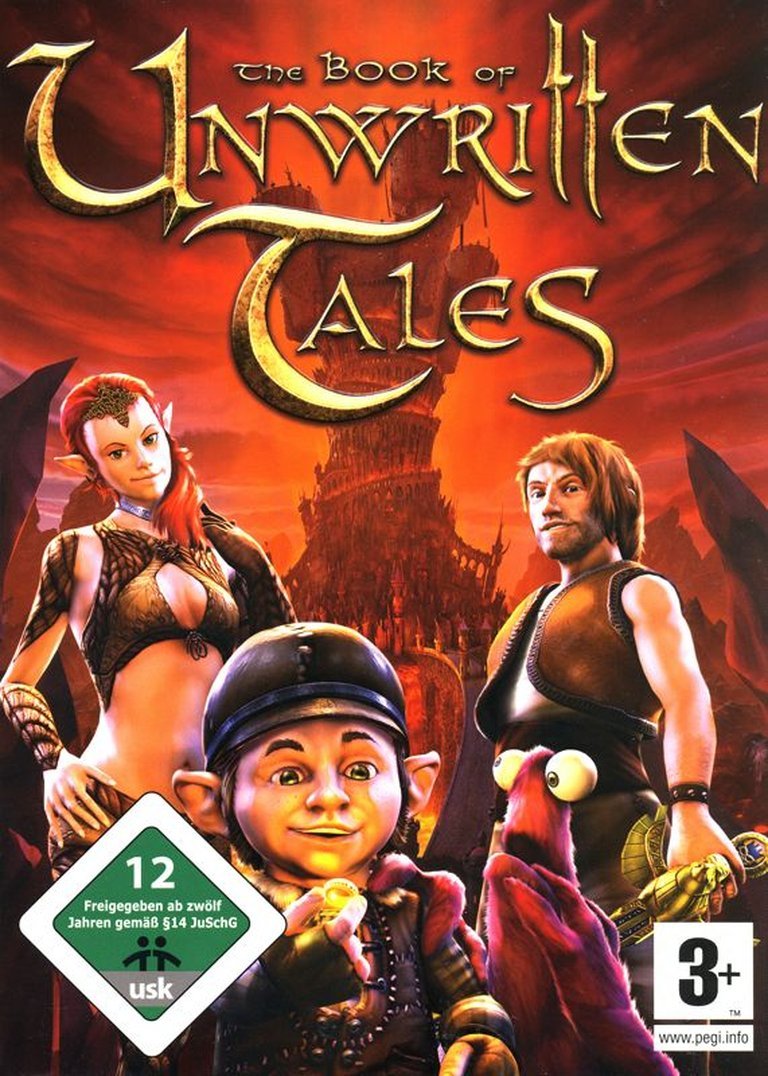
Description
The Book of Unwritten Tales is a classic point-and-click fantasy adventure set in the world of Aventásia, where a long-standing war between the Shadow Army and the Alliance of the Free Races is about to be tipped by the discovery of a legendary artifact. The story follows four unlikely heroes—an elf named Ivo, a gnome named Wilbur, the human Nathaniel Bonnet, and a mysterious companion—who must band together after the artifact’s discoverer, an archaeologist named Mortimer MacGuffin, is targeted by evil forces. The game is heavily focused on comedy, filled with pop-culture references and fourth-wall breaks, and features puzzle-solving where players can often use different characters to find solutions.
Gameplay Videos
Where to Get The Book of Unwritten Tales
PC
Patches & Mods
Reviews & Reception
metacritic.com (82/100): If you’re going to try and woo a modern gaming audience with old-fashioned gameplay, you’d better be pretty special. The Book of Unwritten Tales is. It’s smart, funny, well-crafted and has tons of heart.
gamefaqs.gamespot.com (82/100): Never in the past decade we’ve seen such a well-built comedy/fantasy adventure game, filled to the brim with great narration, sense of purpose and feelings of joy and despair. An absolute must have for every “adventurer”.
gameboomers.com : The Book of Unwritten Tales really does prove to be an exemplar of that statement.
gamepressure.com (90/100): A humorous point and click adventure game, developed by the team of the German studio KING Art Games.
The Book of Unwritten Tales: A Masterclass in Modern Point-and-Click Adventure
In the annals of video game history, few genres have experienced as dramatic a fall and subsequent renaissance as the point-and-click adventure. By the late 2000s, what was once a dominant force had been largely relegated to niche status, kept alive by a dedicated community and the occasional indie gem. It was into this landscape that German developer KING Art Games unleashed The Book of Unwritten Tales in 2009—a title that would not only remind players why they fell in love with the genre but demonstrate how to evolve it for a new generation. This is not merely an adventure game; it is a love letter to fantasy, a masterclass in comedic writing, and one of the most polished, intelligent, and genuinely hilarious examples of interactive storytelling to emerge in the 21st century.
Development History & Context
The German Adventure Renaissance
KING Art Games, founded in 2000 in Bremen, Germany, entered the development scene during a period when the German adventure game market was experiencing a quiet resurgence. While the titans of the genre—LucasArts and Sierra—had largely moved on, German studios like Daedalic Entertainment were proving there was still life in the classic formula. KING Art itself was no stranger to the genre, having developed titles in The Black Mirror series and Simon the Sorcerer.
The development of The Book of Unwritten Tales represented both a technological and creative ambition for the studio. Built using the OGRE 3D engine with Lua scripting, the game presented a “2.5D” aesthetic—pre-rendered 3D environments that maintained the painterly quality of classic 2D adventures while allowing for more dynamic camera work and character animation. This technical approach was both pragmatic and visionary, delivering visual richness without requiring the complex real-time 3D interaction that often complicated adventure game design.
The Long Road to Localization
Originally released in German in April 2009, the game’s journey to English-speaking audiences took over two years—an eternity in the gaming industry. This delay, while frustrating for international fans, proved fortuitous. The extra development time allowed for a meticulous localization process that preserved the game’s nuanced humor and cultural references. When it finally arrived in North America and the UK in October 2011 via publishers Lace Mamba Global and The Adventure Company, it found an audience that had been warmed up by Telltale Games’ resurgence of the genre and was hungry for more substantial, traditional adventures.
The timing was perfect—the gaming landscape had evolved to appreciate indie and niche titles, and digital distribution platforms like Steam and GOG.com provided access to audiences who would never have encountered the game in traditional retail channels.
Narrative & Thematic Deep Dive
Deconstructing the Hero’s Journey
At its core, The Book of Unwritten Tales presents a seemingly conventional fantasy narrative: the war between the Shadow Army and the Alliance of Free Races has reached a stalemate, and a legendary artifact discovered by gremlin archaeologist Mortimer MacGuffin (the name itself a winking confession of narrative mechanics) promises to tip the balance. What follows is an epic quest spanning dwarven halls, sunken temples, magical academies, and the heart of the enemy’s domain.
However, the genius of The Book of Unwritten Tales lies not in its plot but in its execution. The game demonstrates a remarkable self-awareness, simultaneously embracing and subverting fantasy tropes at every turn. This is a story that understands the rules of narrative so thoroughly that it can break them with precision and purpose.
A Quartet of Unlikely Heroes
The player controls four distinct protagonists, each representing a different archetype:
- Wilbur Weathervane: A young gnome with aspirations of heroic grandeur, serving as kitchen help in a northern dwarf fortress. His Welsh-accented earnestness provides the game’s emotional core and serves as the perfect straight man to the world’s absurdities.
- Ivo: The full-name-bearing Ivodora Eleonora Clarissa, Princess of the Silver Forest Realm, an elf who breaks from her people’s isolationist traditions to intervene in mortal affairs. Her character navigates the tension between elven dignity and the messy reality of adventure.
- Nathaniel “Nate” Bonnet: A sky pirate, rogue, and unapologetic narcissist whose genre-savvy commentary consistently breaks the fourth wall. He recognizes he’s in an adventure game and actively looks for ways to cheat the system.
- Critter: Nate’s furry, Chewbacca-like companion who communicates in expressive gibberish, serving as both comic relief and unexpected problem-solver.
The multi-character system isn’t merely a gimmick; it’s fundamental to the game’s puzzle design and narrative structure. Players frequently switch between characters, sometimes controlling them separately in different locations, other times coordinating their actions to solve environmental challenges. This approach allows the game to explore multiple perspectives on the same events and creates a richer sense of a living, interconnected world.
Metatextual Mastery and Comedic Timing
Where The Book of Unwritten Tales truly excels is in its writing. The script is densely packed with references spanning the entire spectrum of fantasy and gaming culture—from obvious nods to The Lord of the Rings (Wilbur’s delivery of a certain “One Ring”) and Harry Potter (butterbeer in taverns) to more subtle winks at Discworld, Monkey Island, and World of Warcraft.
The game’s humor operates on multiple levels. There’s broad physical comedy, witty wordplay, character-based humor arising from the protagonists’ clashing personalities, and sophisticated meta-commentary on adventure game conventions themselves. One particularly brilliant sequence involves Nate needing to increase his “Blacksmithing skill” in a clear parody of RPG mechanics, while another features two characters playing “World of Businesscraft,” a devastatingly accurate send-up of MMORPG culture.
Perhaps most impressively, the game manages this referential humor without descending into lazy parody. The jokes serve the characters and situations rather than feeling tacked on, creating a world that feels both familiar and fresh. As noted in multiple reviews, the quality of the English localization is exceptional, preserving the spirit and timing of the original German script while making cultural adjustments where necessary.
Gameplay Mechanics & Systems
Refining the Classic Formula
The Book of Unwritten Tales follows the traditional point-and-click adventure template: explore environments, collect items, combine them in inventive ways, and solve logic-based puzzles through conversation and interaction. Where it distinguishes itself is in its thoughtful quality-of-life improvements and refined puzzle design.
The interface is clean and intuitive. The cursor changes contextually to indicate possible actions—a magnifying glass for examination, a hand for manipulation, a wrench for using items, and a speech bubble for conversation. Most importantly, pressing the spacebar highlights all interactive elements in the current scene, eliminating the dreaded “pixel hunting” that plagued earlier genre entries.
The inventory system is similarly streamlined. Once an object has served its purpose, it typically becomes inactive, preventing players from fruitlessly attempting to use irrelevant items. When an inventory item is selected, the game only shows interaction points where it might actually be useful—a simple but revolutionary feature that maintains challenge while reducing frustration.
Puzzle Design: Logical, Layered, and Occasionally Lateral
The game features over 150 puzzles ranging from simple fetch quests to complex multi-character, multi-location challenges. The puzzle philosophy clearly prioritizes logical consistency over the absurd “lateral thinking” that sometimes characterized 90s adventures. Solutions generally make sense within the game’s internal reality, even when they’re whimsical.
Standout sequences include:
– A trading card game mini-game where Wilbur must obtain a “game-breaking” card to defeat an opponent who has stacked the deck against him.
– A time-travel puzzle that creates a stable time loop, requiring players to plant an object in the past that will be discovered in the present.
– A cooking mini-game that tests timing and observation skills.
– A “rain dance” sequence presented as a rhythm game.
The multi-character puzzles are particularly ingenious, often requiring items to be transferred between party members or coordinating actions across different locations. This system creates a sense of genuine teamwork and expands the puzzle space beyond what would be possible with a single protagonist.
Pacing and Difficulty Curve
With an average playtime of 20 hours, The Book of Unwritten Tales offers substantial content without overstaying its welcome. The difficulty curve is well-calibrated, starting with simple introductory puzzles and gradually introducing more complex challenges. While some veteran adventurers might find certain sections too easy, the game successfully walks the line between accessibility and engagement—a difficult balance that many modern adventures struggle to achieve.
World-Building, Art & Sound
A Living, Breathing Fantasy World
The world of Aventásia is one of the game’s greatest achievements. Comprising over 60 distinct locations—from gnomish burrows and dwarven halls to sunken Aztec-style temples and bustling fantasy cities—each environment is meticulously crafted and bursting with personality. The “2.5D” visual approach gives scenes remarkable depth and detail while maintaining the painterly quality of classic adventures.
The art direction strikes a perfect balance between cartoonish exaggeration and grounded fantasy realism. Characters are expressively animated, with particular attention paid to facial expressions and body language that sell both the comedy and the emotional beats. The color palette is vibrant without being garish, and the visual storytelling—through environmental details, signage, and background action—consistently enriches the world.
Audio Excellence
The audio presentation is nothing short of superb. The orchestral score, composed by Benny Oschmann, expertly navigates between epic fantasy grandeur and comedic subtlety, with clear homages to classic adventure and film scores (including a delightful nod to John Williams’ Raiders of the Lost Ark theme).
The voice acting, however, is the true standout. Featuring predominantly British talent, the performances are universally excellent, bringing depth and personality to even minor characters. Wilbur’s Welsh accent gives him an endearing quality, Nate’s smug delivery perfectly captures his rogueish charm, and Ivo’s performance balances elven dignity with growing exasperation. The quality of the acting elevates the already excellent script, with impeccable comic timing and emotional authenticity.
Reception & Legacy
Critical Acclaim
Upon its English release in 2011, The Book of Unwritten Tales received widespread critical praise, earning a Metacritic score of 82/100 and an 84% average on MobyGames based on 54 critic reviews. Publications celebrated its writing, production values, and successful modernization of classic adventure mechanics.
Adventure Gamers awarded it 4.5/5 stars, noting it “holds an epic adventure between its pages, bringing to life a gorgeous, multi-dimensional, quest-laden world.” The Escapist gave it a perfect score, declaring it “smart, funny, well-crafted and has tons of heart.” Eurogamer Sweden went further, stating “You’ll have to go all the way back to 1993 until you can find a game that delivers this much fun.”
Player reception was equally enthusiastic, with the game maintaining “Very Positive” status on Steam years after release. The common consensus among both critics and players was that The Book of Unwritten Tales represented a high-water mark for the modern adventure game—honoring its heritage while innovating where it mattered.
Lasting Influence and Franchise Building
The success of The Book of Unwritten Tales established KING Art as a major force in adventure development and spawned a small franchise. The prequel The Critter Chronicles (2012) explored Nate and Critter’s backstory, while the direct sequel The Book of Unwritten Tales 2 (2015) continued the adventures of the core quartet. The series has since been bundled into various collections, ensuring its availability to new generations of players.
More significantly, The Book of Unwritten Tales demonstrated that there was still a substantial audience for traditional point-and-click adventures with high production values and sophisticated writing. Its success contributed to the ongoing adventure game renaissance, proving that the genre could evolve without abandoning its core principles.
Conclusion
The Book of Unwritten Tales is more than just an excellent adventure game—it is a testament to the enduring power of well-told stories, memorable characters, and thoughtful game design. In an industry often obsessed with graphical fidelity and mechanical complexity, it reminds us that intelligence, humor, and heart remain the most powerful tools in a developer’s arsenal.
The game succeeds not by reinventing the wheel but by perfecting it. It understands what made classic adventures timeless—their characters, their worlds, their puzzles—while addressing the genre’s historical weaknesses through thoughtful quality-of-life improvements. The result is an experience that feels simultaneously nostalgic and fresh, familiar and innovative.
For adventure game enthusiasts, The Book of Unwritten Tales is essential playing—a modern classic that stands shoulder-to-shoulder with the genre’s legendary titles. For game developers, it remains a masterclass in comedic writing, character development, and thoughtful puzzle design. And for anyone who believes that games can be both intelligent and uproariously funny, it is nothing short of a masterpiece.
In the final analysis, The Book of Unwritten Tales earns its place in video game history not merely as an excellent representative of its genre, but as one of the most complete, satisfying, and joy-filled interactive experiences of its generation. It is, in every sense, a story worth reading—and a game worth playing—again and again.