
Description
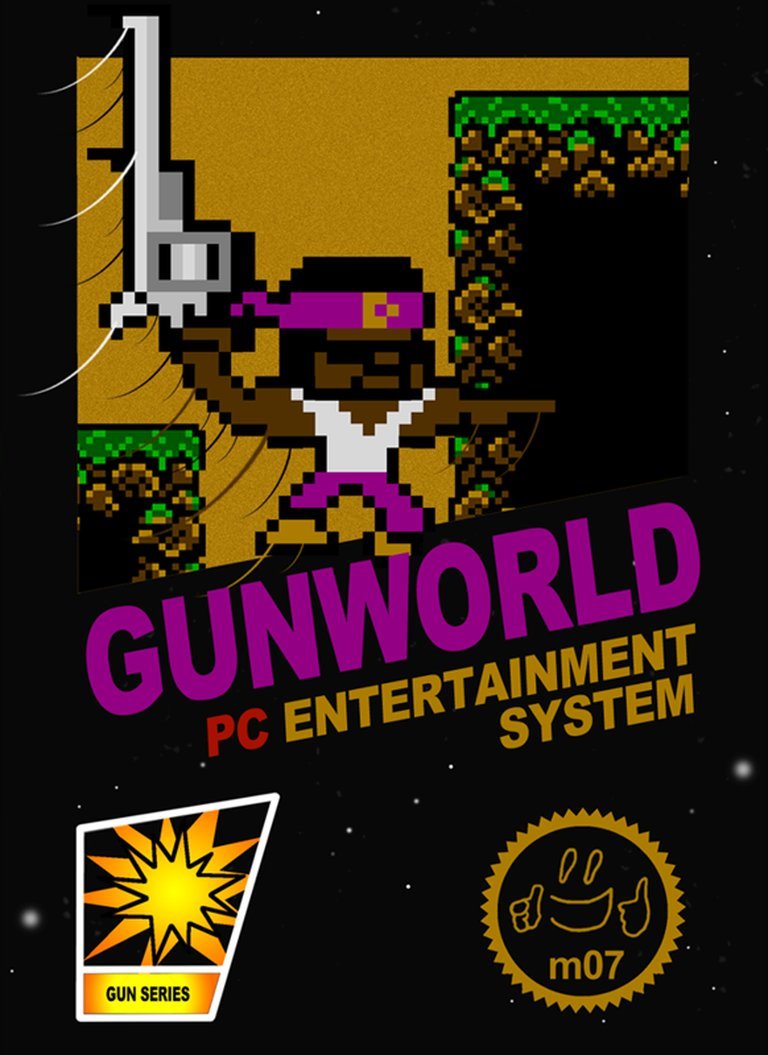
GunWorld is a retro-inspired 2D side-scrolling platform shooter that evokes the charm of classic NES games like Mega Man, set in a whimsical, gun-obsessed universe featuring levels such as New Gun City and a bald eagle as president. Players control a hero navigating challenging platforms, engaging in fast-paced shooting action against waves of enemies, with nostalgic pixel art graphics, a catchy soundtrack, and co-op multiplayer support for up to two players, though its clunky controls add to the frustrating difficulty.
Gameplay Videos
Where to Get GunWorld
PC
Patches & Mods
Guides & Walkthroughs
Reviews & Reception
store.steampowered.com (72/100): The story is humorously ridiculous.
steambase.io (31/100): Mostly Negative
GunWorld: Review
Introduction
Imagine a world where firearms sprout from the soil like wildflowers, where the very essence of defense is woven into the fabric of nature itself. This is the absurd yet captivating premise of GunWorld, a 2014 indie platformer that pays fervent homage to the pixelated grit of 8-bit classics like Mega Man and Contra. Released at a time when retro-inspired games were flooding the indie scene, GunWorld stands as a quirky testament to the enduring allure of NES-era design—tight controls, brutal difficulty, and unapologetic charm. Developed by the small team at m07games, it arrived on PC via Steam Greenlight, followed by an Xbox One port, capturing a niche audience hungry for nostalgic action. Yet, beneath its whimsical gun-toting foliage lies a game that teeters between delightful absurdity and frustrating execution. My thesis: GunWorld is a bold, if flawed, love letter to retro platformers, succeeding in its thematic whimsy and non-linear exploration but stumbling over clunky mechanics that prevent it from transcending its inspirations.
Development History & Context
m07games, a boutique indie studio founded by designer Joe Modzeleski, entered the scene with GunWorld as one of its flagship titles, embodying the DIY ethos of early 2010s indie development. Modzeleski, credited for game design, drew heavily from his passion for 1980s action heroes and classic NES titles, as evidenced by the game’s special thanks to Nintendo for “inspiring a generation of game designers.” The core team was lean: EJ Faasen handled art direction, crafting the pixelated visuals, while Tyler Boon (under his alias Citizen Apollo) composed the soundtrack. Additional nods went to collaborators like Peter Hall and Wally Barger, with the Xbox One edition explicitly thanking them for its existence. Built using the accessible GameMaker engine—a staple for solo and small-team devs—this allowed m07games to prototype quickly without the budgetary heft of AAA tools.
The game’s development unfolded amid the 2014 indie boom, a landscape dominated by retro revivals like Shovel Knight and Super Meat Boy. Platforms like Steam Greenlight democratized distribution, enabling obscure titles like GunWorld to reach players for a mere $1.99. Technological constraints were minimal in the post-Flash era; GameMaker’s 2D focus suited the side-scrolling format perfectly, but it also highlighted limitations in fluid animation and physics—issues that plagued many indie platformers of the time. The gaming industry was shifting toward mobile and open-world epics, yet the indie sector thrived on bite-sized, challenging experiences. GunWorld‘s non-linear structure and emphasis on replayability echoed the metroidvania influences creeping into the genre, positioning it as a response to the era’s call for innovative takes on old formulas. Vision-wise, m07games aimed for “high challenge and non-linear progression,” a deliberate nod to the punishing joy of 8-bit games, where death was a teacher, not a deterrent. However, the small scope—10 credits total, including “thanks”—meant compromises, like simplified multiplayer (local split-screen for 1-2 players) and no online features, reflecting the bootstrapped reality of indie survival.
Narrative & Thematic Deep Dive
At its heart, GunWorld weaves a tale that’s equal parts satirical fable and pulp adventure, unfolding in a world where guns aren’t manufactured but cultivated like crops. The plot kicks off with a cataclysmic event: an alien vessel crashes into GunWorld, poisoning the sacred GunMothers—massive, divine plants that birth all weaponry from seeds. This disrupts the idyllic society, where citizens have long relied on nature’s “destructive fruits” for protection. Fortresses crumble, cities fall, and panic ensues as the guns “dry up and rot.” Enter Dwayne, the archetypal “toughest, roughest GunMan,” summoned by the bombastic President Eagle—a bald eagle in presidential garb, embodying the game’s over-the-top Americana satire. Dwayne’s quest is straightforward yet expansive: traverse shattered landscapes, restore the GunMothers, and repel the alien invaders, all while planting seeds to harvest increasingly bizarre armaments.
Characters are sparse but memorable, leaning into caricature for humor. Dwayne is a silent protagonist, a muscle-bound everyman in a red bandana, evoking Contra‘s faceless soldiers but with a folksy twist. President Eagle serves as the blustery authority figure, his dialogue laced with patriotic bombast like calls to “save GunWorld from the alien menace!” Aliens, depicted as slimy, tentacled foes, represent an external corruption of the natural order, while minor NPCs—scattered survivors in levels like New Gun City—offer quips about dwindling ammo supplies. Dialogue is minimal and pixelated in style, delivered via simple text boxes that mimic NES-era exposition. It’s punchy and absurd: one line might jest about “guns growing on trees” as a literal blessing from an “earthly goddess,” blending environmental themes with gun culture parody.
Thematically, GunWorld dives deep into absurdity as commentary. It satirizes gun proliferation by making firearms organic and essential, questioning reliance on violence in a “blessed” world turned upside-down. Themes of restoration and resilience echo post-apocalyptic tales, with the GunMothers symbolizing lost harmony between man and nature—damaged by extraterrestrial hubris. Non-linearity amplifies this: players choose level order, mirroring Dwayne’s free-roaming heroism, encouraging themes of agency and experimentation. Yet, the narrative’s simplicity borders on superficial; without voice acting or deep lore, it relies on environmental storytelling—like wilted gun-trees in ruined biomes—to convey loss. Subtle nods to 80s action tropes (lone hero vs. invasion) add layers, but the story ultimately serves gameplay, wrapping themes in a package that’s more whimsical homage than profound critique. In sequels like GunWorld 2 and Super GunWorld 2, these elements evolve with intergalactic factions and RPG-lite progression, hinting at m07games’ ambition to expand the absurdity.
Gameplay Mechanics & Systems
GunWorld‘s core loop is a retro platform-shooter hybrid: side-scrolling levels demand precise jumps, enemy waves, and boss fights, all unlocked non-linearly via a hub world. Players start with basic seed-planted guns—a pistol that grows from humble shrubs—progressing by collecting seeds to cultivate upgrades like dual magnums or a drill gun. This “plant to grow guns” mechanic is innovative, turning resource management into a rhythmic cycle: explore, die, replant, experiment. Combat feels punchy on paper—tap to shoot, hold for charged blasts—but clunky movement hampers it. Dwayne’s physics, likely a GameMaker artifact, suffer from slippery momentum and finicky hitboxes, making pixel-perfect platforms (e.g., one-pixel jumps over spikes) feel unfair rather than skill-based. Protection time post-hit is notoriously short, leading to cheap deaths that critics lambasted as “frustratingly difficult” more from controls than design.
Character progression shines in its metroidvania flair: 12 levels, completable in any order, unlock via keys or abilities. New guns open paths—e.g., a wall-drilling tool bypasses barriers—forcing repeated runs and seed farming. UI is clean but basic: a seed inventory screen tracks expansions (12 achievements tied to them, like “Botanist” for all packs), with a simple map showing locked areas. Multiplayer adds split-screen co-op, allowing a second player to join as a sidekick, but it’s unpolished, with shared progression feeling tacked-on. Innovations include the gun-growth system, encouraging loadout swaps mid-run for puzzles (e.g., explosive seeds for crowd control). Flaws abound: input lag on keyboard (gamepad recommended), unbalanced difficulty spikes (trains levels feel “like wading in water”), and no save states, amplifying NES authenticity at modern players’ expense. Steam guides highlight achievement farming via exploits, underscoring accessibility issues. Overall, it’s a loop of high-reward experimentation wrapped in punishing precision, rewarding veterans but alienating casuals.
World-Building, Art & Sound
GunWorld’s setting is a vibrant, gun-infused dystopia that masterfully blends pastoral whimsy with apocalyptic ruin, creating an atmosphere of nostalgic decay. Biomes range from lush forests where gun-seeds bloom amid alien slime to urban sprawls like New Gun City, patrolled by robotic sentries. The world-building is immersive through environmental details: withered GunMothers pulse with corrupted energy, hinting at a lore of divine intervention gone awry. Non-linearity enhances this—revisiting levels post-upgrade reveals hidden paths, like overgrown thickets hiding secret seeds—fostering a sense of a living, reactive ecosystem. Atmosphere evokes 8-bit isolation: empty frontiers underscore the invasion’s toll, while boss arenas (e.g., alien hives) build tension via escalating enemy swarms.
Visually, EJ Faasen’s 2D pixel art captures retro charm without excess. Sprites are crisp, with Dwayne’s animations fluid in jumps but stiff in idles, palette favoring earthy greens and metallic silvers punctuated by alien purples. Scrolling backgrounds add depth—parallax forests sway gently—but resolution limits (GameMaker’s 2D constraints) make distant details fuzzy. It’s no Shovel Knight in polish, but the style suits the homage, with humorous touches like eagle-headed statues in presidential hubs.
Sound design elevates the experience: Tyler Boon’s chiptune soundtrack pulses with 8-bit synths, from upbeat forest chiptunes to ominous alien drones, syncing perfectly to level moods (e.g., frantic beats in train chases). SFX are punchy—seed-planting “pops” and gun “blooms”—but repetitive, lacking variety in enemy deaths. No voice work keeps it authentic, letting music carry emotional weight: triumphant fanfares on GunMother restorations reinforce themes of renewal. Together, these elements craft a cohesive retro bubble, where every gunshot feels like a harvest, immersing players in a world that’s equal parts silly and somber.
Reception & Legacy
Upon its 2014 Steam launch, GunWorld garnered mixed critical reception, averaging 53% on MobyGames from three reviews. TechRaptor’s 7.5/10 praised its “nostalgic and charming” story, graphics, and soundtrack, appealing to NES fans despite clunky movement. Xbox One ports fared worse: Games Cabin’s 4.3/10 called it “frustratingly difficult,” hoping sequels addressed complaints, while GameCrate’s 4/10 deemed it “unforgiving” even at $1.99—its low price cited as the sole sales driver. Player sentiment echoed this: a 2/5 average on MobyGames, with Steam’s 72% positive (from 11 reviews) contrasting broader negativity (31/100 on Steambase). Complaints focused on unfair deaths and poor optimization (e.g., stuttering on mid-range PCs), though some lauded the “nice idea with weapon seeds.”
Commercially, it was a modest indie success, collected by 19 MobyGames users and boasting Steam achievements (50% unlock rate). Its reputation evolved post-launch: sequels GunWorld 2 (2016) and Super GunWorld 2 (expanding to PS4) refined mechanics, introducing RPG elements and intergalactic plots, suggesting m07games iterated on feedback. Legacy-wise, GunWorld influenced niche retro shooters, like Jet Gunner, by popularizing organic weapon mechanics in platformers. It underscores indie’s risks—GameMaker titles often prioritize vision over polish—paving the way for flawed-but-passionate releases. In video game history, it’s a footnote: a cult curiosity for 8-bit purists, but not a genre-shaper like Mega Man. Its Xbox One exclusivity group status highlights console indie’s growth, yet its influence remains subtle, inspiring small devs to embrace absurdity in a polished market.
Conclusion
GunWorld is a pixelated paradox: a joyous tribute to 8-bit heroism marred by controls that feel like relics of a bygone frustration. From its seed-sowing innovation and satirical world to Boon’s evocative chiptunes, it captures the era’s spirit while stumbling on execution—clunky physics and steep difficulty curves alienate more than they challenge. Development constraints birthed a pure vision from m07games, but in a landscape of refined retros, it couldn’t fully bloom. Critical middling and a niche legacy cement it as essential for platformer historians, a quirky artifact of indie’s wild early days. Verdict: Worth the $1.99 for retro die-hards seeking unfiltered nostalgia, but newcomers should approach with patience—GunWorld rewards the persistent, punishing the impatient. In the annals of gaming, it’s a memorable misfire, proving even flawed homages can plant seeds of inspiration.