
- Release Year: 2024
- Platforms: PlayStation 5, Windows, Xbox Series
- Publisher: Plaion GmbH
- Developer: Critical Hit Games Sp. z o. o.
- Genre: Adventure
- Perspective: First-person
- Game Mode: Single-player
- Gameplay: Investigation, Puzzle-solving, Time manipulation
- Setting: Cyberpunk, dark sci-fi, Futuristic, Sci-fi
- Average Score: 81/100
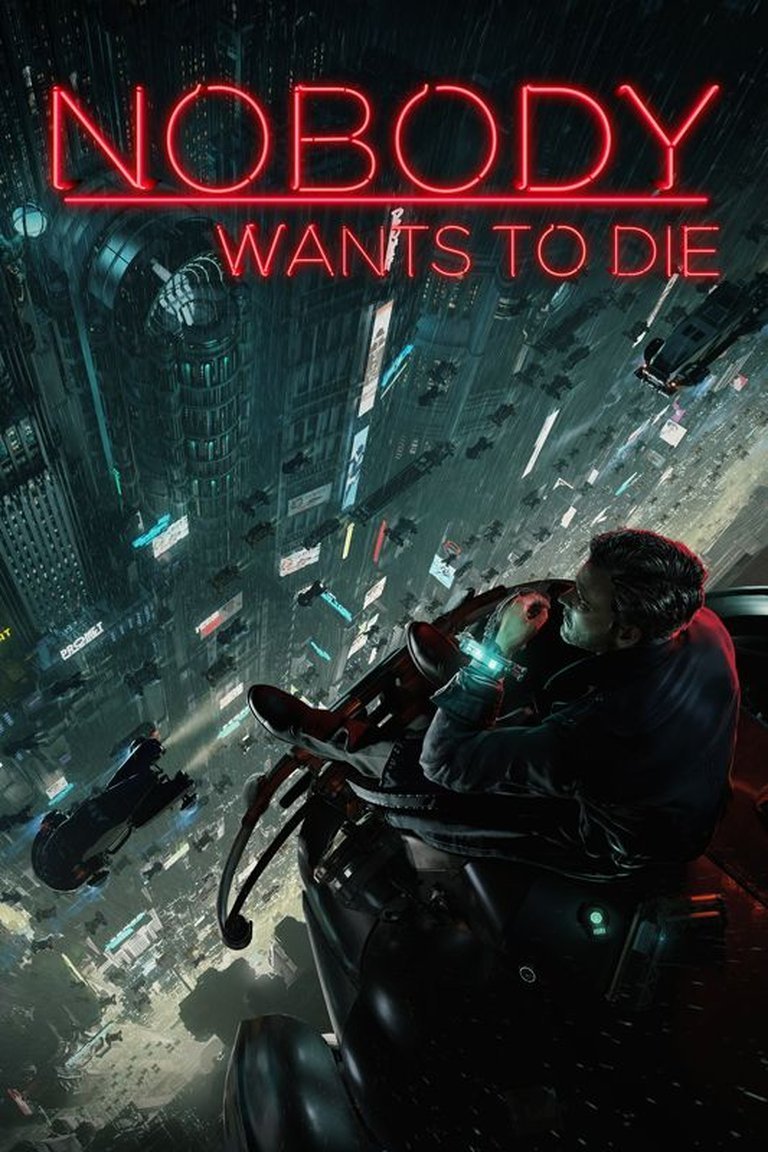
Description
Nobody Wants to Die is a first-person adventure game set in a cyberpunk, dark sci-fi world of futuristic New York, where players embody a detective unraveling a gripping mystery involving immortality technology and shadowy conspiracies. Through direct control gameplay, explore a noir-inspired narrative filled with engaging detective work, stunning visuals powered by Unreal Engine 5, and atmospheric storytelling that delves into themes of life, death, and corporate intrigue.
Gameplay Videos
Where to Get Nobody Wants to Die
Patches & Mods
Guides & Walkthroughs
Reviews & Reception
metacritic.com (75/100): Nobody Wants to Die is a noir gem that captivates with its dark atmosphere and engaging storytelling.
opencritic.com (77/100): Nobody Wants to Die will hold your hand whether you want it to or not, but its deep dialogue trees and unique touches almost manage to elevate it into something special.
gameonreviews.com (90/100): Nobody Wants to Die is a stunning, thought-provoking experience.
game8.co (82/100): Nobody Wants to Die is a visually impressive narrative adventure game that focuses on the mystery rather than the gameplay aspect.
Nobody Wants to Die: Review
Introduction
In the rain-drenched shadows of a retro-futuristic New York City, where immortality is a subscription service for the elite and death is just a body swap away, Nobody Wants to Die emerges as a haunting echo of classic noir tales reimagined through a cyberpunk lens. Released in 2024, this debut title from Polish studio Critical Hit Games doesn’t just tell a story—it immerses you in a world where the pursuit of eternal life corrodes the soul, forcing players to confront the human cost of technological hubris. As a game journalist with a keen eye for narrative-driven adventures, I’ve long admired how titles like Blade Runner-inspired works blend atmospheric dread with philosophical inquiry, but Nobody Wants to Die stands out for its unflinching exploration of transhumanism in a capitalist dystopia. This review argues that while its groundbreaking visuals and thematic depth cement it as a modern noir masterpiece, its linear gameplay and brevity prevent it from achieving timeless status—yet it heralds a bold new voice in interactive storytelling.
Development History & Context
Critical Hit Games, a Wrocław-based studio founded in 2020 by a tight-knit team of around 20 seasoned developers, burst onto the scene with Nobody Wants to Die as their inaugural project. Led by Game Director and Lead Designer Grzegorz Goleń, alongside Art Director Andrzej Marszałek and Lead Writer Marcin Grembowicz, the team drew inspiration from iconic cyberpunk films like Blade Runner and narrative gems such as What Remains of Edith Finch, Firewatch, and Observer. Goleń envisioned a “visually spectacular narrative game” that would push the boundaries of immersion, focusing on a single metaphysical twist—consciousness transfer via Ichorite—to probe real-world anxieties about immortality and inequality. This vision was realized using Unreal Engine 5, which the studio adopted midway through development after starting on Unreal Engine 4, navigating stability issues that tested their small team’s resilience.
The project’s timeline reflects indie ambition amid industry turbulence: conceived in 2018, it was announced in March 2024 via a moody reveal trailer and showcased at Gamescom’s Future Games Show in June. Publisher Plaion (an Embracer Group subsidiary) handled distribution, ensuring a simultaneous digital launch on July 17, 2024, for PC (Steam and GOG), PlayStation 5, and Xbox Series X/S. Priced at $24.99 (often discounted to $9.99), it targeted a niche audience craving short, story-rich experiences.
At release, the gaming landscape was dominated by sprawling open-world epics like Elden Ring: Shadow of the Erdtree and live-service giants, but Nobody Wants to Die arrived as a counterpoint—a concise, single-player adventure bucking AAA bloat. The era’s technological constraints, including Unreal Engine 5’s Nanite and Lumen systems, allowed Critical Hit to craft photorealistic environments on a modest budget, though optimization challenges led to occasional glitches on PC. In a post-Cyberpunk 2077 world, where redemption arcs for flawed sci-fi RPGs had become commonplace, this Polish debut positioned itself as a refined, narrative-first antidote, emphasizing quality over quantity in an oversaturated market.
Narrative & Thematic Deep Dive
At its core, Nobody Wants to Die is a taut, branching detective thriller set in 2329 New York, where humanity’s “victory” over death via Ichorite—crystalline memory banks storing consciousness for body transfers—has stratified society into immortal elites and disposable underclass. Players embody James Karra, a grizzled Mortality Department detective over 100 years old but trapped in his fourth body, haunted by personal demons. Fresh from a near-fatal train wreck and desynchronization glitches (hallucinations signaling Ichorite decay), Karra is handed an off-the-books case: the apparent suicide of billionaire Edward Green, which quickly spirals into a serial killer hunt targeting the city’s corrupt upper echelon.
The plot unfolds across five to eight hours, structured as interconnected investigations blending linear progression with choice-driven branches. Karra, aided by ambitious liaison Sara Kai—a 29-year-old renting her body as an “old lady” avatar for extra cash—uncovers a web of elite depravity: body trafficking, subscription extortion (failing payments at age 21 lands you in eternal “storage” limbo), and a killer’s manifesto against immortality’s flaws. Key twists reveal the “Stranger”—a mysterious voice guiding Karra—is no external antagonist but a manifestation of his psyche fracturing from repeated transfers, echoing Green’s own desynchronization-induced suicide pact with ally Dimitri Kovalev to dismantle the system.
Characters are richly layered archetypes elevated by sharp writing. Karra, voiced with world-weary gravel by David Menkin, embodies noir fatalism; his cigarette-chomping cynicism masks grief over his wife Rachel’s ichoricidal suicide (poisoning her Ichorite for true death) and guilt from partner Seth’s permanent demise. Sara (Rebecca LaChance), initially pragmatic and career-focused, evolves through banter-heavy dialogues that humanize her—revealing her girlfriend Taylor’s storage limbo as motivation—fostering a mentor-protégé bond that choices can strain or strengthen. Antagonists like the scheming Chief of Police (a Dirty Cop archetype) and victims (Asshole Victims indulging in hedonistic immortality) satirize power’s corruption, with optional “perma-death” choices invoking vigilante justice.
Dialogue shines in its economy: witty, philosophical exchanges probe morality (“Time reveals secrets, but does it heal wounds?”), with branching trees yielding unexpected outcomes—like humorous misfires or deeper lore dumps. Themes delve exhaustively into transhumanism’s perils: immortality as “And I Must Scream” limbo, capitalism commodifying souls (lowering subscription age to 18 sparks riots), and existential dread (Who Wants to Live Forever?). Multiple endings—Anguish (eternal storage torment) or End of Deadly Dreams (heroic suicide reuniting with Rachel)—hinge on deductions about the Stranger and a climactic choice to shoot or spare Jane Salma (possessing Sara’s body), underscoring free will’s illusion in a deterministic dystopia. Greek mythology nods (Ichorite evoking ichor, the gods’ blood) add mythic weight, making the narrative a profound meditation on mortality’s value.
Gameplay Mechanics & Systems
Nobody Wants to Die prioritizes narrative over mechanical depth, manifesting as a first-person adventure with investigation loops that feel more cinematic than interactive. Core gameplay revolves around crime scene reconstruction using Karra’s Augmentor gauntlet: scan bodies with the Evolver (to age/regress evidence), deploy the Reconstructor (rewind time to visualize events), and employ the Reporter (project holographic dialogues from clues). These tools form a puzzle-lite loop—locate anomalies, manipulate time (slow/pause for 10-30 seconds per scene), and assemble timelines on an evidence board via inference prompts (e.g., “Link Green’s fall to the Stranger’s call?”).
No combat exists; tension arises from QTE chases or ethical dilemmas, like choosing to revive or perma-kill suspects. Dialogue systems drive progression, with empathy/skepticism sliders influencing Sara’s rapport and endings—rushing inferences risks “Anguish,” thorough sleuthing unlocks “Deadly Dreams.” Character progression is absent, but upgrades (e.g., enhanced scanning) tie to side explorations, revealing lore like extinct cherry trees symbolizing lost nature.
UI is intuitive yet directive: holographic overlays guide scans, minimizing trial-and-error, which critics laud for accessibility but fault for hand-holding (e.g., prompts highlight every interactable). Innovations like time manipulation add novelty—rewinding a zeppelin crash to trace bullet trajectories feels empowering—but flaws emerge in linearity: scenes are diorama-like, with no open exploration beyond scripted paths, leading to repetition over 6 hours. Puzzles lack challenge (often just following on-screen cues), and no chapter select hampers replaying branches, frustrating completionists. Controls support keyboard/mouse or gamepad seamlessly, though desync glitches occasionally disrupt flow. Overall, mechanics serve the story admirably but expose the game’s walking-sim roots, prioritizing emotional beats over agency.
World-Building, Art & Sound
The game’s setting—a retro-futuristic New York blending 1920s Art Deco with cyberpunk excess—forms a Crapsack World of neon-drenched despair, where flying cars zip past decapitated Statues of Liberty amid toxic decontamination pods. World-building is meticulous yet concise: lore drips through pneumatic-tube mail, black-and-white newsreels, and holo-ads decrying “body subscription” riots, painting a Gaia’s Lament dystopia where flora/fauna extinction underscores humanity’s hubris. Locations like Green’s penthouse (housing the last cherry tree) or Liberty Island slums evoke Scenery Gorn, contrasting elite opulence with underclass squalor, reinforcing themes of inequality.
Art direction, powered by Unreal Engine 5’s photorealism, is a triumph: rain-slicked streets gleam under holographic billboards, with Schizo Tech like boxy revolvers and zeppelins amid brain uploads. Visuals achieve Scenery Porn—jaw-dropping vistas from neon perches—while dynamic lighting (Lumen) enhances noir mood, though pop-in and glitches mar PC ports. Atmosphere builds through Cyberpunk with a Chance of Rain: perpetual downpours mirror Karra’s turmoil, with optional “perma-death” choices amplifying moral weight.
Sound design elevates immersion: Mikolai Stroinski’s jazz-infused score (known from The Witcher 3) weaves sultry saxophones with ominous synths, syncing to investigations for thriller tension. Voice acting is stellar—Menkin’s brooding Karra and LaChance’s nuanced Sara anchor emotional highs—bolstered by Wwise audio engine for spatial rain and holographic echoes. Ambient effects (distant sirens, crackling Ichorite) create a palpable City Noir, though occasional sync issues disrupt VO. Collectively, these elements forge an unforgettable sensory experience, making the dystopia feel lived-in and oppressive.
Reception & Legacy
Upon launch, Nobody Wants to Die garnered solid acclaim, with Metacritic aggregates at 75 (PC), 78 (PS5), and 77 (Xbox Series X/S), and an OpenCritic top-critic average of 77—67% recommend it. Critics praised its narrative and visuals: XboxEra’s 9.5/10 hailed it a “noir-yarn masterpiece,” while PC Games (Germany) awarded 90% for its “doubt-inducing cyberpunk world.” Game Informer (8/10) lauded “jaw-dropping sights” and “engaging storytelling,” and Eurogamer (4/5) appreciated its “atmosphere, heart, and relevance.” MobyGames’ 76% critic score (40 reviews) and 4.3/5 player average echoed this, with outlets like RPGFan (80/100) calling it “authentically noir.”
Commercial performance was modest but promising: 3,500+ Steam “Very Positive” reviews, collected by 50+ MobyGames users, and sales boosted by discounts. Polish roots earned national pride—GRYOnline.pl praised its storytelling prowess—but global reach was niche, overshadowed by July blockbusters like EA Sports FC 25.
Reputation has evolved positively: initial critiques of linearity (IGN’s 7/10 noted “too much hand-holding”) softened as players valued its brevity in a bloated market. By late 2024, it topped Eurogamer reader polls and GamePro’s “best of 2024” lists for indie innovation. Legacy-wise, it influences narrative sci-fi, echoing Observer‘s psychological horror while pioneering Ichorite as a metaphor for digital souls—potentially inspiring sequels exploring desynchronization epidemics. As Critical Hit’s debut, it signals Poland’s rising narrative scene (post-The Thaumaturge), though its short runtime limits replay value. Future ports or DLC could expand its footprint, but it already carves a niche as 2024’s thoughtful cyberpunk sleeper hit.
Conclusion
Nobody Wants to Die masterfully weaves noir grit with cyberpunk speculation, delivering a visually stunning, thematically rich tale that lingers like a bad dream in a rain-soaked alley. Critical Hit Games’ debut excels in narrative depth, atmospheric world-building, and philosophical inquiry into immortality’s dark underbelly, bolstered by Unreal Engine 5’s spectacle and Stroinski’s evocative score. Yet, its simplistic, hand-held mechanics and 5-8 hour runtime—while ideal for focused storytelling—frustrate those seeking deeper agency, making it more interactive movie than robust adventure.
In video game history, it occupies a promising perch: a modern heir to Blade Runner adaptations and Firewatch-esque introspection, reminding us that true innovation lies in evoking humanity amid dystopia. For noir enthusiasts and cyberpunk aficionados, it’s an essential 8/10—flawed, fleeting, but profoundly moving. Critical Hit has arrived; here’s hoping their next body swap yields even greater life.