
- Release Year: 2024
- Platforms: Nintendo Switch, PlayStation 4, PlayStation 5, Windows Apps, Windows, Xbox One, Xbox Series
- Publisher: Sometimes You, Stately Snail Games
- Developer: Sometimes You, Stately Snail Games
- Genre: Adventure, Horror
- Perspective: First-person
- Game Mode: Single-player
- Gameplay: Multiple endings, Puzzle elements
- Average Score: 77/100
Description
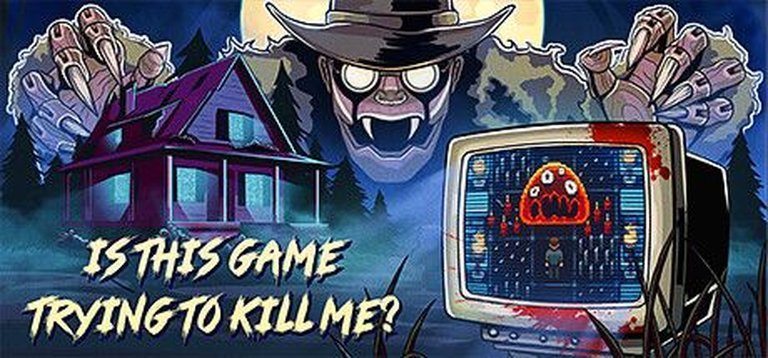
Is This Game Trying to Kill Me? is a first-person horror adventure game that blends puzzle-solving with meta-narrative elements, where players find themselves trapped in a remote forest cabin, desperately solving intricate escape-room-style challenges while evading the game’s own lethal mechanics that manifest as gruesome deaths and suspenseful traps, creating a chilling experience that blurs the line between player and prey in a self-aware digital nightmare.
Gameplay Videos
Where to Get Is This Game Trying to Kill Me?
PC
Guides & Walkthroughs
Reviews & Reception
slythergames.com (75/100): Is This Game Trying to Kill Me? is an awesome concept that suffers a little from being a short experience.
metacritic.com (80/100): Generally Favorable based on 4 critic reviews.
tryhardguides.com : It’s easily become my new favorite in the genre, full of charm and not overly difficult.
gaming.net : Is This Game Trying to Kill Me? invites you to enter the gloomy quarters of an old cabin with a violent twist and gruesome discoveries.
Is This Game Trying to Kill Me?: Review
Introduction
Imagine booting up an old computer in a storm-lashed cabin, only to realize the pixels on the screen are bleeding into your reality—traps in the game manifesting as spikes through your walls, puzzles in a virtual castle dictating whether you’ll draw your next breath. This is the chilling hook of Is This Game Trying to Kill Me?, a 2024 indie horror-adventure that transforms the mundane act of gaming into a life-or-death gamble. Released just months ago by Stately Snail Games, this title has already carved a niche in the meta-horror genre, echoing classics like Inscryption while pioneering a seamless blend of escape-room puzzles and existential dread. As a game historian, I see it as a modern successor to the psychological mind-benders of the PS1 era, like Silent Hill, but stripped to its indie core. My thesis: Is This Game Trying to Kill Me? is a triumph of innovative duality, where the interplay between cabin and code not only delivers razor-sharp puzzles but redefines horror as a recursive nightmare, cementing its place as a must-play for fans of cerebral scares in an era oversaturated with jump-scare slop.
Development History & Context
Stately Snail Games, a small indie studio founded in the early 2020s, crafts their debut major release with Is This Game Trying to Kill Me?, co-developed and published alongside Sometimes You—a collaboration that speaks to the symbiotic nature of modern indie ecosystems. Led by a team of puzzle enthusiasts with roots in Eastern European game dev (hinted at in credits from contributors like Tim Janssen), the studio’s vision was audacious: to literalize the “game within a game” trope amid a post-pandemic surge in isolation-themed horror. Drawing from their prior micro-releases like Access Denied and One More Dungeon, the creators aimed to subvert escape-room conventions by making failure not just frustrating, but fatal—mirroring the high-stakes survival sims popularized by The Escapists or Outlast.
Technological constraints played a pivotal role, as the game runs on Unity—a reliable but budget-friendly engine that allows for quick iteration but limits graphical fidelity. Released on November 13, 2024, for Windows (with ports to Nintendo Switch, PlayStation 4/5, Xbox One/Series, and Windows Apps following in 2025), it navigates the era’s hardware variances adeptly: the 1st-person cabin exploration demands minimal resources, while the 2D Castle Serpentshtain game-within-a-game emulates a retro MS-DOS aesthetic using simple pixel art, evoking the low-poly charm of early 90s adventures like Myst. No VR or advanced ray-tracing here; instead, the focus is on environmental scripting, where Unity’s physics and event triggers enable the meta-interactions that define the experience.
The 2024 gaming landscape was fertile ground for this release. Indie horror exploded post-Among Us and Phasmophobia, with players craving short, replayable experiences amid AAA bloat like Star Wars Outlaws. Priced at $14.99 on Steam and $19.99 on Switch, it tapped into the “cozy horror” niche—think What Remains of Edith Finch meets The Stanley Parable—while consoles in 2025 benefited from cross-play hype. A free prologue, Is This Game Trying to Kill Me? Preface, served as a savvy demo, building buzz in a market wary of microtransactions. Constraints like Unity’s occasional optimization hiccups (e.g., minor frame drops on older PCs) were offset by the game’s brevity, proving that smart design trumps spectacle in indie’s golden age.
Narrative & Thematic Deep Dive
At its heart, Is This Game Trying to Kill Me? is a tale of blurred boundaries, where the player awakens in a rain-soaked cabin to confront a pale, fanged host—a puppet-like figure whose jointed fingers and mask-like face foreshadow deeper manipulations. The plot unfolds as a recursive loop: to escape, you must play Castle Serpentshtain, a faux-retro adventure rife with serpentine castles, frozen statues, and leprechaun hide-and-seek. But actions bleed across realities—melting a statue in-game frees a ghostly ally in the cabin, while missteps summon spikes or drowning lily pads into your world. Dialogue is sparse but potent; the host’s taunts (“Play the game, or the storm never ends”) drip with menace, evolving from condescending to outright sadistic as illusions shatter.
Characters are archetypal yet layered: the unnamed protagonist is a silent everyman, thrust into a Church Militant backstory revealed via All Just a Dream twists—you’re no victim, but a mage-hunter ensnared by your quarry. The host, unmasked as the evil wizard Serpentshtain, embodies puppetry and control, his fate worse than death (head in a jar) inverting power dynamics. Secondary figures, like the spider-phobic hybrid in the pentagram room or the dying wax-covered informant, add grotesque flavor without verbosity, their limited lines (e.g., “Follow the flame”) serving as cryptic guides.
Thematically, the game interrogates the illusion of agency in digital spaces. Why Did It Have to Be Snakes? isn’t just phobia fodder; it’s a metaphor for primal fears amplified by screens, with the Eldritch Abomination true boss symbolizing unchecked digital entropy. Multiple endings deepen this: “Mask” traps you in eternal illusion via a spiked restraint, critiquing addictive gaming; “Survivor” offers escape after decoding symbols and slaying the giant serpent, affirming resilience; “Root of Evil” demands collectible floppy disks to power a crystal gun against the abomination, exploring redemption through destruction. Dialogue underscores meta-commentary—berating switches from scolding to gratitude (e.g., the Frozen Man’s thanks post-melt)—while themes of The Game Come to Life echo Jumanji in pixels, questioning reality in an AI-saturated world. It’s a narrative of entrapment and enlightenment, where horror stems not from gore, but the erosion of self.
Gameplay Mechanics & Systems
The core loop is a masterful duality: alternate between 1st-person cabin navigation (direct control via keyboard/mouse or gamepad) and 2D pixel-art puzzles in Castle Serpentshtain. No traditional combat exists—progression hinges on puzzle-solving, with “deaths” as swift, gruesome resets (e.g., impalement or drowning via Hamiltonian Path lily pads). Character progression is environmental: solving riddles unlocks cabin areas (e.g., side passages for “Interface Screw” fixes like replacing color palettes or textures), while collectibles like three floppy disks enable the true ending.
Mechanics shine in their interconnection—No Inner Fourth Wall means pulling a virtual lever might manifest a real-world clue, or vice versa, fostering lateral thinking. Puzzles vary: moderate logic (matching pedestal symbols from wall etchings), dexterity (timed switches amid disappearing lily pads), and exploration (hunting the leprechaun, risking decapitation). Innovative systems include Achievement Mockery (“First Blood” for your initial death, “Worth a Try” for futile fights) and a hint menu to prevent frustration, though some timed sequences feel “puzzlingly” out of place, per critics.
UI is minimalist and era-appropriate: the cabin’s HUD is absent, heightening immersion, while the game’s retro interface glitches realistically (desaturated colors, escaping textures). Flaws include occasional pacing dips from backtracking—running between realities can feel tedious in the short runtime—and obtuse moments (e.g., obscure symbol hunts), but a rewind feature mitigates deaths. Overall, it’s a flawed-yet-brilliant system that innovates on escape-room tropes, rewarding curiosity over reflex, with multiple endings encouraging 2-3 hour replays.
World-Building, Art & Sound
The game’s dual worlds are a diptych of dread: the cabin, a liminal shack of creaking wood and flickering monitors, evokes a dark fairytale—dense forest outside, skeletal beds inside, evolving from cozy to claustrophobic as traps activate. Castle Serpentshtain contrasts with pixelated medieval whimsy: swampy lily pads, serpentine lairs, and ghostly faces in walls, all tied by shared eldritch lore (runes, amulets, tentacled abominations). Atmosphere builds through subtle world-building—notes hint at the wizard’s puppetry, floppy disks reveal ancient evils—creating a cohesive mythos without info-dumps.
Visual direction is retro-chic: Unity’s low-fi renders give the cabin a PS1-era graininess, with desaturated palettes amplifying unease (e.g., creepy eyeballs in screen borders). The 2D game pops with vibrant pixels against black voids, but “breakages” like monochromatic feeds heighten tension. Art contributes to horror via The Most Dangerous Video Game—spikes piercing monitors feel viscerally real—while scaled-up bosses like the giant serpent add spectacle without overwhelming the intimate scale.
Sound design is sparse but surgical: rain patters and cabin creaks build isolation, punctuated by retro chiptunes in Castle Serpentshtain that warp into dissonance during deaths (e.g., echoing laughs on Game-Over Man screens). No bombastic score; instead, ambient whispers and fleshy impalements create psychological dread, with Game-Over Man’s cackles lingering like tinnitus. These elements synergize to make the worlds feel alive and adversarial, turning every click into a heartbeat-skipping risk.
Reception & Legacy
Upon launch, Is This Game Trying to Kill Me? garnered solid critical acclaim, averaging 79% on MobyGames (7.5/10 overall) and 80 on Metacritic from four reviews—praised for clever puzzles and meta-horror, critiqued for brevity. Try Hard Guides awarded 100%, lauding its “fresh concept” and suspense; Vandal Online (80%) highlighted its puzzle intelligence over Tormenture similarities; Adventure Game Hotspot (70%) noted timed sequences as flaws but endorsed the creative deaths. Console ports in 2025 fared similarly: Games Freezer (85% on Xbox Series) hoped for sequels, Nindie Spotlight (73% on Switch) called it “decent but aggravating.” Commercially, it succeeded modestly—Steam sales buoyed by the $15 price and free prologue, collecting by only four MobyGames users initially but growing via word-of-mouth. No massive hits, but steady: akin to Viewfinder‘s niche success.
Reputation has evolved positively; early 2025 reviews emphasize replayability via endings, influencing discussions on meta-indies. As a historian, its legacy mirrors The Stanley Parable‘s in deconstructing player agency, inspiring hybrids like potential sequels (per Games Freezer). In an industry shifting to live-service giants, it champions short-form innovation, potentially birthing a subgenre of “recursive escape horrors.” Related titles (Inscryption, The Talos Principle) underscore its place; if emulated, it could redefine indie puzzles for VR eras.
Conclusion
Is This Game Trying to Kill Me? distills indie horror to its essence: a taut, inventive puzzle odyssey where realities collide in screams and synapses. From its cabin-crawling tension to pixelated perils, it excels in thematic depth, mechanical ingenuity, and atmospheric chills, despite minor pacing quibbles and a story craving expansion. In video game history, it stands as a 2024 milestone—a bridge between retro meta-narratives and modern psychological thrills—proving small teams can deliver outsized scares. Verdict: Essential for puzzle aficionados (8.5/10), a bloody blueprint for horror’s future; play it, but don’t say the game didn’t warn you.