
- Release Year: 1989
- Platforms: Amiga, Atari ST, DOS, Macintosh, Windows
- Publisher: Adventure Soft Publishing Ltd., Box Office, Inc., Horror Soft Ltd.
- Developer: Horror Soft Ltd.
- Genre: Adventure
- Perspective: First-person
- Game Mode: Single-player
- Gameplay: Graphic adventure
- Setting: Europe
- Average Score: 75/100
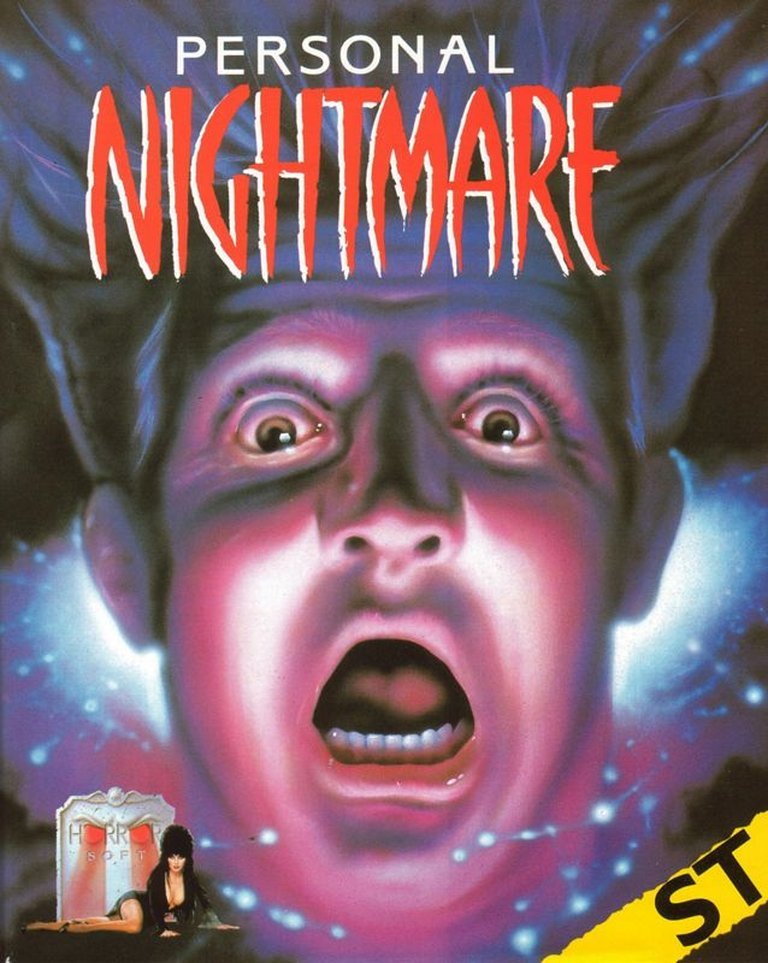
Description
A Personal Nightmare is a 1989 horror adventure game set in a remote European village, where you return home after receiving a mysterious letter from your pastor father, only to discover him missing and the villagers transformed into hostile, strange beings under the control of malevolent supernatural forces, including vampires and demonic creatures. As a first-person graphic adventure with real-time pacing, players must explore the eerie setting, solve puzzles, and confront horrors to unravel the dark conspiracy and restore order to the afflicted community.
Gameplay Videos
Guides & Walkthroughs
Reviews & Reception
myabandonware.com (79/100): Great mouse-driven interface, plot, writing, and puzzles make this an underrated classic. Highly recommended!
A Personal Nightmare: Review
Introduction
In the dim glow of a 1980s computer screen, as thunder rumbles through pixelated speakers and a demonic silhouette flickers amid lightning strikes, A Personal Nightmare thrusts players into a chilling tale of familial dread and supernatural invasion. Released in 1989 by the fledgling Horror Soft Ltd., this graphic adventure game captures the eerie essence of Hammer Horror films, blending gothic mystery with unforgiving real-time mechanics that keep hearts pounding. As a cornerstone of early horror gaming, it marks the debut of the AGOS engine and the studio’s pivot toward visceral, atmospheric terror—foreshadowing cult hits like Elvira: Mistress of the Dark and Waxworks. Though often overshadowed by its successors, A Personal Nightmare endures as an underrated gem, proving that in the shadow of technological limitations, true frights emerge from psychological tension and narrative depth. My thesis: This game is a pivotal, if flawed, evolution of the adventure genre, where real-time pacing injects urgency into puzzle-solving, creating a personal hell that rewards persistence while punishing impatience, cementing Horror Soft’s legacy in horror interactivity.
Development History & Context
Horror Soft Ltd., originally an offshoot of the UK-based Adventure International—a company founded to localize and expand Scott Adams’ pioneering text adventures like the SAGA series—emerged in the late 1980s as a bold reinvention. Formed by a tight-knit team including game designers and programmers Alan Bridgman, Alan Cox, Michael Woodroffe, and Keith Wadhams, the studio sought to capitalize on the graphical revolution ushered in by 16-bit machines like the Amiga and Atari ST. Prior to A Personal Nightmare, Adventure International had dabbled in licensed fare, such as the TV-tie-in Robin of Sherwood: The Touchstones of Rhiannon, but the rise of visually stunning platforms demanded more. Text adventures, once staples on systems like the ZX Spectrum and BBC Micro, were fading into obsolescence against competitors like Sierra On-Line’s parser-driven epics (King’s Quest) and Lucasfilm’s point-and-click innovators (Maniac Mansion).
The vision for A Personal Nightmare stemmed from a desire to infuse adventures with horror’s campy allure, drawing inspiration from Elvira (the Mistress of the Dark) while avoiding overt gore—Elvira herself reportedly shunned excessive violence in her media appearances. Bridgman and Cox, leveraging Cox’s background in MUD development (multi-user dungeons like AberMUD), crafted the AGOS (Adventure Game Operating System) engine from scratch. This hybrid system combined text input with mouse-driven selection, a forward-thinking blend that anticipated full point-and-click dominance. Technological constraints were stark: Released on three floppy disks for Amiga, Atari ST, and DOS, the game grappled with slow disk access on era hardware, leading to frequent swaps that disrupted flow—a common gripe in 1989 reviews. The DOS port, in particular, suffered from corrupted files in many releases, rendering completion impossible without patches, a trivia point that underscores the era’s distribution woes.
The gaming landscape of 1989 was a battleground of genres. Action-adventures like The Secret of Monkey Island emphasized humor, while horror was niche—Infocom’s Anchorhead precursors and Uninvited on NES leaned textual or console-bound. A Personal Nightmare filled a void for PC/Amiga horror, targeting a European audience amid witch-hunt lore and vampire myths. Published initially by Horror Soft themselves, with U.S. distribution via Box Office Inc. (a K-Mart budget label), it bypassed major publishers, reflecting indie ambition in a market dominated by Activision and Electronic Arts. Later re-releases on GOG in 2009 (Windows) and 2012 (Macintosh) via Adventure Soft Publishing preserved its legacy, now playable via ScummVM, which emulates AGOS flawlessly.
Narrative & Thematic Deep Dive
At its core, A Personal Nightmare weaves a taut, personal gothic thriller reminiscent of Italian Giallo films—slasher mysteries laced with supernatural dread. You play as an unnamed protagonist, the vicar’s estranged son, drawn back to the sleepy village of Tynham Cross in Woldshire after cryptic letters from your parents. The setup is masterfully insidious: Your childhood home, once a bastion of quiet piety, now harbors unspoken horrors. The plot unfolds in real-time over a single, fateful evening into night, beginning with your arrival at The Dog and Duck inn. Here, innocuous interactions—chatting with innkeeper Mr. Jones, his wife, photographer Jimmy Blandford, and registrar Mr. Roberts—escalate into tragedy. Jimmy is run down by a car, clutching a key and undeveloped film roll that hints at infidelity (“How could she?”), while your father, the vicar, has vanished amid rumors of his obsession with 17th-century predecessor James Hyatt, lynched in a ritual to exorcise a “devil.”
As the narrative deepens, the village transforms from quaint English hamlet to infernal trap. Evil forces—manifesting as a vampire-like entity, demonic pets, and possessed villagers—reveal themselves through escalating encounters. Key characters include Susan Blandford (Jimmy’s distraught wife, potentially complicit), Aunt Alice (bedridden and vulnerable), and spectral figures like the vengeful Hyatt. Dialogue, delivered via typed commands like “ASK JONES ABOUT FATHER,” is sparse but evocative, blending everyday banalities (“Your room is upstairs”) with ominous undertones (“Leave her husband alone!”). Themes probe the erosion of faith and community: The witch-hunt era backdrop critiques historical hysteria, paralleling the modern village’s descent into paranoia and mob mentality. Personal loss amplifies the horror—your father’s lightning-struck demise in the intro symbolizes corrupted spirituality, forcing you to confront familial guilt and isolation.
The story’s strength lies in its ambiguity; no explicit exposition dumps lore, instead relying on environmental storytelling. Uncovering the devil’s human servants (e.g., through pieced-together license plates or developed photos) builds a web of betrayal, culminating in a ritualistic showdown. Flaws emerge in pacing—real-time events can lock out plot branches if you dawdle—but thematically, it excels as a meditation on inherited evil, where the “personal” nightmare is as much psychological (abandoning family) as supernatural. Compared to Elvira‘s campy excess, this is restrained terror, emphasizing dread over jumpscares, though abrupt deaths (strangulation, spontaneous combustion) underscore mortality’s fragility.
Gameplay Mechanics & Systems
A Personal Nightmare innovates by grafting real-time urgency onto the graphic adventure template, creating a hybrid loop of exploration, interaction, and survival that feels perilously alive. Core gameplay revolves around point-and-select navigation in a 1st-person, fixed-screen world: Click compass directions to move through Tynham Cross’s 50+ locations (inn, church, cemetery, manor), type commands for actions (“EXAMINE BODY,” “TAKE KEY”), and manage a limited inventory (e.g., clothing, pajamas hint at exposure risks, though underutilized). No combat system exists—confrontations are puzzle-resolved, like staking vampires or banishing demons via items (holy water, crosses)—but failure means permadeath, with reloads from timed saves.
The real-time clock is the game’s double-edged sword: Events unfold on a strict schedule (e.g., Jimmy’s 5 PM accident), forcing multitasking. Develop film before the darkroom closes? Rescue villagers before curses ignite you? This pacing elevates tension, distinguishing it from static adventures like Zork, but demands pixel-perfect timing—miss a window, and paths close, fostering trial-and-error frustration. UI shines in its hybrid interface: Mouse highlights objects (beer glasses, bugles), but complex queries require text (“ASK SUSAN ABOUT JIMMY”), blending accessibility with depth. Inventory limits prevent hoarding, encouraging strategic drops, while no progression tree exists; “leveling” is narrative-driven, unlocking areas via keys or clues.
Innovations include dynamic NPCs with schedules (Mrs. Jones shuttles disks, er, serves drinks) and reactive environments (night alters visuals, enabling stealth). Flaws abound: Confusing navigation (compass mismatches screen flows, e.g., north/right from inn), frequent disk swaps (three disks interrupt flow), and opaque puzzles (spotting useful items amid “mountains of cianfrusaglie,” per one review) lead to save-scumming. No hints system exacerbates this, echoing Sierra’s “perfect play” philosophy but without Williams’ narrative pull. Overall, it’s a bold systems fusion—real-time horror adventure—that prefigures The Last Express but stumbles on era tech, making triumphs feel earned amid irritation.
World-Building, Art & Sound
Tynham Cross is a masterclass in compact, atmospheric world-building: A fictional Woldshire village evoking rural England, its fixed screens paint a progression from idyllic (rose gardens, post office) to nightmarish (dilapidated manor, fog-shrouded cemetery). The setting draws from vampire lore and witch-hunt history, with St. Anthony’s Church as a symbolic heart—pulpit sermons hint at Hyatt’s curse, bells toll doomsday. Real-time day-night cycles transform spaces: Morning sunlight bathes the gas station in normalcy, while midnight unveils “evil presences” in bedrooms or ghostly apparitions at the gates. This temporal layering builds immersion, making the village feel like a living entity possessed by the devil’s influence.
Art direction, by Teoman Irmak, leverages Amiga/ST hardware for detailed, flip-screen vistas: Hand-drawn sprites animate subtly (villagers crossing roads, drinking), with 256-color palettes (Amiga) evoking Hammer’s moody palettes—crimson accents on bloodied altars, shadowy asymmetries in demonic faces. DOS versions pale with EGA sparsity and no sounds (barring intro speech), but even there, the gothic aesthetic shines. Sound design amplifies dread: MIDI organ swells and thunderstorm rumbles (Amiga/ST) punctuate key moments, while spot effects (screeching tires, sobs) heighten tension. No voice acting beyond the intro, but ambient noises—like creaking doors or distant howls—contribute to a “Hammer horror” chill, though disk loads shatter immersion. Collectively, these elements forge an oppressive atmosphere: The personal nightmare isn’t just monsters, but isolation in a familiar world turned alien, where every shadow whispers betrayal.
Reception & Legacy
Upon 1989 launch, A Personal Nightmare garnered solid but mixed acclaim, averaging 73% from critics across platforms. Amiga and Atari ST versions fared best (78% and 74% Moby sub-scores), praised by Zzap! (87%) for “chilling plot” and “gorgeous scenery,” and CVG (84%) as a “great adventure” for shock value. ST Action (83%) lauded its grip, calling it a “step towards top quality,” while Commodore User (74%) highlighted the bespoke engine’s Sierra-like identity, warning of its “blood-curdling” unsuitability for kids. Detractors noted shallowness (Games Machine, 73%: “increasingly shallow”) and tech woes—Power Play (59%) mocked tepid scares and “nervige Diskettenwechseln” (annoying disk swaps). DOS lagged at 62%, hampered by bugs; player scores hover at 3.7/5, with modern retrospectives like Adventure’s Planet (57%, 2011) decrying “frustrating trial-and-error” despite nostalgia.
Commercially modest—48 Moby collections suggest niche appeal—it evolved into a cult darling via emulation. GOG reissues (2009 onward) boosted accessibility, fixing DOS corruptions, while ScummVM integration preserved it. Legacy-wise, it influenced Horror Soft’s trajectory: AGOS powered Elvira (1990), amplifying RPG elements and puzzles, birthing a “quadrilogy” of brutal horror-RPGs. Broader impact includes real-time adventure precedents (e.g., The Last Express, 1997) and vampire themes in Vampire: The Masquerade. As Adventure Soft’s engine debut, it bridged text-to-graphic eras, influencing UK indies amid 16-bit shifts. Today, it’s a “missed classic” (per Adventurers’ Guild blog), undervalued for pioneering timed horror but critiqued for unforgiving design—yet essential for understanding 1980s genre fusion.
Conclusion
A Personal Nightmare distills the raw ambition of late-80s adventure gaming into a haunting, if imperfect, nightmare: Real-time stakes breathe life into gothic puzzles, while atmospheric art and sound craft a village of creeping dread. From Horror Soft’s humble reinvention to its AGOS legacy, it captures an era’s technological teething pains—disk swaps and opacity—against narrative triumphs of faith, betrayal, and the supernatural. Flaws like navigation woes and brutality temper its shine, but for horror aficionados, it’s a vital artifact: Not the scariest, but profoundly personal in its terrors. Verdict: 7.5/10—a recommended historical touchstone, securing its place as an influential precursor to immersive sim-horrors, deserving rediscovery beyond Elvira‘s shadow.