
- Release Year: 2003
- Platforms: Windows, Xbox
- Publisher: 1C Company, DreamCatcher Interactive Inc., Kemco, THQ Inc.
- Developer: YAGER Development GmbH
- Genre: Action
- Perspective: Behind view
- Game Mode: Single-player
- Gameplay: Flight Simulation, Shooter
- Setting: Futuristic, Sci-fi
- Average Score: 74/100
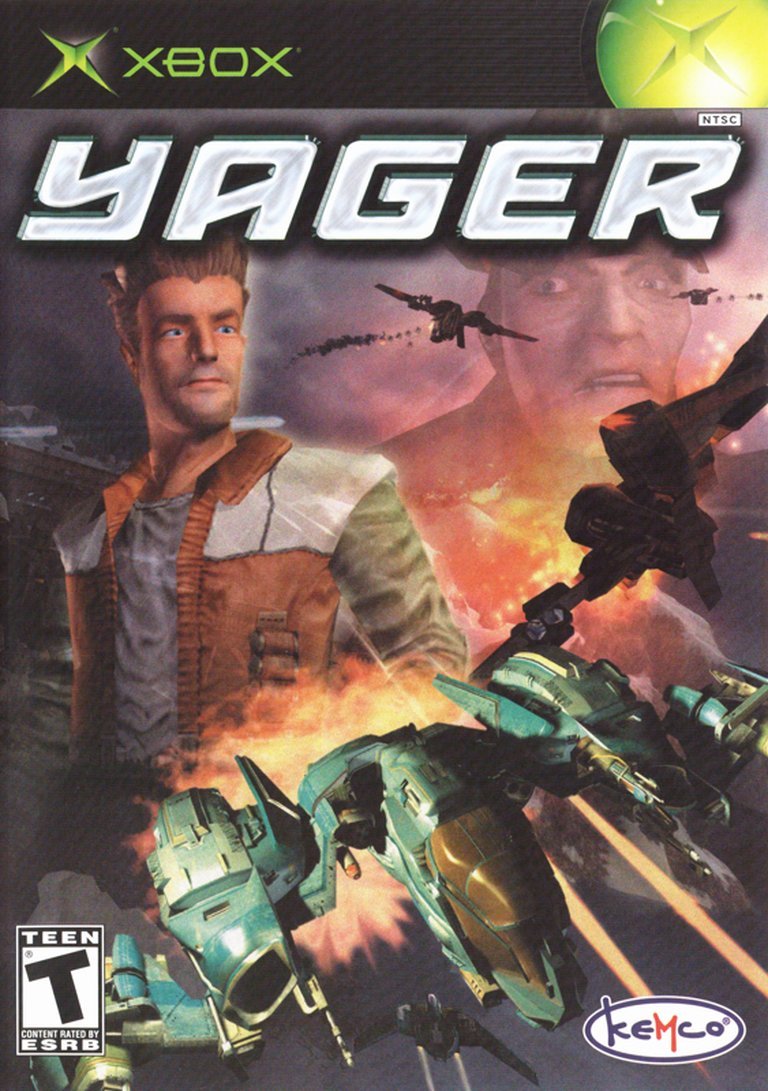
Description
Yager is a futuristic aerial combat game set in a sci-fi world teetering on the edge of all-out war, where players assume the role of ace pilot Magnus Tide. After a series of personal misfortunes including a plane crash, job loss, and breakup, Magnus secures a new ship and freelance gig with his former employer, Proteus, thrusting him into 22 intense missions involving dogfights, ground assaults, and terrain-responsive flight, with opportunities to upgrade his machinery as the conflict escalates.
Gameplay Videos
Patches & Mods
Guides & Walkthroughs
Reviews & Reception
metacritic.com (70/100): Graphically it is the best Xbox game to appear this year.
ign.com (79/100): Colorful, spunky and well-designed, Yager, despite its age, is easily worth the price of admission.
gamespot.com : Yager provides a fair amount of entertaining, highly kinetic, action adventure gameplay at a very affordable price.
Yager: Review
Introduction
In the annals of early 2000s gaming, few titles evoke the thrill of futuristic dogfights quite like Yager, a 2003 Xbox exclusive (later ported to PC) that dared to blend cinematic space opera with grounded aerial combat. Imagine strapping into the cockpit of a sleek hover-jet, weaving through tropical fjords and industrial ruins as corporate overlords clash in a borderless world—it’s a high-stakes ballet of lasers and afterburners that feels both intimate and epic. Developed by the upstart Berlin studio Yager Development, Yager arrived amid the Xbox’s launch-era push for innovative action games, but its delayed North American release and muted marketing left it as a cult curiosity rather than a blockbuster. As a game historian, I see Yager as a bold, if flawed, artifact of its time: a testament to European ingenuity in flight sims, echoing classics like Wing Commander while grappling with the era’s hardware limits. My thesis? While Yager shines in its atmospheric storytelling and responsive flight model, its uneven difficulty and dated presentation relegate it to a niche gem—one that deserves rediscovery for its ambitious vision of corporate dystopia and adrenaline-fueled skirmishes.
Development History & Context
Yager Development GmbH burst onto the scene in 1999, founded by five East Berlin gaming enthusiasts—Uwe Beneke, Roman Golka, Philipp Schellbach, Timo Ullmann, and Mathias Wiese—who had honed their skills at the short-lived Terra Tools studio amid the post-reunification German game industry’s nascent boom. Drawing from DDR-era tinkering roots, these founders envisioned Yager as their debut, a sci-fi aerial combat sim inspired by the narrative depth of Wing Commander and the visual spectacle of emerging console tech. Beneke and Wiese led game design and graphics, while Schellbach, Golka, and Ullmann anchored core programming, crafting a custom engine for Xbox’s then-revolutionary hardware.
The early 2000s gaming landscape was a powder keg of innovation and competition. Microsoft’s Xbox launched in 2001, challenging PlayStation 2’s dominance with superior specs and online ambitions, but flight games lagged behind ground-based shooters like Halo. THQ published the European Xbox version in May 2003, positioning Yager as a “Halo-killer” in aerial form, but publisher woes struck: THQ dropped North American rights, leading to a 17-month delay until Kemco’s September 2004 release. The PC port followed in October 2003 (EU) and February 2005 (NA, retitled Aerial Strike: Low Altitude – High Stakes: The Yager Missions via DreamCatcher Interactive), optimized for joysticks but hampered by the era’s fragmented PC market.
Technological constraints shaped Yager‘s DNA. The Xbox’s 733 MHz CPU and 64 MB RAM allowed for lush, responsive environments but strained against ambitious particle effects and AI swarms—resulting in occasional frame dips during misty fjord battles. Developers prioritized dual-mode flight (hover for precision, jet for speed) over full sim realism, a concession to accessibility on consoles where flight sticks were rare. The studio’s vision was unapologetically cinematic: live-action cutscenes blended with in-engine sequences, echoing Hollywood blockbusters like Top Gun meets Blade Runner. A German special edition (PC-only) bundled a lore book, Die Sagittarius-Verschwörung, and soundtrack CD, hinting at untapped transmedia ambitions. Yet, with no multiplayer at launch (a later PC patch added it) and budgets dwarfed by AAA peers, Yager emerged as a scrappy underdog in a year dominated by Call of Duty and Star Wars: Knights of the Old Republic.
Key Development Milestones
- 1999-2002: Pre-Production – Founders bootstrap from Berlin’s Kreuzberg scene; early demos wow E3 2002 with omnidirectional combat.
- 2003: EU Launch – Xbox version hailed for visuals; PC port boosts sales in Europe.
- Post-Launch Tweaks – Difficulty sliders and multiplayer patches address feedback, but NA delay erodes momentum.
- Studio Evolution – Yager‘s mixed success fueled Yager Development’s pivot to shooters like Spec Ops: The Line (2012), cementing their Berlin legacy.
Narrative & Thematic Deep Dive
At its core, Yager unfolds as a pulpy corporate thriller, thrusting players into the boots of Magnus Tide—a cocky, bed-headed ex-Marine turned freelance pilot whose life unravels after a botched Proteus mission crashes his ship, tanks his career, and ends his romance with commandant Sarah. Voiced with a gravelly charm (though one-liners occasionally grate), Tide embodies the anti-hero archetype: irreverent, resourceful, and haunted by failure. The plot kicks off with Tide salvaging a gig from his old employer, Proteus—a NATO-like conglomerate guarding tropical islands—only to plunge into a web of espionage amid escalating corporate wars. Rival factions like the authoritarian DST (echoing Imperial Germany with fjord bases and harsh officers) and chaotic Lobos Robotics vie for control in a borderless Earth ruled by megacorps, where nations are relics and loyalty is bought with credits.
The 22-mission arc is a rollercoaster of twists, blending high-octane action with soap-opera drama. Early levels introduce Tide’s ragtag allies: the whiny Russian comrade Ivan (whose Cockney-pirate foes mock with sneering accents), the scheming Gunther von Berg of DST, and Sarah’s icy resolve amid betrayals. Dialogue crackles with banter—”That goes ab, Mann!” Tide quips in Dieter Bohlen-inspired flair—but falters in contrived cutscenes, like turret sequences shoehorned via plot contrivances (e.g., defending a bar with furniture targets). Themes probe corporate greed’s dehumanizing toll: war as profit, pilots as disposable assets, and Tide’s redemption arc questioning heroism in a commodified world. Plot twists—such as infiltrating DST bombers or reclaiming sabotaged hangars—culminate in a Sagittarius conspiracy reveal, tying personal stakes (rekindling with Sarah) to global cataclysm.
Yet, the narrative’s ambition outpaces execution. Missions jerk between lush Proteus paradises, turbine-dotted Free Trade Zones, cave-riddled fjords, and Bitterfeld’s derelict ruins—evoking a post-industrial dystopia littered with crashed hulks and abandoned Progress Company debris. Subtle nods to real-world geopolitics (fjords suggesting Scandinavia, Bitterfeld’s East German decay) add depth, but pacing suffers from repetitive fetch quests and unclear objectives, diluting thematic weight. Still, Yager‘s story elevates it beyond rote shooting: it’s a cautionary tale of ambition’s cost, with Tide’s growth from hotshot to reluctant savior mirroring the studio’s own underdog journey.
Character Breakdown
- Magnus Tide: Charismatic lead; his wit shines in monologues but stumbles in rapid-fire zingers.
- Sarah: Emotional anchor; her arc explores love amid war, though underutilized.
- Antagonists (DST/Lobos): Caricatured menace; von Berg’s Teutonic bluster adds flavor but veers into cliché.
Gameplay Mechanics & Systems
Yager‘s core loop is a masterful fusion of arcade accessibility and sim nuance: pilot the Sagittarius through vast, terrain-responsive levels, toggling between hover mode (helicopter-like stability for stealth/strafing) and jet mode (high-speed dogfights with barrel rolls and flips). Combat demands seamless mode-switching—jet in hot, hover to lock targets, evade via canyons—creating exhilarating highs, like threading rivers to ambush foes. The 22 missions span 15-20 hours, blending air-to-air duels, ground assaults, and rare boss fights against behemoth carriers.
Weapons form a balanced arsenal: primary lasers deplete quickly (encouraging ammo pickups), missiles for swarms, and the railgun sniper for precision takedowns—vital for dismantling turrets or battleships sequentially. Auto-aim aids novices, locking onto nearby threats with radar pips, but falters in chaos, demanding manual cursor flicks. Progression is mission-linear with auxiliary tasks (e.g., rescuing locals for bonuses), unlocking a ship database and score multipliers. UI is cockpit-immersive: HUD overlays track health, ammo, and objectives, though the overhead map can overwhelm in fog-shrouded zones.
Innovations shine in environmental interplay—dive into gullies for cover, exploit height ceilings (a noted Bitterfeld flaw)—and repair platforms that refill health mid-brawl, promoting tactical camping. Flaws abound: no quick-save in long missions leads to frustration, especially on higher difficulties where AI ramps unfairly (e.g., endless drone waves). Controls, while responsive on Xbox pad, feel clunky on PC without a stick; turret segments break pacing with jittery aiming. No launch multiplayer (PC patch added deathmatches) limits replayability, and progression feels gated by skill spikes. Overall, Yager innovates in hybrid flight but stumbles on polish, rewarding patient pilots with addictive loops.
Core Systems Analysis
- Flight Modes: Hover for versatility; jet for thrill—core to 80% of gameplay.
- Combat Loop: Scout > Engage > Evade > Repair—tense but repetitive post-midgame.
- UI/Progression: Clean HUD; extras add depth, but no checkpoints punish restarts.
World-Building, Art & Sound
Yager‘s Earth is a fractured mosaic of corporate fiefdoms, where old borders bleed into sci-fi decay. Proteus Islands gleam with tropical splendor—palm-fringed HQ amid azure seas—contrasting DST’s stark fjords (caves and deltas evoking Nordic isolation) and Bitterfeld’s post-apocalyptic sprawl (rusted factories, shipwrecks from the defunct Progress Company). The Free Trade Zone bridges them: wind turbines whirl over anarchic palms, a neutral haven teeming with pirates. This world-building fosters immersion; terrain isn’t backdrop but strategy—rivers for low-altitude runs, ruins for ambushes—heightening tension as lasers scar the horizon.
Art direction nails a neon-drenched futurism: sleek Sagittarius contrasts blocky foes, with dynamic lighting casting long shadows over mist-veiled valleys. Xbox visuals pop—jaw-dropping particle explosions and water reflections—but show age: grainy textures, intangible trees (fly-through holograms), and no persistent damage (e.g., scorch-free hulls). PC ports amp resolution but stutter on mid-tier rigs (5.5 GB install). Atmosphere builds via scale: levels span minutes of flight, evoking isolation in vast skies.
Sound design elevates the chaos: Dolby Digital roars amplify afterburners and laser zaps, while sparse orchestral swells cue drama (e.g., swelling strings in boss approaches). Voice work mixes charm and cheese—Tide’s baritone anchors cutscenes, pirates’ sneers amuse, but accents (whiny Russians, clipped Germans) border caricature. The score’s 20-track CD (German special edition) pulses with synth-rock tension, syncing to plot beats. Collectively, these elements craft a lived-in dystopia: visuals immerse, sounds propel, turning corporate skirmishes into visceral opera.
Reception & Legacy
Upon EU launch, Yager earned solid praise—73% MobyGames average, 86/100 from 4Players.de for “phänomenal” graphics and Wing Commander-esque cinematics—but mixed in NA: Metacritic’s 70 (Xbox) and 62 (PC) reflect dated visuals and steep curves. Critics lauded flight physics (“great sim feel,” Tara Taylor’s player review) and story (“immersive twists,” IGN’s 7.9), but slammed controls (“frustrating,” GameSpot’s 6.7), no saves (“fies,” PC Games), and repetition (“underwhelming,” GameWatcher). Sales flopped commercially—delayed NA drop (amid Halo 2 hype) and zero ads sealed its fate as a budget bin title ($20 by 2005).
Reputation evolved from overlooked to cult: early Xbox rankings (#242) and player gems (“stands at the top,” Moby) endure, influencing extraction shooters via Yager Development’s later hits (Spec Ops: The Line‘s narrative depth, Dreadnought‘s multiplayer flights). No direct sequels, but echoes in Strike Vector or Battle Engine Aquila nod to its hybrid mode. Industry-wise, it highlighted EU studios’ strengths (Berlin’s Yager grew to 130 staff, Tencent-backed by 2021) and pitfalls (publisher flux). Today, amid retro revivals, Yager symbolizes 2000s ambition: a flawed pioneer bridging sims and action.
Critical Spectrum
- Highs: Xbox Front (90%) – “Legende” like Wing Commander.
- Lows: Game Revolution (58%) – “Unremarkable.”
- Player Avg: 3.9/5 – Praised immersion, griped difficulty.
Conclusion
Yager is a cockpit confessional of untapped potential: its responsive flights, conspiratorial narrative, and evocative world capture the Xbox era’s bold spirit, delivering 15-20 hours of kinetic joy for aerial enthusiasts. Yet, punishing difficulty, inconsistent levels, and aging tech temper its shine, underscoring why it faded into obscurity. As a historian, I verdict it a pivotal B-tier classic—essential for fans of Crimson Skies or corporate sci-fi, warranting backward-compatible ports to reclaim its legacy. In video game history, Yager endures as Yager Development’s fiery debut: a near-miss that ignited greater triumphs, proving even grounded jets can soar. Score: 7.5/10.