
- Release Year: 2003
- Platforms: Windows
- Publisher: rondomedia Marketing & Vertriebs GmbH
- Developer: cerasus.media GmbH
- Genre: Puzzle
- Perspective: Fixed / flip-screen
- Game Mode: Hotseat
- Gameplay: Game show, quiz, trivia
Description
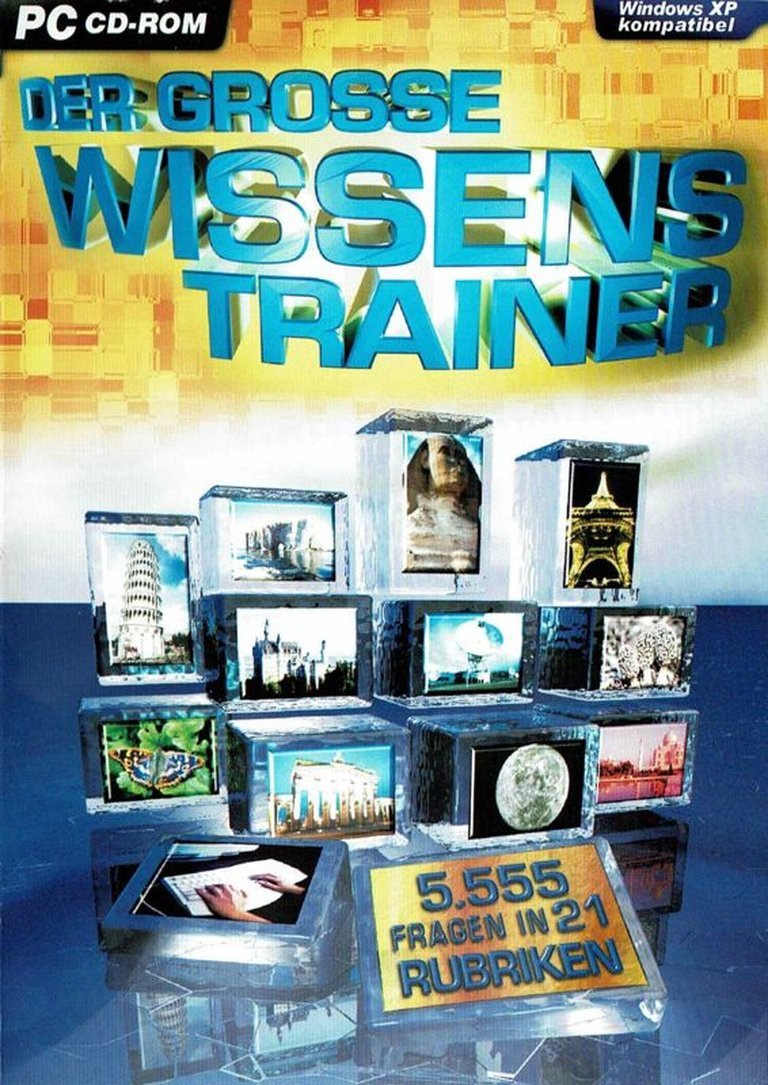
Der Grosse Wissens Trainer is a engaging quiz game designed for up to four players, set in a virtual game show environment where participants test their knowledge across a wide array of topics. Released in 2003 for Windows, it features over 5,500 questions spanning 20 diverse categories including sports, history, politics, and music, with an integrated editor allowing players to create and add their own custom questions for endless replayability.
Der Grosse Wissens Trainer: Review
Introduction
In the early 2000s, as video games began to transcend pure entertainment and flirt with education, titles like Der Grosse Wissens Trainer emerged as unassuming bridges between play and pedagogy. Released in 2003 for Windows, this German-language trivia quiz game promised to sharpen minds with over 5,500 questions spanning 20 diverse categories, all while fostering multiplayer competition among up to four players. Developed by cerasus.media GmbH and published by rondomedia Marketing & Vertriebs GmbH, it arrived in an era when PC gaming was democratizing knowledge through interactive formats, echoing the game show vibes of television staples like Who Wants to Be a Millionaire?. Though largely forgotten today amid the flashier blockbusters of the time, Der Grosse Wissens Trainer stands as a testament to the humble quiz genre’s role in making learning accessible and fun. My thesis: This game, while mechanically straightforward and visually modest, excels as a social edutainment tool, embodying the early 2000s push toward inclusive, family-oriented digital experiences that prioritized knowledge over spectacle—earning it a solid place in the annals of niche European PC gaming history.
Development History & Context
The development of Der Grosse Wissens Trainer reflects the modest ambitions of Germany’s burgeoning edutainment scene in the early 2000s, a period when European studios were carving out niches in budget-friendly, localized content amid the dominance of American and Japanese powerhouses. cerasus.media GmbH, the developer, was a small German outfit founded in the late 1990s, specializing in multimedia and educational software. Known for producing straightforward titles like puzzle compilations and interactive encyclopedias, cerasus.media’s vision for Der Grosse Wissens Trainer appears to have been rooted in democratizing general knowledge for home users. The game’s editor feature—allowing players to input custom questions—suggests an emphasis on user-generated longevity, a forward-thinking nod to community-driven content that predated modern modding cultures. Publisher rondomedia, a marketing and distribution firm focused on German markets, handled the commercial rollout, targeting families and casual gamers with a single CD-ROM release priced affordably for the era.
Technological constraints shaped the game’s unpretentious design. Requiring only a Pentium II processor, 64 MB of RAM, Windows 98 or later, DirectX 8.1, and 16 MB of video memory, Der Grosse Wissens Trainer was optimized for the average mid-2000s PC—think bulky CRT monitors and dial-up internet. This era’s hardware limitations meant no need for 3D graphics or online connectivity; instead, the game leaned on fixed/flip-screen visuals, a staple of 2D puzzle and quiz formats that conserved resources while maintaining accessibility. The broader gaming landscape in 2003 was explosive: Grand Theft Auto: Vice City and Star Wars: Knights of the Old Republic dominated headlines, alongside the rise of online multiplayer with titles like Battlefield 1942. Yet, the trivia genre thrived in Europe’s PC space, influenced by TV quiz shows and the edutainment wave sparked by CD-ROM encyclopedias like Microsoft’s Encarta. In Germany, where educational software was subsidized and culturally valued, Der Grosse Wissens Trainer fit neatly into a market saturated with localized “Wissens” (knowledge) titles, such as the related Das Grosse Racing-Paket from the same year, emphasizing replayability over high-production polish.
Narrative & Thematic Deep Dive
As a trivia quiz game, Der Grosse Wissens Trainer eschews traditional narrative arcs for a modular, question-driven structure that serves as its storytelling backbone. There’s no overarching plot or protagonist; instead, the “narrative” unfolds through 5,500+ questions drawn from 20 categories, including sports, history, politics, music, geography, science, and pop culture. This creates a patchwork tapestry of human knowledge, where each query acts as a vignette—brief, factual snapshots that collectively paint a portrait of global trivia up to the early 2000s. For instance, a history question might probe the fall of the Berlin Wall, tying into Germany’s post-reunification cultural zeitgeist, while a music query could reference Eurovision winners, evoking shared European nostalgia.
Thematically, the game champions intellectual empowerment and social bonding, positioning knowledge as a democratizing force. By supporting up to four players in turn-based rounds, it fosters dialogue and debate, with “characters” limited to abstract avatars or simple player profiles rather than fleshed-out personas. Dialogue is sparse and functional—primarily multiple-choice prompts and answer reveals—delivered in crisp German text, reinforcing the game’s educational intent without Hollywood flair. Underlying themes revolve around lifelong learning and cultural literacy: questions often draw from real-world events, encouraging players to connect trivia to personal or societal contexts. The editor tool deepens this, inviting users to weave their own narratives by adding questions about family history or current events, transforming the game into a personalized knowledge archive. Flaws emerge in potential datedness; post-2003 references (e.g., pre-iPhone tech or early EU politics) may feel archaic today, underscoring a theme of trivia’s ephemerality. Yet, this very specificity grounds the experience in its era, making it a time capsule of millennial curiosities rather than a timeless epic.
Gameplay Mechanics & Systems
At its core, Der Grosse Wissens Trainer revolves around a classic quiz loop: select a category, answer multiple-choice questions under time pressure (implied by game show pacing), and accumulate points for high scores or multiplayer victories. Supporting up to four players, the mechanics emphasize turn-based competition, where rounds cycle through categories to prevent fatigue and promote balanced play. Each question typically offers four options, with correct answers yielding points scaled by difficulty—basic queries for novices, tougher ones for experts—creating a progression system tied to score multipliers rather than levels. The multiplayer mode shines here, allowing hot-seat play where players buzz in (virtually) to steal points, adding tension akin to board games like Trivial Pursuit.
Character progression is minimal, focusing instead on cumulative scores and unlockable question packs, encouraging replayability. The standout innovation is the integrated editor, a robust tool for crafting custom questions with text fields for stems, answers, and explanations. This user-generated system extends longevity, letting families tailor content—e.g., school trivia for kids or niche hobbies for adults—foreshadowing modern platforms like Kahoot. UI-wise, the fixed/flip-screen interface is clean but dated: expect simple menus, category icons, and a game-show timer, all rendered in 2D with minimal animations. Controls are keyboard or mouse-driven, intuitive for the era but lacking modern polish like touch support. Flaws include potential repetition in the question bank (5,500 sounds vast, but overlaps in categories could arise) and no online multiplayer, limiting it to local sessions. Overall, the systems are solid for casual play, blending accessibility with depth through customization, though they pale against more dynamic contemporaries like You Don’t Know Jack.
World-Building, Art & Sound
Der Grosse Wissens Trainer forgoes expansive worlds for a contained “game show studio” aesthetic, where the setting is a metaphorical arena of intellect rather than a literal environment. The fixed/flip-screen visuals manifest as static screens: a central question panel flanked by category wheels or player scoreboards, evoking a TV quiz set with colorful but basic graphics—think bold fonts, spinning wheels, and generic icons (a soccer ball for sports, a globe for geography). Art direction is utilitarian, prioritizing readability over immersion; 2003-era 2D sprites and low-res textures (suited to 16 MB video cards) create a no-frills atmosphere that’s approachable for all ages but visually uninspiring by today’s standards. No sprawling lore or explorable maps exist, yet the “world” feels alive through question variety, building a mental mosaic of global facts that subtly immerses players in diverse cultures—from ancient Rome to 1990s pop icons.
Sound design complements this modesty, likely featuring upbeat game-show jingles for correct answers, buzzers for wrongs, and a neutral narrator voice (in German) for transitions. Ambient music—cheerful MIDI-like tracks—loops to maintain energy without overpowering, while sound effects (dings, whooshes) punctuate the rhythm, enhancing the competitive vibe. These elements contribute to a lighthearted, familial experience, turning trivia into a communal event rather than solitary grind. Limitations, such as compressed audio on CD-ROM, might result in tinny output on older hardware, but overall, the sensory package reinforces themes of accessible education, creating an atmosphere of cozy intellectual sparring rather than high-stakes drama.
Reception & Legacy
Upon its 2003 launch in Germany and broader Europe, Der Grosse Wissens Trainer flew under the radar, with no documented critic scores on platforms like Metacritic (TBD) or user reviews on GameFAQs and MobyGames. This obscurity stems from its budget positioning—rondomedia’s focus on direct sales via retail CD-ROMs meant limited marketing, overshadowed by AAA titles like The Sims 2 (released later that year). Commercially, it likely performed adequately in the niche edutainment market, appealing to families seeking affordable multiplayer fun amid rising broadband adoption. Player anecdotes (scarce as they are) suggest it was a hit for German households, praised for its question depth and editor, but critiqued for lacking depth in visuals or modes.
Over time, its reputation has evolved into cult obscurity, preserved through archival sites like MobyGames (added in 2017) as a relic of early-2000s PC trivia. Legacy-wise, it influenced subsequent German titles, such as cerasus.media’s later works and related compilations like Denk Mal: Der neue grosse Logik Trainer (2009), perpetuating the “Grosse” (great) branding for knowledge-based games. In the industry, it exemplifies the quiz genre’s endurance, paving the way for mobile trivia apps and social platforms. While not revolutionary, its multiplayer and editing features anticipated user-driven content in games like Buzz! series (mid-2000s), underscoring edutainment’s role in broadening gaming’s appeal beyond violence or fantasy. Today, amid trivia revivals like Civilization-style knowledge sims, it reminds us of gaming’s educational roots.
Conclusion
Der Grosse Wissens Trainer is a quintessential artifact of 2003 PC gaming: simple, sincere, and singularly focused on turning trivia into triumph. From its developer-driven emphasis on customization to its game-show mechanics that spark real-world conversations, the title captures the era’s blend of technology and teaching without pretense. While lacking the polish or reception of genre peers, its exhaustive question bank and inclusive design secure its niche as a family staple in European gaming history. Verdict: 7.5/10—A worthy, if understated, entry that proves knowledge truly is the ultimate game, deserving rediscovery for its unflashy charm and enduring replayability. In video game history, it claims a quiet corner as the unheralded trainer of minds.