
- Release Year: 1998
- Platforms: Windows
- Publisher: Ubisoft
- Developer: Ubisoft
- Genre: Driving, Racing
- Perspective: Behind view
- Game Mode: LAN, Online PVP, Single-player
- Gameplay: Arcade, Vehicle simulation
- Setting: Mexico, United States
- Average Score: 79/100
Description
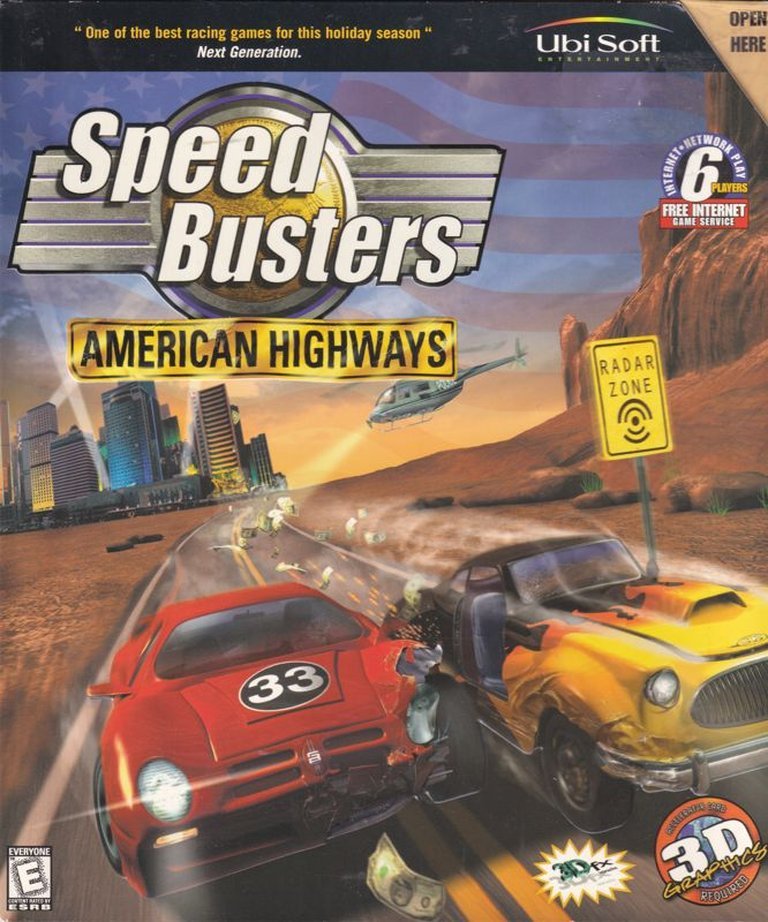
Speed Busters: American Highways is an arcade racing game set on seven diverse American tracks filled with surprises and obstacles, where a former policeman who won the lottery organizes high-stakes races to give away his winnings. Players choose from nine upgradable vehicles that show visible damage affecting handling, utilize nitro boosts for speed advantages, and must evade pursuing cops while bumping rivals to secure the top spot and earn prizes in single-player modes or multiplayer setups.
Gameplay Videos
Where to Buy Speed Busters: American Highways
PC
Crack, Patches & Mods
Guides & Walkthroughs
Reviews & Reception
mobygames.com (80/100): Fun, action packed, arcade style racing game.
gamespot.com : The track design is inventive, the illusion of speed is great, and overall the control is good.
ign.com : Screw the realism! UbiSoft’s latest racer is all about hard-core fun.
Speed Busters: American Highways: A Retro Arcade Thrill Ride Through Whimsical Chaos
Introduction
In the late 1990s, when racing games were locked in a high-stakes showdown between hyper-realistic simulators like Gran Turismo and arcade speed demons like Need for Speed, Speed Busters: American Highways burst onto the scene like a nitro-boosted muscle car careening through a dinosaur-infested highway. Released in 1998 by Ubisoft’s Montreal studio, this arcade racer dared to blend the raw adrenaline of classic Hollywood car-chase flicks—think Smokey and the Bandit meets Cannonball Run—with absurd, over-the-top hazards that turned every lap into a psychedelic gauntlet. As a game historian, I’ve revisited countless titles from this era, and Speed Busters stands out not just for its unapologetic fun but for its bold rejection of realism in favor of chaotic spectacle. My thesis: While it may stumble on technical rough edges, Speed Busters remains a vibrant testament to the arcade racing genre’s golden age, proving that whimsy and speed can outpace simulation every time.
Development History & Context
Speed Busters: American Highways emerged from Ubisoft Montreal, a studio then in its adolescence but already punching above its weight in the Canadian game development scene. Founded in 1992 as Ubi Soft’s North American outpost, the Montreal team was helmed by visionary producer Pierre Szalowski, whose original concept fused high-speed racing with lottery-fueled absurdity—a former cop doling out cash to the fastest drivers as a twisted form of vigilante justice. Lead game designer Marc Benoit, alongside a cadre of young talents like Denis Pham, Éric Bondo, Félix Tremblay, François Bolduc, and François Venne, crafted the core mechanics, emphasizing upgradeable vehicles and dynamic tracks. The art direction fell to Louis Turcot as lead artist, with Vincent Pontbriand-Trudel managing modeling and Rémi Turcotte handling 3D leads. A whopping 146 credits poured into this project, including 2D/3D artists like Aline Desruisseaux and Adrian Chang, reflecting a collaborative effort that bridged the gap between Ubisoft’s simulation roots (e.g., F1 Racing Simulation) and arcade experimentation (like the earlier POD).
Technologically, Speed Busters was a product of 1998’s hardware constraints and innovations. Built for Windows 95/98, it leveraged Direct3D 5 for rendering, optimized for 3dfx Voodoo cards and AGP boards, demanding at least a Pentium MMX 166 MHz with 32 MB RAM—modest by today’s standards but pushing the envelope for fluid 3D racing on consumer PCs. Visible car damage and environmental interactions required clever polygon budgeting, resulting in tracks that felt alive without tanking frame rates. Force feedback support for wheels like the Microsoft SideWinder added arcade authenticity, simulating the rumble of gravel or crashes.
The gaming landscape of 1998 was a racetrack of its own: Electronic Arts’ Need for Speed III: Hot Pursuit dominated with polished police chases and photorealistic cities, while Accolade’s Test Drive 5 and Atari’s N.I.C.E. 2 offered upgrade-heavy economy systems. Ubisoft’s vision was to carve a niche with humorous, hazard-filled tracks inspired by American road movies, countering the era’s sim-heavy trend. Released on November 23, 1998, in North America (and simply as Speed Busters in Europe), it shipped on CD-ROM with optional downloads for extra cars from Ubisoft’s site—a forward-thinking nod to post-launch support that foreshadowed modern DLC. Ports followed: Speed Devils for Dreamcast in 1999, adding a career mode with rival challenges, and a mobile version in 2003. An online racing variant for Dreamcast in 2000 briefly revived multiplayer, but server shutdowns sealed its offline fate. In an industry pivoting toward realism, Speed Busters‘ playful anarchy was a refreshing detour, influencing Ubisoft’s later arcade efforts like the Asphalt series.
Narrative & Thematic Deep Dive
At its core, Speed Busters boasts a narrative as lean and mean as a ’50s hot rod: a retired policeman, flush with lottery winnings, flips the script on law enforcement by hosting illegal street races across America, rewarding speed demons with his fortune. There’s no sprawling storyline or voice-acted cutscenes—just a cheeky premise delivered through in-game text and FMVs that set the tone: cops aren’t chasing you; they’re cheering you on, with radar guns as checkpoints that multiply your earnings based on velocity. This inversion of authority flips the traditional “evade the law” trope from games like Need for Speed, turning pursuit into payout and embodying themes of rebellion against bureaucracy.
Characters are archetypal at best, serving more as flavorful set dressing than deep personalities. You play as an anonymous driver, customizing your ride to reflect your style, while AI opponents are colorful rivals with taunting names and behaviors—aggressive blockers or sly shortcut-takers—that hint at vendettas without dialogue. The Dreamcast port (Speed Devils) expands this with a league-ranking career mode, where “colorful rivals” issue bets and challenges, like “beat me while avoiding boulders” or “outpace me in reverse.” These side quests add thematic layers, exploring risk and reward: gambling prize money on feats underscores the game’s lottery motif, while visible damage mechanics punish recklessness, mirroring real-world consequences in a cartoonish wrapper.
Underneath the absurdity lies a thematic homage to American car culture and road mythology. Tracks evoke cinematic Americana—bayous, deserts, cityscapes—infused with surrealism: dinosaurs rampaging through Louisiana, UFOs abducting cars in Nevada, or a giant ape smashing Hollywood sets. This blend of nostalgia and nonsense critiques the monotony of highway life, positing racing as escapist fantasy. Dialogue is sparse, limited to announcer quips like “Nitro engaged!” or post-race tallies, but it amplifies the humor: a cop’s radar beeps not in warning, but in applause. Ultimately, the narrative’s shallowness is its strength—it’s a high-octane vignette celebrating speed as liberation, unburdened by plot bloat that plagued contemporaries.
Plot Breakdown
- Setup: The ex-cop’s lottery win sparks the “Speed Busters” league, with races funding his giveaway.
- Progression: Advance through championships, unlocking tracks and upgrades; hidden paths and secrets tie into exploratory themes.
- Climax: Multiplayer duels or vendetta modes resolve rivalries, with money as the ultimate score.
Character Analysis
No protagonists beyond the player, but rivals embody archetypes: the brute who rams you, the strategist who shortcuts. The cop host is a satirical anti-hero, his “generosity” masking chaotic anarchy.
Gameplay Mechanics & Systems
Speed Busters distills arcade racing to its purest form: pedal-to-the-metal chaos with strategic depth lurking beneath the surface. Core loops revolve around three modes—Arcade (checkpoint races for practice), Championship (progressive tournaments unlocking content), and Multiplayer (up to 6 players via LAN, modem, or internet)—each pitting you against 5 AI foes in head-to-head sprints. Races emphasize positioning over simulation: bump rivals to disrupt them, deploy nitro for bursts (limited by tank upgrades), and hit radar traps at max speed for cash multipliers. Visible damage is a standout system—crashes dent fenders, impair handling, and slow acceleration, forcing mid-race caution or post-race repairs funded by winnings.
Vehicle progression is the game’s economic heartbeat. Start with 9 base cars (retro ’50s-’90s models like muscle cars and customs), expandable via downloads (e.g., Cortex, Montana, Thunder). Earnings buy upgrades in categories like engine (turbo for top speed), tires (grip on snow/rain), nitro tank (longer boosts), and aesthetics (spoilers for drag reduction, custom skins via paint jobs). Utility items add flair: radar detectors warn of traps, road maps highlight shortcuts, insurance waives repair costs. This creates a satisfying loop—race, earn, upgrade, repeat—echoing N.I.C.E. 2 but with visual feedback (e.g., a supercharged engine visibly bulges the hood).
Controls blend arcade accessibility with light realism: direct input via keyboard, mouse, wheel, or joystick, with handbrake for drifts and nitro for jumps. Behind-view or cockpit perspectives enhance immersion, but flaws emerge—hypersensitive steering leads to spins, and no reverse means obstacles (trees, walls) can trap you for seconds. Tracks shine here: 7 locales (Louisiana bayou, New York streets, Mexico temples, Nevada desert, Colorado mountains, Hollywood backlots, plus a hidden one) span mixed terrain with variants (day/night, rain/snow, forward/reverse, mirror). Hazards innovate: rolling boulders in Mexico demand timing, dinosaur herds in Louisiana require evasion, UFO beams in Nevada pull you off-course. Shortcuts abound—temple ruins, alley jumps—rewarding memorization, but long laps (some overly extended) can frustrate.
UI is clean but dated: a launcher tweaks resolution and controls, in-race HUD shows speed, nitro, damage, and mini-map. Multiplayer adds replayability with null-modem or internet lobbies, though matchmaking was basic. Flaws like buggy menus and controller quirks (worse on pads) mar the experience, yet innovations like weather variables and force feedback elevate it. Overall, mechanics foster addictive “one more race” sessions, balancing whimsy with skill.
Core Loop Deconstruction
- Preparation: Select/upgrade car, bet on challenges.
- Race: Navigate hazards, hit radars, outmaneuver foes.
- Resolution: Tally earnings, repair/upgrade for next lap.
Innovative/Flawed Systems
- Innovative: Hazard integration (e.g., apes hurling cars) and economy-driven progression.
- Flawed: Recovery from crashes (no reverse) and uneven difficulty spikes.
World-Building, Art & Sound
The world of Speed Busters is a fever-dream tapestry of North American icons twisted into arcade absurdity, transforming mundane highways into surreal playgrounds. Settings draw from real locales—swamps of Louisiana Tornado, snowy Aspen Winter, industrial Montreal—but amplify them with thematic flair: Nevada’s Area 51 hides alien abductions, Hollywood’s disaster track unleashes King Kong-like apes amid studio lots. Tracks feel expansive despite tech limits, with dynamic elements like weather (rain slicks roads, snow reduces grip) and time-of-day shifts altering visibility and mood. This builds an atmosphere of unpredictable adventure, where every curve hides a gimmick—temple traps in Mexico or urban chaos in New York City Winter—contributing to replayability and immersion.
Visually, the game punches above 1998’s weight. 3D models for cars boast detailed chrome and customizable skins (six presets or user-designed), with damage deforming panels realistically. Tracks pop with vibrant colors: lush bayous, neon-lit cities, dusty deserts. Animations are fluid—cars “swim” on turns, debris flies from impacts—optimized for Voodoo cards to deliver 30+ FPS. Draw distance holds up, though pop-in occurs on long straights. The behind-view camera captures speed thrillingly, while cockpit adds intimacy. Art direction evokes retro Americana, blending ’50s nostalgia with ’90s flair, fostering a whimsical tone that elevates the chaos.
Sound design, however, lags. Engine roars and tire screeches provide punchy feedback, with force feedback enhancing crashes’ thud. Ambient effects shine—dinosaur roars, boulder rumbles, cop sirens as cheers—but music is a weak link: looping bluesy tracks (trumpet-heavy for Mexico) feel generic and repetitive, failing to match the visuals’ energy. SFX are mediocre, lacking the polish of rivals like Need for Speed. Still, audio reinforces the theme: nitro whooshes propel urgency, radar beeps reward speed. Collectively, these elements craft an experience that’s visually intoxicating and aurally serviceable, immersing players in a cartoonish road trip where spectacle trumps subtlety.
Reception & Legacy
Upon release, Speed Busters: American Highways revved up solid acclaim, earning an 80% critic average across 26 reviews on MobyGames and a 7.8/10 aggregate on GameRankings. Outlets like PC Gamer (85%) and Power Play (87%) hailed its “fast-paced arcade fun” and inventive tracks, awarding it “Best Action Racing Game of 1998.” IGN (7.8/10) praised its “quick and dirty” entertainment and hidden secrets, while GameSpot (7.5/10) lauded the speed illusion but docked points for frustrating obstacles. European press, like Power Unlimited (87%), called it an “LSD-trip on wheels,” appreciating the whimsy. Player scores averaged 3.5/5, with fans loving the obstacles and graphics’ longevity, though gripes about music, controls, and track length persisted—one 2014 review dubbed it a “cheap arcade thrill.”
Commercially, it sold modestly but spawned ports: Speed Devils on Dreamcast (78% aggregate, praised as “the best racer on the system” by NextGen) added career modes and split-screen for five players, while the 2000 online edition (76/100 on Metacritic) briefly innovated with netplay. The 2003 mobile port mixed reviews (65%), criticized for simplified controls. Legacy-wise, Speed Busters influenced arcade racers by injecting humor into the genre—its hazard-filled tracks echoed in Asphalt‘s stunts and Burnout‘s crashes, while the economy system prefigured Forza‘s customization. Re-released on GOG in 2011 (sans DRM), it endures as a cult classic for retro enthusiasts, its SafeDisc woes fixed via wrappers like dgVoodoo. In an industry now dominated by sims like Forza Horizon, it reminds us of racing’s joyful roots, influencing Ubisoft’s whimsical output.
Conclusion
Speed Busters: American Highways is a nitro-fueled relic of 1998’s arcade renaissance—a game that trades simulation’s precision for chaotic joy, wrapping seven hazard-packed tracks and deep customization in a lottery-lotto premise that’s equal parts absurd and addictive. Its development captured Ubisoft Montreal’s youthful ambition, gameplay loops balanced risk with reward, and worlds blended Americana with fantasy to create lasting thrills. Though controls and audio falter, and its narrative is whimsically thin, the highs outweigh the spins. In video game history, it claims a spirited niche: not the king of the road like Need for Speed, but a rogue hot rod that proved fun could outrun realism. Verdict: 8/10—a must-play for arcade purists, eternally revving in the hall of retro fame.