
- Release Year: 1998
- Platforms: Macintosh, Windows
- Publisher: A.W. Bruna Uitgevers B.V., LaserMedia
- Developer: Daddy Oak
- Genre: Educational
- Perspective: First-person
- Game Mode: Single-player
- Gameplay: Collectibles, Exploration, Mini-games, Photography
- Setting: Forest
- Average Score: 89/100
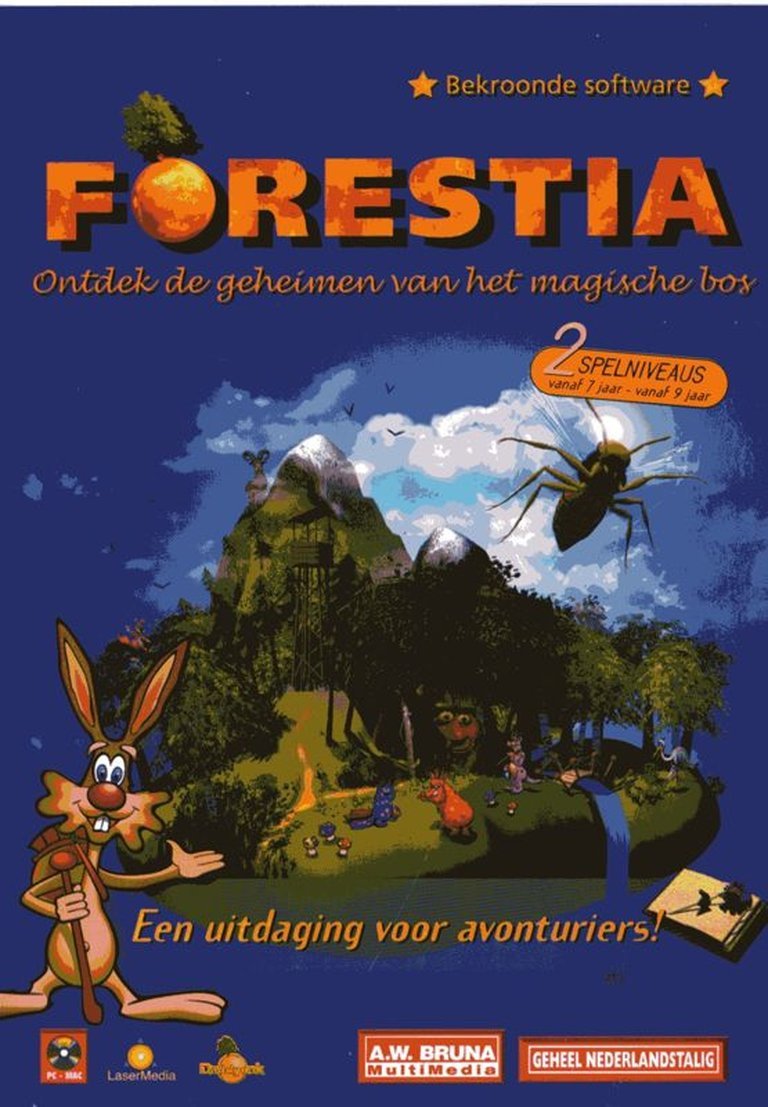
Description
Forestia is a 1998 educational point-and-click adventure game for children around nine years old, set in a enchanting floating forest island teeming with European flora and fauna. Players explore the vibrant wilderness guided by Sam the anthropomorphic rabbit, using a camera to photograph diverse animals like birds, mammals, reptiles, fish, and amphibians—each appearing in specific locations and times—while collecting plants, mushrooms, and flowers, and participating in nine whimsical chapters of missions such as crafting gifts for Daddyoak the talking tree, breaking a siren’s hypnotic spell, rearranging crystals to thwart an evil sorcerer, and helping forest inhabitants in creative mini-games that teach ecology and nature appreciation.
Gameplay Videos
Where to Buy Forestia
PC
Forestia Free Download
Guides & Walkthroughs
Reviews & Reception
reddit.com : an otherwise cheerful kids’ edutainment game with a truly nightmarish, out-of-the-blue horror chapter
en.wikipedia.org (78/100): finding all the animals and plants will keep interested youngsters hunting for some time
lostmediaarchive.fandom.com : an otherwise innocent children’s game suddenly turning terrifying
Forestia: Review
Introduction
Imagine stumbling into a whimsical floating forest where anthropomorphic rabbits guide you through ecology lessons, only to have the serene canopy shatter into a blood-red nightmare of dragons and doomsday sorcery—welcome to Forestia, the 1998 edutainment gem that has lingered in the shadows of gaming history like a half-remembered childhood dream. Developed by the small French studio Daddy Oak, this point-and-click adventure for children around nine years old masquerades as a straightforward nature explorer but reveals layers of inventive storytelling and tonal whiplash that have earned it a cult following decades later. As a game journalist with a penchant for unearthing forgotten titles, I’ve revisited Forestia through its abandonware availability and rare English playthroughs, and my thesis is clear: while it excels as an educational tool that immerses young players in European biodiversity, its bold narrative risks and atmospheric design mark it as a pioneering edutainment experience that punches above its weight, influencing the blend of whimsy and unease in modern children’s media.
Development History & Context
Forestia emerged from the unassuming confines of Daddy Oak, a boutique French developer founded in the mid-1990s by a tight-knit team including Hervé Antony, Stéphane Pruvost, Jacques Champigny, and Luc Éléouet. Champigny, who voiced and conceptualized the wise old tree Daddyoak, wore multiple hats—handling music, tools, and even “his big heart and the rest,” as the credits poetically note—reflecting the indie ethos of a project built on passion rather than big budgets. Published by LaserMedia (with regional releases by A.W. Bruna Uitgevers B.V. in the Netherlands), the game launched in 1998 for Windows and Macintosh, arriving amid a late-’90s surge in CD-ROM edutainment titles. This era saw publishers like The Learning Company and Humongous Entertainment dominate with kid-friendly adventures like Pajama Sam or Oregon Trail II, capitalizing on the multimedia boom where PCs became household staples for education.
The creators’ vision was rooted in environmental stewardship: teach children about European flora and fauna through playful exploration, emphasizing forest conservation via Sam’s rabbit-guide tutorials. Technological constraints shaped its form—pre-rendered 3D backgrounds (a nod to Myst‘s 1993 success) mixed with 2D animated sprites for characters, rendered on Pentium-era hardware with just 16MB RAM and an 8x CD-ROM drive. This hybrid approach maximized visual flair without taxing modest systems, but it also limited interactivity; no real-time 3D like contemporaries Tomb Raider (1996), just static nodes connected by mouse-click navigation. The 1998 gaming landscape was bifurcating—console blockbusters like The Legend of Zelda: Ocarina of Time (that year’s N64 hit) overshadowed PC edutainment, yet Forestia‘s French origins infused it with a European flair, drawing from folklore (fairies, sirens) in a market hungry for localized, multilingual releases (it was dubbed in English, Dutch, Finnish, German, and Italian). Small-team acknowledgments to family, friends, and “music artists who helped us through the long workdays” underscore the two-year grind, culminating in a title that feels handmade, not mass-produced.
Narrative & Thematic Deep Dive
At its core, Forestia unfolds as a featureless protagonist’s odyssey on a floating continent—a World in the Sky where waterfalls cascade into the abyss—tasked with aiding forest inhabitants through nine randomly ordered chapters. Sam, the anthropomorphic rabbit guide, serves as the narrative anchor, dispensing ecology facts with folksy charm: “Caring for a forest means knowing its friends,” he quips upon gifting the player a camera and map. Dialogue is simple yet endearing, voiced by a small cast (including Estelle and Claire for female roles), blending tutorial exposition with light humor—Daddyoak’s grandfatherly baritone pontificates on tree lore, while a know-it-all squirrel in the quiz chapter delivers snarky barbs like “Think you know more than me? Prove it!”
The plot weaves episodic missions into a loose arc of community and discovery, culminating in a farewell party after all chapters. Themes center on ecology and empathy: collecting flora/funga (trees, mushrooms, flowers) and photographing fauna (19 birds like the elusive kingfisher, 22 mammals including badgers at sunrise-only spots, 6 reptiles, fish, and amphibians) reinforces biodiversity’s interconnectedness. Yet, anthropomorphism humanizes nature—animals aren’t mere specimens but quirky personalities, from the hypnotized forest-dwellers in “The Little Siren” to polka-dotted victims in “The Enchanted Mushrooms.”
Deeper thematic currents emerge in the chapters’ folklore-infused tales. “The Painting Present” evokes creativity’s value, as players craft a birthday gift for Daddyoak via mini-painting puzzles. “The Clouds” and “The Little Squirrel” quiz players on animal shapes and facts, embedding education seamlessly. “The Rocking Horse” and “The Music Festival” celebrate craftsmanship, with assembly-line instrument-building and memory games fostering problem-solving. “The Queen of the Ants’ Secret Service” delights in scale-shifting whimsy—shrinking via potion for ant-colony espionage, swapping disguises in a tense quick-change mechanic.
But the narrative’s masterstroke is its tonal pivot in “The Fire Mountain,” the game’s infamous horror outlier. What begins as stargazing with Sam erupts into a Lovecraftian fever dream: the forest tints blood-red, a droning choir underscores doom, and players confront soulless husks of friends with floating spirits. A dragon briefs you on thwarting the ax-crazy sorcerer Morhurl, who awakens a volcano via crystal puzzles in his tower. Dialogue here shifts to ominous whispers—”The end comes for all”—contrasting Sam’s later gaslighting: “Dragons? Just a dream!” This “Or Was It a Dream?” twist probes reality vs. illusion, turning ecology into apocalypse prevention. Overall, Forestia‘s themes—nature’s fragility, imagination’s power, and hidden dangers—transcend kid fare, using dialogue’s sparsity to let visuals and player agency amplify emotional stakes, much like folktales warning of environmental hubris.
Gameplay Mechanics & Systems
Forestia‘s core loop is a gentle point-and-click exploration: navigate pre-rendered forest nodes (clearings, mountains, workshops) via mouse, using Sam’s inventory (camera for fauna snaps, picker for flora) to catalog discoveries in an encyclopedia. Time-of-day cycles add strategy—wait for dusk to spot owls or dawn for badgers—forcing observation over button-mashing, aligning with its 8-11 age target. Progression ties to chapter completion: random order ensures replayability, with each mission blending collection (e.g., mushroom rearrangement in fairy rings) and mini-games (cloud-drawing races, board-game quizzes).
No combat exists—it’s pure edutainment—but puzzles innovate within constraints. “The Little Siren” requires guiding a hypnotic melody back to sea via sound-based navigation, teaching acoustics subtly. Shrinking in the ant chapter introduces disguise swaps (worker/soldier ant costumes) under time pressure, a rare tension builder. UI is intuitive: a compass/map for navigation, dynamic inventory tabs, and a day-night clock, though clunky ’90s load times between nodes frustrate modern play. Flaws include occasional pixel-hunting (spotting camouflaged reptiles) and repetitive collection— photographing all 50+ species demands patience, potentially alienating impatient kids. Innovations shine in integration: ecology facts pop up contextually (e.g., “This mushroom’s spores aid decomposition”), making learning feel organic. Character progression is light—unlock chapters and encyclopedia entries— but the farewell party rewards full completion with a biodiversity montage, reinforcing themes. Overall, mechanics prioritize curiosity over challenge, with the Fire Mountain’s crystal-puzzle tower providing the series’ most intricate logic test.
World-Building, Art & Sound
The floating forest of Forestia is a verdant utopia suspended in ethereal skies, its world-building a masterful evocation of European woodlands reimagined through whimsy. Layered biomes—from misty meadows to volcanic rims—host hyper-detailed pre-rendered 3D vistas: sunlight filters through oak canopies, revealing 3D Effects like rippling streams or swaying branches, while 2D sprites for characters (Sam’s floppy-eared hops, Daddyoak’s creaky animations) add cartoonish warmth. The art direction mixes traditional cel-shading with Myst-like realism, creating an atmosphere of wonder—clouds morph into animals mid-flight, emphasizing nature’s fluidity. Yet, the Fire Mountain subverts this: red filters doom the palette, waterfalls turn lava-like, and static, soul-drained sprites evoke uncanny valley horror, heightening immersion through contrast.
Sound design amplifies the dual tones: Jacques Champigny’s folksy score—flutes and harps for sunny jaunts—gives way to a relentless, low-drone choir in nightmare sequences, evoking dread without jumpscares. Ambient effects (bird chirps, wind rustles) ground ecology education, while voice acting (multilingual dubs) adds charm—Sam’s enthusiastic “Snap that badger!” builds excitement. These elements coalesce into an experience where art and sound don’t just decorate; they educate and unsettle, making the forest a living, breathing character whose atmosphere lingers long after the credits.
Reception & Legacy
Upon 1998 release, Forestia garnered modest acclaim in niche edutainment circles but flew under mainstream radar, hampered by its regional focus and lack of console ports. Critics praised its charm: Hungary’s PC Format awarded 78% for engaging exploration, Portugal’s Revista Player gave five stars for interactivity, and the UK’s PC Gaming World (three stars) lauded environments that “keep interested youngsters hunting.” No Metacritic aggregate exists, but player ratings on MobyGames average 5/5 from scant votes, reflecting fond nostalgia. Commercially, it was a quiet seller—CD-ROM era abandonware now, with English versions scarce (one full YouTube playthrough by Retro Pixel Lizard), contributing to lost media status. Sequels like Forestia Junior (1999), Revoltozoo (2002), and Terra Forestia (2003) expanded the universe but remain elusive, underscoring its obscurity.
Over time, reputation evolved via internet rediscovery. The Fire Mountain chapter birthed cult notoriety—Reddit threads in r/creepygaming and r/ObscureMedia hail it as a “nightmarish out-of-the-blue horror” in kids’ games, akin to I Spy riddles gone wrong. This tonal surprise influenced edutainment’s boundaries, echoing in titles like Don’t Starve (2013) for survival whimsy or Slime Rancher (2017) for hidden darkness. Industry-wide, Forestia prefigured eco-focused adventures (Eco 2018) and multilingual indies, proving small teams could blend education with narrative depth. Its legacy endures as a time capsule: charming yet creepy, educating generations on why forests matter—lest they burn.
Conclusion
In synthesizing Forestia‘s educational heart, inventive chapters, and atmospheric daring, it stands as a flawed yet forward-thinking artifact of ’90s edutainment—engaging for kids, intriguing for adults via its Fire Mountain enigma. While technical limits and obscurity temper its reach, the game’s empathetic ecology and folklore flair cement its place in video game history as a hidden pioneer, deserving re-release for modern audiences. Verdict: 8/10—a must-play relic that reminds us gaming’s wild side thrives in the woods.